Oct 1, 2026
What if a smaller home gave you more comfort and freedom, but released less money than you expected? That’s the question behind downsizing for retirement pros and cons uk homeowners need to weigh: a sale may unlock equity, yet moving and purchase costs can reduce what’s left. The decision isn’t simply about having fewer rooms. It’s about finding a home that fits your finances, routines and changing needs.
If you’re attached to the home where you’ve built a life, or unsure whether a smaller property will remain comfortable and accessible, it’s sensible to pause before deciding. Downsizing can lower some ongoing costs and make day-to-day living easier, but it can also mean leaving familiar neighbours and surroundings without a worthwhile financial gain.
This guide will help you assess the trade-offs without pressure to move. We’ll look at potential financial benefits and costs, practical questions about space and accessibility, and the emotional impact of leaving a long-time home. You’ll also consider alternatives, so you can compare realistic options against what matters most in your retirement.
Key Takeaways
- Weigh the downsizing for retirement pros and cons uk homeowners face against your own financial, practical and emotional priorities.
- Look beyond the sale price to understand what costs and circumstances could affect the equity you release.
- Compare staying put, adapting your current home and moving to a smaller or more suitable property before viewing homes.
- Check whether a potential home can support your comfort, accessibility and everyday routines as your needs change.
- If you decide to move, confirm your finances, property suitability, legal process and timeline before making commitments.
Downsizing for retirement in the UK: what changes when you move to a smaller home?
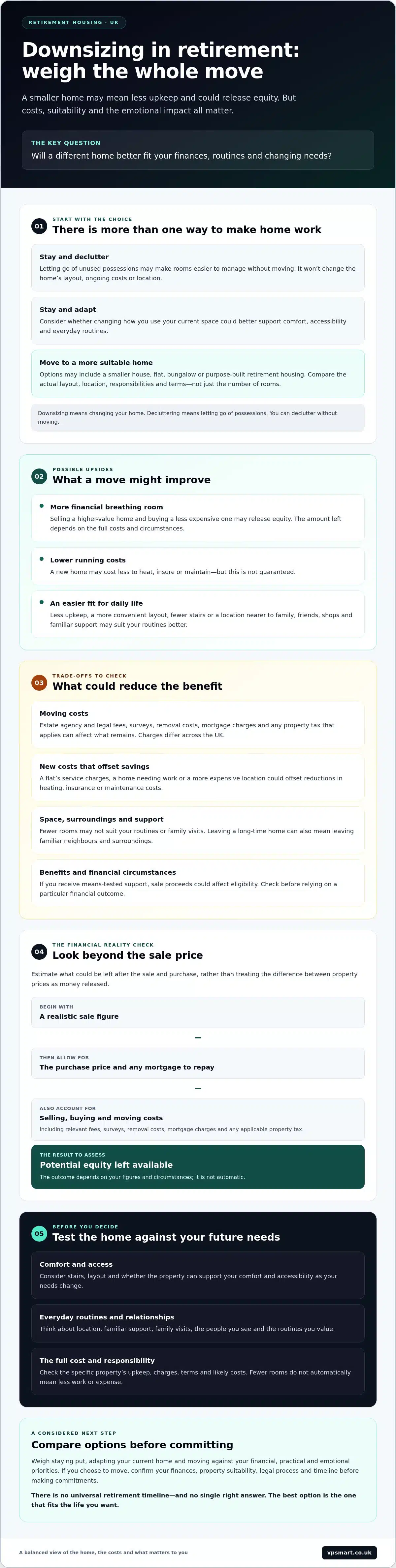
Retirement downsizing is a choice to move to a home that better fits your priorities, not a step everyone is expected to take at a certain age. It might mean fewer rooms, less upkeep or a different location. A move could be nearby, keeping familiar routines and support close, rather than taking you far from the people and places you know.
Downsizing means changing your home to suit the life you want; decluttering means letting go of possessions, which you can do without moving. The distinction matters: clearing unused belongings may make your current rooms easier to manage, but it won’t change the property’s layout, ongoing costs or location.
What does downsizing for retirement involve?
Possible choices include a smaller house, flat, bungalow or purpose-built retirement housing. These options differ in layout, maintenance responsibilities and how they support everyday life. Compare the specific property and its terms rather than assuming that fewer rooms automatically mean less work or expense.
Separate the decisions. First, consider whether you want to move at all. Then assess tenure, location and property type: you might remain in your current area, choose a different kind of home, or stay where you are and adapt the space. The UK’s varied housing arrangements provide useful background on the state of the UK housing market, but the right option depends on your circumstances, including finances, health, relationships and preferred routines.
Why do people consider a smaller home after retirement?
Motivations vary. A large garden or several unused rooms may feel like more upkeep than they’re worth; stairs or an awkward layout may become less convenient; or a move may bring family, friends, shops or other familiar support closer. Some people also hope that selling a more valuable home and buying a less expensive one will release equity. Whether it does depends on the full costs and circumstances, not simply the difference in property prices.
These reasons can overlap, but they don’t point to one answer. Someone who wants less maintenance, for example, may find that a different layout works better than simply choosing fewer rooms. Someone who values family visits may prioritise location and space for guests. The question behind downsizing for retirement pros and cons uk is how a possible move fits your priorities, not whether retirement itself makes moving the obvious next step.
There’s no universal retirement timeline. Treat this as a personal assessment of the home and life you want, not an age-based expectation. A smaller property won’t automatically reduce total housing costs or improve quality of life: upkeep, location, layout and suitability for changing needs all matter.
The pros of downsizing for retirement: finances, upkeep and everyday comfort
A move can create more breathing room in your budget or simplify daily routines, but neither result is automatic. The benefit depends on the home you leave, the one you choose and the costs and responsibilities that come with it. For a balanced view of the downsizing for retirement pros and cons uk homeowners may face, test each hoped-for gain against what needs to be true for it to happen.
Could downsizing improve retirement finances?
Selling a higher-value home and buying a less expensive one may release equity. The amount left available depends on the sale proceeds, purchase price, any mortgage to repay, and the costs of selling and buying. Allow for relevant estate agency and legal fees, surveys, removal costs, mortgage charges and any property tax that applies. The rules differ across the UK, so check the position for the nation where you’re buying rather than assuming one set of charges applies everywhere.
There may also be ongoing savings if the new home costs less to heat, insure or maintain. Yet a flat’s service charges, a property in need of work or a more expensive location could offset some of those reductions. If you receive means-tested support, check whether sale proceeds could affect your eligibility before relying on a particular financial outcome. Hamptons discusses these financial and practical considerations; for decisions involving your pension, tax or benefits, seek independent advice suited to your circumstances.
Make a net-proceeds estimate before committing. Start with a realistic sale figure, subtract the purchase price and likely transaction and moving costs, then account for mortgage arrangements and expected changes to regular household expenses. This gives you a clearer basis for judging whether the financial gain is meaningful.
Can a smaller home make daily life easier?
Fewer rooms may mean less cleaning and a simpler maintenance routine. A compact garden, level access or a more convenient layout could reduce everyday effort, whilst a well-placed home may make it easier to reach people and services you rely on. Assess the actual property, not just its floor area.
A smaller home improves comfort only when its layout, location and facilities fit the resident’s needs, routines and plans for the future. Check whether there’s room for hobbies and visitors, whether you can move around comfortably, and how the property’s condition and ongoing charges affect daily life. A spare room for regular family visits may matter more than reducing the amount of space.
If you decide that a move is right, professional packing and moving support can be one practical part of planning the transition.
The cons of downsizing in retirement: costs, space and emotional ties
A smaller home isn’t automatically cheaper, simpler or easier to leave than a larger one. A move can reduce some demands but introduce others, and a property that looks ideal on paper may not suit your everyday life. Weigh each possible gain against what you could lose or take on.
| Potential benefit |
Possible drawback to check |
| Less space to clean and maintain |
Service charges, repair needs or shared maintenance responsibilities may add costs or obligations. |
| Equity released from the sale |
Legal, sale, purchase and moving expenses can reduce the amount left over. |
| A more manageable layout |
There may be less room for visitors, hobbies, treasured belongings or future needs. |
| A more convenient location |
Moving could make existing friendships, routines or familiar services harder to reach. |
What hidden financial and practical drawbacks should you consider?
Build a complete picture before deciding. Ask which legal, selling and purchase costs apply, whether the property needs repairs, what moving will involve and whether ongoing charges apply. Compare total housing costs, not just floor area or asking price: include expected bills, maintenance responsibilities and any service charges.
Read the relevant property documents carefully. Lease terms, charges and responsibility for repairs can vary, so don’t assume a flat or retirement property will be low-maintenance simply because it’s smaller. Check the home’s condition and clarify which upkeep falls to you. If figures or terms are unclear, ask an appropriate professional to explain them before you commit.
How can leaving a long-time home affect retirement?
A familiar home can hold more than furniture. Its garden, favourite rooms, neighbours and everyday routines may be part of your identity and family history. Leaving can bring grief as well as excitement, particularly if you’ll lose space for visitors or feel less connected to the people and activities that make daily life enjoyable.
Test the practical impact of a new location. Consider how you’d reach friends, healthcare, transport and community activities, and whether those journeys would still feel manageable. Talk through concerns with trusted family or an independent adviser, and give yourself time to reflect before making commitments. The downsizing for retirement pros and cons uk question isn’t settled by comparing room numbers alone; it’s about whether the full change supports your finances, connections and way of life.
How to decide whether retirement downsizing suits your future needs
Start with the life you want your home to support, not a list of properties to view. A clear set of priorities makes it easier to compare staying, adapting your current home and moving, without assuming one route is automatically best. Use this process to turn broad hopes, such as “less hassle”, into practical requirements.
- 1. Identify what matters most. Note what works well now, what feels difficult and what you’d like to change. Include finances, comfort, independence and the routines that make home feel like home.
- 2. Separate needs from preferences. List non-negotiables, such as manageable access or space for essential belongings, then distinguish these from features you’d enjoy but could live without. Consider how both lists might change over time.
- 3. Picture foreseeable changes. Think about mobility, potential care needs, visitors and the support you may want nearby. Ask whether stairs, bathroom access, transport links and outdoor space would still suit you if your circumstances changed.
- 4. Compare three realistic options. Assess staying as you are, adapting your current home and moving to a smaller or otherwise more suitable property. For each, consider total household finances, accessibility, social connections and the everyday effort involved.
- 5. Check the evidence before committing. Gather relevant financial information, inspect a potential property carefully and seek qualified advice about adaptations or other complex decisions. Give yourself time to discuss the options with people you trust.
Which questions should you ask before deciding to downsize?
Be specific. Is the main challenge maintaining the garden, managing stairs or heating rooms you rarely use? Would a different layout solve the problem, or is being near family and everyday services more important? Consider whether you need room for visitors, hobbies or treasured possessions. These questions help you judge a home by how it functions, not just its size.
What alternatives could make staying at home work?
Decluttering may make rooms easier to use without a move. Targeted adaptations could address particular access needs, whilst maintenance support may help with tasks that have become difficult. Ask relevant qualified professionals to assess whether adaptations are suitable and what they would involve. Then compare these options with moving using the same financial, accessibility and lifestyle priorities.
Choose the option that best meets your foreseeable needs, not simply the smallest home. The right answer may be to stay, make considered changes or move. A useful way to approach the downsizing for retirement pros and cons uk is to test every option against the life you want to lead.
Explore house removal support
Planning a retirement move: make the next step manageable
If you’ve weighed the trade-offs and decided moving is right for you, a clear plan can make the change feel more manageable. Before committing, check four essentials: your financial position, whether the new property suits your needs, the legal process and a realistic moving timeline. Confirm who is handling each part, and allow time for questions or delays rather than building plans around best-case assumptions.
How can you prepare belongings and plan the move?
Start sorting gradually, one room or category at a time. Label items to keep, pass on, donate or store. This helps you see what will fit in the new home and gives family or friends time to help with decisions, without leaving every choice until moving week.
Make a separate list of belongings that need careful packing or specialist handling, such as fragile keepsakes, valuable items or a piano. Check access at both properties, including stairs, doorways and any restrictions that could affect moving larger furniture. Set aside medicines, important documents, chargers, a kettle and a change of clothes so essentials are easy to find on the first day.
Agree a schedule that allows time for packing, final checks and the handover of keys. If support would make the physical work easier, professional packing services can be considered alongside house removals. The right level of help depends on what you want to manage yourself and what you’d prefer to delegate.
When could removal or storage support be useful?
A removal team may help move belongings and furniture, while packing support can take some preparation off your hands. Check what is included in any service you consider, particularly if furniture needs to be dismantled or items require careful handling. These options can support your plan, but they aren’t a requirement for making the move.
Temporary storage may help if completion dates don’t align, the new home isn’t ready for everything, or you want more time to decide what to keep. Make a list of what needs to be accessible straight away and what can be stored, then check the arrangements and costs before choosing this option.
Keep your plan in one place, with key dates, contact details, tasks and essential belongings. That gives you a simple reference point as moving day approaches, whilst leaving room to adjust if circumstances change.
If you’ve decided that moving is right for you, explore UK house removal support as one practical option for planning the next step.
Choose the home that supports your next chapter
Downsizing isn’t automatically the right move for retirement. The downsizing for retirement pros and cons uk come down to more than sale proceeds or floor space: consider the full financial picture, the practical fit of a new home and what you’d miss about your current one.
Compare moving with staying put or adapting your home, using your future accessibility, finances and daily routines as your guide. If you decide to move, confirm the property, costs, legal process and timing before making commitments. Sorting belongings in stages can also make it easier to decide what to keep, pass on or store.
Should you choose to move, VP Smart Removals provides house removals across the UK, with optional packing and storage services. Furniture disassembly and specialist handling, including for delicate items such as pianos, are also available.
Take the time you need. The right decision is the one that makes your next home feel comfortable, manageable and genuinely suited to the life you want.
Frequently Asked Questions
Is downsizing a good idea when you retire?
It can be a good idea if a different home better suits your finances, access needs and daily routines, but retirement alone isn’t a reason to move. Consider what you’d gain, such as less upkeep, alongside possible costs and the emotional effect of leaving a familiar home. The right choice may be moving, adapting your current property or staying as you are. Compare each option against the life you want to lead.
What are the disadvantages of downsizing in retirement?
Downsizing can involve selling, legal, purchase and moving costs, which may reduce the equity left over. You could also lose useful space for visitors, hobbies or belongings, along with a familiar garden, neighbours and routines. A smaller property may bring new responsibilities or charges, too. In weighing the downsizing for retirement pros and cons uk homeowners face, look beyond room numbers and consider the full financial and personal impact of the move.
Can downsizing release equity for retirement?
Yes, selling your current home and buying a less expensive one may release equity, but the amount depends on the sale proceeds, purchase price, mortgage arrangements and costs involved. Make an estimate that accounts for relevant legal, sale, purchase and moving expenses before relying on the money. If releasing equity could affect your pension, tax or benefits, seek independent advice based on your circumstances before deciding.
Will downsizing reduce my bills in retirement?
It might, but lower bills aren’t guaranteed. A smaller home may cost less to heat or maintain, yet its location, condition, insurance and ongoing charges can change the overall household budget. Compare the likely costs of both properties, including energy, council tax, maintenance and any service charges that apply. Focus on total ongoing housing costs rather than assuming that fewer rooms automatically mean cheaper bills.
When should you downsize for retirement?
There’s no set age or single ideal time to downsize. Consider a move when your current home no longer fits your priorities, or while you have time to plan carefully, but don’t feel obliged to move just because you’ve retired. Before committing, check your finances, future accessibility needs, support network and property options. Allow time to compare moving with adapting your current home, and make the decision at a pace that feels right.
Is it better to downsize or adapt your home in retirement?
Neither option is automatically better. Adapting your home may preserve familiar surroundings and relationships, while downsizing could offer a more suitable layout or reduce some upkeep. Compare both against the same needs: access, finances, maintenance, transport, social connections and room for your routines. Ask relevant qualified professionals to assess proposed adaptations and their costs. If changes won’t make your home workable, moving may be worth considering; otherwise, staying could suit you well.
Disclaimer
Some links in this article may be affiliate links, which means we may earn a small commission if you make a purchase through them, at no additional cost to you. We only recommend products or services we believe provide value to our readers.
Sep 30, 2026
The room is ready, but the facility’s access arrangements, the resident’s familiar belongings and the family’s packing decisions still need to come together. Choosing moving services for assisted living facilities is about more than transporting items from one address to another: the plan needs to work for the resident, the facility and the household.
It’s understandable to feel unsure about what can be brought, what the new room can accommodate and how to keep moving day manageable. A removal company can help with the practical work, but the facility’s requirements should be confirmed and the move’s scope agreed in advance.
This guide explains how to compare movers, coordinate access and timings with the facility, and decide what to move, pack, store or pass on. You’ll also find practical ways to prepare an inventory and organise the day around the resident, so each decision feels more manageable.
Key Takeaways
- Build the move plan around the resident’s routines, room size, facility rules, access and timing.
- Compare self-packing, professional packing and furniture handling to decide what support suits the move.
- When assessing moving services for assisted living facilities, check the written scope, inventory, crew and vehicle requirements, and any access-related charges.
- Confirm facility arrangements, finalise what’s moving and label boxes clearly so belongings are easier to place and identify.
- Prepare a clear list of requirements before requesting a quote, including any packing, storage or furniture services needed.
Moving into assisted living: what should the move plan cover?
A move into assisted living changes more than an address. It can reshape familiar routines and involve choosing which belongings will make a new room feel personal. A good removal plan accounts for both the practical work and the resident’s comfort, rather than treating every item as just another box.
The term assisted living can describe different arrangements. For a neutral overview of what assisted living means, see the general definition, then check directly with the chosen facility about its services and procedures. Room dimensions, permitted belongings, delivery access and move-in timing can all affect what needs to be moved and how the day is organised. Don’t assume one facility’s process applies elsewhere.
What changes when the destination is an assisted living facility?
A smaller room may not accommodate all the furniture from a previous home. Measure key items against the available space before arranging transport, and ask the facility about room dimensions and any restrictions on furniture or personal belongings. Confirm how the removal team should reach the room, including arrival instructions and any access arrangements. These details help shape a realistic inventory and reduce last-minute decisions about what can be delivered.
Who should coordinate the move with the facility?
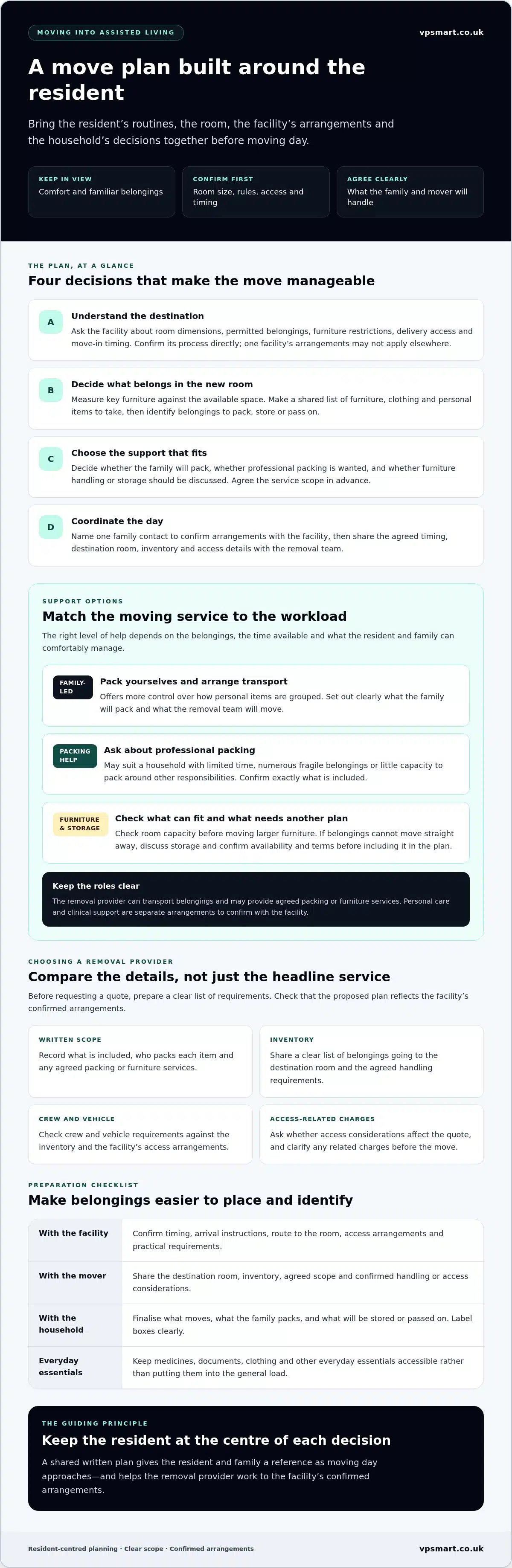
Choose one family contact to confirm the move-in timing, access arrangements and practical requirements with the facility. Share the agreed details with the removal company before moving day, including the destination room, inventory and any confirmed handling or access considerations. A removal provider can transport belongings and, if agreed, provide relevant packing or furniture services. Personal care and clinical support are separate arrangements, which the family should confirm with the facility.
Before requesting a quote for moving services for assisted living facilities, clarify who is responsible for each part of the move. A simple checklist keeps decisions visible:
- What moves: List the furniture, clothing and personal items going to the new room.
- What is packed: Decide which belongings the family will pack and whether to ask about professional packing.
- What is stored or passed on: Set aside items that won’t travel to the facility and agree what happens to them.
- Who coordinates: Name the family contact and record who will confirm details with the facility and removal team.
With these choices documented, you can discuss a clear scope with a removal provider and check that the proposed plan reflects the facility’s confirmed arrangements. The written list also gives the resident and family a shared reference as moving day approaches.
What moving services can help with an assisted-living move?
The right level of help depends on the belongings, the time available and what the resident and family can comfortably manage. Some families pack themselves and arrange transport; others ask a removal company about packing as well as moving. A combined arrangement can reduce the number of tasks the family needs to coordinate, while leaving decisions about what to take in their hands.
For a combined option, explore professional packing and moving services and confirm exactly what the requested service includes. House removals and packing services may suit parts of the move, but confirm the scope and availability in advance. Agree the inventory and packing responsibilities so everyone knows what the removal team will handle and what the family will pack.
When is professional packing useful?
Professional packing may suit families with limited time, numerous fragile belongings or little capacity to pack around other responsibilities. Self-packing gives the family more control over how personal items are grouped; a combined service may ease the workload. Whichever approach you choose, set aside medicines, documents, clothing and other everyday essentials so they remain accessible rather than going into the general load. Age UK’s moving advice offers further pointers on preparing for a move and deciding what to bring.
Should belongings be moved, stored or sorted first?
Check the room’s capacity before deciding whether larger furniture can come along. If some belongings can’t move straight away, storage may be worth discussing, subject to confirmed availability and terms. Ask the provider whether storage suits the move and clarify the arrangements before including it in the plan. For broader packing considerations, the professional packing and moving page provides further information.
Sort belongings with the resident’s wishes at the centre of the decision. A simple three-way review can help:
- Take: Belongings that fit the room and matter to the resident’s comfort or routine.
- Store: Items to keep but not move immediately, once storage arrangements are confirmed.
- Pass on: Belongings the resident chooses to donate, give to family or otherwise rehome.
For larger pieces, ask whether furniture disassembly and reassembly is needed, and identify the items when discussing the removal scope. This helps the team plan the work and understand which furniture is intended for the destination. If storage could help with belongings that won’t move at once, check the provider’s service details and confirm suitability and availability for your requirements.
How to compare movers for an assisted-living facility move
A general removal company may be able to transport household belongings, but don’t assume it has specialist care expertise or experience working with every facility. Compare providers on the practical scope of the move, and check any claims about specialist handling, staff screening, insurance or previous experience before relying on them. The facility’s instructions should guide access and arrival arrangements.
For moving services for assisted living facilities, a clear written plan is more useful than a broad promise. Give each mover the same item inventory and information about the collection and delivery addresses, room access, furniture, and any packing or storage needs. This makes it easier to compare proposals on the same basis and spot differences in what’s included.
What should a removal quote make clear?
Check which tasks are included or excluded, such as packing, loading, transport, and furniture disassembly or reassembly. Ask how the quote reflects the inventory, agreed timing and access arrangements, including any applicable access-related charges. If belongings may need temporary storage, clarify whether that is included or requires a separate arrangement. You can review the provider’s removal pricing information, then confirm how the proposed scope applies to your particular move.
Don’t compare quotes by the headline total alone. A lower figure may cover fewer tasks, while another proposal may include packing or furniture work. Check whether the cost is based on an hourly rate or a fixed-price project, and ask how changes to the inventory or agreed plan would be handled. Rates for hourly work can vary with the day and crew size, so compare the assumptions behind each quote. Ask the provider to record any revised scope in writing.
What questions should families ask prospective movers?
Specific questions can expose gaps before moving day. Ask how the team will receive facility instructions, who is responsible for confirming arrival arrangements and what information they need about access. Explain which belongings are fragile or require careful handling, and ask how packing and furniture tasks will be managed. If the plan changes, find out who should be contacted and how the change will be agreed.
Before choosing, ask the provider to confirm the following in writing:
- Scope: Which items and tasks are included, and what is excluded?
- People and vehicle: What crew and vehicle requirements have been allowed for based on the inventory?
- Claims: What evidence or details can they provide for any insurance, screening, specialist handling or experience claims?
- Moving-day contact: Who is the family’s point of contact, and what timing and facility arrangements have been agreed?
This approach helps families assess moving services for assisted living facilities on clarity and fit, without confusing removal work with care provision. A documented scope also gives the family and removal provider a shared reference if details need checking before the move.
How to prepare the resident, belongings, and facility for moving day
A written sequence helps everyone know what happens next. It also gives the resident and family a clear way to check details with facility staff and the removal team, rather than relying on memory during a busy day.
What should families confirm with the facility beforehand?
Ask staff to confirm the move-in date, expected arrival window, access route and any booking process. Check the room measurements and whether planned furniture or personal belongings are suitable. Find out who to contact if the removal team is delayed or arrangements change. Facility procedures differ, so confirm each detail directly rather than assuming the same access or delivery rules apply everywhere.
How can belongings be packed for an easier transition?
Keep everyday essentials separate from items that can be unpacked later. Label each box with its destination room and a brief description of the contents, such as “bedroom, jumpers” or “bathroom, toiletries”. A simple inventory helps the family identify boxes at delivery. If packing everything feels difficult, discuss professional packing as part of the agreed removal scope. If belongings can’t all move at once, ask about storage options and confirm availability and terms before relying on them.
Use this sequence to keep the practical tasks in order:
- 1. Confirm facility details. Record the agreed date, arrival window, access route, room measurements and any facility-specific instructions.
- 2. Finalise the inventory. Check what is travelling, including furniture, and share the final list with the removal team.
- 3. Pack and set essentials aside. Agree who is packing which belongings, and keep frequently needed items easy to reach rather than buried in boxes.
- 4. Label boxes clearly. Include the destination room and contents so family members can direct items when they arrive.
- 5. Oversee delivery. Agree who will meet the removal team, answer practical questions and pass on facility instructions.
Before the day, decide who will communicate with the removal team and make sure they have the family contact’s details. Share confirmed changes promptly with both the facility and the mover. If the agreed plan includes packing or storage, VP Smart Removals offers these services, subject to confirming availability and scope for the move.
Arrange a removal plan that fits the move and the resident
A clear quote starts with a clear brief. Before contacting a removal company, list what needs to travel, what packing support the family wants and any details the facility has confirmed. This helps the provider assess the requested work and prepare a quote based on the actual move, rather than assumptions about a typical household.
What information should a family prepare for a quote?
Gather the proposed move date, collection and delivery addresses, and an inventory of belongings. Include furniture dimensions or details of items that may need disassembly and reassembly. Add confirmed information about delivery access, arrival arrangements and facility instructions. Be specific about packing needs, and mention whether storage may be required if some belongings won’t move immediately. Check service availability and the requested scope with the provider before making plans around a booking.
VP Smart Removals provides house removals, packing, storage, and furniture disassembly and reassembly. These services may be relevant to particular parts of a move, subject to confirming the requirements and availability. The company is a removals provider, not a care provider or a confirmed assisted-living specialist. Families should arrange personal care and resident support separately with the appropriate people.
How can the family make the final arrangements clearer?
Name one person to share updates between the family, facility and removal company. This gives everyone a clear contact for confirming practical details and discussing any changes to the plan. Before confirming a booking, review the written quote and agreed service scope, including the tasks, schedule and any packing, storage or furniture arrangements. Ask for corrections if the document doesn’t match what the family and provider have discussed.
Keep care arrangements separate from removal logistics, and check directly with facility staff if its instructions or access arrangements change. A written plan can serve as a shared reference for the resident’s supporters and the removal team, helping everyone understand their role.
For families considering moving services for assisted living facilities, the next step is to gather confirmed details and request a clearly scoped quote. A complete inventory and facility instructions give the provider a better basis for discussing the move and any relevant services.
Make the next move feel more manageable
A calmer transition starts with a plan built around the resident, the facility and the belongings that matter most. Confirm room capacity, access arrangements and timing with facility staff, then share those details with your removal provider. A clear inventory and written scope help everyone understand what’s being packed, moved or stored.
Choosing moving services for assisted living facilities also means checking that the provider’s services match your needs. VP Smart Removals provides house removals, packing, storage and furniture assembly, with services available across the UK. It’s a removals provider, not a care provider or confirmed assisted-living specialist, so arrange personal care and resident support separately.
With the practical arrangements agreed and the resident’s preferences kept at the centre, you can approach moving day with greater confidence, one clear step at a time.
Frequently Asked Questions
What should I look for in moving services for an assisted living facility?
Look for a removal provider whose written scope matches the move, rather than assuming it offers specialist care expertise. Compare the inventory, packing responsibilities, furniture handling, crew and vehicle requirements, access arrangements and process for changes. Ask the facility to confirm its move-in instructions, then check that the provider has included them in its plan. Verify any claims about insurance, screening or specialist experience before relying on them.
Can a regular removals company help with a move into assisted living?
Yes, a general removal company may be able to move household belongings, pack items or provide storage, depending on its services and confirmed availability. Don’t assume it has assisted-living expertise or a relationship with the facility. Confirm the provider’s experience and handling arrangements directly, and agree in writing what it will and won’t do. Personal care and clinical support need to be arranged separately with the appropriate people.
How do I coordinate a removal company with an assisted living facility?
Choose one family contact to liaise with the facility and removal provider. Ask facility staff to confirm the move date, arrival window, access route, room details and any booking or delivery process. Give the removal company the confirmed instructions, inventory and contact details before moving day. If timing or access changes, have the named contact update both parties so the resident and everyone supporting the move know what to expect.
What should I ask the facility before moving furniture into a room?
Ask for the room’s measurements and check whether each planned item will fit, including larger pieces that may need to be assembled or dismantled. Confirm which furniture and personal belongings are permitted, how the delivery team should reach the room, and whether arrival needs to be arranged in advance. Don’t assume the facility follows another provider’s rules. Share confirmed access instructions with the removal company when agreeing the move plan.
Can a removal company pack and store belongings before an assisted-living move?
Some removal providers offer packing and storage, but check which services are available and confirm the requested scope before making arrangements. Ask what packing tasks are included, which items the family should handle, and what storage terms and availability apply. Keep everyday essentials separate so they’re easy to find after delivery. VP Smart Removals lists packing and storage among its services, but these should be confirmed for the individual move.
How far in advance should I arrange moving services for assisted living?
There’s no single lead time that suits every move, so start planning once the facility’s move-in date and arrangements are known. Contact removal providers to check availability for the required date and allow time to share an inventory, confirm access details and agree the written scope. If the date or facility instructions are still subject to change, explain that when enquiring and confirm arrangements again once they’re settled.
What information do I need to get a removal quote for this type of move?
Prepare the proposed move date, collection and delivery addresses, and an itemised inventory, including furniture dimensions where useful. Note which belongings need packing, whether furniture disassembly or reassembly may be needed, and whether storage is being considered. Include facility-confirmed access instructions and arrival arrangements. Ask the provider to state what’s included, excluded and dependent on availability, so you can compare quotes against the same requirements.
Disclaimer
Some links in this article may be affiliate links, which means we may earn a small commission if you make a purchase through them, at no additional cost to you. We only recommend products or services we believe provide value to our readers.
Sep 29, 2026
Furniture that looks manageable in a room can take up more space in a removals vehicle than you expect. An online furniture volume calculator uk gives you a useful starting estimate, provided you measure consistently and understand what the result leaves out. Bulky sofas, wardrobes and awkwardly shaped pieces can be difficult to measure, and a calculator may not include boxes, packing materials or access constraints.
A clear estimate can help you prepare before discussing your move. This guide explains how to measure furniture, convert dimensions into cubic metres and use an online calculator to build a practical inventory. You’ll also learn how to record difficult-to-measure items, account for packing and furniture disassembly, and distinguish an initial volume estimate from a complete removals assessment. Treat the result as a planning aid, not a final measure of the space your move requires. An organised inventory helps you ask informed questions and gives a removals team useful details for planning, whether you provide a list or arrange a site survey.
Key Takeaways
- Use an online furniture volume calculator uk as a planning aid, and check which items and assumptions its estimate includes.
- Measure each piece at its greatest outer length, width and height, including fixed protruding parts, then record dimensions consistently.
- Compare calculator methods carefully: item-by-item measurements, preset furniture lists and room-based estimates may produce different totals.
- Build a fuller inventory by noting boxes, outdoor and stored belongings, plus fragile, heavy or specialist items and furniture that needs dismantling.
- Check uncertain measurements and share your inventory with a removal company. A professional discussion or site survey can help clarify complex moves.
What an online furniture volume calculator UK estimate tells you
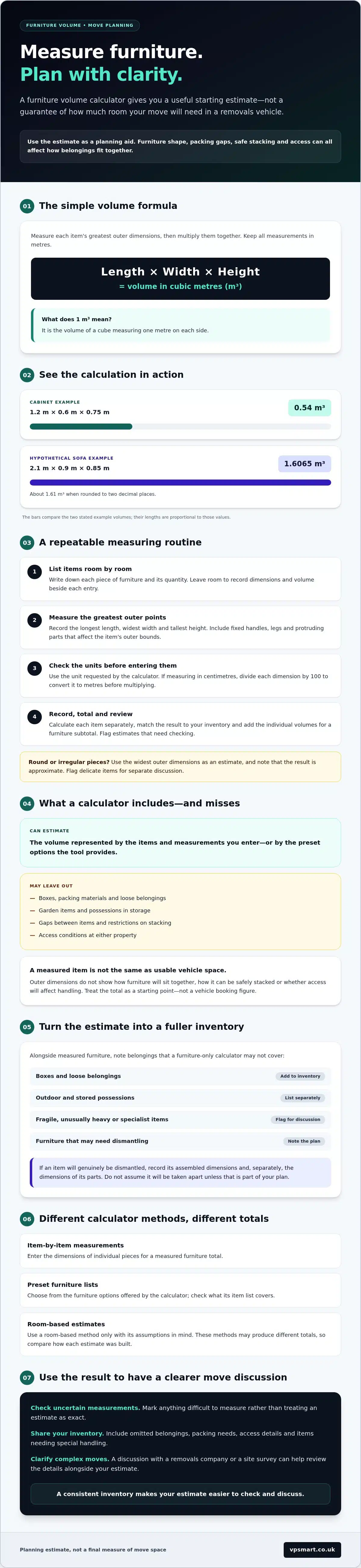
A furniture volume calculator estimates the space represented by the outside dimensions of the items you enter, usually in cubic metres (m³). It provides a consistent way to total measured furniture for move planning, but it cannot guarantee how much room your belongings will need in a removals vehicle. The measured volume of an item is not the same as the usable space required once everything is loaded and arranged.
Use the result as a starting point, not as a vehicle booking figure. Furniture shapes, packing gaps, safe stacking and access can all affect how items fit together. A wardrobe’s dimensions describe its outer bounds, for example, but do not show how it will sit alongside a sofa or whether a doorway will affect handling.
What does cubic metre mean when measuring furniture?
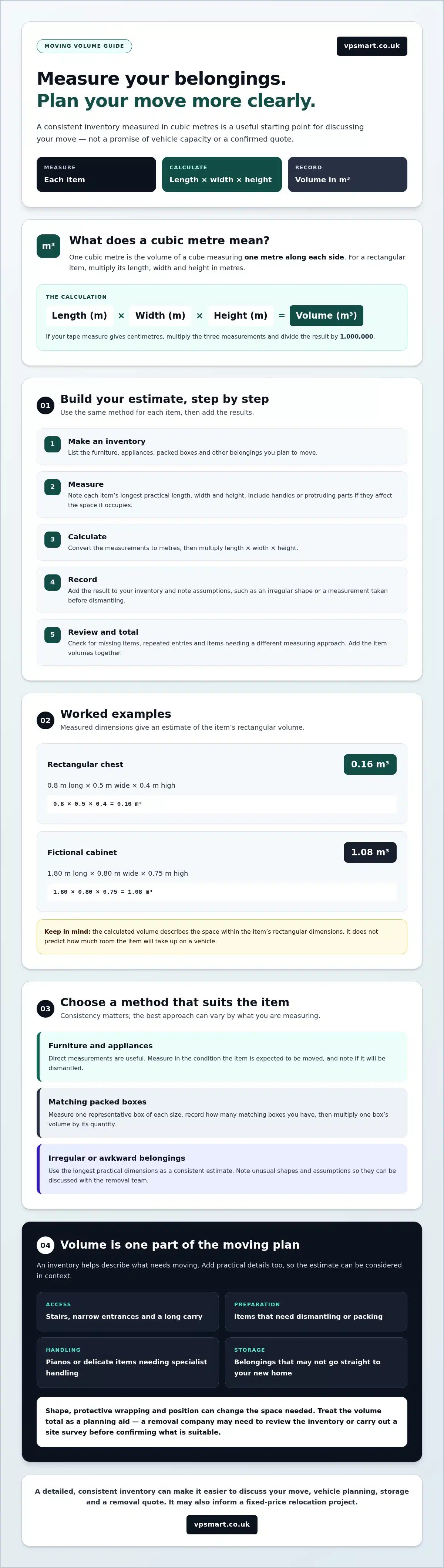
A cubic metre (m³) is the volume of a cube measuring one metre on each side. To estimate an item’s volume, multiply its length by its width by its height, with all three measurements in metres. For example, a cabinet measuring 1.2 m by 0.6 m by 0.75 m has an estimated volume of 0.54 m³.
If you measure in centimetres, convert each dimension to metres before multiplying by dividing each measurement by 100. For a 120 cm by 60 cm by 75 cm cabinet, that gives 1.2 × 0.6 × 0.75 = 0.54 m³. Keeping units consistent prevents a misleading total.
What an online furniture calculator can and cannot include
An online furniture volume calculator uk can only use the items and measurements you provide, or the preset options offered by the tool. A furniture-only result may leave out boxes, loose belongings, garden items and possessions in storage. Check the tool’s item list before treating its total as the volume of your whole move.
Even a detailed estimate has limits. A calculator may not account for gaps between items, restrictions on stacking or access conditions at either property. These affect loading and handling, not just the dimensions of each object. Add omitted belongings to a separate inventory and flag anything difficult to measure, fragile, unusually heavy or requiring specialist handling. A removals company can then discuss these details alongside your estimate, packing needs and any furniture disassembly.
How to measure furniture and calculate its volume accurately
A reliable estimate starts with a tidy inventory and repeatable measurements. Work room by room, label each item clearly and use the same unit throughout. Measure the item’s outer bounds, including fixed parts that affect how much space it occupies. This gives an online furniture volume calculator UK consistent information to process and makes your results easier to check.
- Prepare an inventory. List furniture by room, noting each item and quantity. Leave space beside each entry for dimensions and volume.
- Measure each item. Record its greatest outer length, width and height, including fixed handles, legs or protruding parts.
- Calculate the volume. Check the calculator’s required unit, then enter each item’s measurements separately.
- Record and review. Write the result against the matching inventory entry, then add the individual volumes for a furniture subtotal. Flag estimates that need checking.
Which dimensions should you record for each item?
Measure the longest point, widest point and tallest point of sofas, wardrobes, tables and appliances. Include fixed legs or handles if they extend beyond the main body. If an item will genuinely be dismantled, record its assembled dimensions and, separately, the dimensions of its parts for the move. Don’t assume it will be taken apart unless that is part of your plan.
How should you enter measurements into a volume calculator?
First check whether the tool asks for centimetres, millimetres or metres. Mixing units can distort the result. For a quick refresher on the box method, see how to calculate the volume. For round or irregular pieces, use the widest outer dimensions as an estimate and note that the result is approximate. Mark delicate items for separate discussion rather than presenting a rectangular calculation as exact.
Example: Imagine a hypothetical sofa measuring 210 cm long, 90 cm wide and 85 cm high. Convert each measurement to metres: 2.1 × 0.9 × 0.85 = 1.6065 m³, or about 1.61 m³ when rounded to two decimal places. Calculate each item separately before adding the results. Keep the unrounded figures in your inventory if you want to reduce rounding differences in the subtotal.
Use the finished list as a planning document, not just a calculator record. Add notes about furniture disassembly, packing and anything that is difficult to measure. These details help inform a removals discussion. If you’d like support reviewing a move inventory, explore VP Smart Removals’ movers and packers service.
Furniture volume calculator UK results: compare estimates and check limitations
Two calculators can produce different totals from the same move without either making an arithmetic mistake. An item-by-item tool uses the dimensions you enter, while a preset furniture list may assign standard dimensions to categories such as sofas or wardrobes. A room-based estimate may use the number or type of rooms instead of measurements, so its result depends on the assumptions built into that method.
Why can two online calculators give different results?
Check what each tool counts before comparing its total. One might include appliances or outdoor furniture, while another focuses on indoor furniture. Preset dimensions, rounding rules and unit requirements can also vary. A room-based estimate relies on assumptions about what a room contains, which may not match your measured inventory. Review each calculator’s instructions, item list and units first. A difference in totals may reflect different inputs rather than a meaningful change in the volume of your belongings.
For a useful comparison, keep a small record alongside your inventory. Include:
- Item: for example, a two-seat sofa.
- Dimensions: the measurements entered, with units.
- Calculated volume: the result from the tool.
- Measurement confidence: note whether the dimensions were measured directly, estimated or selected from a preset list.
This makes it easier to spot a missing item or an assumed dimension. If totals differ, compare the entries rather than automatically choosing the larger or smaller result. An online furniture volume calculator uk is most useful when you understand what its total represents.
Does furniture volume equal the space a removal vehicle needs?
No. Adding the measured volumes of individual items does not show how efficiently they can be arranged together. Protective wrapping can increase the space an item occupies, gaps may remain between irregular shapes, and stacking limits can affect how belongings are loaded. Access at the property can also influence the practical loading plan.
Calculated item volume describes the dimensions entered; assessed vehicle-space requirements account for how belongings can be protected, carried and arranged.
Use calculator results as a planning reference, then share your item list and any uncertain measurements during a removals discussion. A detailed inventory or site survey can help clarify what a calculator alone cannot assess, particularly if your belongings are varied or access may affect handling.
How to turn your furniture volume estimate into a complete move inventory
A furniture total is only one part of the move. Use your online furniture volume calculator UK result as a starting point, then expand the list to cover belongings the calculator may not ask about. A clear inventory helps a removals company understand what is travelling, what needs extra care and which details still need checking.
What belongs on a household moving inventory?
Group items by room so you can review the list against your home. Start with larger furniture, then add smaller belongings and packed boxes. Include outdoor items, loft or shed contents, and anything held in storage. Record storage-bound belongings separately from items going to your new home, so the two parts of the move are easy to distinguish.
Add practical notes beside each item rather than trying to express every requirement as a volume. Identify furniture that needs dismantling and reassembly, fragile belongings that need careful packing, unusually heavy pieces and items requiring specialist handling. If you need packing and moving services, these notes can help you discuss the support that may be appropriate.
Keep access details in a separate section of the inventory. Note relevant information about entrances, stairs, lifts, parking or restricted routes at both addresses. These details can affect handling and planning, but they are not measurements of the belongings’ volume.
How can you use the estimate when requesting a removals quote?
Share the inventory and calculator total, making clear which dimensions or box counts are estimates. Point out anything you could not measure confidently, along with packing needs and furniture disassembly. This gives the removals team a fuller picture than a volume figure alone and makes it easier to identify what still needs clarification.
Ask whether a site survey or more detail would help assess your move, particularly if the inventory is complex, access is restricted or some items need specialist handling. VP Smart Removals can use a detailed inventory or site survey when planning a relocation. You can also review the company’s removals pricing information as part of preparing for that conversation.
Once your inventory is organised, share it with a team that can help plan your house move.
Discuss house removals planning
Next steps after using a furniture volume calculator UK
Your estimate is a useful starting point for organising a move, not a final assessment of the space or service required. Before sharing it, check the list against each room and add anything the calculator may have missed, such as boxes, outdoor belongings or items in storage. Recheck dimensions that were guessed, confirm the calculator’s units and mark uncertain entries clearly.
Keep practical details alongside the volume total. Note which items are fragile, awkward to carry, unusually heavy or likely to need specialist handling. Record relevant access information for both properties, such as stairs or restricted routes, separately from measurements. This gives a removals provider a clearer basis for discussing your move.
When is a calculator estimate enough to start planning?
An early estimate can help you organise belongings, identify what still needs measuring and prepare useful questions for a removals provider. It is less conclusive if your inventory includes awkward furniture, delicate possessions or items requiring specialist handling. A calculator alone cannot confirm vehicle suitability, assess access or provide a final removals quote. Treat the total as a guide to discuss, not a promise of the space needed.
How can a removals team help refine your inventory?
A professional discussion can add context that a volume figure cannot capture. Share your inventory and explain which measurements or item counts are estimates. Ask whether a site survey or more detail would help assess the move, particularly if access is complicated or the inventory includes items that need extra care.
VP Smart Removals can use a detailed inventory or site survey when planning house removals. If they suit your move, mention packing requirements, furniture that may need disassembly and reassembly, or belongings that need storage. These details support a more informed discussion without assuming that the calculator’s total tells the whole story.
Have your inventory ready? Discuss your house move with VP Smart Removals.
Turn your estimate into a confident moving plan
An online furniture volume calculator uk can help you organise measured furniture, but its result is only a starting estimate. Check the dimensions, include belongings the calculator may leave out and mark uncertain measurements clearly. A complete inventory gives a removals team more useful context than a volume total alone.
If your move includes fragile or awkward items, restricted access, packing requirements or furniture that needs disassembly, raise these details when discussing your plans. VP Smart Removals can use a detailed inventory or site survey to help plan residential removals, with packing services and furniture disassembly and reassembly available where they suit your needs.
With your belongings organised and the right details ready to share, you can take the next step towards a more considered move.
Frequently Asked Questions
How do I calculate the volume of furniture for a house move?
List each large item, measure its outer length, width and height, then multiply the three dimensions to estimate its volume. Keep measurements in the same unit, converting them where needed so your result is in cubic metres. Add individual results for a furniture subtotal, but record boxes and other belongings separately. Use the total as a planning estimate, not a guarantee of the space a removal vehicle will need.
What measurements do I need for an online furniture volume calculator?
Most tools ask for each item’s length, width and height, but check the calculator’s instructions because input units vary. Measure the greatest outer points, including fixed parts that extend beyond the main body. If furniture will be dismantled, note its assembled dimensions and the realistic size of the parts being moved. Mark uncertain measurements in your inventory so you can check them before relying on the estimate.
Can a furniture volume calculator include moving boxes and other belongings?
Some calculators include boxes or wider household categories, whilst others list furniture only. Check the available options and record anything missing separately. Include packed boxes, loose belongings, outdoor items and possessions going into storage if they are part of the move. Keeping furniture and non-furniture totals distinct makes your inventory easier to review and helps you spot omissions before sharing it with a removals provider.
Is an online furniture volume calculator accurate enough for a removal quote?
An online furniture volume calculator UK can provide a useful starting estimate if you enter complete, careful measurements. However, tools may differ in their item lists, preset dimensions and rounding. A calculator also cannot assess loading gaps, access or handling needs. Share your inventory and identify uncertain measurements when discussing your move. The removals provider may ask for more detail or a site survey before confirming its plan or quote.
How much space does a three-bedroom house move need?
There is no single volume that reliably fits every three-bedroom home. The amount depends on the furniture and belongings you are taking, what needs packing, and whether some items are going into storage. Rather than relying on a general figure, list your belongings and measure larger pieces consistently. Treat the result as an initial guide, then ask a removals provider whether your inventory needs more detail or a site survey.
What happens if I underestimate my furniture volume?
An incomplete estimate may mean the move plan needs to be reviewed, especially if you have missed large furniture, boxes or specialist items. Check each room, add belongings the calculator did not cover and flag measurements you are unsure about. Share the updated inventory with your removals provider before confirming arrangements, and ask whether the new details affect the plan. An online result alone cannot guarantee that a particular vehicle will be suitable.
Do I need to include dismantled furniture in a volume calculator?
Include every item you are moving, and note whether it will travel assembled or dismantled. If it is genuinely being taken apart, record its assembled size and the dimensions of parts that remain bulky or need careful handling. Dismantling does not necessarily remove all the space an item needs. Tell your removals provider what needs taking apart and whether reassembly is required, so those tasks can be considered in the move plan.
Disclaimer
Some links in this article may be affiliate links, which means we may earn a small commission if you make a purchase through them, at no additional cost to you. We only recommend products or services we believe provide value to our readers.
Sep 28, 2026
A house move as a single parent works best when the plan is built around your children and daily routine, not an idealised packing schedule. If you’re wondering how to manage a house move as a single parent while balancing work, childcare and a long list of jobs, start with the tasks that have firm deadlines. You don’t have to handle every job yourself.
It’s understandable to worry about children feeling unsettled or about asking friends and family for help when they have their own commitments. A clear sequence can make the move more manageable, while familiar routines can give children a sense of security amid the change.
This guide covers practical priorities for the weeks before moving day, ways to keep children safe and occupied, and how to decide which tasks to share or delegate. You’ll also find out when professional house removals, packing services or storage may help, particularly if your moving dates and household plans don’t line up. The aim is a calmer transition, with you in control of the decisions that matter most.
Key Takeaways
- Learn how to manage a house move as a single parent by prioritising childcare, work and important dates.
- Work backwards from moving day to build a practical schedule, including time to prepare an essentials bag.
- Compare self-packing, help from people you trust and professional packing services to find a workable balance.
- Agree who will supervise your children and keep important belongings accessible on moving day.
- Delegate specific tasks, share practical details clearly and settle into your new home at a pace that works for your family.
How to manage a house move as a single parent without doing everything at once
Co-ordinating a move alongside parenting, work and everyday household jobs can feel like several full-time tasks competing for the same hours. If you’re working out how to manage a house move as a single parent, success doesn’t mean having every cupboard perfectly sorted. It means knowing what must happen, keeping essential belongings and routines in view, and arranging enough support to make moving day manageable.
There’s no single template for family life or the help available. Build your plan around your child’s needs, working hours, key dates and the support you can realistically access. Focus on decisions that make the move safer and easier for your family, rather than comparing your situation with anyone else’s.
Which moving tasks should a single parent prioritise first?
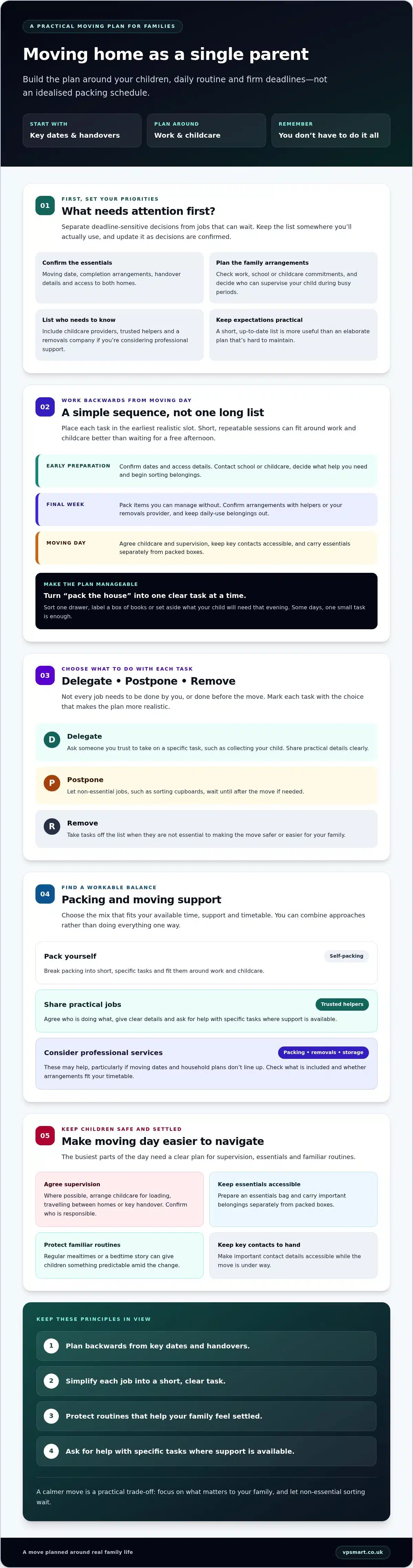
Separate deadline-sensitive decisions from jobs that would be useful but can wait. Confirm the moving date and key handover arrangements, check what affects access to either home, and decide who will care for your child during the busiest parts of the day. Then list anyone you need to contact, such as childcare providers, trusted helpers or a removals company if you’re considering professional support.
Keep your list somewhere you’ll actually use it, such as a notebook, calendar or notes app. Record confirmed decisions and dates, then add smaller jobs as you have time. A short list you keep up to date is more useful than an elaborate plan that’s difficult to maintain.
How can you make a move feel manageable for your family?
Turn broad jobs such as “pack the house” into short, specific tasks: sort one drawer, label a box of books or set aside what your child will need that evening. Fit these jobs around work and childcare instead of relying on long, uninterrupted stretches. Some days, one small task will be enough.
Keep a few familiar routines where possible, such as regular mealtimes or a bedtime story. They can give children something predictable amid the change, even if the rest of the day looks different. Adjust your expectations too: the home may be untidy, and non-essential sorting may need to wait. That’s a practical trade-off, not a failed move.
Keep four principles in view:
- Plan backwards from key dates and handovers.
- Simplify each job into a short, clear task.
- Protect routines that help your family feel settled.
- Ask for help with specific tasks where support is available.
Build a single-parent moving plan around childcare, work and key dates
A useful moving plan connects the dates that cannot shift with the time and support you actually have. Confirm the move date, completion arrangements and key handover details with the relevant people. Then check how these fit around work, school or childcare, and identify any periods when you’ll need another adult’s help. This turns a large job into a sequence of decisions rather than one long list of pressure.
Include your family’s needs from the outset. Note routines or practical arrangements that may help your child feel settled, alongside your work commitments and available time. A realistic schedule should support both the move and your household, with room to adjust if arrangements change.
How do you organise moving tasks when you have limited time?
Build a simple timeline around three phases. Work backwards from the handover and moving date, then place each task in the earliest realistic slot. Use a paper calendar, phone notes or a spreadsheet, whichever you’ll keep checking. Short, repeatable sessions are more practical than waiting for a free afternoon that may not arrive.
- Early preparation: confirm dates and access details, contact school or childcare, decide what help you need, and begin sorting belongings.
- Final week: pack items you can manage without, confirm arrangements with helpers or your removals provider, and keep daily-use belongings out.
- Moving day: agree childcare and supervision, keep key contacts accessible, and carry essentials separately from packed boxes.
Mark each task as delegate, postpone or remove. A trusted person might collect your child, for instance, while non-essential cupboards can wait until after the move. If you’re considering help with packing or transport, check what’s included and whether the arrangements fit your timetable.
What should you arrange for children before moving day?
Where possible, arrange childcare for the busiest periods, such as loading, travelling between homes or key handover. Confirm who is responsible, where your child will be and how you’ll stay in touch. If childcare isn’t available, plan how to keep your child close and supervised, away from busy access points and lifting areas.
Pack a separate bag with familiar comfort items, snacks, a change of clothes, any regular medicines and the essentials for the day. Explain the move in a way that suits your child’s age and temperament. Some children may want clear details, while others need time to ask questions. Keep your timeline simple and leave room to adjust as dates, work and childcare arrangements become clearer.
Compare packing and moving support with doing everything yourself
There’s no single right way to organise a move. Packing everything yourself gives you control over what goes into each box and can make it easier to fit jobs around work and childcare. The trade-off is the time and physical effort, often spread across evenings when you may already be tired.
Friends or family you trust may be able to take on specific jobs, such as packing books, watching your child or helping sort belongings. Agree what they can realistically do and when, rather than relying on vague offers. Professional packing or removals support is another option if it would free you to focus on childcare, key decisions or work. The right mix depends on your budget, available help, belongings and energy. Paid help isn’t essential for every move.
Which moving jobs can you delegate or simplify?
Choose tasks that reduce pressure without creating extra co-ordination. You could ask someone you trust to pack clearly labelled, non-essential items, or arrange professional packing for selected belongings. Before agreeing, clarify what’s included and how the items should be handled. If you’re comparing professional help, this packing and moving service is one option to consider.
Decluttering can reduce the amount you need to pack, but only if sorting is manageable. Start with obvious decisions, such as unused duplicates, instead of turning every possession into a new project. If a task takes more time and energy than it saves, postpone it.
When might temporary storage make a move easier?
Storage may help if your new home isn’t ready for everything, or if the move-out and move-in dates don’t align. It can create breathing space, but you’ll need to decide what goes into storage, how long you may need it and when you’ll retrieve it. Keep everyday essentials and anything your child relies on accessible.
Before choosing storage, check access arrangements, the expected duration, handling responsibilities and how your belongings will be protected. Make a simple inventory and label boxes clearly, so you can identify what you need without searching through everything. Compare the storage arrangements with your moving dates and practical needs before committing. The aim is to reduce pressure, not add another complicated step.
When working out how to manage a house move as a single parent, think about capacity: what can you comfortably manage yourself, what can someone reliably take on, and what could wait? That balance may change as dates and family needs become clearer, so keep the plan flexible.
Make moving day safer and calmer for you and your children
Moving day can bring unfamiliar people, open doors and busy walkways into your family’s space. Decide in advance who is responsible for your child during loading, handover and travel. If a trusted adult is helping, agree when they’ll take charge and how you’ll stay in contact. If you’re the only adult available, plan where your child can stay safely while you manage essential decisions, away from lifting and access routes.
Keep a small essentials bag with you rather than loading it onto the removals vehicle. You’ll be able to reach what your family needs without searching through boxes. A clear sequence also helps: check the bag and key documents, confirm supervision, keep essential items with you, then do a final check of the property before leaving.
What should go in a family moving-day essentials bag?
Pack for the day and the first part of your arrival, not every possible eventuality. Include essential documents, your phone and charger, keys, snacks, water, spare clothing, toiletries and familiar items your child may want close by. Add daily necessities that would be difficult to replace quickly. Keep medication accessible and follow the relevant medical advice for storing and using it.
If your child has particular routines or needs, tailor the bag accordingly. A favourite book, comfort item or familiar cup may help make an unfamiliar setting feel more reassuring. Keep the bag somewhere easy to reach, and tell any helper where it is.
How can you protect children’s routines during the move?
Keep familiar touchpoints where circumstances allow: a usual snack, a rest break or a bedtime item ready for the first night. Explain what will happen in simple, age-appropriate language, such as who will be there and what happens after the boxes arrive. Children respond differently, so make room for questions without expecting them to feel a particular way.
Be honest about what may change. Instead of promising an exact arrival time or that a bedroom will be ready straight away, describe the next step you know for certain. Once you arrive, unpack a few essentials first and let the rest wait. A broader house-move plan can help you keep key tasks and practical decisions in view.
For how to manage a house move as a single parent, calm comes from clear supervision and keeping essentials close, not from making the day run perfectly. If plans shift, return to the next practical priority and adjust around your child’s needs.
Choose the right help and settle into your new home at your own pace
Once you’re in the new home, decide what needs attention first and what can wait. You don’t have to unpack every box straight away. Focus on getting essential rooms and routines working, then make a realistic plan for the remaining jobs.
How do you decide whether to hire professional movers?
Consider the time you have, how much lifting is involved, the size of the move and whether people you trust can offer practical help. You might manage the packing but need support moving heavier belongings, or prefer to delegate more if work and childcare leave little time. Neither choice is automatically right for every family.
If you’re comparing professional house removals, ask what the service includes and discuss access at both homes, timing, belongings that need special handling and any arrangements that could affect the move. Clear details help you compare options and plan your own responsibilities. For broader information, see this house removals guide.
What should you unpack first after moving with children?
Make the first evening more comfortable by setting up somewhere to sleep, unpacking essential toiletries and finding the items your family uses every day. Keep familiar bedding, night-time comfort items and frequently used kitchen or school essentials easy to reach. That gives everyone a workable base, even if the rest of the home is still full of boxes.
Unpack in stages instead of treating every box as urgent. Tackle one essential area at a time, then give your child a chance to explore the new home and become familiar with its rooms. A steady routine, such as a familiar meal or bedtime activity, can help the space feel more settled without requiring everything to be in place.
Learning how to manage a house move as a single parent includes deciding where your time and energy will make the greatest difference. Ask trusted people for specific help if they’re available, and consider professional support for tasks that are physically demanding or difficult to fit around family life. Keep communication clear and adjust your plan as you see what the new home needs.
Explore professional house removal support
Take the next step towards a calmer move
Learning how to manage a house move as a single parent starts with a realistic plan, not a perfect one. Work backwards from key dates, fit tasks around childcare and work, and keep your child’s essentials and supervision arrangements at the centre of moving day.
Choose support based on what would genuinely ease the pressure. Trusted people may be able to help with specific jobs, while professional packing or house removals can take practical tasks off your list. After you arrive, focus first on familiar routines and the spaces your family needs most. The rest can wait.
VP Smart Removals provides house removals, packing services and storage across the UK. These services may be worth considering if additional support would make your move more manageable.
You don’t have to do everything at once. A few clear priorities and help suited to your circumstances can make the next chapter easier to begin.
Frequently Asked Questions
How do you move house as a single parent with no help?
Simplify the plan and focus on essential tasks first. Confirm key dates, keep a short checklist, pack a little at a time and postpone jobs that don’t affect moving day. If you have no personal help, consider whether professional house removals or packing services could cover tasks that are difficult to manage alone. Arrange suitable childcare for busy periods where possible, and keep your child’s essentials with you.
How can I prepare my child for moving house?
Talk about the move in simple, age-appropriate language and explain what you know about the next steps. A younger child may benefit from seeing a familiar toy packed last, while an older child might like to choose what goes in their essentials bag. Make space for questions, and avoid expecting a particular reaction. Familiar routines and honest explanations can help, even if your child needs time to adjust.
What should I pack first when moving with children?
Pack items your family won’t need before moving day, such as out-of-season clothes, books or rarely used kitchenware. Leave daily necessities accessible, then prepare a separate bag with toiletries, medicines, chargers, snacks, spare clothes and familiar items for your child. Label boxes clearly by room and contents, so you can find what you need without opening several boxes. Keep important documents and keys with you rather than packing them away.
How do I keep children safe on moving day?
Agree who is responsible for supervising your children during loading, travel and key handover. If a trusted adult is available, confirm where your child will be and how you’ll stay in contact. Otherwise, arrange childcare for the busiest periods where possible. Keep children away from active loading areas, open access routes and heavy belongings, and make sure their essentials are within reach. Adjust your plan if timings or arrangements change.
Should I hire a removal company as a single parent?
It depends on your available time, the physical demands of the move, your budget and the support you can rely on. Professional help isn’t essential, but house removals or packing services may take practical tasks off your hands. Ask what the service includes, how access and timing will be handled, and how any special belongings should be prepared. VP Smart Removals provides house removals, packing services and storage across the UK.
How can I make moving house less stressful for my family?
Keep the plan realistic: work backwards from important dates, break packing into manageable tasks and protect a few familiar routines. On moving day, agree who is supervising the children and keep medication, documents and comfort items accessible. At the new home, unpack sleeping essentials and everyday items first; the rest can wait. To work out how to manage a house move as a single parent, focus on the next useful step, not a perfect move.
Disclaimer
Some links in this article may be affiliate links, which means we may earn a small commission if you make a purchase through them, at no additional cost to you. We only recommend products or services we believe provide value to our readers.
Sep 27, 2026
What makes a removal estimate useful rather than surprising? Often, it starts with a well-measured inventory. Calculating the volume of your belongings for a move can seem straightforward until you reach an L-shaped sofa, a dismantled wardrobe or boxes in different sizes. Underestimate what needs moving and the vehicle or quote may not reflect your belongings. Overestimate, and your plans may be less clear.
It’s understandable to be unsure how to measure bulky furniture and awkward items. Your estimate doesn’t need to be perfect, but it should be consistent, detailed and clear enough to discuss with a removal team.
This guide explains how to measure belongings in cubic metres, use the same method for furniture and packed boxes, and handle items that are irregular or dismantled. You’ll also learn what to include in your inventory and why packing, storage and specialist handling matter beyond volume alone.
Key Takeaways
- Start with an inventory, measure each item and record its estimated volume in cubic metres.
- For a rectangular item, multiply its length, width and height in metres. Review your list for omissions and inconsistent measurements.
- Choose a method to suit the item: direct measurements are useful for furniture, while box counts can help with matching packed boxes.
- Record access details and dismantling needs alongside volume, as these can affect planning too.
- A detailed inventory can help you discuss your move with VP Smart Removals and may inform a fixed-price relocation project.
Why calculate the volume of your belongings before a move?
Moving volume is the amount of space your belongings occupy, usually recorded in cubic metres (m³). A measured estimate is a more useful starting point for discussing a move than a guess based on the number of rooms. Two homes with the same number of rooms can contain very different amounts of furniture, boxes and bulky possessions.
Calculating the volume of your belongings for a move can help you discuss vehicle planning, a removal quote and whether you may need storage. A removal company can consider the estimate alongside your inventory and the practical details of the move. Treat it as a planning aid, not a promise of vehicle capacity, a confirmed quote or a complete assessment of the work involved.
What does cubic metre volume mean for a household move?
One cubic metre is the volume of a cube measuring one metre along each side. It’s one of the standard units for measuring volume. To estimate an item’s volume, measure its length, width and height in metres, then multiply the three measurements.
Example: A rectangular chest measuring 0.8 m long, 0.5 m wide and 0.4 m high has a measured volume of 0.16 m³. That figure describes the space within its rectangular dimensions, not how much room it will take up on a vehicle. Protective wrapping or an unusual shape may affect the space needed.
What can a volume estimate help you plan?
A consistent estimate helps you describe what needs moving and gives you a list to check against the move plan. It can also prompt a useful storage discussion if some belongings won’t be going straight to your new home. A clear inventory makes it easier to spot what still needs measuring instead of relying on a rough impression.
Volume is only one part of the picture. A tall wardrobe may need dismantling, while a piano or delicate item may need specialist handling. Stairs, narrow entrances or a long carry can affect access, and packing can change the space belongings occupy. Mention these details when discussing the move, so the volume estimate is considered in context.
Room count alone won’t show what’s inside cupboards, how many boxes you’ll pack or whether a bulky item will fit through an entrance. An inventory-based estimate gives more detail, but it’s still an estimate. A removal company may need to review your inventory or carry out a site survey before confirming what’s suitable for your move.
How to calculate the volume of your belongings step by step
Use the same method for each item, then add the results. This makes your estimate easier to check and more useful to share with a removal company.
- Make an inventory: List the furniture, appliances, packed boxes and other belongings you plan to move.
- Measure: Note each item’s longest practical length, width and height.
- Calculate: Convert the measurements to metres, then multiply them.
- Record: Add the result to your inventory and note any assumptions.
- Review: Check for missing items, repeated entries and belongings that need a different measuring approach.
How do you measure furniture and boxes consistently?
Measure each item in the condition it’s expected to be moved. If furniture will be dismantled, note that in your inventory and list the parts that will need moving. For boxes, measure one representative box of each size, then record how many matching boxes you have. This saves time while keeping the calculation easy to check.
Use the item’s longest practical dimensions, including handles or protruding parts if they affect the space it occupies. Measure in metres for a direct cubic metre calculation. If your tape measure gives centimetres, multiply the three measurements and divide the result by 1,000,000.
How do you total your inventory in cubic metres?
For a rectangular item, multiply its length in metres by its width in metres and its height in metres. For example, a fictional cabinet measuring 1.80 m long × 0.80 m wide × 0.75 m high has a calculated volume of 1.08 m³ (1.80 × 0.80 × 0.75).
This is an illustrative calculation, not a prediction of the space the cabinet will occupy on a vehicle. Its shape, protective wrapping and position can affect the space needed. A volume calculation reference can provide another point of comparison. Apply one consistent method throughout your inventory.
For repeated items, group matching entries in a spreadsheet or written list. Multiply one item’s volume by its quantity, then add that subtotal to the volumes of the other items. Note approximate figures, such as an irregular shape or a measurement taken before dismantling. These notes make assumptions clear when you review your estimate with a removal team.
A clear inventory can also help you discuss what needs packing or handling. If you’re exploring removal support, see VP Smart Removals’ moving and packing services.
Which measuring method works best for awkward belongings?
The best approach depends on what you’re measuring and how detailed an estimate you need. Direct measurement gives you a consistent starting point, while a box count can be quicker once belongings are packed. An inventory review or survey by a removal professional may help when the contents are difficult to assess remotely. No method captures every handling or access requirement on its own.
- Direct dimensions: Useful for furniture and larger objects you can measure. The result is a practical estimate, but it may not match the space the item occupies when loaded.
- Box-count estimate: Convenient for matching packed boxes. It depends on accurate box dimensions and won’t include loose belongings or furniture that still needs packing.
- Professional inventory or survey: Helpful if you’re unsure about your list or have bulky or delicate belongings. It allows the volume estimate to be considered alongside handling and access, but some uncertainty may remain.
How should you estimate irregular or oversized items?
For a sofa, wardrobe or other awkward item, note its widest and tallest points, its depth and any protruding parts. A sofa’s cushions and sloping arms, for example, can leave gaps when it’s placed beside other furniture. Don’t present the item as a perfectly measured cuboid. Record the dimensions as a guide and label the volume as an estimate. The cubic metre is the official SI unit of volume, but using a standard unit doesn’t make an irregular shape easier to pack.
If an item will be dismantled, record its assembled dimensions and note how it will be moved. Taking it apart can change the dimensions of its separate pieces and how they need to be handled. Flag pianos, delicate belongings and other items that may need specialist handling for separate discussion. Their volume alone doesn’t tell the whole story.
When is a professional inventory or survey more useful?
Consider discussing an inventory review or site survey with a removal company if your list feels incomplete, measurements are uncertain or the move includes bulky or delicate items. Share what you know, including access details and whether furniture will be dismantled, so the removal professional can consider more than the volume total.
Use your estimate as a planning tool, not as a final decision about vehicle suitability. The space required can depend on how items fit together, packing and handling needs, and access at each property. Mark approximate figures clearly so they aren’t mistaken for confirmed requirements.
How to turn your volume estimate into a practical moving plan
Your volume total is most useful as part of a clear inventory. Treat it as one planning detail, not a complete measure of how complex the move will be. Before adding everything together, separate belongings by destination: items going to your new home, items for storage, and anything you plan to donate or dispose of. This gives a removal team a clearer picture of what needs moving and where.
What details should accompany your volume estimate?
For each item or group, record the quantity, dimensions and whether it’s packed. Mark measurements you’re unsure about and note furniture that needs dismantling. Add access information for both properties, such as stairs, restricted collection access or a long carry between the entrance and where a vehicle can stop.
Flag belongings that may need specialist handling, including pianos and delicate items. Photographs can help explain an unusual shape, condition or access constraint that’s difficult to describe in a list. Keep them ready to share if a removal professional needs more context. If you’re preparing for a house move, VP Smart Removals’ house removal service information may help you explore the support available.
How can packing and storage change the plan?
Belongings can take up more space once they’re wrapped or packed into boxes, so distinguish measurements taken before packing from estimates of the packed load. Record the number and size of boxes where you can, and note whether packing is still to be done. If you’re considering professional packing help, see the information on packing and moving services.
Keep a separate storage list rather than combining those belongings with the items going to your new home. This makes it easier to discuss what needs transporting now and what may need storage, while reducing the chance that something is missed. Packing, storage and specialist handling can all affect arrangements beyond the cubic metre total.
Before discussing a quote, review your inventory and point out anything that has changed since you measured it. A volume estimate is a helpful starting point, but a detailed inventory, packing status and access notes provide context for a more informed conversation. If details are uncertain, say so rather than presenting a rough estimate as exact.
View removal pricing information
How VP Smart Removals can help refine your moving inventory
Your measurements are a useful starting point for a conversation with a removal team. A clear list shows what you plan to move, while notes about packing, access and special handling add context a cubic metre total can’t provide. VP Smart Removals offers house removals and packing services. A detailed inventory or site survey may inform a fixed-price relocation project.
You don’t need a perfect figure before asking for guidance. Share what you’ve measured, mark assumptions clearly and ask what else the team needs to understand your move. A tailored assessment may help clarify the plan, but an early estimate alone doesn’t confirm the final requirements or quote.
What can you share when discussing your move?
Prepare an item list with dimensions where available and an approximate count of packed or expected boxes. Be open about uncertainty: mark estimates that need checking, especially for unusually shaped or bulky belongings. Mention furniture that may need dismantling, delicate items or a piano, and whether any belongings may need storage.
Access details are useful too. Note stairs, restricted entrances, long carries or other constraints at either property. If a size or condition is difficult to explain in writing, keep a photograph available to illustrate it. This helps the removal team consider handling and access alongside volume, rather than treating a total as the whole story.
What happens after you request moving guidance?
An enquiry gives you the opportunity to discuss your inventory and services that may be relevant, such as house removals or packing. The team may ask for clarification about measurements, box numbers, access or items requiring particular care. Depending on the move, a detailed inventory or site survey may provide further planning information. It won’t remove every uncertainty or guarantee a particular vehicle or quote outcome.
Keep your list handy and update it if the belongings you plan to move change. Clear, honest notes show what’s known and what still needs discussion, without making your estimate seem more precise than it is.
Discuss your house removal
Make your moving estimate work for you
Calculating the volume of your belongings for a move gives you a practical starting point, especially when you work from an itemised inventory rather than room count alone. Measure consistently, total the cubic metres and mark approximations clearly. For awkward or bulky belongings, remember that shape, packing and handling can affect the space and planning involved.
Turn the figure into a useful moving plan by noting access, dismantling needs and which belongings are going to your new home or into storage. This context makes discussions with a removal team more informative. VP Smart Removals offers house removals, packing and storage. A detailed inventory or site survey may also inform a fixed-price relocation project.
Share the information you have and ask what else is needed to assess your move. Your estimate doesn’t need to be perfect to help you take a confident next step.
Frequently Asked Questions
How do you calculate the volume of belongings for a move?
Measure each item’s length, width and height in metres, then multiply the three measurements to estimate its volume in cubic metres. For centimetre measurements, multiply the dimensions and divide the result by 1,000,000. Repeat for each item. For matching boxes, multiply one box’s volume by the number of boxes, then add the results. Mark irregular shapes as estimates, since their actual packing space may differ.
What is the formula for calculating volume in cubic metres?
For a rectangular item, the formula is length × width × height, with all three measurements in metres. For example, an item measuring 1 m × 0.5 m × 0.5 m has a measured volume of 0.25 m³. This calculation describes the dimensions of a simple bounding box around the item. It may not equal the space the item occupies when packed, particularly if it has an irregular shape or needs protective wrapping.
Can I estimate moving volume by counting boxes?
Yes. Box counting can help if your belongings are packed in boxes of a consistent size. Measure one representative box, calculate its volume, then multiply that figure by the number of matching boxes. Treat the result as part of your estimate, not the whole inventory. It won’t include furniture, loose belongings, irregular items or things you haven’t packed yet. Listing those separately gives a fuller picture of the move.
Should I measure furniture before or after dismantling it?
Measure the furniture in the condition it’s expected to be moved, and note that condition in your inventory. If it’ll be dismantled, record the largest dimensions of the separate parts and identify which item they belong to. If it’ll stay assembled, measure its widest and tallest points. Include any dismantling needs, as access and handling can affect planning as much as volume.
How accurate does my moving volume estimate need to be?
A useful estimate should be consistent and clear enough for an initial planning conversation, but it isn’t a guaranteed measurement. Use actual dimensions where practical, count matching boxes carefully and flag guesses or awkward shapes. A removal professional may also need to review your full inventory, access arrangements and handling requirements before advising how the move should be organised. Be clear about what you’ve measured and what you’ve estimated.
Do removal companies need an inventory or a volume estimate?
An inventory describes what you plan to move, while a volume estimate summarises the space those belongings may occupy. Sharing both gives a removal company helpful context for discussing your move. Include bulky or delicate items, dismantling needs and access details, and identify uncertain measurements. Ask whether a more detailed inventory or site survey would help assess the project. Requirements depend on the move and its specific circumstances.
Disclaimer
Some links in this article may be affiliate links, which means we may earn a small commission if you make a purchase through them, at no additional cost to you. We only recommend products or services we believe provide value to our readers.
Sep 26, 2026
Finding somewhere for the sofa may be simpler than deciding who owns it. During a separation, furniture can become a source of worry: one person may fear it will be sold or damaged, while both need to make space for separate homes. Treat furniture storage during separation uk as two separate questions: first, clarify what is known about ownership; then decide how to protect the items while matters are resolved.
It’s understandable to feel unsure, especially when furniture was bought together, given as a gift or used by the whole household. This guide explains what information may help an ownership discussion, how to make a clear record and how to keep conversations practical. If you can’t yet agree who keeps an item, temporary storage may offer breathing space, provided you agree what will be stored and how access will work. A removals and storage provider can help with handling, but can’t determine legal ownership. Check collection, access, inventory and handling arrangements with the provider before making plans.
Key Takeaways
- Separate the question of who owns each item from the practical decision about where to keep it temporarily.
- Gather receipts, bank statements, finance agreements, messages and written arrangements to organise the facts for discussion. These are not a guaranteed legal test.
- Compare agreed shared access, collection by agreement and temporary third-party storage. Settle access and coordination before choosing an option.
- For furniture storage during separation uk, make a dated record of each item and any existing damage before packing or moving it.
- Agree what will be stored and how access will work. Seek legal advice if ownership remains disputed, as a storage provider handles logistics rather than deciding who owns the furniture.
Furniture storage during separation in the UK: what needs deciding first?
There are two separate decisions to make: who owns or should keep each piece of furniture, and where it can stay safely in the meantime. Temporary furniture storage is a practical arrangement, not a legal ruling. Putting a sofa or dining table into storage doesn’t, by itself, establish who owns it or decide what should happen to it later.
This distinction can bring some order to a difficult situation. You might agree to store a disputed wardrobe while you gather purchase records or seek advice. Before arranging this, agree which items are included and how access will work. A removals and storage provider can help with handling and logistics, but can’t determine ownership.
Does separation automatically decide who keeps the furniture?
No single assumption works for every item or relationship. Who paid, who uses a piece, whose name appears on a finance agreement, when it was acquired and any arrangements between you may all be relevant to a discussion. None should be treated here as a universal rule. Relationship status and the wider circumstances can affect how property questions are handled. If you need advice for your situation, speak to a family-law solicitor before selling, giving away or disposing of disputed furniture.
Which UK jurisdiction applies to a separation?
England and Wales, Scotland, and Northern Ireland have distinct legal jurisdictions, and relevant rules and processes can differ. Don’t assume that guidance written for one part of the UK applies to another. Confirm which jurisdiction is relevant to your circumstances and check current guidance or consult a solicitor qualified to advise there. The general Division of property laws overview includes a UK section, but it isn’t a substitute for tailored legal advice.
For furniture storage during separation uk, treat legal questions and practical arrangements as separate tasks. Note which items you agree on and which remain in dispute, then seek advice where ownership is unclear. Once you’ve agreed what may be stored and how access will work, you can consider a temporary storage option without presenting it as a final decision about who keeps the furniture.
Who owns furniture after a separation? Evidence and circumstances to consider
There isn’t one document or simple rule that settles every furniture disagreement. Gather information that helps both of you discuss how an item was acquired and what was agreed at the time. These records provide context, not a legal test or a guarantee of who will keep the furniture. A solicitor can explain how the evidence may apply to your circumstances and the relevant UK jurisdiction.
What records can help clarify who paid for an item?
For each disputed piece, note its description, approximate purchase date and the names shown on any available paperwork. Keep copies of:
- Receipts, invoices or order confirmations
- Bank statements or records of transfers that may show payment
- Credit or finance agreements, including whose name appears on them
- Messages or emails discussing the purchase, payment or ownership
- Any written arrangements made between you about furniture
A receipt in one person’s name may help explain a purchase, but it doesn’t necessarily settle every question about ownership. For example, one person may have paid upfront on behalf of both partners, or the furniture may have been bought using shared funds. Keep original records where possible and make copies so each person can refer to the same information.
How should jointly bought, gifted or inherited furniture be treated?
Make separate notes for furniture with a clearly documented individual purchase and items either of you says were bought together. Shared purchases may raise questions about contributions and any agreement made at the time. For a gift, record who gave it and look for a card, message or other document that may clarify the giver’s intention. Inherited furniture may raise different questions, so note how it came into the household without assuming its history alone decides the outcome.
If you’re married, in a civil partnership or cohabiting, your relationship status may be relevant to the advice you need. Citizens Advice explains some legal differences for cohabiting couples. Use general guidance as a starting point, then ask a family-law solicitor how the relevant rules apply to your situation.
Mark items you can’t agree about as unresolved in your notes. Keep copies of relevant records and avoid selling, giving away or disposing of disputed furniture while you seek advice. If you later agree that particular items need temporary storage, VP Smart Removals provides furniture storage services. Confirm arrangements directly, as a provider can handle logistics but can’t determine ownership.
Keeping disputed furniture: compare storage, shared access and an agreed collection
If neither of you has room for a large item, or you can’t yet agree who should keep it, there are practical ways to avoid rushing a final decision. Choose an arrangement that both parties understand and can manage. Moving furniture into storage doesn’t decide who owns it; it changes where it’s kept for the time being.
Compare the options before making arrangements:
| Option |
Practical benefit |
Coordination and questions to settle |
| Agreed shared access |
The furniture stays available for use in an agreed home. |
Who can use it, and when? How will you arrange access? Who will look after it and record its condition? |
| Collection by agreement |
One person takes an item they’ve agreed to keep, avoiding ongoing shared access. |
Confirm which items are being collected, the collection arrangements and what happens if either person needs to change the plan. |
| Temporary third-party storage |
Furniture is kept out of either home while you consider next steps. |
Agree who arranges and pays for storage, who can authorise access or collection, and when you’ll review the arrangement. |
When can temporary furniture storage make sense?
Storage may help when a shared home is being cleared, neither person has room for an item, or you need time to discuss its allocation. Agree the intended storage period and access arrangements in writing before anything is moved. Check the provider’s service terms, including who may authorise access or collection and what happens if plans change. Confirm available arrangements directly rather than assuming they’re included.
What should an agreement say before furniture is moved?
Make the plan specific enough that both parties can check what was agreed later. Identify every item, note its current condition, state the agreed storage location and record who arranged the move. Set out who can request access or collection, how storage responsibilities and costs will be handled, and how you’ll record changes. If consent to moving or disposing of an item is disputed, pause and seek legal guidance before proceeding.
A written agreement can reduce uncertainty without resolving the ownership question. For furniture storage during separation uk, agree the practical arrangements first, keep a copy of the plan and review it together if circumstances change. A removals and storage provider can help with handling and logistics once you agree what’s moving and how access will work. It can’t decide who owns the furniture.
How to document, pack and store furniture safely during a separation
A consistent record helps both parties see what’s being moved, its condition and where it’s going. Before packing starts, make sure the items and handling arrangements have been agreed. An inventory helps clarify the practical process, but it isn’t proof of who owns an item.
Build a shared furniture inventory
Use a shared list that both of you can check. Give each piece a clear description, such as “oak dining table with six chairs”, and add photographs, condition notes and any ownership evidence you’ve collected. Mark disputed items as unresolved rather than recording one person as the owner. Keep a copy accessible to both parties, and note who approved collection and the agreed destination.
Follow a clear preparation checklist
- 1. Agree the scope. Confirm which furniture may be packed or moved, and pause if consent is disputed.
- 2. Photograph each item. Take dated photographs before packing or collection, including close-ups of existing scratches, marks or other damage. Keep the images with the inventory.
- 3. Complete the inventory. Record descriptions, condition, any relevant ownership documents, approval for collection and the destination. Share the latest copy with both parties.
- 4. Prepare items carefully. Where appropriate, clean and dry furniture before wrapping it. Protect vulnerable surfaces and detachable parts, and label components so they can be matched to the right item.
- 5. Confirm storage arrangements. Check the provider’s terms, handling requirements, access arrangements and who can authorise collection. Ask about item-specific requirements before moving delicate, upholstered or wooden furniture.
Photograph furniture again before dismantling or wrapping if those steps could hide its condition. Keep fittings together and labelled, and avoid taking furniture apart unless it’s suitable to dismantle. For a delicate chair, check how its materials should be protected rather than assuming one wrapping method suits every item. Confirm handling or storage requirements with the provider before collection.
These checks support clearer furniture storage during separation uk: both parties can refer to the same item list, images and agreed arrangements. If you’d like practical help with handling, explore movers and packers services from VP Smart Removals. A removals or storage provider can assist with logistics, but can’t determine ownership.
To make the process smoother, you can easily arrange help with furniture handling through VP Smart Removals today.
Choosing a practical next step for furniture storage during separation
A clear sequence can help you move forward without confusing practical arrangements with decisions about ownership:
- Seek agreement on which items may be moved and where they’ll go.
- Document the plan, including item condition, access and who can authorise collection.
- Get legal advice if ownership or consent is disputed, or you’re considering disposal.
- Arrange the logistics once the storage plan is agreed.
A storage provider can move and hold furniture, but can’t decide who owns it. Keeping that boundary clear helps you choose the right support for each part of the process.
What should you ask a storage provider before arranging collection?
Check exactly what the provider can offer rather than assuming collection, inventory preparation, access or particular handling arrangements are included. Ask how access and collection instructions are authorised, and how changes are recorded. Read the current terms to understand responsibilities, including what happens if your plans change. Confirm these details before agreeing to a move, and make sure they match the written plan between you.
VP Smart Removals provides removals, packing and storage for residential customers across the UK. You can review its storage services, then confirm directly which arrangements are available for your furniture and circumstances.
When should you seek legal advice before moving furniture?
Pause for advice if you disagree about ownership, the other person hasn’t consented to moving an item, or either of you is considering selling or disposing of disputed furniture. A family-law solicitor can advise on your individual situation and the relevant jurisdiction. If there are urgent safety concerns or a court-related issue, seek support from an appropriately qualified professional before taking practical steps.
Once you’ve agreed what can be stored, the destination and access arrangements, you can discuss the move with a provider. Keep a copy of the agreement and confirm collection, handling and storage terms directly. This gives both parties a clearer record while the ownership question is addressed separately.
If you have an agreed storage plan, you can explore practical storage options and discuss the arrangements with VP Smart Removals.
Make your next move with a clear plan
Furniture storage during separation uk is easier to organise when ownership discussions and practical arrangements stay separate. Agree what can be moved, keep a shared record of the items and their condition, and get advice from a family-law solicitor if ownership or consent remains uncertain. Storage can protect furniture temporarily, but it doesn’t decide who will eventually keep it.
Once the plan is agreed, VP Smart Removals can support the practical side with UK-wide removals and storage services, plus packing and furniture-handling support. The company offers secure storage facilities. Confirm current collection, access, inventory and handling arrangements directly before booking, so the service fits the plan you’ve made.
A considered next step can ease pressure while decisions are still being resolved. With clear records and agreed logistics, you can focus on moving forward with greater confidence.
Frequently Asked Questions
Who gets the furniture when a couple separates in the UK?
There isn’t a reliable one-size-fits-all answer. Who keeps furniture can depend on the facts, available documents and the applicable UK jurisdiction. Having an item in your home is practical possession, not necessarily proof of ownership. Marriage, paying for an item or using it daily won’t automatically settle every case. Make an inventory of disputed pieces and relevant records, then ask a family-law solicitor familiar with the applicable jurisdiction how they may apply.
Can my ex-partner take furniture from our home without my agreement?
Whether an ex-partner can take furniture without agreement depends on ownership, the circumstances and the applicable law, so don’t rely on a blanket rule. Record the items in question and keep relevant messages, receipts and other documents. Get legal advice before removing or disposing of disputed belongings. If there’s an immediate safety concern, contact emergency services or an appropriate support professional, rather than asking a removal company to resolve it.
Does the person who paid for the furniture automatically own it?
Proof of payment may be relevant, but it doesn’t necessarily settle ownership on its own. The wider circumstances, other records and the rules in the applicable jurisdiction may also matter. Gather receipts, bank statements, finance documents and messages about the purchase or any agreement between you. A family-law solicitor can explain how those facts may apply to your situation. Don’t treat one payment record as a definitive legal test or a guaranteed outcome.
Can we put disputed furniture into storage while we decide who keeps it?
Temporary storage can be a practical option if you both agree what will be moved, how access will work, how costs and instructions will be handled, and what happens if plans change. For furniture storage during separation uk, keep the practical arrangement separate from the ownership decision: storage doesn’t determine who owns an item. Record the furniture and its condition, agree the plan in writing and check the provider’s terms. If consent is disputed, seek legal guidance before moving or disposing of belongings.
How should I document furniture before it goes into storage?
Create a dated inventory with clear descriptions, photographs and notes about each item’s condition, including existing marks or damage. Add any available purchase or gift records, and note who approved collection, where the furniture is going and who may access it. Keep copies available to both parties where appropriate. These records can make practical arrangements clearer, but they don’t independently establish ownership. Ask a family-law solicitor about items that remain disputed before arranging their move.
What should I check before choosing furniture storage during a separation?
Confirm which items will be stored, who can authorise collection, how access works, what handling the provider offers and how changes to instructions are recorded. Check the provider’s current terms and ask about requirements for particular items, such as delicate or upholstered furniture. Put responsibilities and agreed arrangements in writing. If ownership or consent is uncertain, seek legal advice rather than expecting a storage provider to settle the disagreement. The provider can handle logistics, not determine ownership.
Does furniture ownership work the same way across England, Wales, Scotland and Northern Ireland?
No single legal conclusion should be assumed to apply across all four. England and Wales, Scotland, and Northern Ireland are distinct legal jurisdictions, and relevant rules or processes may differ. First establish which jurisdiction applies to your circumstances, then seek current advice from a family-law solicitor qualified to advise there. Check that any legal guidance you rely on is accurate for that jurisdiction and up to date, especially before acting on a disputed item.
Disclaimer
Some links in this article may be affiliate links, which means we may earn a small commission if you make a purchase through them, at no additional cost to you. We only recommend products or services we believe provide value to our readers.