
Rushing to empty an inherited home is one of the most stressful, and potentially costly, mistakes an executor can make. When you’re managing grief alongside administrative duties, making rapid decisions about decades of personal belongings often leads to physical exhaustion and family friction. Securing reliable probate furniture storage offers vital breathing room, ensuring delicate chattels and valuable heirlooms remain completely protected whilst you wait for HMCTS to issue the grant.
VP Smart Removals understands that balancing unoccupied property rules with your legal duties feels overwhelming. You shouldn’t have to sort through a lifetime of memories under intense time pressure. This complete 2026 checklist provides a methodical roadmap to catalogue, clear, and safeguard estate assets with total precision, helping you avoid distribution errors and reduce emotional strain. Here is how to manage the clearance process systematically while keeping every piece of furniture secure until final settlement.
Key Takeaways
- Master executor responsibilities to safeguard estate chattels and prevent accidental distribution before the Grant of Probate is issued.
- Follow a structured clearance checklist to secure the property and document thorough visual inventories for precise valuations.
- Discover why managed containerised facilities reduce handling risks compared to standard units when organising probate furniture storage london.
- Protect delicate finishes and upholstered heirlooms by disassembling modular pieces and applying breathable export-grade wrapping.
- Coordinate estate transport seamlessly by booking professional removals teams equipped with verified goods-in-transit insurance.
What Is Probate Furniture Storage and When Is It Necessary?
Probate furniture storage provides secure, managed holding for personal possessions, formally classed as estate chattels, while executors work through the administrative stages of settling an estate. During the formal probate process, personal representatives hold a strict legal duty to preserve the condition and value of these assets until the probate registry grants authority to distribute them. When practical pressures arise, such as an upcoming property exchange, the end of a tenancy agreement, or strict insurer vacancy clauses, clearing the residence becomes an immediate priority. Utilizing dedicated probate furniture storage london bridges the gap between vacating the residence and final estate settlement, preventing rushed decisions that risk costly mistakes.
The Legal Framework: Protecting Estate Chattels Before Grant of Probate
Personal representatives remain personally accountable for safeguarding every physical asset under their care. Legally, household chattels cannot be distributed, gifted, or sold off-record before receiving the Grant of Probate and completing statutory creditor notice periods. If an antique sideboard suffers water damage in a neglected property or an uncatalogued painting goes missing, beneficiaries can hold executors personally liable for the financial loss. Most standard buildings insurance policies severely restrict comprehensive cover once a property sits unoccupied for 30 to 60 consecutive days. Professional storage removes high-value pieces from vulnerable vacant premises, maintaining complete oversight and inventory control within a managed facility.
Emotional Breathing Space: Overcoming Decision Fatigue in Bereavement
Grief significantly clouds practical judgment. Sifting through decades of furniture, personal paperwork, and family keepsakes under strict property handover deadlines frequently triggers intense decision fatigue. Rushing this clearance often sparks painful friction among family members over sentimental heirlooms. Transferring furniture into neutral, specialist storage halts the ticking clock. It removes external pressure, giving families the necessary time and clarity to complete formal valuations, discuss heirloom distribution calmly, and carry out their duties without unnecessary conflict.
The Comprehensive House Clearance Checklist for Executors
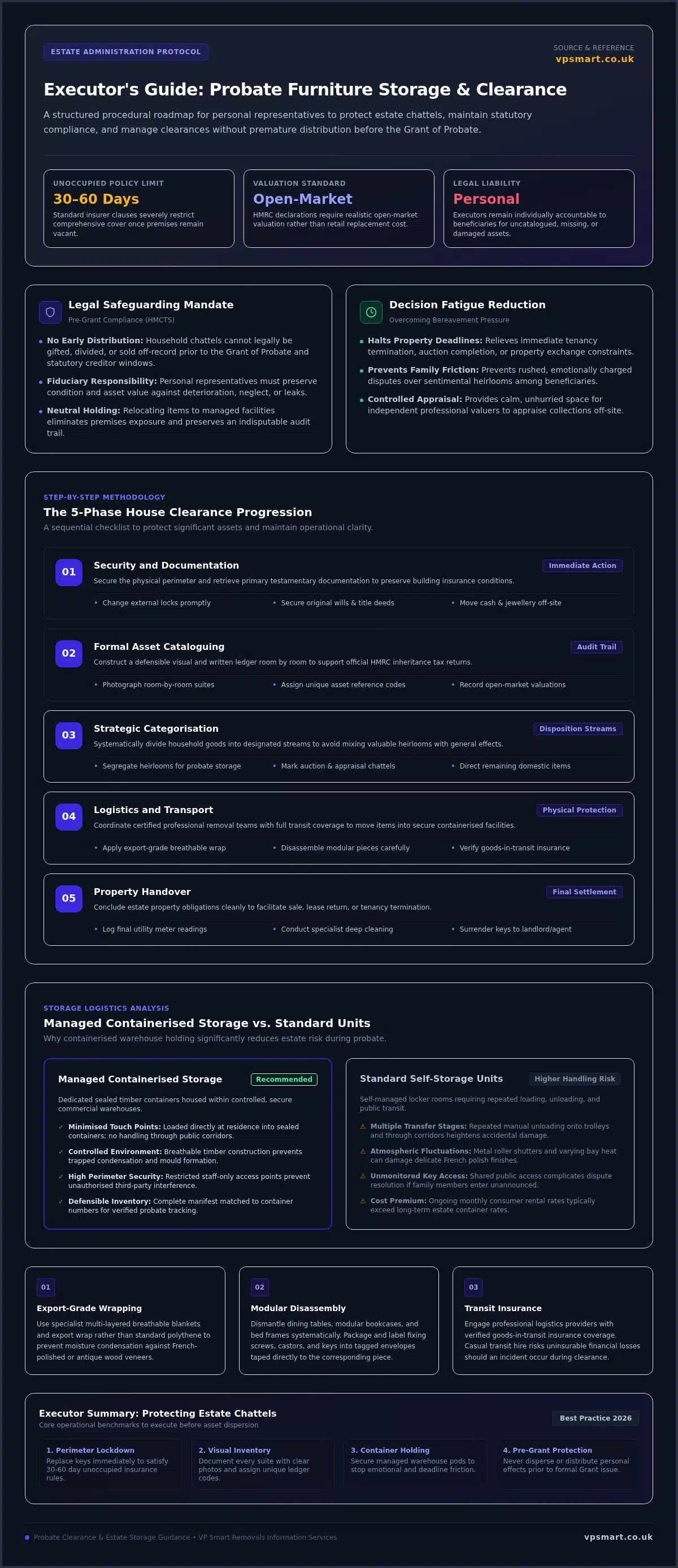
Clearing a deceased estate requires a structured operational plan rather than hasty sorting. Executors must balance legal responsibilities with logistical deadlines, moving step by step to maintain total control over estate chattels. By breaking the clearance into five distinct stages, you protect significant assets, preserve administrative clarity, and ensure a seamless transition when placing items into probate furniture storage london.
A reliable clearance progression follows five clear phases:
- Phase 1: Security and Documentation. Secure the physical perimeter and retrieve vital testamentary records.
- Phase 2: Formal Asset Cataloguing. Create a detailed visual and written ledger to support HMRC reporting.
- Phase 3: Strategic Categorisation. Separate estate chattels into practical disposition streams.
- Phase 4: Logistics and Transport. Arrange professional packing and placement into secure storage.
- Phase 5: Property Handover. Take final utility readings, complete specialist cleaning, and return property keys.
Phase 1: Securing Important Documents and High-Value Valuables
Begin by changing external locks immediately to preserve insurance validity and maintain complete oversight over who accesses the premises. Systematically search for primary paperwork, including original wills, title deeds, insurance policies, and recent bank statements. Locate high-risk, portable assets such as jewellery, loose cash, and small family keepsakes. Transfer these high-value items off-site into secure holding before general clearance operations begin.
Phase 2: Creating a Defensible Inventory for Probate Valuation
Official guidance on valuing an estate for probate requires executors to declare open-market valuations rather than replacement costs. Document the property room by room, capturing clear photographs of every furniture suite, decorative object, and collection. Assign a unique reference code to each piece. This systematic record provides an indisputable audit trail for HMRC, legal advisors, and distributed beneficiaries, dramatically simplifying later conversations regarding division.
Phase 3: The Methodical Sorting Framework for Estate Belongings
Sort remaining chattels into five defined categories: family retention, managed storage, open-market sale, charitable donation, and ethical recycling. Share your visual inventory with beneficiaries to resolve distribution questions collaboratively before moving any physical items. For significant heirlooms and fine antiques that require preservation while legal processes unfold, booking professional movers and packers ensures delicate woodwork and upholstery receive specialised protective wrapping before entering managed facilities.
Managed Warehouse Storage vs. Self-Storage: Choosing the Right Solution
Selecting the right facility for estate chattels requires balancing physical handling risks against ongoing operational costs. Traditional self-storage facilities offer walk-in access, but they force executors to manage transport, hiring vans, and multiple loading stages during an already demanding period. Opting for managed containerised warehouse facilities transforms this workflow entirely. Professional teams load sealed wooden containers directly at the estate address, transport them to secure hubs, and stack them safely until probate settles. For executors coordinating probate furniture storage london, this model provides complete oversight without the exhausting physical labour.
When comparing these models, the structural differences become clear:
- Handling frequency: Managed containers require single-touch handling; self-storage requires loading, transporting, unloading into corridors, and re-stacking into units.
- Transit protection: Professional containerisation incorporates heavy-duty padding and structured packing; self-storage relies on personal loading techniques.
- Facility access: Managed warehouses operate under strict appointment controls; self-storage facilities permit general public foot traffic.
- Administrative convenience: Full-service providers deliver end-to-end collection, inventory tracking, and eventual redelivery directly to beneficiaries.
Managed Storage: Minimising Physical Labour and Handling Hazards
Fine furniture suffers the highest rate of cosmetic damage during loading and unloading. Every doorway, staircase, and tail-lift transition increases the chance of scuffing polished veneers or loosening antique joints. The containerised vault approach cuts handling points in half. Professional crews pack and inventory each piece once at the property, sealing the vault immediately before transit. Because certified crews operate to standards aligned with the British Association of Removers, executors avoid transit shock and preserve delicate heirlooms for future distribution.
Security, Environmental Control, and Asset Preservation Standards
Standard self-storage corridors often experience rapid temperature fluctuations, increasing condensation risks that can warp timber or encourage mould on upholstered seating. Managed warehouse repositories provide purpose-built environments designed for sustained preservation. These commercial hubs feature 24/7 CCTV surveillance, advanced perimeter controls, integrated fire suppression systems, and strict visitor verification. Leveraging these professional secure storage facilities guarantees that delicate estate chattels remain shielded from both environmental deterioration and unauthorised physical access throughout the administration period.
How to Prepare, Pack, and Protect Estate Furniture for Storage
Safeguarding family heirlooms during extended holding requires specialist packing protocols rather than everyday removals techniques. Antiques and quality furnishings react intensely to trapped humidity, friction, and shifting pressure during transit. Preparing estate assets correctly ensures that items emerge from probate furniture storage london in the exact condition recorded on your initial inventory ledger. By systematically breaking down large items and using breathable materials, executors uphold their legal duty to preserve asset value.
Follow these essential packing principles for antique and modern estate furniture:
- Dismantle heavy structures: Remove table legs, bed frames, and detached leaves to reduce joint strain.
- Select breathable protective wraps: Layer thick quilted furniture blankets instead of sealing surfaces in non-breathable stretch plastics.
- Reinforce delicate contact zones: Secure double-walled corrugated cardboard edge protectors along decorative cornices, cabriole legs, and carvings.
- Sync inventory markers: Label every individual wrapped bundle with the unique reference number from your master probate catalogue.
Disassembly and Hardware Management for Complex Furniture
Photograph each dismantling phase from multiple angles before loosening a single bolt. Place all screws, brackets, drawer pulls, and dowels into durable zip-lock bags labelled with the corresponding asset code, then tape the bag securely to the main furniture frame. For drop-leaf dining tables, vintage bureau desks, or grandfather clocks, lock internal pendulum mechanisms and brace folding brackets with archival card to prevent internal mechanical strain during handling.
Material Selection: Safeguarding Polished Timber and Upholstery
Direct contact with standard polythene or bubble wrap traps ambient moisture, causing clouding, blooming, and irreparable damage on antique French polish and traditional oil finishes. Protect timber surfaces first with breathable wool-mix removal blankets or acid-free paper, securing the edges with textile webbing rather than adhesive tape. High-end textiles and upholstered seating need ventilated cotton covers to prevent dust accumulation while allowing natural fabric aeration. For complex family estates containing fragile antiques, scheduling professional packing services guarantees that irreplaceable possessions receive expert handling aligned with strict insurance standards.
Order certified packing materials
Arranging Professional Removals and Estate Transport with Confidence
Transporting estate chattels from a private residence into dedicated storage requires far more diligence than a standard domestic relocation. Grieving families should never be expected to haul heavy oak furniture, negotiate tight stairwells, or organise multi-trip van hires. Entrusting the physical transit to a qualified removal partner protects both personal safety and fiduciary integrity. When setting up probate furniture storage london, executors need a coordinated logistical partner capable of liaising smoothly with probate solicitors, estate agents, and facility managers.
Before committing to an estate clearance team, verify the following baseline protections:
- Specialist Goods in Transit insurance: Standard vehicle policies do not cover antique breakage; verify comprehensive per-load transit indemnity.
- Substantial Public Liability cover: Confirm indemnity that shields against structural scuffs, bannister damage, or communal hallway claims.
- Heavy asset handling capabilities: Check for specialist equipment and techniques tailored to grand pianos, antique armoires, and fire safes.
- Transparent pricing frameworks: Insist on clear, upfront terms to prevent unexpected clearance bills from depleting the residual estate.
Key Criteria for Selecting an Estate Removal and Storage Specialist
Estate administration demands absolute financial clarity. Choose providers offering transparent pricing structures with fixed-fee options, ensuring your estate accounts remain tidy and defensible against beneficiary queries. Make sure the firm possesses specialised equipment such as padded piano shoes, heavy lifting straps, and window hoisting gear for challenging access routes. You can review detailed selection advice within our practical house removals guide to vet prospective transport providers thoroughly.
The Final Step: Releasing and Distributing Chattels Post-Probate
Releasing personal possessions from storage requires formal legal closure. Reputable storage facilities enforce strict release protocols, requiring an official sealed copy of the Grant of Probate alongside signed executor instructions before unlocking containerised vaults. Once cleared, an experienced logistics team can coordinate multi-drop deliveries to various beneficiary households nationwide, bringing probate to a smooth, dignified conclusion. Secure complete peace of mind today by scheduling your initial consultation with our team.
Streamline Your Estate Administration with Methodical Care
Navigating house clearance alongside probate obligations doesn’t have to cause exhausting personal strain or legal anxiety. Establishing a methodical room-by-room inventory, securing vital testamentary paperwork, and transferring delicate furnishings into single-touch containerisation safeguards estate assets against avoidable damage and dispute. Relying on professional probate furniture storage london grants you the vital breathing room required to resolve legal formalities calmly, free from the ticking clock of property deadlines or premature distribution worries.
Experienced crews bring dependable care to every collection, utilising specialised equipment for fine antiques, pianos, and fragile heirlooms alongside comprehensive inventory tracking. Clear, transparent fixed-fee options eliminate financial guesswork, giving personal representatives complete oversight and reassurance across each stage of estate administration.
Take the process forward one methodical step at a time, confident that every treasured possession remains safe, secure, and respected.
Frequently Asked Questions
Can an executor move furniture into storage before the Grant of Probate is issued?
Yes, an executor possesses legal authority derived directly from the will to secure and protect estate chattels immediately upon death. Transferring vulnerable belongings into managed probate furniture storage london is considered a prudent administrative action to prevent theft, accidental damage, or insurance invalidation in a vacant property. However, you cannot legally sell, gift, or distribute these items to beneficiaries until probate is formally granted.
How long can furniture remain in probate storage during estate disputes?
Furniture can remain in secure managed storage indefinitely whilst contentious probate claims, caveats, or family disputes are resolved. Estate disagreements can take many months or even years to settle through legal channels. Containerised warehouse facilities keep chattels protected, sealed, and catalogued until personal representatives resolve their differences or receive a binding court order authorising final collection and distribution.
Who pays for furniture storage costs during the probate process?
Storage fees are classed as a legitimate administration expense, meaning the deceased’s estate ultimately pays these costs. Because bank accounts remain frozen prior to the grant, an executor typically settles recurring invoices personally and claims full reimbursement from estate funds before making final distributions. In many instances, probate solicitors can also arrange direct fee settlements from available cash reserves held in estate accounts.
Does standard home insurance cover estate furniture placed in storage?
No, standard residential home insurance policies cease to protect contents once belongings are permanently removed from the primary property address. In addition, vacant home clauses often void contents cover after 30 to 60 days of unoccupancy. Executors must secure specialised transit and storage protection. Professional removal companies provide dedicated goods-in-transit cover and comprehensive warehouse indemnity to safeguard the estate against accidental loss.
How should high-value antique furniture be valued before entering storage?
High-value furniture should receive a formal open-market valuation conducted by an accredited RICS or SOFAA appraiser before entering warehouse vaults. HMRC guidelines require separate itemisation for personal chattels valued at £1,500 or more. Appraisers assess realistic second-hand auction liquidation value on the date of death, rather than higher retail insurance replacement figures, giving you a defensible record for tax calculations.
Can individual beneficiaries access the storage facility to inspect specific items?
No, individual beneficiaries cannot independently enter the facility without the formal written authorisation and presence of the executor. Managed facilities enforce strict access protocols to maintain an unbroken chain of custody. When handling probate furniture storage london, operators only open containerised vaults under direct instruction from the registered executor, ensuring contested chattels remain entirely safe from unauthorised removal or damage.
What happens to furniture if the estate lacks sufficient liquid funds to pay storage fees?
If liquid funds are tied up, executors can arrange specialist executor lending, settle balances privately for later reimbursement, or negotiate fixed-fee options with logistics partners. Storing furniture in cost-effective managed warehouse crates rather than expensive self-storage units keeps ongoing overhead remarkably low, protecting estate solvency whilst you wait for property transactions or investment liquidations to release essential cash.
Disclaimer
Some links in this article may be affiliate links, which means we may earn a small commission if you make a purchase through them, at no additional cost to you. We only recommend products or services we believe provide value to our readers.