
What makes a removal estimate useful rather than surprising? Often, it starts with a well-measured inventory. Calculating the volume of your belongings for a move can seem straightforward until you reach an L-shaped sofa, a dismantled wardrobe or boxes in different sizes. Underestimate what needs moving and the vehicle or quote may not reflect your belongings. Overestimate, and your plans may be less clear.
It’s understandable to be unsure how to measure bulky furniture and awkward items. Your estimate doesn’t need to be perfect, but it should be consistent, detailed and clear enough to discuss with a removal team.
This guide explains how to measure belongings in cubic metres, use the same method for furniture and packed boxes, and handle items that are irregular or dismantled. You’ll also learn what to include in your inventory and why packing, storage and specialist handling matter beyond volume alone.
Key Takeaways
- Start with an inventory, measure each item and record its estimated volume in cubic metres.
- For a rectangular item, multiply its length, width and height in metres. Review your list for omissions and inconsistent measurements.
- Choose a method to suit the item: direct measurements are useful for furniture, while box counts can help with matching packed boxes.
- Record access details and dismantling needs alongside volume, as these can affect planning too.
- A detailed inventory can help you discuss your move with VP Smart Removals and may inform a fixed-price relocation project.
Why calculate the volume of your belongings before a move?
Moving volume is the amount of space your belongings occupy, usually recorded in cubic metres (m³). A measured estimate is a more useful starting point for discussing a move than a guess based on the number of rooms. Two homes with the same number of rooms can contain very different amounts of furniture, boxes and bulky possessions.
Calculating the volume of your belongings for a move can help you discuss vehicle planning, a removal quote and whether you may need storage. A removal company can consider the estimate alongside your inventory and the practical details of the move. Treat it as a planning aid, not a promise of vehicle capacity, a confirmed quote or a complete assessment of the work involved.
What does cubic metre volume mean for a household move?
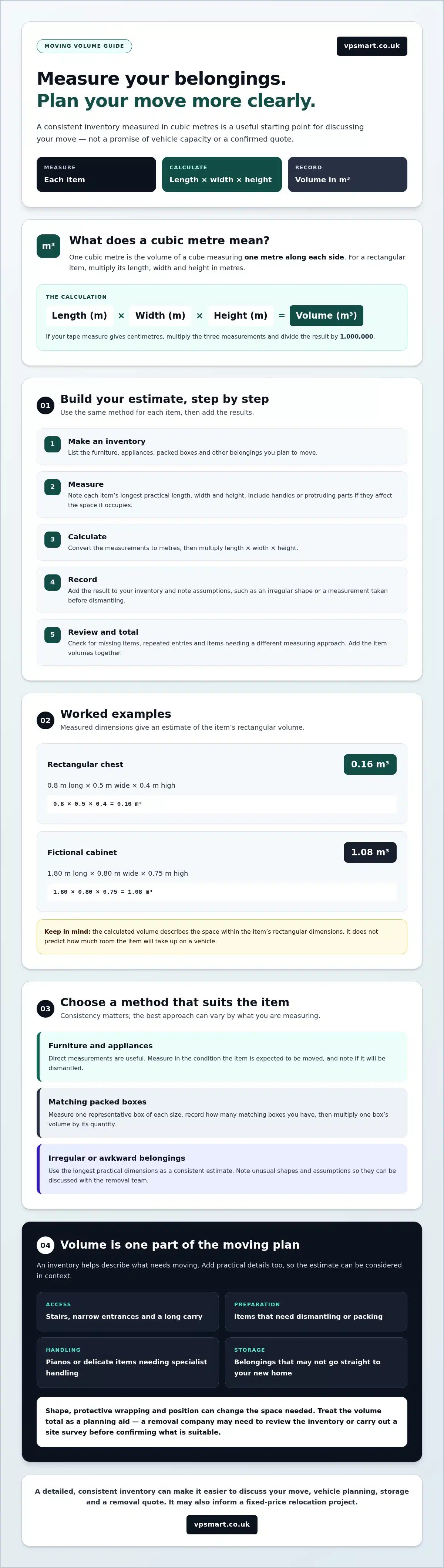
One cubic metre is the volume of a cube measuring one metre along each side. It’s one of the standard units for measuring volume. To estimate an item’s volume, measure its length, width and height in metres, then multiply the three measurements.
Example: A rectangular chest measuring 0.8 m long, 0.5 m wide and 0.4 m high has a measured volume of 0.16 m³. That figure describes the space within its rectangular dimensions, not how much room it will take up on a vehicle. Protective wrapping or an unusual shape may affect the space needed.
What can a volume estimate help you plan?
A consistent estimate helps you describe what needs moving and gives you a list to check against the move plan. It can also prompt a useful storage discussion if some belongings won’t be going straight to your new home. A clear inventory makes it easier to spot what still needs measuring instead of relying on a rough impression.
Volume is only one part of the picture. A tall wardrobe may need dismantling, while a piano or delicate item may need specialist handling. Stairs, narrow entrances or a long carry can affect access, and packing can change the space belongings occupy. Mention these details when discussing the move, so the volume estimate is considered in context.
Room count alone won’t show what’s inside cupboards, how many boxes you’ll pack or whether a bulky item will fit through an entrance. An inventory-based estimate gives more detail, but it’s still an estimate. A removal company may need to review your inventory or carry out a site survey before confirming what’s suitable for your move.
How to calculate the volume of your belongings step by step
Use the same method for each item, then add the results. This makes your estimate easier to check and more useful to share with a removal company.
- Make an inventory: List the furniture, appliances, packed boxes and other belongings you plan to move.
- Measure: Note each item’s longest practical length, width and height.
- Calculate: Convert the measurements to metres, then multiply them.
- Record: Add the result to your inventory and note any assumptions.
- Review: Check for missing items, repeated entries and belongings that need a different measuring approach.
How do you measure furniture and boxes consistently?
Measure each item in the condition it’s expected to be moved. If furniture will be dismantled, note that in your inventory and list the parts that will need moving. For boxes, measure one representative box of each size, then record how many matching boxes you have. This saves time while keeping the calculation easy to check.
Use the item’s longest practical dimensions, including handles or protruding parts if they affect the space it occupies. Measure in metres for a direct cubic metre calculation. If your tape measure gives centimetres, multiply the three measurements and divide the result by 1,000,000.
How do you total your inventory in cubic metres?
For a rectangular item, multiply its length in metres by its width in metres and its height in metres. For example, a fictional cabinet measuring 1.80 m long × 0.80 m wide × 0.75 m high has a calculated volume of 1.08 m³ (1.80 × 0.80 × 0.75).
This is an illustrative calculation, not a prediction of the space the cabinet will occupy on a vehicle. Its shape, protective wrapping and position can affect the space needed. A volume calculation reference can provide another point of comparison. Apply one consistent method throughout your inventory.
For repeated items, group matching entries in a spreadsheet or written list. Multiply one item’s volume by its quantity, then add that subtotal to the volumes of the other items. Note approximate figures, such as an irregular shape or a measurement taken before dismantling. These notes make assumptions clear when you review your estimate with a removal team.
A clear inventory can also help you discuss what needs packing or handling. If you’re exploring removal support, see VP Smart Removals’ moving and packing services.
Which measuring method works best for awkward belongings?
The best approach depends on what you’re measuring and how detailed an estimate you need. Direct measurement gives you a consistent starting point, while a box count can be quicker once belongings are packed. An inventory review or survey by a removal professional may help when the contents are difficult to assess remotely. No method captures every handling or access requirement on its own.
- Direct dimensions: Useful for furniture and larger objects you can measure. The result is a practical estimate, but it may not match the space the item occupies when loaded.
- Box-count estimate: Convenient for matching packed boxes. It depends on accurate box dimensions and won’t include loose belongings or furniture that still needs packing.
- Professional inventory or survey: Helpful if you’re unsure about your list or have bulky or delicate belongings. It allows the volume estimate to be considered alongside handling and access, but some uncertainty may remain.
How should you estimate irregular or oversized items?
For a sofa, wardrobe or other awkward item, note its widest and tallest points, its depth and any protruding parts. A sofa’s cushions and sloping arms, for example, can leave gaps when it’s placed beside other furniture. Don’t present the item as a perfectly measured cuboid. Record the dimensions as a guide and label the volume as an estimate. The cubic metre is the official SI unit of volume, but using a standard unit doesn’t make an irregular shape easier to pack.
If an item will be dismantled, record its assembled dimensions and note how it will be moved. Taking it apart can change the dimensions of its separate pieces and how they need to be handled. Flag pianos, delicate belongings and other items that may need specialist handling for separate discussion. Their volume alone doesn’t tell the whole story.
When is a professional inventory or survey more useful?
Consider discussing an inventory review or site survey with a removal company if your list feels incomplete, measurements are uncertain or the move includes bulky or delicate items. Share what you know, including access details and whether furniture will be dismantled, so the removal professional can consider more than the volume total.
Use your estimate as a planning tool, not as a final decision about vehicle suitability. The space required can depend on how items fit together, packing and handling needs, and access at each property. Mark approximate figures clearly so they aren’t mistaken for confirmed requirements.
How to turn your volume estimate into a practical moving plan
Your volume total is most useful as part of a clear inventory. Treat it as one planning detail, not a complete measure of how complex the move will be. Before adding everything together, separate belongings by destination: items going to your new home, items for storage, and anything you plan to donate or dispose of. This gives a removal team a clearer picture of what needs moving and where.
What details should accompany your volume estimate?
For each item or group, record the quantity, dimensions and whether it’s packed. Mark measurements you’re unsure about and note furniture that needs dismantling. Add access information for both properties, such as stairs, restricted collection access or a long carry between the entrance and where a vehicle can stop.
Flag belongings that may need specialist handling, including pianos and delicate items. Photographs can help explain an unusual shape, condition or access constraint that’s difficult to describe in a list. Keep them ready to share if a removal professional needs more context. If you’re preparing for a house move, VP Smart Removals’ house removal service information may help you explore the support available.
How can packing and storage change the plan?
Belongings can take up more space once they’re wrapped or packed into boxes, so distinguish measurements taken before packing from estimates of the packed load. Record the number and size of boxes where you can, and note whether packing is still to be done. If you’re considering professional packing help, see the information on packing and moving services.
Keep a separate storage list rather than combining those belongings with the items going to your new home. This makes it easier to discuss what needs transporting now and what may need storage, while reducing the chance that something is missed. Packing, storage and specialist handling can all affect arrangements beyond the cubic metre total.
Before discussing a quote, review your inventory and point out anything that has changed since you measured it. A volume estimate is a helpful starting point, but a detailed inventory, packing status and access notes provide context for a more informed conversation. If details are uncertain, say so rather than presenting a rough estimate as exact.
View removal pricing information
How VP Smart Removals can help refine your moving inventory
Your measurements are a useful starting point for a conversation with a removal team. A clear list shows what you plan to move, while notes about packing, access and special handling add context a cubic metre total can’t provide. VP Smart Removals offers house removals and packing services. A detailed inventory or site survey may inform a fixed-price relocation project.
You don’t need a perfect figure before asking for guidance. Share what you’ve measured, mark assumptions clearly and ask what else the team needs to understand your move. A tailored assessment may help clarify the plan, but an early estimate alone doesn’t confirm the final requirements or quote.
What can you share when discussing your move?
Prepare an item list with dimensions where available and an approximate count of packed or expected boxes. Be open about uncertainty: mark estimates that need checking, especially for unusually shaped or bulky belongings. Mention furniture that may need dismantling, delicate items or a piano, and whether any belongings may need storage.
Access details are useful too. Note stairs, restricted entrances, long carries or other constraints at either property. If a size or condition is difficult to explain in writing, keep a photograph available to illustrate it. This helps the removal team consider handling and access alongside volume, rather than treating a total as the whole story.
What happens after you request moving guidance?
An enquiry gives you the opportunity to discuss your inventory and services that may be relevant, such as house removals or packing. The team may ask for clarification about measurements, box numbers, access or items requiring particular care. Depending on the move, a detailed inventory or site survey may provide further planning information. It won’t remove every uncertainty or guarantee a particular vehicle or quote outcome.
Keep your list handy and update it if the belongings you plan to move change. Clear, honest notes show what’s known and what still needs discussion, without making your estimate seem more precise than it is.
Make your moving estimate work for you
Calculating the volume of your belongings for a move gives you a practical starting point, especially when you work from an itemised inventory rather than room count alone. Measure consistently, total the cubic metres and mark approximations clearly. For awkward or bulky belongings, remember that shape, packing and handling can affect the space and planning involved.
Turn the figure into a useful moving plan by noting access, dismantling needs and which belongings are going to your new home or into storage. This context makes discussions with a removal team more informative. VP Smart Removals offers house removals, packing and storage. A detailed inventory or site survey may also inform a fixed-price relocation project.
Share the information you have and ask what else is needed to assess your move. Your estimate doesn’t need to be perfect to help you take a confident next step.
Frequently Asked Questions
How do you calculate the volume of belongings for a move?
Measure each item’s length, width and height in metres, then multiply the three measurements to estimate its volume in cubic metres. For centimetre measurements, multiply the dimensions and divide the result by 1,000,000. Repeat for each item. For matching boxes, multiply one box’s volume by the number of boxes, then add the results. Mark irregular shapes as estimates, since their actual packing space may differ.
What is the formula for calculating volume in cubic metres?
For a rectangular item, the formula is length × width × height, with all three measurements in metres. For example, an item measuring 1 m × 0.5 m × 0.5 m has a measured volume of 0.25 m³. This calculation describes the dimensions of a simple bounding box around the item. It may not equal the space the item occupies when packed, particularly if it has an irregular shape or needs protective wrapping.
Can I estimate moving volume by counting boxes?
Yes. Box counting can help if your belongings are packed in boxes of a consistent size. Measure one representative box, calculate its volume, then multiply that figure by the number of matching boxes. Treat the result as part of your estimate, not the whole inventory. It won’t include furniture, loose belongings, irregular items or things you haven’t packed yet. Listing those separately gives a fuller picture of the move.
Should I measure furniture before or after dismantling it?
Measure the furniture in the condition it’s expected to be moved, and note that condition in your inventory. If it’ll be dismantled, record the largest dimensions of the separate parts and identify which item they belong to. If it’ll stay assembled, measure its widest and tallest points. Include any dismantling needs, as access and handling can affect planning as much as volume.
How accurate does my moving volume estimate need to be?
A useful estimate should be consistent and clear enough for an initial planning conversation, but it isn’t a guaranteed measurement. Use actual dimensions where practical, count matching boxes carefully and flag guesses or awkward shapes. A removal professional may also need to review your full inventory, access arrangements and handling requirements before advising how the move should be organised. Be clear about what you’ve measured and what you’ve estimated.
Do removal companies need an inventory or a volume estimate?
An inventory describes what you plan to move, while a volume estimate summarises the space those belongings may occupy. Sharing both gives a removal company helpful context for discussing your move. Include bulky or delicate items, dismantling needs and access details, and identify uncertain measurements. Ask whether a more detailed inventory or site survey would help assess the project. Requirements depend on the move and its specific circumstances.
Disclaimer
Some links in this article may be affiliate links, which means we may earn a small commission if you make a purchase through them, at no additional cost to you. We only recommend products or services we believe provide value to our readers.