Sep 25, 2026
Could one overlooked loft, garden shed or awkward stairwell leave your removal team planning with only half the picture? Knowing how to prepare for a video removal survey helps you show what’s involved, so the team can make a more informed plan and quote.
It’s understandable to worry that a missed item, poor lighting or a patchy connection could affect the assessment. A little preparation puts you in control: make each room easy to view, check your camera and signal, and think ahead about bulky belongings and access at both properties.
This guide explains what to organise before the call, how to walk through your home clearly, and which details to point out, from stored-away items to stairs, narrow entrances and parking constraints. You’ll also find useful questions to ask about what the quote includes and what happens next. Video surveys aren’t available from every removals company, so confirm this option before arranging one. A clear walkthrough and complete inventory can help the removals team understand your needs and reduce the chance of important details being missed.
Key Takeaways
- Prepare a simple inventory to help the removals team understand the scale of your move.
- Follow a clear walkthrough order so the surveyor can assess your belongings and access points without missing important details.
- Ask which items and services are included, and how special handling needs or uncertain inventory details will be recorded.
- Check the written quote or move plan against what you showed, then flag omissions or changes before the move.
- Confirm that your chosen removals company offers video surveys before arranging one.
How to prepare for a video removal survey and why the details matter
A video removal survey is a remote walkthrough in which a surveyor reviews your belongings and moving requirements on a live video call. You guide the camera through the property, highlight items that need attention and answer questions about the move. The survey can give the company a clearer picture than a brief phone conversation, but you still need to point out anything the camera might miss.
A removal company may provide more than transport for household belongings. The range of moving company services helps explain why it’s useful to discuss specific requirements, such as packing or storage, during the assessment. Ask how the survey works before the appointment, as the rooms and details reviewed may vary between companies.
What does a video removal survey cover?
The surveyor will typically ask to see rooms, furniture, belongings, property access and any services you’ve requested. A video walkthrough is a visual assessment, not automatically a written inventory. Check whether the company will record the items discussed and share a list or move plan afterwards. A video survey also differs from an in-person site survey, where a representative visits the property. Confirm which survey method is available and what the resulting quote will include.
You’re not simply holding up a camera while someone else makes decisions. Guide the walkthrough, mention items stored out of sight, and explain any special handling needs. Pause if the picture is unclear or you’re unsure whether something has been included. A detailed assessment can support a more considered plan. VP Smart Removals can base fixed-price relocation projects on a site survey or detailed inventory, but confirm directly whether a video survey is available for your move.
Why a thorough walkthrough can make moving day smoother
An omitted shed, loft or bulky item can change the workload and the space required in the vehicle. Access matters too: stairs, narrow entrances or difficult turns may affect how the team plans to move larger furniture. Pointing these out helps the removals company understand the practical demands of the job and whether to discuss requested services, such as packing or storage.
Complete survey information gives the removals team a stronger basis for planning the vehicle, crew and services your move may require. It doesn’t guarantee that every detail has been captured, so check the written quote or move plan afterwards. Confirm what’s included, raise anything missing and ask how changes to your inventory could affect the plan before moving day.
What to check before your video removal survey starts
A few minutes of preparation can help you give the surveyor a clear view of the move, rather than relying on memory as you go from room to room. Make a brief inventory of what’s moving, including belongings in the loft, garage, shed, cupboards and other storage spaces. You don’t need to list every small item, but note anything bulky, fragile or unusual that could affect the plan.
Prepare your inventory and flag items needing special attention
Include large furniture, pianos, fragile belongings and anything that may need dismantling or specialist handling. Mark items that aren’t going to the new home too, so they aren’t accidentally counted as part of the move. If you need packing or storage, add that to your notes. It’s easier to discuss options while the surveyor is assessing your requirements.
Keep a short question list nearby. You might ask:
- Which belongings and requested services will be included in the assessment?
- How will special handling needs or uncertain inventory details be recorded?
- What does the written quote include, and what should I check when I receive it?
If packing may be useful, review the company’s packing services and ask which options are relevant to your move. Confirm directly whether your chosen removals company offers video surveys and how its process works.
Set up your device and rooms for a clear walkthrough
Use a charged smartphone or tablet, then test its camera, microphone and internet connection in the rooms and storage areas you’ll show. A strong connection in one room doesn’t always mean the signal will be as clear elsewhere. Check that the camera lens is clean, switch on lights and open curtains where helpful. Move at a steady pace so the surveyor can see furniture, entrances and the full layout.
Before the call, clear safe routes between rooms and make storage spaces accessible to view. You don’t need to move heavy belongings or create a perfect showroom. Make it possible to show the items and access points safely. If another household member is available, they could hold the device while you explain what’s in view, or take notes on answers and follow-up questions.
This checklist is a practical starting point for how to prepare for a video removal survey: know what’s moving, flag exceptions and make sure the camera can show the spaces clearly. If the connection becomes unreliable or an item can’t be shown, tell the surveyor rather than leaving it out of the discussion.
How to show every room and access point during the video survey
A consistent route helps the surveyor build a clear picture of your home without guessing what lies beyond the camera’s view. Start at the entrance, briefly explain the layout, then move through the living areas, kitchen and bedrooms before showing relevant storage spaces. Tell the surveyor when you’re moving between floors or into an outbuilding, and pause at each stop so they can ask questions or make notes.
Follow a simple room-by-room survey route
In each room, show the floor area and larger furniture, then open cupboards or storage areas if belongings inside are moving. A brief pan can reveal the overall layout, but linger on items that may be easy to miss, such as furniture behind a door or boxes stored under a bed. Include the loft, garage, shed or other outbuilding if its contents are part of the move. Say clearly if something isn’t moving.
Keep the order predictable rather than doubling back whenever you remember another item. This makes it easier for the surveyor to connect what they see with the room or storage area it belongs to. You’re in charge of the walkthrough, so ask for a moment to clarify details if the surveyor’s questions reveal something you haven’t shown.
Make access challenges and unusual items visible
Show access at both the property entrance and the rooms containing large belongings. Point out narrow doorways, tight turns, stairs or lifts where they may affect moving furniture. If there’s a long distance between the entrance and where a vehicle could stop, explain it. Show parking arrangements only where they’re relevant and safe to film. Don’t walk backwards, climb or put yourself at risk to capture a better angle.
For a piano, a large wardrobe or another awkward item, show its full shape from more than one angle if you can do so safely. Explain if it’s fragile, unusually heavy or difficult to reach. The camera may not show measurements or details clearly, so describe them and ask the surveyor how they’d like you to provide any extra information.
Clear views of your belongings and access points give the removals team more useful information for planning the move. That’s the practical aim of how to prepare for a video removal survey: not a perfect film, but a steady, complete walkthrough that leaves fewer unanswered questions. Before ending the call, check whether the surveyor has seen every room and relevant access point, and agree how to follow up on anything that couldn’t be shown.
What to ask during a video removal survey before ending the call
Before the call ends, check that the surveyor’s understanding matches what you showed and explained. A useful assessment depends on more than seeing each room: belongings, access details and requested services need to be recorded clearly enough to inform the written quote or move plan.
Clarify what the survey and quote include
Ask the surveyor to confirm which belongings and services they’ve included. If you may need packing, storage or specialist handling, make sure those requirements have been discussed rather than assumed. For furniture that may need dismantling or reassembly, ask what’s covered and whether you’ll need to arrange anything separately. VP Smart Removals offers furniture assembly, but check the specific scope for your move.
- Are all the rooms, storage areas and items we’ve shown included in the assessment?
- How have you recorded access details and any special handling requirements?
- What services are included in the quote, and what is excluded?
- How should I report changes to the inventory or moving requirements?
- When should I expect written confirmation, and which details will it set out?
Clear answers make it easier to compare the survey findings with the written quote later. If packing support is on your list, explore the company’s packing services and ask which options fit your requirements. Don’t assume packing or furniture work is included unless the company confirms it in writing.
Resolve uncertainties before the survey ends
Ask the surveyor to repeat any assumptions about item quantities, access or services. For example, check whether a bulky item in a loft has been counted or whether a difficult entrance has been noted. If something was missed or couldn’t be shown clearly, ask how to provide further information, such as a written description or photographs, and how it will be added to the assessment.
Knowing how to prepare for a video removal survey also means finishing with a clear record of what happens next. Note any details you’ve agreed to send and the company’s instructions for doing so. If an answer is unclear, ask again before ending the call. Resolving uncertainty now can help prevent different assumptions later.
What to do after a video removal survey
The walkthrough is only useful if its details carry through to the written quote or move plan. When it arrives, compare it with your survey notes and check that the rooms, storage spaces, belongings and access points you showed are represented. Look for easily missed items, such as contents in a shed or a large piece of furniture, as well as any special handling or services you discussed.
Check the written quote against your survey notes
Read the scope carefully. Confirm what’s included and excluded, including any agreed packing, storage or specialist handling. If furniture dismantling or reassembly was discussed, check how that requirement is described rather than assuming it’s covered. Make sure access details, such as stairs or a long carry, haven’t been lost between the survey and the paperwork.
Keep the written quote, inventory, survey notes and related messages together. This gives you a clear reference if something needs correcting. If an item is missing, a quantity seems wrong or your requirements have changed, contact the removals company promptly and ask for the documentation to be updated. Check how changes are handled too, so you know what to do if the inventory shifts before moving day.
Choose the next step for your move
Before accepting a quote or confirming arrangements, resolve any uncertainty about the work, the services included or the information used to prepare the plan. A survey informs the assessment, but the written scope lets you check exactly what has been allowed for. Don’t rely on an assumption discussed on camera if it isn’t reflected in the follow-up documentation.
VP Smart Removals can agree fixed-price relocation projects based on a site survey or detailed inventory. This doesn’t mean every video survey leads to a fixed price, so confirm the basis of your quote and whether video surveys are currently available for your move. For details about the company’s quotation approach, review its removals pricing information.
If the details are accurate and the scope is clear, you’ll be in a stronger position to decide what happens next. You can also explore the quotation process and discuss the appropriate next step for your move.
Make your next move with confidence
A clear inventory, steady room-by-room walkthrough and a few focused questions help turn a video survey into useful information for planning your move. Knowing how to prepare for a video removal survey also means checking the written quote against what you showed, then promptly correcting any omissions or changes.
VP Smart Removals provides removals across the UK, with packing, storage and specialist handling among its services. Fixed-price relocation projects can be based on a site survey or detailed inventory. If you’re considering a video survey, confirm its availability and the process directly with the company.
With the right details recorded and the next steps clear, you can move ahead feeling prepared and in control.
Frequently Asked Questions
How long does a video removal survey take?
The time needed depends on the size of your home, how many belongings need assessing and how many questions arise. Allow enough time to show each relevant room and storage area without rushing, including a loft, garage or shed if items there are moving. Ask the removals company how long to set aside when arranging the appointment. Mention unusual belongings or access concerns in advance, as these may need extra discussion.
Do I need to be at home for a video removal survey?
Someone should be able to show the belongings and access points included in the move and answer questions accurately. Ask the removals company whether you need to be present at the property, and what arrangements it accepts if another household member will lead or join the walkthrough. Agree who can confirm what’s moving, including items in storage spaces, and make sure they can access the relevant rooms during the appointment.
What should I show during a video removal survey?
Show every room and any loft, garage, shed or storage area containing belongings that are moving. Include larger furniture, fragile or specialist items, and relevant access features such as stairs, narrow doorways or a long carry. Explain which belongings aren’t moving, too. If an item or area can’t be shown clearly, tell the surveyor and ask how to provide the missing details so the assessment reflects your requirements.
Can a video removal survey provide an accurate quote?
A video survey can give the removals company useful information if you show the full inventory, access conditions and services you may need. The quote still depends on the details provided and the company’s assessment process. Review the written quote for its scope, assumptions and exclusions rather than relying on the walkthrough alone. If an item is missing or your plans change, contact the company and ask whether the quote or move plan needs updating.
What happens if I forget to show something during the survey?
Contact the removals company as soon as you notice the omission. Describe the item or area, such as boxes in a shed or a large piece of furniture, and provide an updated inventory or photographs if requested. Ask whether the new information changes the quote or move plan, then request written confirmation of any revision. Sharing accurate details promptly helps the company reassess the work and reduces uncertainty before moving day.
Should I empty cupboards before a video removal survey?
You don’t usually need to empty every cupboard, but belongings that are moving should be included in the assessment. Open relevant cupboards or storage spaces if their contents aren’t visible, and point out items that could be overlooked. You can ask the surveyor whether a closer look is needed or whether a separate written inventory would help. Make clear which cupboard contents are staying behind, so they aren’t mistaken for part of the move.
Can I ask about packing or storage during the survey?
Yes. Explain if you may need packing support, storage or specialist handling, such as for a piano, and ask whether those services are included or quoted separately. If furniture may need dismantling, check what the company can provide rather than assuming it’s covered. VP Smart Removals offers packing, storage and specialist handling, but confirm the services relevant to your move and check that agreed requirements appear in the written documentation.
Disclaimer
Some links in this article may be affiliate links, which means we may earn a small commission if you make a purchase through them, at no additional cost to you. We only recommend products or services we believe provide value to our readers.
Sep 24, 2026
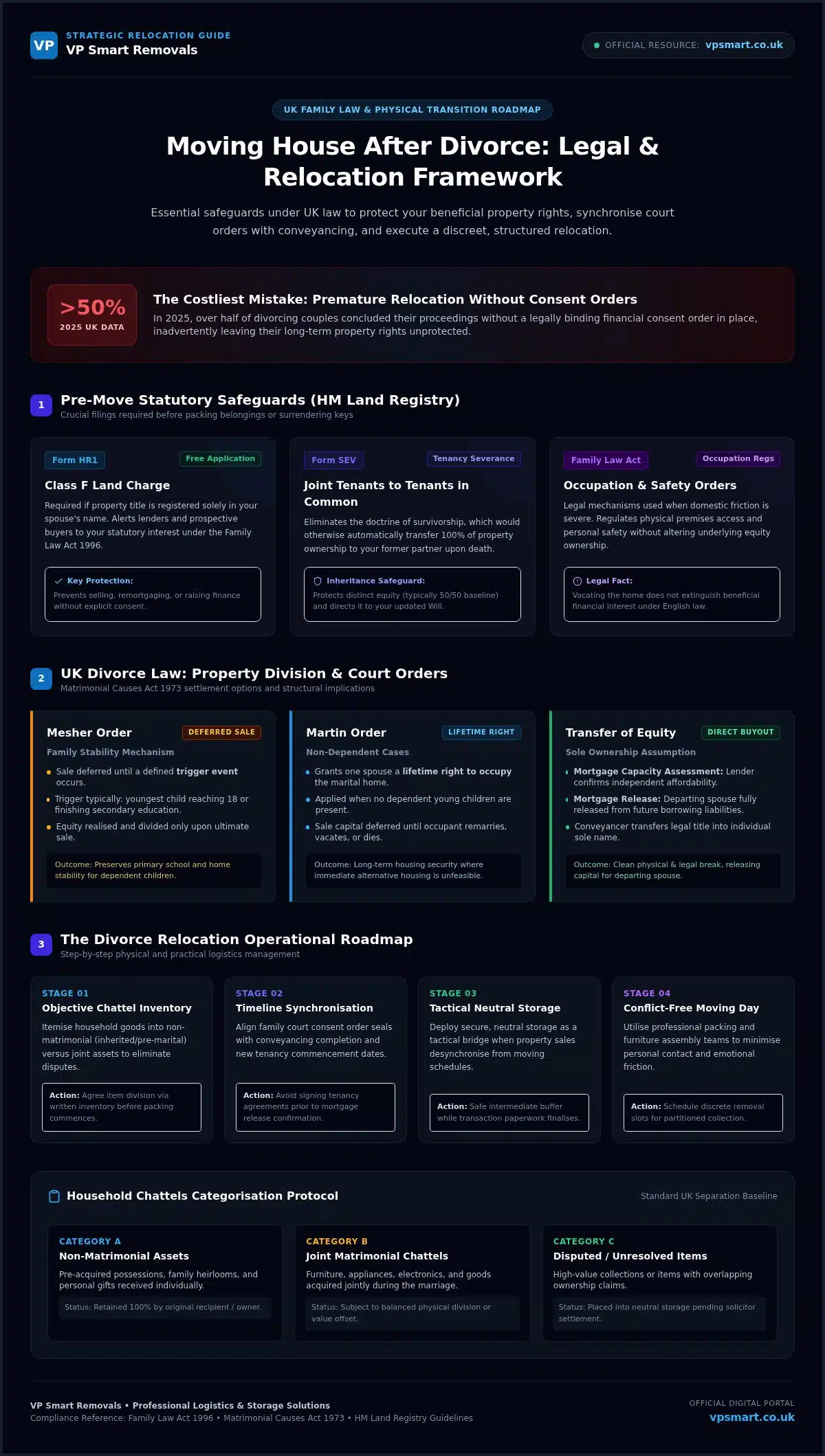
Packing your belongings and leaving the matrimonial home before securing a financial consent order is one of the costliest mistakes you can make under UK law. In 2025, over half of divorcing couples concluded their divorces without a legally binding financial order in place, inadvertently leaving their long-term property rights unprotected. Establishing complete oversight of both your legal standing and your physical transition is essential. This moving house after divorce checklist uk bridges the gap between family court timelines and the practical logistics of establishing a new home.
It is completely natural to feel exhausted by the emotional friction of dividing personal possessions whilst managing conveyancing deadlines and independent packing on your own. You shouldn’t have to carry that uncertainty without a reliable plan. This guide provides total clarity on your legal property entitlements, asset division, and moving arrangements, ensuring you protect your future with calm confidence. Below is your chronological, step-by-step roadmap covering the essential legal notices, financial safeguards, and physical moving milestones required for a smooth transition.
Key Takeaways
- Understand your statutory rights under UK law to ensure vacating the family property does not compromise your legal or beneficial financial interest.
- Follow our step-by-step moving house after divorce checklist uk to synchronise family court consent orders, conveyancing timelines, and physical removal milestones.
- Differentiate personal non-matrimonial items from joint assets using an objective inventory to eliminate conflict during household division.
- Deploy flexible, secure storage as a tactical bridge to safeguard household goods whilst financial settlements and property sales finalise.
- Minimise emotional friction on moving day by utilising professional packing and furniture assembly services to manage the transition smoothly.
Understanding Property Rights and Legal Status Before You Move
One dangerous misconception in marital breakdown is that walking out forfeits your financial stake. Under English law, vacating the family home does not extinguish your beneficial interest. Leaving prematurely without statutory safeguards can severely weaken your day-to-day negotiating position. Before packing a single box or handing over keys, establishing complete oversight of your legal occupation rights protects your long-term housing security.
Married partners have automatic “home rights” under the Family Law Act 1996, giving both individuals a legal entitlement to enter and remain in the matrimonial home regardless of whose name appears on the title deeds. Where domestic friction turns severe, you can apply for an Occupation Order to regulate who lives on the premises, or a non-molestation order to secure personal safety. Neither order alters actual ownership; they manage physical occupation whilst legal representatives negotiate the wider division of property. Consulting a qualified family solicitor before altering your living arrangements remains the foundational item on any robust moving house after divorce checklist uk.
Home Rights and the Land Registry HR1 Notice
If the title deeds are registered solely in your spouse’s name, submit Form HR1 to HM Land Registry immediately. This free application registers a Class F land charge against the property, alerting lenders and prospective buyers to your statutory interest. It prevents your former partner from selling, remortgaging, or raising finance against the property without your explicit consent, safeguarding your beneficial stake until financial proceedings formally conclude.
Severing Joint Tenancies to Protect Inheritance
Most married couples purchase property as beneficial joint tenants, meaning the legal doctrine of survivorship automatically passes the entire house to the surviving spouse if one partner dies. During divorce, this setup exposes your intended beneficiaries to significant risk. Severing the joint tenancy converts your ownership into “tenants in common”, formalising distinct individual equity shares (typically 50/50 initially).
- Submit Form SEV: Send an application to HM Land Registry alongside written notice of severance served on your spouse.
- Update your Will: Your share of the equity no longer passes automatically to your ex-partner; it transfers strictly according to your updated testamentary instructions.
- Coordinate with Conveyancers: Align these registry adjustments with your broader moving house after divorce checklist uk so that prospective home purchases or equity buyouts proceed from a clearly partitioned baseline.
Financial Orders and Property Division Options in UK Divorce Law
Ending a marriage legally does not terminate your financial obligations. Under the Matrimonial Causes Act 1973, English courts possess wide discretion to redistribute property based on fairness, housing needs, and children’s welfare. Resolving these arrangements early ensures your physical relocation rests on firm financial foundations, avoiding disruptive disputes later.
A crucial stage of any moving house after divorce checklist uk is aligning legal settlement milestones with your moving schedule. Without synchronisation, you risk signing tenancy agreements or scheduling vans before mortgage releases complete. When house sales and completion dates desynchronise, booking flexible storage services provides valuable breathing space whilst your solicitor finalises transaction paperwork.
Mesher and Martin Orders: Deferred Property Sales
Courts do not always mandate an immediate open-market sale. A Mesher order retains the family property until a specified “trigger event” occurs, such as the youngest child turning 18 or completing secondary education. In contrast, a Martin order grants one spouse a lifetime right to occupy the home without dependent children present. Both mechanisms provide domestic stability, but defer capital release until the eventual sale.
Transfer of Equity and Property Buyouts
If one party retains the matrimonial residence, an equity transfer buyout is the standard legal vehicle. Key steps include:
- Mortgage Capacity Assessment: Lenders must formally confirm that the remaining spouse can shoulder borrowing liabilities independently before approving a transfer.
- Mortgage Release Procedures: The departing spouse must obtain an official release of liability, ensuring their borrowing capacity remains unencumbered for their next property purchase.
- Tax Exemptions: Property equity transferred pursuant to a formal court order or separation agreement is normally exempt from Stamp Duty Land Tax (SDLT).
Securing a Clean Break Consent Order
A Final Order (formerly Decree Absolute) dissolves the legal marriage; it does not dismiss future financial claims. For absolute legal protection, apply to the court for a Financial Consent Order (with an agreed fee of £62). This document creates a binding “clean break”, preventing your ex-spouse from claiming against future wealth, business growth, or inherited assets. Incorporating clear clearance deadlines into this order guarantees mutual oversight regarding when personal belongings must be removed from the property, keeping your moving house after divorce checklist uk on schedule.
The Comprehensive Moving House After Divorce Checklist
Separating the physical logistics of a move from the emotional friction of relationship breakdown requires methodical discipline. Legal proceedings establish the division of assets on paper; your moving checklist translates those court rulings into practical, controlled steps. Breaking your relocation into chronological milestones protects sensitive data, prevents financial disputes, and provides your children with stable domestic routines.
Using a structured moving house after divorce checklist uk gives you complete oversight across administrative, legal, and operational tasks. The timetable below keeps your transition on track.
Six to Eight Weeks Out: Legal Filings and Administrative Setup
Early preparation centres on ring-fencing your personal information and establishing financial independence. Begin with these core priorities:
- Redirect Personal Post: Set up an independent Royal Mail Redirection service immediately so confidential legal correspondence, bank statements, and court updates go straight to a private address or secure PO Box.
- Separate Banking and Digital Profiles: Open sole bank accounts, secure individual mobile contracts, and update account recovery passwords on personal email accounts.
- Notify Statutory Bodies: Inform HMRC, child benefit offices, and your children’s schools regarding individual primary contact details and residency changes.
- Review Professional Removals: Plan your moving resources by consulting trusted house removals guidance to reserve provisional dates that align with your expected legal exchange.
Two to Four Weeks Out: Logistics and Packing Preparations
With administrative foundations secure, shift your focus to property clearance and utility transfers. These logistical steps ensure a smooth exit:
- Book Moving Support: Confirm vetted movers once completion dates become legally enforceable.
- Arrange Municipal Changes: Notify your local authority to close joint council tax liability, and apply for the statutory 25% single-occupancy discount on your prospective new home.
- Source Packing Supplies: Order dedicated, heavy-duty packing materials to protect your assigned items and prevent disputes over damaged property.
- Schedule Disconnections: Arrange broadband transfers, energy accounts, and water services well ahead of move day.
Moving Week: Final Inspections and Key Handover
The final days demand meticulous evidence gathering to prevent retrospective claims. On departure day, take clear, timestamped photographs of all utility meters (gas, electricity, and water) alongside visual records of the vacated rooms. Hand over all sets of keys strictly according to agreed solicitor instructions, marking the final physical milestone on your moving house after divorce checklist uk.
Dividing Household Chattels and Utilising Neutral Storage
Arguments over household contents often generate more acrimony than dividing liquid capital. Disputing everyday furniture through solicitors quickly burns through thousands of pounds in legal fees over depreciating items. Structuring an objective division method early is an essential milestone on your moving house after divorce checklist uk, keeping domestic transitions dignified and cost-effective.
Creating an Objective Household Chattel Inventory
English family law distinguishes between non-matrimonial property and joint assets. Items owned before the marriage, personal gifts, and direct inheritances generally remain separate property, provided they were not intermingled into joint usage. For joint chattels, compile a shared digital spreadsheet detailing descriptions, photographs, and realistic second-hand replacement values rather than original purchase costs. Allocating items based on the actual floorplans of each party’s prospective home helps resolve disputes pragmatically without court intervention.
Bridge the Relocation Gap with Secure Storage
Property completions rarely align perfectly when untangling a joint household. When sales or purchases desynchronise, flexible storage services offer vital intermediate breathing room. Placing contested or surplus goods into managed storage prevents hasty sales, accidental damage, or premature disposal. Both parties retain complete oversight through itemised storage manifests, guaranteeing transparency until financial orders are signed.
Arrange secure storage facilities for your upcoming move
Professional Packing to Minimise Conflict
Packing up a family residence alone carries immense psychological weight and easily triggers interpersonal tension. Bringing in professional movers and packers acts as an effective, neutral buffer. Trained crews pack according to agreed inventories, record item conditions before transit, and apply distinct colour-coded labels to indicate which belongings travel to which destination. This structured handling eliminates accusations of improper packing, keeping your moving house after divorce checklist uk moving forward smoothly.
Executing a Discreet, Conflict-Free Moving Day
Moving day represents the physical reality of a concluded chapter. It can also bring intense emotional vulnerability. Without intentional boundaries, loading furniture easily triggers heated arguments over old grievances. Managing move day as an operational process rather than an emotional confrontation protects your dignity and keeps the physical relocation on schedule.
Positioning a professional removals crew on-site introduces an impartial presence that naturally diffuses tension. Moving teams focus entirely on efficient loading, inventory verification, and secure transit. With experienced personnel handling the manual labour, you retain complete oversight without being drawn into exhausting personal disputes. This operational safeguard is the final practical step in completing your moving house after divorce checklist uk.
Coordinating Move-Day Timings and Attendance
Direct contact between separating partners on move day should be minimised. Establish unambiguous boundaries early by confirming written collection hours through legal representatives or mediation services. Where possible, agree that your former spouse remains away from the property during the loading window. Children and pets should spend the day with trusted family or professional carers, shielding them from domestic upheaval.
Safeguarding Sensitive Legal and Personal Documents
Never entrust private legal and financial paperwork to the main removal vehicle. Separate your essential records before loading begins and keep them in your personal transit bag:
- Court Filings and Agreements: Financial remedy orders, Form E disclosures, sealed consent documents, and solicitors’ correspondence.
- Identity and Property Titles: Passports, original birth certificates, title register copies, and vehicle logbooks.
- Digital Assets: External hard drives, laptops, and encrypted storage devices containing backups of personal records.
Settling Seamlessly into Your New Residence
Arriving at your new property marks the beginning of your domestic independence. Focus on immediate comfort rather than tackling every unboxing task at once. Assemble children’s beds first to create a secure, welcoming environment on night one. You can also review transparent rates for professional furniture assembly services, ensuring bed frames, wardrobes, and substantial tables are reconstructed correctly without added exhaustion. For comprehensive operational planning, consult our proven house removals guidance to round off your moving house after divorce checklist uk with complete confidence.
Take Confident Control of Your Next Chapter
Navigating a marital separation requires both legal vigilance and methodical practical planning. By establishing statutory property rights prior to departure, securing an enforceable clean break consent order, and following a disciplined moving house after divorce checklist uk, you protect your hard-earned financial future whilst shielding yourself from unnecessary personal conflict.
VP Smart Removals provides nationwide moving and storage logistics tailored specifically for complex life transitions. Our dedicated, neutral packing and inventory services minimise household friction, providing intermediate breathing room and dependable hands to shoulder the physical demands of relocation.
Request a discreet, professional moving quote
Stepping across the threshold of your independent home is an empowering milestone. With sound legal safeguards and reliable logistical support in place, you can turn the page with complete clarity and lasting peace of mind.
Frequently Asked Questions
Can my spouse legally stop me from moving house with our children?
Yes, your spouse can apply to the family court for a Prohibited Steps Order if your proposed relocation disrupts established schooling or co-parenting routines. Both parents with parental responsibility must consent to any significant domestic relocation. If mutual agreement cannot be reached, you must apply for a Specific Issue Order. The court evaluates your request purely based on the children’s welfare under the Children Act 1989.
Do I lose rights to the matrimonial house if I move out?
No, moving out does not surrender your legal or beneficial property rights under UK matrimonial law. Your financial stake in the property remains fully protected until a court grants an enforceable Financial Order. However, leaving prematurely can impact temporary living arrangements and daily negotiation leverage. Reviewing your rights forms a vital first step on your moving house after divorce checklist uk before surrendering house keys.
How do I divide furniture and personal belongings fairly during divorce?
Begin by cataloguing all items on an objective inventory spreadsheet, distinguishing separate non-matrimonial property from joint purchases. Value everyday furnishings at second-hand resale value rather than original purchase costs. Allocate furniture logically based on the floorplans of your respective new homes. Avoid disputing lower-value items through legal channels, as solicitor fees rapidly eclipse the actual monetary replacement value of standard household goods.
What is a Home Rights Notice and when should I register it?
A Home Rights Notice is an official Land Registry entry that protects a spouse whose name does not appear on the property deeds. You should submit Form HR1 to HM Land Registry as soon as relationship breakdown occurs. This free statutory registration alerts prospective lenders and buyers to your legal interest, preventing your spouse from selling, transferring, or remortgaging the matrimonial residence without your formal consent.
Who is responsible for paying mortgage and utility bills after one partner moves out?
Both borrowers remain jointly and individually liable to the mortgage lender for regular monthly payments, irrespective of who resides in the property. If payments stop, the bank holds both individuals accountable. For council tax and energy bills, operational liability usually transfers to the resident spouse once suppliers are notified of departure, though interim financial support agreements often address these domestic outgoings during divorce proceedings.
Can I change the locks on the family home after my ex moves out?
You cannot legally change the locks if your ex-partner is a joint property owner or holds registered Home Rights, unless you possess an Occupation Order. Taking unilateral action risks urgent court applications and financial penalties for unlawfully restricting access. If domestic safety is an issue, instruct a family solicitor to apply for an Occupation Order granting you exclusive occupation rights before altering physical entry points.
How can secure temporary storage help during a high-conflict divorce move?
Secure storage acts as a neutral tactical bridge when property sale and purchase dates desynchronise. Moving disputed or excess items into managed storage facilities prevents hasty disposals, removes friction from the family home, and ensures full transparency through itemised inventory logs. Professional removal teams can pack and transfer designated belongings directly to storage, keeping your moving house after divorce checklist uk strictly focused on practical execution.
Disclaimer
Some links in this article may be affiliate links, which means we may earn a small commission if you make a purchase through them, at no additional cost to you. We only recommend products or services we believe provide value to our readers.
Sep 23, 2026
Over four million older adults across the UK want to move, yet research from the Centre for Ageing Better shows that barely 3.4% actually relocate each year. The sheer dread of rushed packing, physical exhaustion, and parting with a lifetime of memories often halts the process before it begins. Securing genuine compassionate removals for the elderly requires far more than booking basic transit logistics; it demands patient pacing, emotional attunement, and absolute respect for personal dignity.
You already know that orchestrating a move in later life is profoundly personal. You need certainty that sentimental heirlooms will stay safe, vital medication schedules won’t be disrupted, and your loved one will avoid physical strain. In this 2026 buying guide, you will discover how to evaluate specialist removal firms, verify robust handling practices, and leverage managed packing and furniture assembly to protect domestic well-being. We examine the critical criteria checklist to vet dependable providers, ensuring you maintain complete oversight and secure a gentle, turnkey transition.
Key Takeaways
- Understand why genuine compassionate removals for the elderly prioritise emotional pacing and dignity over rapid transit logistics.
- Discover the critical vetting criteria to select providers offering full packing services and furniture assembly that prevent senior injury.
- Evaluate the hidden physical and emotional costs of standard moving options compared to fully managed relocation care.
- Learn a structured, room-by-room downsizing framework designed to protect cherished memories whilst maintaining familiar daily routines.
- See how coordinated planning and flexible storage facilities ensure complete oversight and an immediate, turnkey settling-in experience.
What Are Compassionate Removals for the Elderly?
Standard removals focus almost entirely on speed, loading vans rapidly to meet rigid transit schedules. In contrast, compassionate removals for the elderly reshape relocation into an empathetic, supportive service centered around personal dignity, emotional well-being, and absolute safety. Leaving a home inhabited for thirty, forty, or fifty years carries profound emotional weight. When conventional crews rush through rooms and pack heirlooms indiscriminately, they strip away an older adult’s sense of control. Compassionate moving balances meticulous technical organisation with deep patience, ensuring individuals retain complete oversight throughout every phase of the transition.
The Emotional and Psychological Dimension of Later-Life Moves
Downsizing represents far more than simple decluttering; it is a sensitive reckoning with personal history. Navigating the complex emotional aspects of downsizing for seniors requires sufficient space to pause, reflect, and make unhurried choices about what to keep, gift, or pass forward. Dedicated teams recognise the grief and anxiety tied to parting with familiar surroundings. By maintaining clear, patient dialogue, experienced movers and packers protect an older adult’s personal agency, transforming what could feel like a destabilising event into an empowering step toward a safer, low-maintenance home.
Physical Safeguarding and Health Considerations
Beyond emotional support, senior relocations require rigorous physical safeguards to eliminate fatigue and fall hazards. Experienced crews systematically manage the living space to protect domestic safety from start to finish:
- Hazard management: Keeping primary transit corridors completely clear of tape, packing materials, and loose boxes.
- Vital access: Safeguarding immediate availability to mobility aids, daily prescriptions, and basic comfort items throughout the day.
- Sanctuary preservation: Leaving a comfortable armchair and resting area intact until the final loading stage so routines remain steady.
Maintaining familiar routines prevents physical exhaustion and cognitive disorientation. When older adults know their essential items are secure and accessible, anxiety drops dramatically, making compassionate removals for the elderly an indispensable support system for families.
Key Criteria for Choosing an Elderly Moving Specialist
Selecting the right moving partner requires scrutinising operational habits rather than just transport fleet capacity. Delivering genuine compassionate removals for the elderly hinges on a team’s interpersonal empathy, bespoke pacing, and full-spectrum practical support. By establishing clear vetting benchmarks upfront, families can protect their loved ones from unneeded disruption and physical vulnerability.
Crew Temperament and Clear Communication
Patience isn’t an optional extra during a later-life move; it’s the core operational requirement. Assess whether the company assigns a single, dedicated move coordinator who takes time to understand individual preferences and anxieties. Crews must possess the interpersonal training required to accommodate physical limitations, honour requests, and listen patiently without displaying frustration or urging haste.
Comprehensive Service Breadth and Practical Assistance
A gentle move demands an end-to-end operational framework that eliminates all heavy lifting for older adults. Look for specialists capable of managing every physical task seamlessly:
- Professional wrapping: Deploying specialist packing services to safeguard fragile china, glassware, and sentimental heirlooms.
- Technical handling: Complete disassembly and reassembly of complex furniture, ensuring beds and wardrobes are functional on arrival.
- Interim space: Providing access to secure storage facilities so families can phase downsizing rather than making hurried disposals.
Leaving furniture assembly and unpacking to older adults dramatically raises fall risks. Partnering with a full-service team ensures the new home is immediately functional, comfortable, and safe from day one.
Contract Certainty and Transparent Pricing
Financial ambiguity generates acute stress for older individuals on fixed incomes. Open-ended hourly arrangements frequently cause anxiety if traffic or access delays occur during transit. Instead, choose providers that conduct comprehensive upfront surveys to assess stairways, access constraints, and specialist items before issuing a contract.
Reputable firms provide fixed-price project agreements rooted in clear pricing structures, giving you total budget certainty and complete oversight from initial consultation to final placement. If you are coordinating a relocation for an older relative, exploring full-service house removals provides the transparent framework and practical support needed for a seamless transition.
Comparing Moving Options: Standard Removals vs Compassionate Care
Relocating later in life involves unique challenges that standard transport services simply aren’t equipped to manage. Choosing the right support requires weighing physical risk, emotional well-being, and operational thoroughness across different moving models.
| Relocation Model |
Physical Burden |
Sentimental Care |
Settling-In Speed |
| Self-Managed (DIY) |
Severe; high risk of injury and exhaustion |
High risk of breakages from improper packing |
Slow; leaves boxes unpacked for weeks |
| Standard Removals |
Moderate; basic loading without tailored pacing |
Variable; focused primarily on speed and volume |
Basic; cartons placed in designated rooms |
| Compassionate Relocations |
Zero; complete crew management and lifting |
Methodical protective wrapping and labelled care |
Immediate; complete furniture assembly and setup |
Self-Managed Moves vs Professional Full-Service Relocations
Attempting a DIY move places immense physical strain on older adults and their adult children. Hauling heavy cartons, repeatedly bending to tape boxes, and lifting awkward furniture quickly lead to muscular injury or serious falls. Chaotic packing also causes deep distress when everyday essentials vanish into unmarked containers. Opting for full-service assistance protects family relationships. When trained teams take over the physical logistics, family members can step away from manual labour and focus on offering calm, continuous emotional support.
Assessing Dedicated Senior Removals Against Basic Man-and-Van Services
Budget alternatives like basic man-and-van hire provide transit rather than care. Leaving stacked cartons at the kerbside or inside the front doorway creates immediate hazards for an older individual living alone. In stark contrast, compassionate removals for the elderly incorporate thoughtful, room-by-room replication.
Experienced crews assemble bed frames, position favourite armchairs, and reconnect essential lamps before departing. Cherished porcelain, antique dressers, and generational heirlooms receive individual, protective wrapping rather than basic stacking. By rebuilding a familiar domestic layout on day one, this methodical approach removes disorientation and turns an unfamiliar property into a safe, reassuring home.
How to Plan and Pace a Later-Life Move Step by Step
Rushing downsizing into an intense weekend is the fastest route to physical exhaustion and distress. Structuring the relocation across several deliberate weeks ensures complete oversight and preserves emotional stamina. True compassionate removals for the elderly treat preparation as a steady progression, giving older adults the time they need to process changes comfortably.
Empathetic Downsizing and Sorting Possessions
Tackle one room at a time, beginning with neutral utility areas rather than spaces laden with memories. Limit sorting sessions to sixty minutes daily to prevent cognitive fatigue. Group items methodically into four clear categories: retain, gift to family, donate, or place into interim storage. If cherished heirlooms won’t fit into a smaller footprint, taking photographs creates a lasting visual keepsake without crowding walkways.
Floor Planning and Accessibility Preparation
Precise spatial planning eliminates moving-day surprises. Map the dimensions of the new residence against retained furniture, ensuring corridors and door frames remain clear for walking aids or wheelchairs. Less than 10% of UK homes meet basic accessibility standards, so wide, uncluttered pathways are vital for preventing slips. Confirm that central heating, electricity, and water supplies are fully operational prior to arrival, and arrange the safe disconnection and reconnection of essential white goods.
Managing Moving Day for Optimal Calm
On the day itself, maintain familiar domestic anchors to minimise confusion and protect wellbeing:
- Designate a sanctuary room: Keep an armchair and tea station in one quiet room undisturbed until the final loading phase.
- Pack an essentials bag: Keep daily prescriptions, important documents, fresh linens, toiletries, and favourite teacups in a separate bag that travels with family.
- Prioritise reassembly: Instruct the crew to assemble the bed and arrange familiar bedroom items first so resting space is ready immediately.
When tasks are paced methodically, the entire household feels protected and supported.
Find an experienced team of house movers near you
Partnering with VP Smart Removals for a Dignified Transition
Transitioning into a new residence should mark the beginning of an effortless, comfortable chapter rather than a period of physical exhaustion. VP Smart Removals delivers comprehensive, empathetic moving solutions designed specifically around later-life relocations. By blending methodical technical planning with approachable domestic warmth, our crews ensure every move preserves personal dignity, familiar routines, and emotional well-being.
Bespoke Packing, Furniture Reassembly, and Placement
We eliminate physical strain entirely by managing every stage of packing and setting up the living space. Our experienced teams use high-grade protective materials to secure delicate china, framed portraits, and generational heirlooms against transit vibrations. Each carton is catalogued logically so everyday belongings can be found effortlessly in the new home.
Arrival at the property focuses on immediate domestic reconstruction. We assemble bed frames, rebuild wardrobes, and position favourite armchairs exactly where requested. For delicate musical instruments and weighty heirlooms, our personnel carry out specialised piano removals using dedicated transit techniques, guaranteeing irreplaceable possessions arrive undamaged and ready to enjoy.
Clear Project Management and Dependable Support
Communication remains steady and reassuring from initial consultation to the final placed item. Move coordinators keep clients and their families informed at every stage, answering questions patiently so there isn’t any guesswork or confusion. This collaborative approach preserves personal agency whilst taking the logistical strain off family members.
To prevent the financial anxiety that often accompanies hourly moving rates, we conduct thorough pre-move surveys to inspect narrow corridors, flight access, and specialist items upfront. We then supply transparent, fixed-price project agreements that guarantee complete budget certainty with no surprise surcharges on moving day. You maintain complete oversight over your environment while our crew shoulders the physical workload.
Arranging dependable, compassionate removals for the elderly starts with an unhurried conversation. Reach out to our team today to organise a comprehensive pre-move assessment and secure a calm, dignified transition for your loved one.
Securing Peace of Mind for Your Loved One’s Next Chapter
A successful relocation in later life is measured by preserved well-being rather than the hours logged on a transit van. By choosing genuine compassionate removals for the elderly, you ensure that every phase of the move honours personal dignity, familiar routines, and domestic safety. Comprehensive packing and unpacking solutions remove all physical strain from family members, safeguarding against senior fatigue and fall risks, whilst expert furniture assembly ensures bedrooms and living areas are fully reconstructed from day one. Transparent fixed-price project agreements eliminate moving-day friction and deliver total budget certainty without unexpected surcharges, keeping you firmly in control of the entire process.
Step forward with complete confidence. With patient coordination, methodical handling, and dependable domestic care, you can turn what felt like a daunting transition into an effortless, reassuring settling-in experience that helps your loved one feel instantly at home.
Frequently Asked Questions
How far in advance should an elderly person start planning a move?
Families should ideally begin planning eight to twelve weeks prior to the intended moving date. Spacing tasks over several months allows older adults to sort possessions gradually without mental or physical exhaustion. Early planning also provides ample time to book an in-home site assessment, measure entryways in the new residence, and secure preferred moving dates with a dedicated coordinator.
What is included in a full-service compassionate removal package?
A full-service package covers the entire physical relocation from start to finish. This includes providing all packing materials, wrapping fragile heirlooms, loading, and secure transit. At the destination, the team unpacks cartons, assembles beds and wardrobes, and arranges furniture according to pre-agreed floor plans. This turnkey approach delivers genuine compassionate removals for the elderly by eliminating domestic disruption.
How can adult children help elderly parents downsize without causing upset?
Adult children should focus on active listening and preserve their parent’s final decision-making power. Break decluttering into short, manageable sessions lasting under an hour, focusing on utility spaces before tackling sentimental items. Framing the process around curating a comfortable gallery of favourite belongings, rather than getting rid of possessions, helps parents maintain emotional agency and reduces moving friction.
What happens if cherished furniture cannot fit into the new home?
Valued furniture that exceeds the floor plan of the new property can be placed into secure storage facilities. Rather than forcing hasty decisions during a high-stress week, interim warehouse storage gives families time to offer pieces to relatives or arrange private sales later. Dedicated removal teams can transport these surplus items directly into storage on moving day.
Can removal teams disassemble and rebuild specialist beds or mobility furniture?
Yes, experienced crews possess the technical tools and expertise to disassemble, transport, and reassemble complex furniture, including heavy bed frames, large wardrobes, and mobility-assisted pieces. Our movers ensure essential sleeping and seating furniture is reconstructed and safely positioned immediately upon arrival, eliminating fall hazards and making the bedroom comfortable from the very first night.
How do compassionate movers support clients living with dementia or memory loss?
Movers support individuals experiencing memory loss by maintaining absolute environmental consistency and calm communication. Crews carefully replicate familiar furniture layouts, placing bedside tables, lamps, and cherished photos in identical orientations within the new home. Teams also work unobtrusively around a dedicated quiet space, ensuring familiar daily routines and tea breaks continue uninterrupted throughout the day.
Is transit insurance included when moving delicate antiques and sentimental heirlooms?
Professional removal companies operate with comprehensive goods-in-transit insurance to protect household possessions against unforeseen damage. When arranging compassionate removals for the elderly, firms conduct detailed pre-move surveys to log delicate antiques, artwork, or musical instruments. This process ensures the correct specialist wrapping techniques, transit securing methods, and appropriate cover levels apply across every mile of the journey.
Disclaimer
Some links in this article may be affiliate links, which means we may earn a small commission if you make a purchase through them, at no additional cost to you. We only recommend products or services we believe provide value to our readers.
Sep 22, 2026
Rushing to empty an inherited home is one of the most stressful, and potentially costly, mistakes an executor can make. When you’re managing grief alongside administrative duties, making rapid decisions about decades of personal belongings often leads to physical exhaustion and family friction. Securing reliable probate furniture storage offers vital breathing room, ensuring delicate chattels and valuable heirlooms remain completely protected whilst you wait for HMCTS to issue the grant.
VP Smart Removals understands that balancing unoccupied property rules with your legal duties feels overwhelming. You shouldn’t have to sort through a lifetime of memories under intense time pressure. This complete 2026 checklist provides a methodical roadmap to catalogue, clear, and safeguard estate assets with total precision, helping you avoid distribution errors and reduce emotional strain. Here is how to manage the clearance process systematically while keeping every piece of furniture secure until final settlement.
Key Takeaways
- Master executor responsibilities to safeguard estate chattels and prevent accidental distribution before the Grant of Probate is issued.
- Follow a structured clearance checklist to secure the property and document thorough visual inventories for precise valuations.
- Discover why managed containerised facilities reduce handling risks compared to standard units when organising probate furniture storage london.
- Protect delicate finishes and upholstered heirlooms by disassembling modular pieces and applying breathable export-grade wrapping.
- Coordinate estate transport seamlessly by booking professional removals teams equipped with verified goods-in-transit insurance.
What Is Probate Furniture Storage and When Is It Necessary?
Probate furniture storage provides secure, managed holding for personal possessions, formally classed as estate chattels, while executors work through the administrative stages of settling an estate. During the formal probate process, personal representatives hold a strict legal duty to preserve the condition and value of these assets until the probate registry grants authority to distribute them. When practical pressures arise, such as an upcoming property exchange, the end of a tenancy agreement, or strict insurer vacancy clauses, clearing the residence becomes an immediate priority. Utilizing dedicated probate furniture storage london bridges the gap between vacating the residence and final estate settlement, preventing rushed decisions that risk costly mistakes.
The Legal Framework: Protecting Estate Chattels Before Grant of Probate
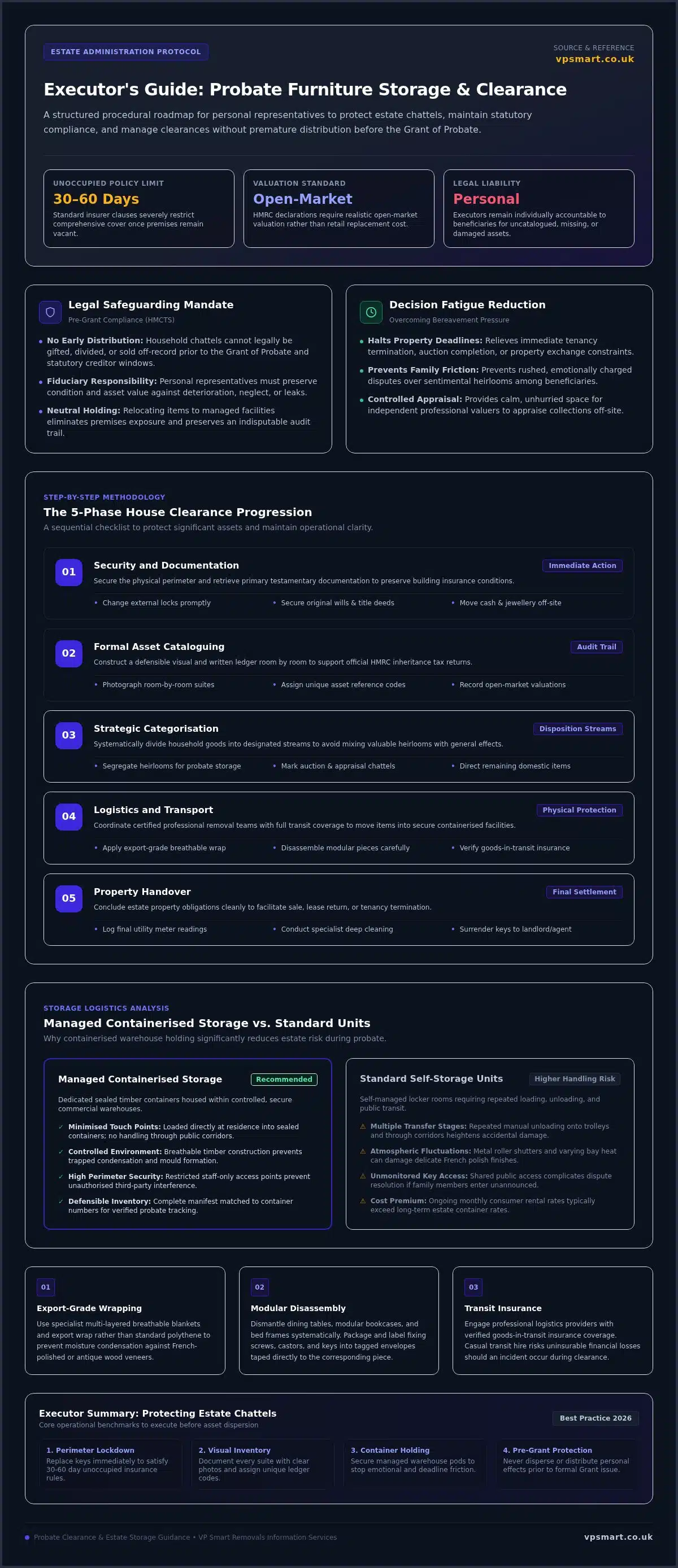
Personal representatives remain personally accountable for safeguarding every physical asset under their care. Legally, household chattels cannot be distributed, gifted, or sold off-record before receiving the Grant of Probate and completing statutory creditor notice periods. If an antique sideboard suffers water damage in a neglected property or an uncatalogued painting goes missing, beneficiaries can hold executors personally liable for the financial loss. Most standard buildings insurance policies severely restrict comprehensive cover once a property sits unoccupied for 30 to 60 consecutive days. Professional storage removes high-value pieces from vulnerable vacant premises, maintaining complete oversight and inventory control within a managed facility.
Emotional Breathing Space: Overcoming Decision Fatigue in Bereavement
Grief significantly clouds practical judgment. Sifting through decades of furniture, personal paperwork, and family keepsakes under strict property handover deadlines frequently triggers intense decision fatigue. Rushing this clearance often sparks painful friction among family members over sentimental heirlooms. Transferring furniture into neutral, specialist storage halts the ticking clock. It removes external pressure, giving families the necessary time and clarity to complete formal valuations, discuss heirloom distribution calmly, and carry out their duties without unnecessary conflict.
The Comprehensive House Clearance Checklist for Executors
Clearing a deceased estate requires a structured operational plan rather than hasty sorting. Executors must balance legal responsibilities with logistical deadlines, moving step by step to maintain total control over estate chattels. By breaking the clearance into five distinct stages, you protect significant assets, preserve administrative clarity, and ensure a seamless transition when placing items into probate furniture storage london.
A reliable clearance progression follows five clear phases:
- Phase 1: Security and Documentation. Secure the physical perimeter and retrieve vital testamentary records.
- Phase 2: Formal Asset Cataloguing. Create a detailed visual and written ledger to support HMRC reporting.
- Phase 3: Strategic Categorisation. Separate estate chattels into practical disposition streams.
- Phase 4: Logistics and Transport. Arrange professional packing and placement into secure storage.
- Phase 5: Property Handover. Take final utility readings, complete specialist cleaning, and return property keys.
Phase 1: Securing Important Documents and High-Value Valuables
Begin by changing external locks immediately to preserve insurance validity and maintain complete oversight over who accesses the premises. Systematically search for primary paperwork, including original wills, title deeds, insurance policies, and recent bank statements. Locate high-risk, portable assets such as jewellery, loose cash, and small family keepsakes. Transfer these high-value items off-site into secure holding before general clearance operations begin.
Phase 2: Creating a Defensible Inventory for Probate Valuation
Official guidance on valuing an estate for probate requires executors to declare open-market valuations rather than replacement costs. Document the property room by room, capturing clear photographs of every furniture suite, decorative object, and collection. Assign a unique reference code to each piece. This systematic record provides an indisputable audit trail for HMRC, legal advisors, and distributed beneficiaries, dramatically simplifying later conversations regarding division.
Phase 3: The Methodical Sorting Framework for Estate Belongings
Sort remaining chattels into five defined categories: family retention, managed storage, open-market sale, charitable donation, and ethical recycling. Share your visual inventory with beneficiaries to resolve distribution questions collaboratively before moving any physical items. For significant heirlooms and fine antiques that require preservation while legal processes unfold, booking professional movers and packers ensures delicate woodwork and upholstery receive specialised protective wrapping before entering managed facilities.
Managed Warehouse Storage vs. Self-Storage: Choosing the Right Solution
Selecting the right facility for estate chattels requires balancing physical handling risks against ongoing operational costs. Traditional self-storage facilities offer walk-in access, but they force executors to manage transport, hiring vans, and multiple loading stages during an already demanding period. Opting for managed containerised warehouse facilities transforms this workflow entirely. Professional teams load sealed wooden containers directly at the estate address, transport them to secure hubs, and stack them safely until probate settles. For executors coordinating probate furniture storage london, this model provides complete oversight without the exhausting physical labour.
When comparing these models, the structural differences become clear:
- Handling frequency: Managed containers require single-touch handling; self-storage requires loading, transporting, unloading into corridors, and re-stacking into units.
- Transit protection: Professional containerisation incorporates heavy-duty padding and structured packing; self-storage relies on personal loading techniques.
- Facility access: Managed warehouses operate under strict appointment controls; self-storage facilities permit general public foot traffic.
- Administrative convenience: Full-service providers deliver end-to-end collection, inventory tracking, and eventual redelivery directly to beneficiaries.
Managed Storage: Minimising Physical Labour and Handling Hazards
Fine furniture suffers the highest rate of cosmetic damage during loading and unloading. Every doorway, staircase, and tail-lift transition increases the chance of scuffing polished veneers or loosening antique joints. The containerised vault approach cuts handling points in half. Professional crews pack and inventory each piece once at the property, sealing the vault immediately before transit. Because certified crews operate to standards aligned with the British Association of Removers, executors avoid transit shock and preserve delicate heirlooms for future distribution.
Security, Environmental Control, and Asset Preservation Standards
Standard self-storage corridors often experience rapid temperature fluctuations, increasing condensation risks that can warp timber or encourage mould on upholstered seating. Managed warehouse repositories provide purpose-built environments designed for sustained preservation. These commercial hubs feature 24/7 CCTV surveillance, advanced perimeter controls, integrated fire suppression systems, and strict visitor verification. Leveraging these professional secure storage facilities guarantees that delicate estate chattels remain shielded from both environmental deterioration and unauthorised physical access throughout the administration period.
How to Prepare, Pack, and Protect Estate Furniture for Storage
Safeguarding family heirlooms during extended holding requires specialist packing protocols rather than everyday removals techniques. Antiques and quality furnishings react intensely to trapped humidity, friction, and shifting pressure during transit. Preparing estate assets correctly ensures that items emerge from probate furniture storage london in the exact condition recorded on your initial inventory ledger. By systematically breaking down large items and using breathable materials, executors uphold their legal duty to preserve asset value.
Follow these essential packing principles for antique and modern estate furniture:
- Dismantle heavy structures: Remove table legs, bed frames, and detached leaves to reduce joint strain.
- Select breathable protective wraps: Layer thick quilted furniture blankets instead of sealing surfaces in non-breathable stretch plastics.
- Reinforce delicate contact zones: Secure double-walled corrugated cardboard edge protectors along decorative cornices, cabriole legs, and carvings.
- Sync inventory markers: Label every individual wrapped bundle with the unique reference number from your master probate catalogue.
Disassembly and Hardware Management for Complex Furniture
Photograph each dismantling phase from multiple angles before loosening a single bolt. Place all screws, brackets, drawer pulls, and dowels into durable zip-lock bags labelled with the corresponding asset code, then tape the bag securely to the main furniture frame. For drop-leaf dining tables, vintage bureau desks, or grandfather clocks, lock internal pendulum mechanisms and brace folding brackets with archival card to prevent internal mechanical strain during handling.
Material Selection: Safeguarding Polished Timber and Upholstery
Direct contact with standard polythene or bubble wrap traps ambient moisture, causing clouding, blooming, and irreparable damage on antique French polish and traditional oil finishes. Protect timber surfaces first with breathable wool-mix removal blankets or acid-free paper, securing the edges with textile webbing rather than adhesive tape. High-end textiles and upholstered seating need ventilated cotton covers to prevent dust accumulation while allowing natural fabric aeration. For complex family estates containing fragile antiques, scheduling professional packing services guarantees that irreplaceable possessions receive expert handling aligned with strict insurance standards.
Order certified packing materials
Arranging Professional Removals and Estate Transport with Confidence
Transporting estate chattels from a private residence into dedicated storage requires far more diligence than a standard domestic relocation. Grieving families should never be expected to haul heavy oak furniture, negotiate tight stairwells, or organise multi-trip van hires. Entrusting the physical transit to a qualified removal partner protects both personal safety and fiduciary integrity. When setting up probate furniture storage london, executors need a coordinated logistical partner capable of liaising smoothly with probate solicitors, estate agents, and facility managers.
Before committing to an estate clearance team, verify the following baseline protections:
- Specialist Goods in Transit insurance: Standard vehicle policies do not cover antique breakage; verify comprehensive per-load transit indemnity.
- Substantial Public Liability cover: Confirm indemnity that shields against structural scuffs, bannister damage, or communal hallway claims.
- Heavy asset handling capabilities: Check for specialist equipment and techniques tailored to grand pianos, antique armoires, and fire safes.
- Transparent pricing frameworks: Insist on clear, upfront terms to prevent unexpected clearance bills from depleting the residual estate.
Key Criteria for Selecting an Estate Removal and Storage Specialist
Estate administration demands absolute financial clarity. Choose providers offering transparent pricing structures with fixed-fee options, ensuring your estate accounts remain tidy and defensible against beneficiary queries. Make sure the firm possesses specialised equipment such as padded piano shoes, heavy lifting straps, and window hoisting gear for challenging access routes. You can review detailed selection advice within our practical house removals guide to vet prospective transport providers thoroughly.
The Final Step: Releasing and Distributing Chattels Post-Probate
Releasing personal possessions from storage requires formal legal closure. Reputable storage facilities enforce strict release protocols, requiring an official sealed copy of the Grant of Probate alongside signed executor instructions before unlocking containerised vaults. Once cleared, an experienced logistics team can coordinate multi-drop deliveries to various beneficiary households nationwide, bringing probate to a smooth, dignified conclusion. Secure complete peace of mind today by scheduling your initial consultation with our team.
Streamline Your Estate Administration with Methodical Care
Navigating house clearance alongside probate obligations doesn’t have to cause exhausting personal strain or legal anxiety. Establishing a methodical room-by-room inventory, securing vital testamentary paperwork, and transferring delicate furnishings into single-touch containerisation safeguards estate assets against avoidable damage and dispute. Relying on professional probate furniture storage london grants you the vital breathing room required to resolve legal formalities calmly, free from the ticking clock of property deadlines or premature distribution worries.
Experienced crews bring dependable care to every collection, utilising specialised equipment for fine antiques, pianos, and fragile heirlooms alongside comprehensive inventory tracking. Clear, transparent fixed-fee options eliminate financial guesswork, giving personal representatives complete oversight and reassurance across each stage of estate administration.
Take the process forward one methodical step at a time, confident that every treasured possession remains safe, secure, and respected.
Frequently Asked Questions
Can an executor move furniture into storage before the Grant of Probate is issued?
Yes, an executor possesses legal authority derived directly from the will to secure and protect estate chattels immediately upon death. Transferring vulnerable belongings into managed probate furniture storage london is considered a prudent administrative action to prevent theft, accidental damage, or insurance invalidation in a vacant property. However, you cannot legally sell, gift, or distribute these items to beneficiaries until probate is formally granted.
How long can furniture remain in probate storage during estate disputes?
Furniture can remain in secure managed storage indefinitely whilst contentious probate claims, caveats, or family disputes are resolved. Estate disagreements can take many months or even years to settle through legal channels. Containerised warehouse facilities keep chattels protected, sealed, and catalogued until personal representatives resolve their differences or receive a binding court order authorising final collection and distribution.
Who pays for furniture storage costs during the probate process?
Storage fees are classed as a legitimate administration expense, meaning the deceased’s estate ultimately pays these costs. Because bank accounts remain frozen prior to the grant, an executor typically settles recurring invoices personally and claims full reimbursement from estate funds before making final distributions. In many instances, probate solicitors can also arrange direct fee settlements from available cash reserves held in estate accounts.
Does standard home insurance cover estate furniture placed in storage?
No, standard residential home insurance policies cease to protect contents once belongings are permanently removed from the primary property address. In addition, vacant home clauses often void contents cover after 30 to 60 days of unoccupancy. Executors must secure specialised transit and storage protection. Professional removal companies provide dedicated goods-in-transit cover and comprehensive warehouse indemnity to safeguard the estate against accidental loss.
How should high-value antique furniture be valued before entering storage?
High-value furniture should receive a formal open-market valuation conducted by an accredited RICS or SOFAA appraiser before entering warehouse vaults. HMRC guidelines require separate itemisation for personal chattels valued at £1,500 or more. Appraisers assess realistic second-hand auction liquidation value on the date of death, rather than higher retail insurance replacement figures, giving you a defensible record for tax calculations.
Can individual beneficiaries access the storage facility to inspect specific items?
No, individual beneficiaries cannot independently enter the facility without the formal written authorisation and presence of the executor. Managed facilities enforce strict access protocols to maintain an unbroken chain of custody. When handling probate furniture storage london, operators only open containerised vaults under direct instruction from the registered executor, ensuring contested chattels remain entirely safe from unauthorised removal or damage.
What happens to furniture if the estate lacks sufficient liquid funds to pay storage fees?
If liquid funds are tied up, executors can arrange specialist executor lending, settle balances privately for later reimbursement, or negotiate fixed-fee options with logistics partners. Storing furniture in cost-effective managed warehouse crates rather than expensive self-storage units keeps ongoing overhead remarkably low, protecting estate solvency whilst you wait for property transactions or investment liquidations to release essential cash.
Disclaimer
Some links in this article may be affiliate links, which means we may earn a small commission if you make a purchase through them, at no additional cost to you. We only recommend products or services we believe provide value to our readers.
Sep 21, 2026
It is 2:30 PM on a Friday, your entire life is packed into the back of a van, and your solicitor’s line is constantly busy. This is the moment every homeowner dreads, where the excitement of a new start is suddenly replaced by the cold reality of a legal logjam. You are likely staring at the clock and asking, what happens if moving day completion is delayed, especially when your removal crew is nearing their legal driving limits. It is an incredibly vulnerable position to be in, but you do not have to navigate this uncertainty alone.
We understand that a delay isn’t just a legal technicality; it’s a direct threat to your family’s comfort and financial security. This guide offers a pragmatic look at your rights and responsibilities when the keys aren’t handed over by the contractual cut-off. You will discover how to manage the daily penalty interest rates, how to handle removal standby fees, and why a Notice to Complete is your most vital tool. We provide a clear sequence of actions to help you maintain oversight of your belongings, ensuring your furniture remains secure in managed storage whilst you find a comfortable solution for the night ahead.
Key Takeaways
- Identify the legal triggers of a completion delay, including the standard 1:00 PM to 2:00 PM fund arrival window and the formal 10-day Notice to Complete process.
- Calculate the financial impact of a breach by understanding how the 7.75% daily interest penalty is applied to the outstanding purchase balance.
- Gain clarity on what happens if moving day completion is delayed for your belongings, including the role of late key waivers and secure managed storage solutions.
- Implement a precise action plan to maintain oversight of the move, ensuring you coordinate with your solicitor and removals team before CHAPS banking cut-offs.
- Learn how to mitigate relocation anxiety by partnering with professionals who offer fixed-price quotes and expert packing to protect your budget and your home.
The Mechanics of Completion: Why Delays Occur on Moving Day
Completion isn’t just about handing over a set of keys; it’s the final, pivotal step in the residential conveyancing process where legal ownership officially transfers. In the UK, this happens when the seller’s solicitor confirms they’ve received the full purchase funds. Most contracts aim for this to occur between 1:00 PM and 2:00 PM. However, even the most organised move can stall if a single link in the chain falters. This is often where homeowners start to panic, wondering what happens if moving day completion is delayed when their entire life is sitting in a van on the driveway.
The “domino effect” is the most frequent culprit. Because funds must move sequentially from the bottom of the chain to the top, a 30-minute delay for the first buyer can escalate into a three-hour wait for the person at the end. If your seller’s solicitor doesn’t receive the money by the agreed time, they aren’t legally obligated to release the keys, leaving you in a stressful logistical limbo.
The Role of the Banking System and CHAPS
Solicitors use the Clearing House Automated Payment System (CHAPS) to move the significant sums required for property purchases. While these transfers are usually same-day, they aren’t instant. Each bank has internal cut-off times, typically falling between 3:00 PM and 4:25 PM. If the money doesn’t hit the seller’s account before these windows close, the transaction cannot “complete” until the next working day. For a Friday move, this means waiting until Monday morning, triggering unexpected costs for weekend storage and temporary accommodation.
Contractual Obligations and the 2:00 PM Deadline
Under the Law Society Standard Conditions of Sale, 2:00 PM is the standard contractual deadline for completion. While missing this time by an hour is a technical breach, it doesn’t usually result in a cancelled sale. It does, however, trigger daily penalty interest and potentially heavy charges from your removals team.
For professional house movers, the 2:00 PM mark is often the “point of no return.” It’s the time when crews must decide if they can still unload today or if they need to secure your belongings in a depot. Understanding this timeline helps you maintain oversight of the situation, allowing you to make informed decisions about what happens if moving day completion is delayed rather than reacting in a crisis.
The Legal and Financial Fallout: Notice to Complete and Penalties
When the 2:00 PM deadline passes without the keys being released, the situation shifts from a logistical delay to a technical breach of contract. Understanding what happens if moving day completion is delayed requires a look at the financial protections built into the Law Society Standard Conditions of Sale. These rules ensure that the party responsible for the hold-up compensates those further up or down the chain. While a delay of a few hours is often resolved through a “key undertaking” between solicitors, a failure to complete on the day triggers significant legal mechanisms.
Understanding the Notice to Complete
If funds do not arrive by the contractual cut-off, the innocent party’s solicitor will likely serve a formal Notice to Complete. This document is a powerful legal lever that makes “time of the essence.” It officially gives the defaulting party 10 working days (excluding weekends and bank holidays) to finalise the transaction. If the buyer fails to perform within this window, the seller has the right to rescind the contract, resell the property, and forfeit the buyer’s 10% deposit. For a mid-range UK home, this could mean a loss of tens of thousands of pounds, making it a catastrophic financial outcome.
Financial Penalties Beyond the Contract
The most immediate financial impact is the daily penalty interest. As of September 2026, the standard contractual rate is 7.75% per annum, which is 4% above the Barclays Bank base rate of 3.75%. This interest is calculated daily on the purchase price minus the deposit already paid. For a broader overview of these milestones, the GOV.UK guide to buying a home details the transition from exchange to the final transfer of funds and the legal obligations involved.
Beyond interest, the innocent party can claim for “consequential losses.” These are the actual, out-of-pocket expenses caused by the delay, such as:
- Overnight hotel or temporary accommodation costs.
- Additional charges for removals teams and van hire.
- Kennel or cattery fees for pets.
- Professional storage services to house furniture whilst the legal breach is rectified.
It is vital to keep every receipt and invoice. Your solicitor will use these to build a claim against the defaulting party. Whilst indemnity insurance can sometimes cover these costs, maintaining meticulous records ensures you have the oversight needed to recover your funds. Managing the environment when the legal side fails is about protecting your domestic well-being and your bank balance simultaneously.
Removals and Logistics: Managing Your Belongings During a Delay
While solicitors and lenders debate the finer points of the Law Society’s Standard Conditions of Sale, you are left with a more immediate concern: what happens if moving day completion is delayed when your possessions are already in transit? A professional house removals service acts as your logistical anchor during this period of uncertainty. Unlike DIY moves where you are personally responsible for returning a hire van by a strict deadline, a managed service provides the flexibility needed to navigate a stalled chain. It transforms a chaotic afternoon into a structured, albeit delayed, transition.
Clear communication is your best tool for maintaining oversight. As soon as you suspect a delay, alert your removals team. They can then coordinate with their dispatch office to adjust schedules and manage resources. This proactive approach ensures that your belongings remain protected whilst you wait for the final confirmation from your solicitor.
Removals Standby Charges and Hourly Rates
Removals firms operate on tight schedules where every hour is accounted for in terms of labour and vehicle overheads. If a crew is forced to sit idle outside your new home past the contractual 2:00 PM mark, standby charges usually apply. Many professional movers now offer ‘Late Key Waivers’ at the time of booking. This small upfront fee acts as a safeguard, covering you for a set number of hours if the keys are not released on time. Without this waiver, you may face hourly penalties for each porter and vehicle involved in the move. Discussing these terms early provides budget certainty and alleviates the fear of mounting costs during an already stressful day.
Emergency Storage Solutions
There is a physical limit to how long a removals crew can wait. Under GB Domestic Drivers’ Hours rules, crews are restricted to specific duty limits and must have an unbroken rest period between working days. If keys are not released by approximately 5:00 PM or 6:00 PM, the team legally cannot stay to unload. In this scenario, your move transitions from a same-day relocation to a ‘move-to-store’ operation.
This is where secure storage services become a vital safety net. Your furniture is not left in an unsecured van on a public street; instead, it is taken to a managed warehouse. This preserves the condition of your items and ensures your domestic well-being isn’t compromised by the legal breach. Once completion is officially confirmed, often the following morning or Monday, a redelivery is organised. While this involves additional labour, it ensures your environment remains well-managed and your possessions remain secure until they can be properly placed in your new home.
Action Plan: What to Do When Keys Aren’t Released
Success on a turbulent moving day depends on early intervention. You shouldn’t wait until the 2:00 PM deadline to discover what happens if moving day completion is delayed for your specific chain. At 1:30 PM, you must proactively call your solicitor to confirm the status of the funds. If the money hasn’t reached the seller’s account, this is your signal to initiate a contingency plan. Rapid communication allows you to maintain oversight before the banking system’s daily cut-off windows begin to close.
Immediately alert your removals team to the potential hold-up. They need to know the latest possible time they can wait before they must legally cease work due to driver hour restrictions. Simultaneously, you should scout for emergency accommodation. Secure a pet-friendly hotel nearby if you have animals, as this alleviates the immediate anxiety of having nowhere to sleep. A well-managed move is one where the homeowner stays in control of the environment, even when the legal timeline shifts.
The ‘Keys Under Licence’ Agreement
If the funds are delayed but certain to arrive, your solicitor can request a ‘licence to occupy’. This temporary legal arrangement allows you to move your belongings into the property, and sometimes even stay overnight, before the legal title has officially transferred. This arrangement is often the most effective answer to what happens if moving day completion is delayed by just a few hours. It is a pragmatic solution that saves on double-handling furniture and emergency storage costs. However, sellers are often hesitant to grant this, fearing a situation where a buyer takes possession but the sale ultimately fails. If they refuse, you must respect the decision and pivot to your storage and hotel plan without delay.
Essential Communication Log
From the moment a delay is suspected, you must keep a meticulous log of every interaction. Record the time of each call, the name of the person you spoke with, and the specific instructions provided. This isn’t just for your own peace of mind; it is vital evidence for your solicitor. When it comes to reclaiming consequential losses, such as hotel bills or removals standby fees, a clear paper trail is your strongest asset. Avoid making verbal ‘handshake’ deals with the seller or estate agent. Every agreement regarding keys or access must be authorised by your legal representative to ensure you remain contractually protected.
Find professional house movers near me
Minimising the Impact: How Professional Removals Protect Your Move
While you cannot control the speed of the CHAPS banking system or the responsiveness of a solicitor in a complex chain, you can control the quality of the support you have on the ground. Choosing an experienced removals company is the most effective way to reduce the inherent anxiety of a transition. A professional team doesn’t just lift boxes; they provide a buffer against the unexpected. When homeowners ask what happens if moving day completion is delayed, the answer often depends on the flexibility and expertise of their chosen movers. A partner who understands the domestic environment as well as the technical logistics ensures that a delay remains a manageable hurdle rather than a total collapse of your plans.
Transparent pricing and clear contractual terms are the foundations of this trust. At VP Smart Removals, we specialise in providing fixed-price quotes that offer budget certainty. This means you aren’t left guessing about costs if the legal timeline shifts by a few hours. By establishing clear protocols for waiting times and late key releases upfront, we empower you to maintain oversight of your finances during a high-pressure afternoon. Expert packing services further enhance this security. When goods are professionally packed, they are prepared for the potential of double-handling or a sudden move into a warehouse, ensuring your belongings remain pristine regardless of the timeline.
The Benefit of Managed Logistics
A professional removals team handles the transition to storage with clinical efficiency. If the keys aren’t released by the cut-off point, the move evolves from a simple delivery into a managed storage operation. This process relies on meticulous inventory management. Every item is tracked and secured, ensuring that nothing is lost or damaged whilst held overnight. This level of technical oversight significantly reduces the physical and mental burden on your family. You can step away from the driveway knowing that your life’s work is housed in a secure, managed environment, leaving you free to focus on the legal resolution.
Preparing for the Unexpected
Maintaining oversight of your move also requires personal preparation. We always recommend that families pack an ’emergency overnight bag’ containing essentials like chargers, basic toiletries, and a change of clothes. This simple step ensures your domestic well-being is preserved even if you have to stay in a hotel. Staying calm is much easier when you know what happens if moving day completion is delayed and you have a reliable partner like VP Smart Removals standing by. We act as the calm experts who handle the logistics when the legal side fails, providing a safety net that protects both your property and your peace of mind.
Get a fixed-price removals quote today
Securing Your Move Against the Unexpected
Navigating a property chain requires more than just legal paperwork; it demands a resilient logistical strategy. Understanding what happens if moving day completion is delayed allows you to maintain oversight of a complex situation, ensuring that a banking glitch or a slow solicitor doesn’t lead to financial collapse. By knowing the standard 10-day notice period and the daily interest penalties, you can make informed decisions about your family’s immediate comfort and your long-term budget.
We provide the technical expertise and domestic warmth needed to bridge the gap when timelines shift. Our team is experienced in handling delicate items and pianos, ensuring that even the most precious belongings remain safe during an emergency transition to our secure storage facilities. With transparent hourly and fixed-rate options, you gain the budget certainty required to manage a modern household with confidence. You don’t have to face the uncertainty of a stalled completion day alone.
Request a Fixed-Price Moving Quote from VP Smart Removals
Take charge of your relocation today and ensure your next chapter begins with effortless comfort, no matter what the legal timeline holds.
Frequently Asked Questions
What is the latest time keys can be released on moving day?
Keys are released once the seller’s solicitor confirms receipt of the full purchase funds. While the standard contractual deadline is 2:00 PM, keys can technically be released as late as the banking system allows, often up to 4:00 PM or 5:00 PM. If the money arrives after the bank’s daily cut-off, completion is legally deferred to the next working day, meaning you cannot take possession until the following morning.
Who pays for the removals company if completion is delayed?
You are initially responsible for paying your removals company for any standby time or emergency storage services required. However, if the seller or another party in the chain caused the delay, your solicitor can claim these “consequential losses” back from them as part of a breach of contract claim. It is vital to keep all invoices and receipts for extra labour or storage to ensure you have the evidence required for recovery.
Can I sue the seller for a delayed completion?
Yes, you can claim for financial losses resulting from a breach of contract if the seller fails to complete on the agreed date. This typically includes penalty interest and out-of-pocket expenses such as hotel bills and additional removals costs. Most cases are settled between solicitors through the formal Notice to Complete process rather than a full court case, ensuring that the party at fault compensates others for the disruption.
What happens if my money doesn’t arrive by the bank’s cut-off time?
If funds miss the CHAPS banking cut-off, legal completion cannot occur until the next working day. This is a primary concern when asking what happens if moving day completion is delayed on a Friday, as it results in a weekend-long hold. You will likely need to arrange temporary accommodation and move your belongings into secure storage until the banking systems reopen on Monday morning to finalise the transfer and release the keys.
Can I move my furniture into the house before completion?
You can only move furniture in early if the seller grants a “licence to occupy” or if solicitors agree to a “key undertaking.” This is a temporary legal arrangement that allows access before funds have officially cleared. While it prevents the double-handling of goods, many sellers refuse this due to the risk of the sale failing entirely. Always consult your solicitor before attempting to unload any items into the new property.
Will my removals company wait if the keys are delayed by a few hours?
Most professional teams will wait, but they typically apply standby charges after the contractual 2:00 PM deadline to cover labour and vehicle overheads. However, crews must adhere to strict daily duty limits under GB Domestic Drivers’ Hours rules. If keys aren’t released by late afternoon, the team may be legally required to stop work. In these instances, they will transition your move to a storage-based solution to keep your belongings secure.
What is a ‘Notice to Complete’ and how does it work?
A Notice to Complete is a formal legal document served by a solicitor when the other party misses the completion deadline. It officially gives the defaulting party 10 working days to finalise the transaction. Once served, “time is of the essence,” meaning failure to complete within this window allows the innocent party to rescind the contract, forfeit the deposit, and seek substantial damages for all related financial and logistical losses.
Do I have to pay interest if I am the one causing the delay?
Yes, if your funds arrive late, you are contractually obliged to pay daily penalty interest to the seller. As of September 2026, the standard rate is 7.75% per annum, calculated daily on the remaining purchase balance minus the deposit. This is one of the most significant risks when what happens if moving day completion is delayed is due to your own banking issues, as these costs accumulate rapidly until completion occurs.
Disclaimer
Some links in this article may be affiliate links, which means we may earn a small commission if you make a purchase through them, at no additional cost to you. We only recommend products or services we believe provide value to our readers.
Sep 20, 2026
The true weight of a lifetime isn’t measured in kilograms, but in the memories attached to every item left behind. When you’re tasked with managing deceased estate removals, the physical act of moving furniture is often the simplest part. The real challenge lies in the emotional exhaustion of sorting through a loved one’s legacy whilst facing the strict deadlines of probate and property sales. It’s a period where the fear of accidentally discarding a vital legal document or a cherished heirloom can feel overwhelming.
VP Smart Removals understands that you need more than just a moving crew; you need a respectful partner who treats every box with the dignity it deserves. This guide will show you how to manage the complexities of estate relocations with a professional, custodian-led approach that prioritises both logistical efficiency and sentimental care. You’ll learn about specialised packing services to protect valuables, the benefits of secure storage for items awaiting a final decision, and how fixed-price quotes provide much-needed financial certainty during a difficult transition. We’ll help you transition from a place of stress to a well-managed environment where every memory is handled with precision.
Key Takeaways
- Learn how professional deceased estate removals london provide a respectful alternative to standard house clearances by protecting sentimental items and legal documents.
- Understand why waiting for formal probate valuations is essential before relocating high-value assets to ensure compliance with HMRC and Inheritance Tax requirements.
- Discover how specialised services like piano removals and hoisting ensure that even the most delicate or bulky heirlooms are moved safely from challenging properties.
- Follow a logical step-by-step checklist to secure the property and categorise belongings while managing the emotional exhaustion of the process.
- Gain financial certainty with fixed-price quotes and secure storage solutions that allow executors to manage estate logistics at a pace that suits the family.
What are Deceased Estate Removals and Why Do They Require Extra Care?
A deceased estate removal is the methodical process of sorting, packing, and relocating the contents of a home following a bereavement. It’s a task that demands far more than simple manual labour. While a standard house clearance often prioritises the rapid disposal of unwanted items, professional deceased estate removals london focus on the careful preservation of a legacy. This distinction is crucial for families who need to distinguish between items for donation, sale, or sentimental keeping.
Executors must prioritise a philosophy of custodianship. This means viewing every piece of furniture and every box of documents as a vital component of a person’s life story. By choosing a professional removal service over a basic clearance firm, you ensure that the home’s contents are treated with the technical precision and domestic warmth they deserve. This professional support removes the physical burden from grieving families, allowing them the space to process their loss whilst the logistics are handled with expert oversight.
The Role of the Executor in Property Relocation
Taking on the role of an executor involves significant legal duties, particularly regarding the protection of the estate’s physical assets. You are responsible for ensuring that nothing of value is lost or damaged before it can be distributed. This responsibility is a core part of the legal process of probate, which requires a meticulous approach to asset management. A professional inventory is essential here. It provides a transparent audit trail for insurance purposes and helps satisfy HMRC requirements if Inheritance Tax is applicable.
Managing the expectations of various beneficiaries can be complex. When you utilise a structured house removals London service, you provide all parties with the reassurance that the property is being managed professionally. This transparency reduces friction amongst family members and ensures that the distribution of personal effects remains orderly and respectful.
The Emotional Impact of Sorting a Loved One’s Home
The psychological toll of clearing a family home is often underestimated. Every drawer opened or cupboard emptied can trigger intense memories, making the process feel insurmountable. Outsourcing the physical labour to a neutral, professional team provides a necessary buffer. It allows the family to step back from the heavy lifting and focus on the items that truly matter. Our movers and packers are trained to remain respectful and unobtrusive, acting as a steady hand that keeps the relocation on schedule.
To prevent the loss of irreplaceable items, we recommend a “sentimental item” protocol. This involves identifying specific categories of goods, such as photographs, legal deeds, or jewellery, that are handled with extra care and kept separate from general household goods. This level of detail ensures that whilst the house is cleared efficiently, the small, priceless fragments of a life are never overlooked. It’s about creating a well-managed environment where efficiency never comes at the cost of empathy.
Navigating Probate and Property Valuation Requirements
The intersection of legal duties and physical logistics is where many executors feel the most pressure. When coordinating deceased estate removals london, you aren’t just clearing a house; you’re managing a legal inventory. The timeline for moving high-value items is strictly dictated by the valuing the deceased’s estate process. Moving assets before they’ve been officially appraised can lead to significant complications with HMRC, particularly if the total estate value exceeds the Inheritance Tax (IHT) threshold.
Valuation and Inheritance Tax (IHT) Considerations
HMRC requires assets to be valued at their “fair market value” on the date of death. This is the price the item might reasonably fetch if sold on the open market. If you move or relocate items prematurely, you risk losing the evidence needed for an accurate appraisal. Professional movers add technical value here by identifying items that require specialist attention. For instance, if an estate includes a high-quality instrument, our piano removals team ensures these assets are handled with the precision required to preserve their condition for valuation. We provide detailed inventories that serve as a reliable record for your legal team, ensuring transparency across the board.
If you’re currently balancing legal deadlines with property viewings, our team can provide fixed-price quotes to give you complete oversight of your estate costs during the transition.
Timing the Removal with the Property Sale
Estate agents often encourage executors to clear a property quickly to facilitate viewings, but a phased approach is usually more effective. A “clear and clean” strategy involves removing all non-essential items whilst leaving enough furniture to “stage” the home, making it more appealing to potential buyers. Once a sale is agreed, a final removal can be scheduled to ensure the property is vacant for the new owners. This logic balances the needs of the property market with the steady pace of the legal system, ensuring the home remains a well-managed environment throughout the sale process.
Items specifically mentioned in a Last Will and Testament must be handled with extreme care. These aren’t just personal effects; they’re legal obligations. It’s often helpful to tag these items clearly before the removal team arrives. If you aren’t ready to distribute these legacies yet, using storage services London provides a secure environment where items can be held safely until the probate grant is issued. This prevents the accidental loss of heirlooms and protects the executor from claims of mismanagement.
Choosing Between House Clearance and Professional Removals
The decision between a basic clearance firm and a specialist removal company is a pivotal moment for any executor. Whilst a clearance service focuses on emptying a property as quickly as possible, professional deceased estate removals london prioritise the protection of the home’s contents. For those dealing with the estate’s financial affairs, this distinction is vital. A hybrid approach often works best; high-value heirlooms are moved to beneficiaries or secure storage, whilst only genuine waste is cleared. This ensures that the estate’s value is preserved and that the executor maintains complete oversight of every asset.
The “Custodian” Mindset: Preservation vs. Disposal
High-quality furniture and sentimental items require a level of care that general labourers simply cannot provide. We believe in a custodian mindset, where the goal is preservation rather than disposal. Bulky estate pieces, such as mahogany wardrobes or large dining tables, often require expert furniture disassembly and reassembly to prevent damage to the item or the property’s walls. This technical expertise ensures that heirlooms arrive at their new destination in the same condition they left. When family members aren’t ready to make final decisions, using storage facilities buys the necessary time to sort through items without the pressure of a looming property sale deadline.
Insurance and Liability for Estate Assets
One of the greatest risks in estate management is hiring a service that lacks proper protection. Many low-cost “man and van” operators don’t carry comprehensive Goods in Transit or Public Liability insurance. If a valuable antique is damaged during transit, the financial loss could fall on the estate, potentially leading to disputes amongst beneficiaries. Professional packing services mitigate this risk by using industrial-grade packing materials tailored to the specific needs of fragile items. By insisting on a provider that offers a detailed inventory list, you protect yourself legally and ensure that every item is accounted for from the moment it’s packed until it reaches its final destination.
Budget certainty is another crucial factor for executors. Whilst some firms charge hourly rates that can spiral if a property contains more items than expected, we recommend opting for fixed-price quotes. This transparent pricing model allows you to account for removal costs accurately within the probate documents, avoiding any unexpected financial setup concerns later. It’s a pragmatic way to manage the estate’s resources whilst ensuring a high-performance removal that respects the family’s legacy.
How to Organise a Deceased Estate Move: A Step-by-Step Checklist
The transition from a lived-in family home to a vacant property is a significant milestone in estate management. To maintain control, you must follow a structured plan that balances legal requirements with physical logistics. Organizing deceased estate removals london requires a steady, logical rhythm to prevent oversight and reduce the emotional burden on the family. By following a professional sequence, you ensure that every asset is accounted for and every memory is respected.
- Step 1: Secure the property. Change the locks if necessary and locate all essential legal documents, including the Will, property deeds, and insurance policies.
- Step 2: Categorise every item. Divide the home’s contents into “Keep”, “Sell”, “Donate”, and “Recycle” to provide a clear roadmap for the removal team.
- Step 3: Arrange a formal valuation. Ensure high-value assets are appraised for probate before they are moved to avoid compliance issues with HMRC.
- Step 4: Select an experienced partner. Hire a removal company that understands the technical and emotional nuances of estate relocations.
- Step 5: Finalise the distribution plan. Coordinate the delivery of specific heirlooms to various beneficiaries across different locations.
Sorting and Categorising Belongings
A pragmatic way to manage multi-beneficiary moves is the use of a colour-coded sticker system. Assign a specific colour to each family member or destination; this visual oversight ensures that “bequest” items mentioned in the Will are never misplaced. Before the physical move begins, consider digitising old photographs and personal documents. This reduces the physical volume of the relocation whilst preserving the estate’s digital legacy in a portable, secure format. It’s about creating a well-managed environment where the past is preserved without cluttering the future.
Logistics for Multi-Stop Deliveries
Estate moves rarely involve a simple journey from point A to point B. They often require a complex web of deliveries to multiple family homes or storage facilities. A house removals specialist is better equipped for these multi-drop logistics than a standard courier. We plan routes that maximise efficiency whilst ensuring that all beneficiaries are present or have authorised the receipt of their items. This level of coordination prevents delivery disputes and ensures that every piece of furniture is placed exactly where it needs to be, providing an effortless transition for the entire family.
Get a fixed-price quote for your estate removal
Ensuring a Respectful Transition with Professional Support
The final phase of a deceased estate removals london project is about more than just clearing rooms. It’s about ensuring every high-value item and sentimental heirloom is handled with the technical precision required to maintain its integrity. Standard removals often overlook the unique requirements of aged timber or delicate internal mechanisms. We use industrial-grade, acid-free paper and double-walled boxes to ensure that items destined for long-term storage or delivery to beneficiaries remain protected against moisture and physical impact.
Specialist Handling for High-Value Estate Pieces
Relocating a legacy often involves navigating the architectural quirks of historic properties. When a home features narrow staircases or restricted doorways, we utilise bespoke hoisting services to move bulky items safely through external windows. This technical solution prevents damage to both the heirloom and the property’s structural finishes. For larger items like wardrobes or bed frames, our team performs professional furniture disassembly and reassembly. This ensures that even the most imposing pieces can be relocated without stress. To give families a head start, our packing box delivery service provides all the necessary materials well before the removal date.
Delicate instruments require even more specific oversight. Our piano removals service uses specialised equipment to manage the weight and balance of these complex items. It’s a task that demands a visionary pragmatist’s approach: understanding the high-tech requirements of the move whilst remaining grounded in the domestic reality of a family home. This level of care ensures that every valuable asset is preserved for the next generation.
The VP Smart Removals Commitment to Respect
We believe that a well-managed environment is the key to a stress-free transition. Our commitment to reliability and transparency is reflected in our pricing structure, which provides executors with clear, fixed costs for their estate accounts. This financial optimisation allows you to focus on the emotional needs of the family rather than worrying about mounting logistical expenses. We treat every property with domestic warmth, ensuring that our presence is helpful and unobtrusive throughout the entire process.
The process concludes with a meticulous final walkthrough. We ensure that every cupboard is checked and every floor is clear, leaving the property in a condition that truly honours the deceased. By combining technological capability with a deep sense of regional reliability, we help you close this chapter with confidence and complete oversight of the estate’s physical assets.
Securing a Respectful Legacy for Your Family
Transitioning a loved one’s home is a complex legal and emotional journey that requires a steady, professional hand. By prioritising a custodian approach over simple disposal, you ensure that every sentimental heirloom and vital legal document is preserved. We’ve explored how timing your move with probate milestones and using specialist handling for pianos or antiques protects the estate’s value and your peace of mind. Managing deceased estate removals london doesn’t have to be a source of exhaustion when you have a partner focused on reliability and transparent, fixed pricing.
Our comprehensive packing and secure storage solutions provide the necessary time to make difficult decisions without the pressure of property sale deadlines. You deserve a service that combines technical expertise with genuine domestic warmth, ensuring a well-managed environment from the first box packed to the final walkthrough.
Request a Compassionate Fixed-Price Quote for Your Estate Move
Take the next step toward a stress-free transition today. We’re here to help you honour the past whilst moving toward a future of effortless comfort.
Frequently Asked Questions
How much do deceased estate removals cost in the UK?
Costs depend on the total volume of goods, the number of movers required, and the complexity of the property access. We provide fixed-price relocation project fees based on a detailed inventory, which gives executors budget certainty for their probate accounts. Alternatively, smaller jobs are handled with hourly-rate labour and transportation fees. Factors like stair charges or hoisting services for heavy items also influence the final quote, ensuring you only pay for the specific resources utilised.
Can a removal company help with probate valuation?
While removal specialists don’t provide official legal valuations for HMRC, they play a critical role in the process. We assist by creating detailed inventory lists that your solicitor or valuer can use. Our team also identifies items requiring specialist appraisal, such as antiques or instruments. By providing professional packing materials and secure handling, we ensure that high-value assets remain in their original condition until a formal probate valuation is completed by a certified professional.
What happens to items that no family member wants to keep?
Managing a deceased estate removals london project often involves deciding what to do with unwanted items. You can categorise these into goods for sale, donation, or recycling. We can transport items to local charity shops or auction houses as part of a multi-stop delivery plan. For everything else, we recommend using professional clearance partners who prioritise environmentally conscious disposal, ensuring the property is left vacant and clean for the next occupants or a property sale.
Do I need to be present during the estate removal?
You don’t necessarily need to be present, provided we have clear instructions and access to the property. Many executors prefer to authorise a trusted representative or provide keys in advance. Our team operates with complete oversight, following your colour-coded inventory or room-by-room plan to ensure every item reaches its correct destination. We maintain steady communication throughout the day, providing you with the agency to manage the process remotely whilst focusing on other legal duties.
How long does it typically take to clear a deceased estate?
The duration varies significantly based on the property size and the level of sorting required. A standard three-bedroom home usually takes one to two days for a full removal and packing service. However, if the move involves multi-stop deliveries to various beneficiaries or moving items into storage facilities, the timeline may extend. We recommend a phased approach, starting with securing legal documents and high-value heirlooms before proceeding to the main household contents.
Is it better to use storage or move items immediately to family homes?
Using secure storage services is often the more pragmatic choice during the early stages of probate. It provides a neutral, well-managed environment where goods can be held whilst the family makes final decisions or resolves disputes. Moving items immediately to family homes can be logistically challenging if the beneficiaries aren’t ready to receive them. Our managed warehouse facilities offer weekly or monthly rental options, giving you the flexibility to distribute legacies at a pace that suits everyone.
What insurance coverage is needed for moving high-value antiques?
You should ensure your provider has comprehensive Goods in Transit and Public Liability insurance. Standard removals insurance often has limits, so it’s vital to declare high-value antiques or delicate items like pianos beforehand. We use professional packing materials and specialised equipment to mitigate risks, but having a detailed inventory list ensures that the estate is legally protected. This technical oversight is essential for maintaining the financial integrity of the estate during the relocation process.
Can you handle multi-stop deliveries to different beneficiaries?
Yes, coordinating deliveries to multiple addresses is a core part of our professional service. We design a logical route that incorporates stops at various family homes or storage units, ensuring each beneficiary receives their specific bequest. This high-performance logistics plan is managed by our experienced crew, who handle the furniture assembly and placement at each destination. It’s a helpful way to ensure the fair distribution of assets whilst removing the physical burden from the executor.
Disclaimer
Some links in this article may be affiliate links, which means we may earn a small commission if you make a purchase through them, at no additional cost to you. We only recommend products or services we believe provide value to our readers.