Sep 19, 2026
Moving day chaos isn’t an inevitable part of relocating. It’s actually a failure of logistical oversight that you can engineer out of your experience through a professional, methodology-driven approach. Most homeowners approach their move with a persistent knot of anxiety, worrying about the safety of heirloom furniture or the precise timing of key exchanges. This guide provides the definitive framework for common moving day problems and solutions, helping you navigate the technical setup of your new life with absolute confidence and total oversight.
You deserve a transition that prioritises both performance and domestic well-being. We’ll show you how to anticipate hurdles like difficult property access or the sudden appearance of hidden costs. By understanding the mechanics of a successful move, you can secure a future of effortless comfort without the worry of unreliable teams. We’ll explore how expert packing services, specialised hoisting, and secure storage transform a high-stress event into a calm, organised transition where you remain firmly in charge of your environment.
Key Takeaways
- Master the “key exchange” timeline by coordinating with solicitors to avoid costly delays whilst your removals team is on the clock.
- Protect high-value electronics and heirlooms by using high-grade packing materials that prevent the structural failures common in DIY moves.
- Resolve “impossible” access issues in Victorian terraces or modern apartments by utilising specialised hoisting and piano removal services.
- Discover a definitive framework for common moving day problems and solutions to ensure your national relocation remains calm, organised, and free from hidden fees.
- Minimise the emotional toll on your household by implementing a safety-first plan for pets and children amongst the movement of heavy furniture.
Logistical Delays and the ‘Key Exchange’ Crisis
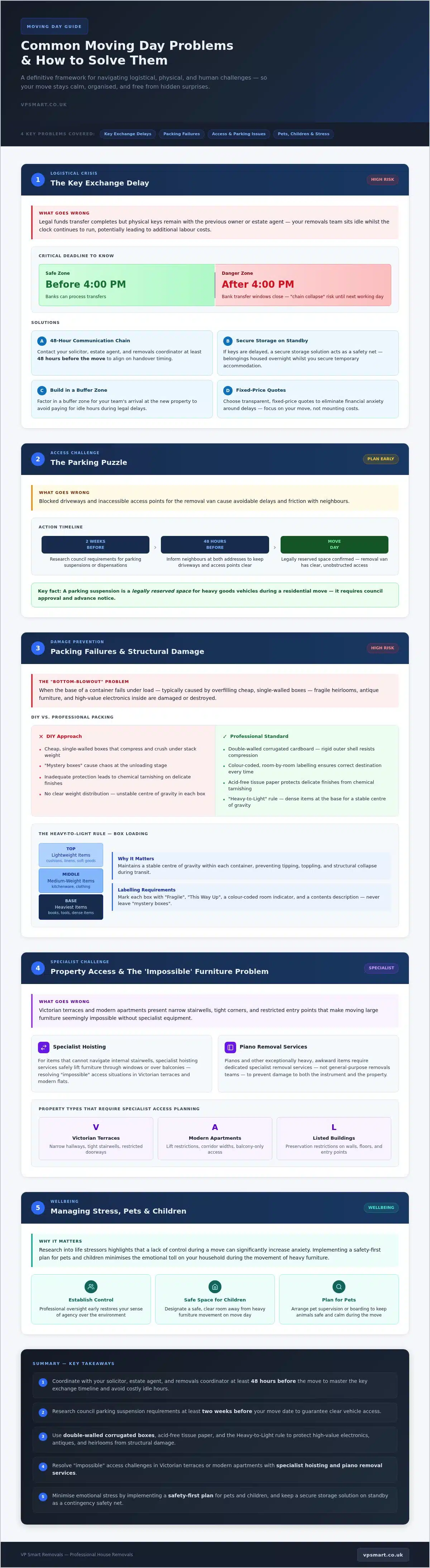
The ‘Key Exchange’ is perhaps the most notorious hurdle in the UK residential market. It occurs when the legal transfer of funds completes, but the physical keys remain with the previous owner or estate agent. When you hire a professional house removal service, timing is everything. If the transaction stalls, your removals team sits idle whilst the clock continues to run, potentially leading to additional labour costs. Identifying these common moving day problems and solutions ensures you aren’t caught off guard by the unexpected.
The psychological impact of personal relocation is often exacerbated by these moments of uncertainty. Research into life stressors highlights that a lack of control during a move can significantly increase anxiety. By establishing professional oversight early, you regain agency over your environment and protect your domestic well-being.
Managing the Handover Timeline
To prevent a total logistical breakdown, establish a clear communication chain between your solicitor, estate agent, and removals coordinator at least 48 hours before the move. Don’t assume the legal process will follow a standard rhythm. Factor in a “buffer zone” for the arrival of your team at the new property to avoid paying for idle hours. If keys are delayed past 4:00 PM, banks may close their transfer windows, leaving you in a “chain collapse” scenario where legal completion cannot occur until the following working day. In these instances, having a secure storage solution on standby is essential. It acts as a safety net, allowing your belongings to be safely housed overnight whilst you secure temporary accommodation.
Securing Access and Parking
The ‘Parking Puzzle’ is another technical hurdle that requires early intervention. You should research local council requirements for parking suspensions or dispensations at least two weeks before your move date. A parking suspension is a legally reserved space for heavy goods vehicles during a residential move. Informing your neighbours at both addresses ensures driveways and access points remain clear, reducing the risk of local friction or blocked paths for the removal van. Managing these common moving day problems and solutions requires a visionary approach to domestic logistics.
When you choose transparent pricing and fixed-price quotes, you eliminate the financial anxiety often associated with these delays. Instead of worrying about every minute of downtime, you can focus on the lived experience of moving into a well-managed new home.
Packing Failures and Structural Damage
Structural failure is one of the most disheartening aspects of relocation. A “bottom-blowout” occurs when the base of a container fails under load, typically because of overfilling cheap, single-walled boxes. Identifying these common moving day problems and solutions early allows you to build a more resilient plan for your belongings. When a box fails, the damage isn’t just to the container; it’s to the fragile heirlooms and high-value electronics within. Inadequate protection for antique furniture often stems from a lack of technical packing knowledge, but this can be engineered out of your move through professional methodology.
Professional movers and packers mitigate these risks by treating your belongings as helpful household entities that deserve respect. They use methodology-driven techniques to ensure every item remains secure, providing the oversight you need for a damage-free transition.
The Science of Secure Packing
Professional standards require double-walled corrugated cardboard for heavy items. This specification provides a rigid outer shell that prevents the compression and crushing often seen in DIY moves when boxes are stacked in the van. You should implement the “Heavy-to-Light” rule: place the densest items at the base and lighter ones on top to maintain a stable centre of gravity within each container. High-quality packing materials, like acid-free tissue paper, protect delicate finishes from chemical tarnishing, ensuring your furniture arrives in its original condition.
Labelling for Logical Oversight
“Mystery boxes” create immediate friction during the unload and lead to domestic chaos in your new property. To maintain complete oversight, adopt a colour-coded system for each room. This simple visual cue influences handler behaviour and ensures every container reaches its correct destination without hesitation. Clearly marking “Fragile” and “This Way Up” is a technical necessity that reduces the risk of mishandling by the removal team. Whilst UK standards are the priority, following international FMCSA consumer protection guidelines for inventory management helps you track every item amongst the hundreds in transit. This systematic approach ensures your common moving day problems and solutions are managed with professional precision.
By investing in the right materials and methods, you engineer a future of effortless comfort in your new home. If you’re feeling overwhelmed by the technical requirements of a safe move, you can always explore our professional packing services to ensure your belongings receive the highest level of care.
Property Access and the ‘Impossible’ Furniture Problem
Property access is often the point where logistical theory meets the physical reality of British architecture. Many homeowners discover too late that their favourite sofa or a bespoke wardrobe built in-situ simply won’t fit through the narrow Victorian stairwell or the modern, lift-free apartment block of their new home. These common moving day problems and solutions require more than just brute force; they demand a technical strategy that prioritises property integrity and item safety. Bulky furniture can easily become a liability, causing scuffs to fresh paintwork or structural damage to doorframes if not handled with precision.
The challenge isn’t merely about size. It’s about the technical setup of the transition. When you’re managing a national relocation, identifying these common moving day problems and solutions early ensures you maintain complete oversight of the process. This proactive mindset prevents the “impossible” furniture scenario from stalling your entire move.
Disassembly and Reassembly Strategies
A professional approach involves identifying large items like bed frames, dining tables, and multi-part wardrobes at least a week before the move. Professional furniture assembly is often the most efficient route to maintaining oversight of your environment, as it frees you to focus on settling into your new space. If you choose a DIY approach, keep all fixings, screws, and Allen keys in clearly labelled bags taped directly to a main component. This prevents the frustration of missing hardware during the evening setup. Whilst you manage these structural logistics, don’t overlook the domestic atmosphere; consulting an ASPCA guide to moving with pets ensures your animals remain secure and calm whilst heavy items are being manoeuvred through open doors.
Specialised Handling: Hoisting and Piano Removals
When internal access is physically impossible, technical innovation provides the answer. A professional hoisting service allows for the safe transit of oversized items through first-floor windows or balconies, bypassing narrow hallways entirely. This methodology-driven solution protects both the item and the property’s internal finishes. Similarly, moving a piano is a specialised operation. It requires specific equipment and a team of at least three experts to prevent structural stress or tuning damage. To safeguard your new home, professional teams utilise floor runners and doorframe protectors as a standard protocol. These protective measures ensure that your transition is marked by visual appeal rather than repair bills. For those seeking total budget certainty, our transparent pricing models include these specialised considerations, ensuring you remain in charge of your relocation costs without hidden surprises.
Human Factors: Managing Stress, Pets, and Children
The human element is often the most volatile variable in a relocation. Whilst technical logistics are paramount, the emotional toll of moving house can cloud judgement and lead to rushed decision-making on the day. Identifying these common moving day problems and solutions ahead of time allows you to preserve your domestic well-being and maintain complete oversight of your household’s needs. Whether you’re coordinating a local shift or a complex national relocation, the atmosphere of your move is just as important as the safety of your furniture. High stress levels can lead to friction between family members, making it essential to approach the day with a visionary pragmatism that accounts for human fatigue.
Creating a Safe Environment
Moving day involves heavy lifting, open doors, and a constant stream of movement. For pets and young children, this environment is both confusing and physically hazardous. It’s best to arrange for them to stay with family, at a nursery, or in a kennel to remove them from the operational zone entirely. If this isn’t possible, designate a “safe zone”; a single room that is cleared and locked early in the morning. This space should remain off-limits to the removals team, providing a quiet sanctuary for rest. You must also ensure all walkways are free from trip hazards like loose bubble wrap or stray tape, as these are common causes of minor injuries during the final sweep of the property.
The ‘First Night’ Essentials Kit
The “Essentials Box” failure is a classic logistical oversight. After a long day of transit, the last thing you want to do is hunt through dozens of identical containers for a phone charger or a tea bag. To avoid this, pack a separate suitcase for each family member containing clothing, medications, and basic toiletries for the first 24 hours. Your “Survival Box” should be the last item on the van and the first one off. It acts as a helpful household entity that bridges the gap between arrival and unboxing.
Include these items in your kit:
- A kettle, mugs, tea, and coffee for immediate morale boosts.
- Basic tools like a universal screwdriver and a utility knife for unboxing.
- Power banks and chargers for all essential mobile devices.
- Fresh bed linen and towels for a restful first night.
- Basic cleaning supplies to wipe down kitchen surfaces before use.
Crucially, keep all high-value documents, such as passports, rental agreements, and insurance papers, in a personal bag that stays with you. Never load these onto the removal van. This level of organisation ensures you remain the person in charge of your own environment, even amongst the transition.
Book our professional movers and packers
Why Professional Oversight is the Ultimate Solution
Transitioning from a chaotic DIY attempt to a professional house removal service represents a fundamental shift in relocation philosophy. It’s the move from reactive stress to proactive logistical management. An experienced team brings technical authority to the process, identifying potential bottlenecks in narrow corridors or complex legal chains before they manifest as delays. This professional oversight ensures you remain the person in charge of your own environment, rather than a victim of moving day circumstances. By engineering out the common moving day problems and solutions through a methodology-driven approach, you secure a future of effortless comfort in your new property.
The ROI of Professional Removals
Many homeowners underestimate the true cost of a self-managed move. When you calculate van rental, fuel, insurance, and the significant risk of personal injury or property damage, the perceived savings of DIY often evaporate. Professional movers optimise van space through technical stacking and weight distribution, which potentially reduces the number of trips required for a national relocation. Professional oversight is an investment in your domestic well-being and property security. This strategic approach eliminates the physical and financial risks of unguided labour, providing a clear path to a well-managed transition.
Choosing the Right Partner
Selecting a dependable home service provider requires looking beyond a basic price tag. You should prioritise companies that offer a detailed site survey or a comprehensive digital inventory list. This level of detail ensures you receive pricing and fixed-price quotes that are accurate and transparent, effectively eliminating moving day financial anxiety. It’s also vital to verify the company’s experience with specialised items, such as piano removals or hoisting requirements for properties with difficult access. For those moving across the UK, a partner with a national service area ensures consistency and reliability from the first box packed to the final piece of furniture assembled.
By integrating these common moving day problems and solutions into a professional framework, you gain the peace of mind that comes with comprehensive insurance and expert handling. This steady, logical progression from packing to arrival creates a trustworthy flow that guides you toward a successful move. Ultimately, professional oversight transforms a high-stakes event into a calm, organised experience where your belongings are treated as helpful household entities rather than just cargo.
Master Your National Relocation with Professional Oversight
Engineering a successful transition requires more than just a removals van; it demands a sophisticated approach to logistical oversight. By identifying common moving day problems and solutions early, you transform potential crises like key exchange delays or property access hurdles into manageable technical steps. Professional packing remains your primary defence against breakage, whilst specialised services like piano removals and hoisting ensure even the most complex architectural challenges are met with precision.
Our national UK coverage is built on the pillars of reliability and transparent pricing, providing you with budget certainty from the outset. Whether you require secure storage for a delayed chain or expert furniture assembly to settle in quickly, having a dependable partner ensures you remain in charge of your environment. You can achieve a future of effortless comfort by choosing a methodology that prioritises your domestic well-being and property security.
Get a fixed-price quote for your stress-free move today
Your new chapter deserves a start defined by calm organisation and visual appeal. We’re here to help you navigate every technical setup with absolute confidence.
Frequently Asked Questions
What happens if my removals team is late on moving day?
If your removals team is delayed, the first step is to establish direct communication with the company’s coordinator to receive a real-time tracking update. Professional firms maintain operational oversight and should provide a revised arrival window promptly. Whilst minor delays can occur due to traffic, a reliable provider will have contingency plans to ensure the move is completed within the agreed timeframe without compromising the safety of your belongings.
How do I handle a delay in getting the keys to my new house?
Key exchange delays are a frequent hurdle, often occurring when legal funds haven’t cleared by the mid-afternoon deadline. If keys aren’t released, you should notify your removals team immediately to discuss holding options. VP Smart Removals offers secure storage services as a safety net for these situations. This allows your goods to be safely housed overnight in a managed facility whilst you wait for legal completion the following morning.
Can removal companies move furniture through windows if it won’t fit the stairs?
Yes, professional teams utilise specialised hoisting services to navigate items that cannot fit through internal stairwells or doorways. This technical solution involves lifting bulky furniture through first-floor windows or balconies using specialised equipment. It’s an essential part of common moving day problems and solutions for properties with narrow Victorian hallways or multi-storey apartment blocks, ensuring your furniture arrives safely without damaging the property’s structural finishes or fresh paintwork.
What should I do if a box breaks and an item is damaged during the move?
If you discover damage, you should document the breakage with photographs immediately and notify the removals supervisor on-site. Professional companies provide comprehensive insurance as part of their service, offering you financial protection and peace of mind. Ensure you keep the damaged item and its original packaging for inspection. A transparent provider will guide you through the claims process to ensure a fair resolution and restore your domestic well-being.
Is it worth paying for a professional packing service?
Investing in professional packing services is the primary defence against structural damage and “bottom-blowouts” caused by inferior DIY methods. Experts use high-grade materials and technical stacking logic to ensure every item is secure for transit. This service not only saves you significant time but also provides the oversight needed to prevent breakages. It’s a visionary pragmatist’s choice that prioritises the safety of heirloom furniture and high-value electronics above all else.
How do I secure a parking space for the removal van in a busy area?
You should apply for a formal parking suspension or dispensation through your local council at least two weeks before your move. This legally reserves a specific space for heavy goods vehicles, ensuring the removal van can park as close to your property as possible. Managing parking is one of the most technical common moving day problems and solutions, as it reduces the transit distance for movers and prevents costly fines or delays.
Do I need to empty my chest of drawers before the movers arrive?
You should generally empty all drawers to protect the furniture’s structural integrity and make it lighter for safe lifting. Heavy contents can shift during transit, putting undue stress on the drawer runners and the unit’s frame. Whilst some light clothing can occasionally remain, clearing the unit entirely ensures your belongings are packed into reinforced boxes, providing the complete oversight required to prevent damage to both the furniture and its contents.
What is the best way to move a piano safely?
A piano requires specialised handling by a team of at least three experts using dedicated equipment like piano shoes and heavy-duty covers. Because of their immense weight and delicate internal mechanisms, pianos cannot be moved using standard techniques. Professional piano removals ensure the instrument is protected from structural stress and tuning damage. This methodology-driven approach safeguards your high-value instrument whilst protecting the property’s floors and doorframes from significant scuffs.
Disclaimer
Some links in this article may be affiliate links, which means we may earn a small commission if you make a purchase through them, at no additional cost to you. We only recommend products or services we believe provide value to our readers.
Sep 18, 2026
What if the removal firm you trusted with your family’s most precious belongings leaves you with a £600 repair bill and a wall of silence? It’s a frustrating reality for many homeowners who find themselves facing property damage or hidden surcharges just as they should be settling into their new environment. If you’re currently dealing with unresponsive customer service or broken furniture, filing a complaint against a moving company in the UK requires a systematic approach rather than an emotional one.
We understand that your home is more than just a collection of assets; it’s a carefully managed space where you deserve complete oversight. You likely feel that professional standards should be a guarantee, not a gamble. This 2026 guide promises to clarify your legal standing and provide the precise steps needed to secure a formal apology, a refund, or a successful compensation claim. We will explore the vital hierarchy of dispute resolution, starting from internal procedures and moving through to the technicalities of UK consumer law and the Small Claims Court.
Key Takeaways
- Learn how the Consumer Rights Act 2015 protects your move as a professional service. You’ll gain the legal standing to demand reasonable care and skill throughout the process.
- Master the internal dispute hierarchy to expedite your resolution; filing a complaint against a moving company uk is most effective when initiated within the critical seven-day damage notification window.
- Identify the role of trade bodies like the British Association of Removers. We’ll explain how Alternative Dispute Resolution provides a stress-free path to compensation without the need for a courtroom.
- Understand the 2026 Small Claims Court thresholds and the Money Claim Online system. This is vital for holding independent operators accountable for service failures or contract breaches.
- Discover how to prevent future disputes by prioritising technical oversight. Detailed site surveys and professional packing services significantly mitigate transit risks and provide clear evidence for any claims.
Understanding Your Consumer Rights for Removals in the UK
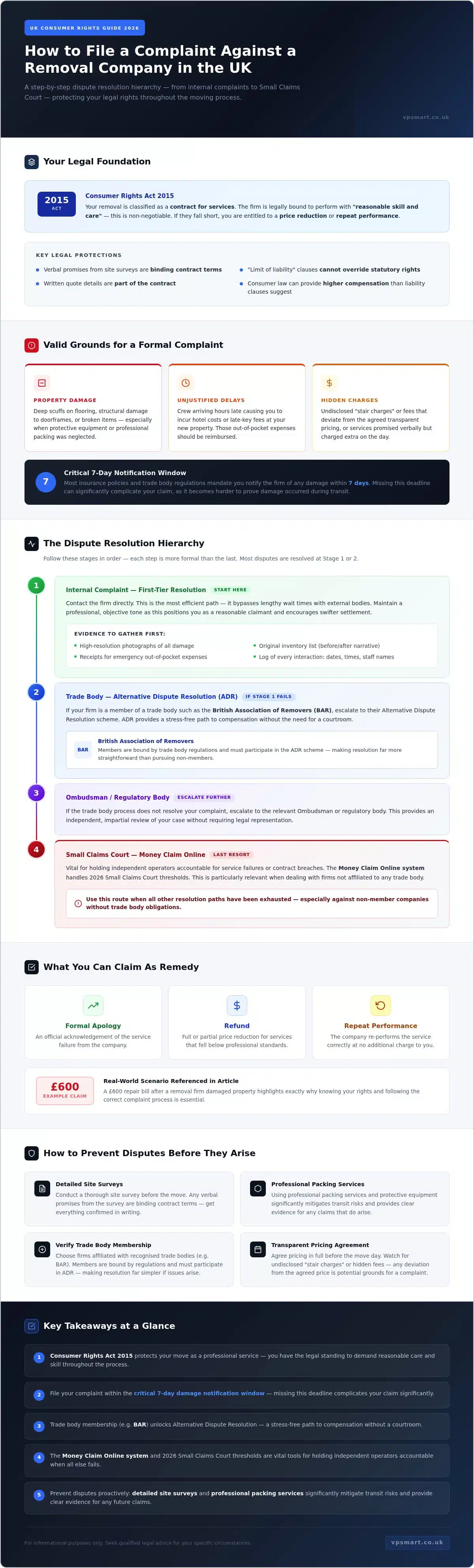
The UK legal system treats your home move as a contract for services, which provides you with specific, non-negotiable protections. When a firm handles your furniture assembly or piano removals, they’re legally bound to perform the work with “reasonable skill and care”. This benchmark isn’t just a suggestion; it’s a technical requirement. If a removal team fails to meet this standard, you aren’t just stuck with the bill; you have the right to a legal remedy that restores your domestic peace of mind.
The Consumer Rights Act 2015 and Your Move
Under the Consumer Rights Act 2015, your removal project is classified as a service. This distinction is vital because it entitles you to a price reduction or a repeat performance if the quality falls below professional standards. Any verbal promises made during your site survey or written details in your initial quote are considered binding contract terms. If a representative told you that a hoisting service was included and then charged extra on the day, they’ve breached these terms. This legislation ensures you maintain oversight of the moving process, which is essential when filing a complaint against a moving company uk to rectify a breach of service.
Valid Grounds for a Formal Complaint
Knowing exactly when to escalate is the first step in filing a complaint against a moving company uk. Valid grounds aren’t limited to broken plates; they encompass the entire service delivery. Physical damage to your property, such as deep scuffs on flooring or structural damage to doorframes, amongst the most common claims, often occurs when professional packing services or protective equipment are neglected. Unjustified delays also provide strong grounds for a claim. If a crew arrives hours late, causing you to incur hotel costs or late-key fees at your new property, those expenses should be reimbursed. Additionally, watch for undisclosed “stair charges” or hidden fees that deviate from your transparent pricing agreement.
Most firms include “limit of liability” clauses in their terms and conditions. Whilst these may seem restrictive, they cannot override your statutory rights. If a company claims they’re only liable for £40 per item, but their negligence caused the damage, consumer law often provides a path to higher compensation. If direct negotiations stall, you can seek alternative dispute resolution to find a fair middle ground without the complexity of a full court hearing. This structured approach helps alleviate the anxieties of a move, ensuring your financial interests are as well-managed as your furniture.
The Internal Complaint Process: Resolving Issues Directly
Resolving a dispute directly with your provider is often the most efficient path to securing a refund or repair. This “First-Tier” resolution bypasses the lengthy wait times associated with external bodies, allowing you to regain control over your home environment quickly. Timing is everything; most insurance policies and trade body regulations mandate a critical 7-day window for notifying a firm of any damage. Missing this deadline can complicate your claim, as it becomes harder to prove that the damage occurred during transit rather than after the crew departed.
Maintaining a professional, objective tone is your strongest asset. Whilst it’s natural to feel frustrated by property damage or unexpected surcharges, a calm approach positions you as a reasonable claimant. This clarity of communication often encourages a swifter settlement, as it demonstrates that you are prepared to follow a logical process. If you’ve already checked our transparent pricing and found a discrepancy, presenting this data clearly will speed up the internal review.
Step 1: Gathering Indisputable Evidence
A successful claim relies on data, not just descriptions. Start by cross-referencing high-resolution photographs of the damage with your original inventory list. This provides a clear “before and after” narrative that is difficult to dispute. You should also collect receipts for any emergency out-of-pocket expenses, such as temporary storage or hotel stays, caused by the company’s failure. Keep a detailed log of every interaction, noting dates, times, and the names of staff members you spoke with. This level of oversight ensures that when filing a complaint against a moving company uk, your case is built on a foundation of documented facts.
Step 2: Drafting the Formal Letter of Complaint
Your formal letter should be a precise document that leaves no room for ambiguity. Explicitly state that you are filing a complaint against a moving company uk under the Consumer Rights Act 2015. This technical reference signals that you understand your legal standing. Clearly specify your desired outcome: do you require a partial refund, a professional repair, or a full replacement of an item? Set a firm but reasonable deadline, typically 14 days, for the company to provide a substantive response. If this internal route fails, you may eventually need to consider making a small claims court claim in the UK, but a well-structured letter often prevents the need for such escalation.
Escalating the Dispute: Trade Bodies and the Ombudsman
If your formal letter doesn’t yield a satisfactory response, the next logical step is to check for trade body membership. Professional oversight is a hallmark of a dependable mover, and membership in organisations like the British Association of Removers (BAR) or the National Guild of Removers and Storers provides a vital safety net. Filing a complaint against a moving company uk is most effective when you can leverage these regulatory frameworks, as member firms are required to adhere to strict codes of practice that prioritise consumer protection and service quality.
Alternative Dispute Resolution (ADR) serves as a modern solution to the anxieties of litigation. It offers a structured path to a resolution without the emotional and financial strain of a courtroom. These schemes are designed to be approachable, ensuring that the domestic well-being of the homeowner is protected through a transparent, evidence-based process. This layer of protection is often the difference between a lingering dispute and a successful compensation claim.
Using the British Association of Removers (BAR) ADR
BAR members provide their customers with access to a free, independent ombudsman service. This technical mechanism ensures that your case is reviewed by a neutral third party with industry expertise. One of the most significant benefits is the Advanced Payment Guarantee. This feature protects your deposit and advance payments if a firm ceases trading before your move is complete. The conciliation process acts as a helpful middle ground, using logic and fairness to settle disputes over property damage or service failures whilst avoiding the sterile coldness of legal proceedings.
The Role of the Furniture & Home Improvement Ombudsman
When internal complaints fail to resolve the issue, the Furniture & Home Improvement Ombudsman provides a final, authoritative decision. This independent body has the power to award compensation for both direct financial losses and the distress caused by a sub-standard move. Their decisions are legally binding on the removal company, which ensures a high level of accountability. When you are filing a complaint against a moving company uk, the ombudsman’s role is to act as the final arbiter of fairness. Whilst the company must follow the ruling, you as the consumer generally retain the oversight to decide whether to accept the decision or pursue further legal action. This system empowers you to hold companies accountable for their performance, ensuring your home environment remains well-managed and secure.
Legal Recourse for Complaints Against Non-Member Companies
While association membership is a helpful quality benchmark, thousands of independent operators and “Man and Van” services operate outside these bodies. When filing a complaint against a moving company uk that isn’t a member of BAR or the National Guild, you must rely on statutory legal frameworks. You still have complete oversight of the situation, but the process moves from industry conciliation to formal regulatory reporting and legal action. This path ensures that even smaller, independent firms are held to the same professional standards as larger competitors.
First, verify the firm’s insurance coverage. Public Liability insurance protects your home’s structure, whilst Goods in Transit insurance covers your specific belongings. If an independent mover remains unresponsive, checking their insurance status provides a technical route to compensation. If their insurer denies the claim due to the mover’s negligence, you can hold the company directly liable for the loss. This proactive oversight is a vital part of managing your domestic environment during a transition.
Reporting to Trading Standards
Trading Standards teams investigate commercial practices that cross the line into criminal behaviour, such as fraud or aggressive sales tactics. If you’ve been hit with unexpected surcharges not in your contract or faced intimidation, report the company via the Citizens Advice consumer helpline. Whilst Trading Standards usually focuses on prosecution rather than individual refunds, your report builds a case against rogue operators. This helps protect the regional quality benchmarks that dependable local firms work hard to maintain, ensuring a safer market for every homeowner.
Initiating a Small Claims Court Action
For claims under £10,000 in England and Wales, the Small Claims Court is a logical, instructional path to recovery. Before using the Money Claim Online system, you must issue a “Letter Before Action”. This is a final, formal warning that provides the mover with a final 14-day window to settle the dispute. If they refuse, the court fee structure is tiered based on the claim value. Judges apply a “reasonableness” test, evaluating whether the mover exercised the care expected of a professional service. Documented evidence is your primary tool when filing a complaint against a moving company uk through the court system.
Secure a transparent and fixed-price removal quote
How to Prevent Moving Disputes: Choosing a Reliable Partner
Prevention is the most effective way to avoid the stress of filing a complaint against a moving company uk. It begins with selecting a partner that values technical oversight as much as domestic comfort. A reliable mover doesn’t just transport boxes; they manage an environment through detailed site surveys and digital risk assessments. This proactive approach identifies potential hurdles, such as narrow stairwells or the need for specialised piano removals, before the moving day begins. By addressing these technical specifications early, you ensure a future of effortless comfort in your new home.
Before signing any agreement, verify the mover’s insurance credentials. Adequate Goods in Transit and Public Liability cover are essential safety nets that provide emotional security. A dependable provider will be transparent about their policy limits and excess amounts, ensuring your assets are protected. This professional expertise differentiates a visionary pragmatist from a rogue operator, positioning you as the person in charge of your own environment.
The Importance of Transparent Pricing
Financial optimisation is a core pillar of a well-managed move. You should understand the mechanics of your quote, specifically the difference between hourly rates and fixed-price relocation fees. Hourly models can sometimes lead to disputes if traffic or access issues cause unexpected delays, whereas fixed-price models offer predictable oversight. Avoid any operator that refuses to provide a written inventory or a formal contract. You should also ask about potential surcharges for stairs or difficult access upfront. By securing these details in writing, you eliminate the ambiguity that often leads to homeowners filing a complaint against a moving company uk.
VP Smart Removals: A Commitment to Excellence
Choosing a specialist ensures that your belongings are treated as helpful household entities rather than just cargo. Our house removals services prioritise the careful handling of delicate items, utilising specialised equipment like hoisting services for difficult access points. Data suggests that engaging professional movers and packers significantly lowers the statistical likelihood of transit damage. Our teams use high-quality packing materials and technical packing methods to secure your items for the journey. This level of professional oversight ensures every detail is organised to prevent the need for complaints, allowing you to settle into your digitally integrated lifestyle with total confidence.
Securing Your Future Domestic Peace of Mind
Securing a resolution when a service fails is about reclaiming oversight of your home environment. We’ve explored how the Consumer Rights Act 2015 provides a technical safety net, whilst the internal complaint process remains the fastest route to a refund or repair. Whether you are navigating trade body arbitration or pursuing the Small Claims Court, your success depends on maintaining a documented, objective record of every interaction. Filing a complaint against a moving company uk doesn’t have to be an emotional burden when you follow a steady, logical progression.
By choosing a partner that prioritises transparent performance, you can avoid these anxieties entirely. Our experienced team specialises in high-stakes tasks like delicate piano removals and expert furniture disassembly and reassembly. With comprehensive Goods in Transit insurance included as standard, we ensure your domestic well-being is protected from the very first site survey.
Get a Fixed-Price Quote for a Stress-Free Move
Your transition to a new home should be defined by effortless comfort and professional reliability. Take charge of your next move with a service designed to deliver complete peace of mind and technical excellence.
Frequently Asked Questions
How long do I have to file a complaint against a moving company in the UK?
You typically have up to six years to bring a legal claim for breach of contract, but most removal firms require notification of damage within seven days. This shorter window is a technical requirement for insurance claims and trade body regulations. Filing a complaint against a moving company uk immediately ensures that the evidence is fresh and the link between the move and the damage is indisputable and well-documented.
Can I complain if the moving company arrived late or took too long?
Yes, you can complain if a delay causes financial loss or violates the “reasonable time” requirement of the Consumer Rights Act 2015. If a late arrival leads to additional hotel costs or late-key charges from your solicitor, the firm may be liable for these expenses. Ensure you’ve documented the arrival time and any subsequent costs to support your request for a price reduction or a formal refund.
What should I do if the moving company is refusing to pay for damages?
If a company rejects your internal claim, you should escalate the dispute to an independent body like the British Association of Removers (BAR) or the Furniture & Home Improvement Ombudsman. These organisations provide Alternative Dispute Resolution (ADR) to find a fair middle ground. If the company is not a member of a trade body, your next logical step is issuing a formal “Letter Before Action” followed by a court claim.
Does a “limit of liability” clause mean I cannot claim the full value of my items?
A “limit of liability” clause often attempts to cap payouts at a specific amount per item, but it cannot override your statutory rights. If the mover failed to use reasonable skill and care, they may be liable for the full repair or replacement cost regardless of their contract terms. You should challenge any cap that feels unfair or does not reflect the actual loss incurred during your relocation project.
Is it worth taking a moving company to the Small Claims Court?
Taking a mover to court is often worth it for claims between £500 and £10,000 where the evidence of negligence is clear. The Money Claim Online system makes the process instructional and steady, though you should weigh the tiered court fees against your potential recovery. Most cases settle before reaching a hearing once a formal “Letter Before Action” is issued, as companies prefer to avoid the record of a judgment.
How do I check if a removal company has valid insurance?
You should request a copy of the company’s insurance certificate to verify they have both Public Liability and Goods in Transit cover. A dependable firm will provide these documents during the site survey to offer you emotional security. Check that the policy is current and the limit of indemnity is high enough to cover the total value of your belongings, especially for specialised tasks like piano removals.
What happens if I didn’t sign a contract with the mover?
Even without a signed physical document, a binding contract exists through your exchange of emails, text messages, or verbal agreements. The Consumer Rights Act 2015 applies to any service agreement, meaning the company must still perform the move with reasonable skill and care. When filing a complaint against a moving company uk in this situation, your digital trail of quotes and booking confirmations serves as the technical evidence of your agreement.
Can I stop payment if I am unhappy with the service on moving day?
Stopping payment is generally not advised as it can be viewed as a breach of contract on your part, potentially leading to debt collection actions. It’s legally safer to pay the invoice and then immediately initiate a formal complaint to seek a partial refund. This approach maintains your oversight of the situation and ensures you remain the reasonable party if the dispute eventually requires escalation to an ombudsman or court.
Disclaimer
Some links in this article may be affiliate links, which means we may earn a small commission if you make a purchase through them, at no additional cost to you. We only recommend products or services we believe provide value to our readers.
Sep 17, 2026
Your favourite armchair isn’t just a seat; it’s a complex logistical asset that requires a strategic transit plan to survive a relocation unscathed. Most people view moving as a simple act of transport, but the reality is that your furniture represents the largest variable in your moving budget and your post-move comfort. It’s completely natural to feel a sense of dread when you look at a heavy sideboard and wonder if it will actually fit through your new front door. Deciding what to do with furniture when moving house often feels like a choice between sentimental guilt and physical exhaustion.
We believe that complete oversight of your inventory is the only way to ensure a seamless transition to your new lifestyle. This guide provides a professional framework to help you audit your belongings with technical precision. You’ll learn how to manage disassembly without losing vital hardware, how to protect delicate finishes during transit, and how to ethically rehome items that no longer serve your space. By the end of this article, you’ll have a clear, actionable programme for every piece of furniture you own, ensuring your new home feels like a sanctuary from the moment you step inside.
Key Takeaways
- Learn how to conduct a room-by-room audit using the “Three-Year Rule” to decide which pieces deserve a place in your new layout.
- Discover exactly what to do with furniture when moving house by navigating UK fire safety regulations for ethical donations and high-value resale.
- Master the technical art of furniture disassembly, including the golden rule for organising fixings to ensure a stress-free reassembly.
- Identify potential access bottlenecks like narrow stairwells early and learn how specialised hoisting services can move bulky items where lifts cannot.
- Understand how to use managed storage as a strategic buffer for undecided items, protecting your domestic well-being during a complex transition.
Auditing Your Inventory: Deciding What Earns a Place in Your New Home
A successful relocation begins with a rigorous audit of every item you own. This isn’t just about decluttering; it’s about exercising complete oversight of your future environment. When deciding what to do with furniture when moving house, you must evaluate each piece based on its future utility rather than its past service. We recommend a room-by-room assessment that prioritises both structural integrity and spatial logic. This proactive approach ensures you only invest in moving items that truly enhance your daily life.
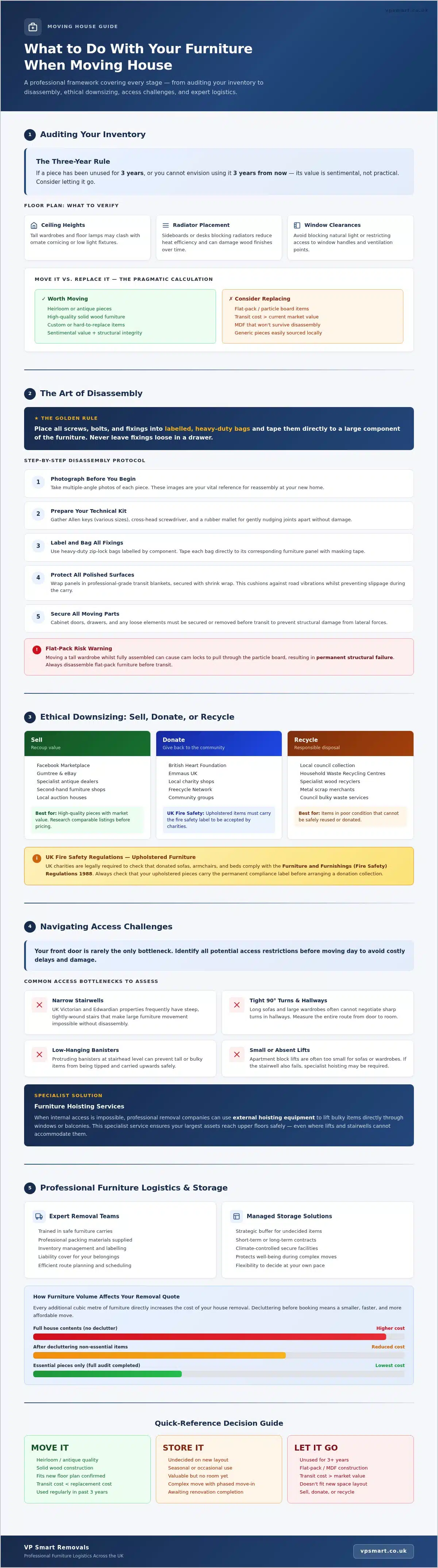
The “Three-Year Rule” serves as an excellent emotional filter during this process. If a piece of furniture has remained in storage for three years, or if you cannot realistically envision it functioning in your lifestyle three years from now, its value is likely sentimental rather than practical. Additionally, inspect your flat-pack items with a critical eye. Particle board and MDF often lose structural stability once disassembled, so determine if a budget wardrobe will survive the transition before committing to its transport. It’s often more efficient to replace these items than to risk them failing mid-move.
The Floor Plan Assessment
Visualising your new layout is essential for preventing “furniture shock” on moving day. UK property dimensions vary significantly, and a sofa that feels proportionate in a modern open-plan space may overwhelm a period cottage. Use a floor plan to map out your primary pieces, paying close attention to potential overcrowding. You should also verify specific vertical clearances, including:
- Ceiling Heights: This is essential for tall wardrobes or floor lamps that might interfere with light fixtures or ornate cornicing.
- Radiator Placement: Ensure your sideboard or desk doesn’t block heat sources, which can reduce efficiency and damage wood finishes.
- Window Clearances: Avoid obscuring natural light or restricting access to window handles and vents.
The Cost-Benefit of Moving vs. Buying New
Every cubic metre of furniture impacts your house removals quote. It’s a pragmatic calculation: if the cost of professional transit exceeds the current market value of a generic item, it’s often more logical to sell it and purchase a replacement at your destination. However, heirloom pieces or high-quality solid wood furniture deserve the investment of expert handling because they are difficult to replicate. Measuring access points is the final technical hurdle in this audit. Remember that your front door is rarely the only bottleneck. Instead, focus on narrow hallways, tight ninety-degree turns, and low-hanging banisters that could impede the progress of your largest assets.
The Art of Disassembly: Preparing Bulky Furniture for Safe Transit
Once you have completed your inventory audit, the technical phase of preparation begins. Disassembling large items is often the only way to ensure they navigate narrow hallways without sustaining or causing damage. When considering what to do with furniture when moving house, many homeowners overlook the structural risks of moving fully assembled flat-pack items. These pieces are designed for static use, not for the lateral forces experienced during transit. Moving a tall wardrobe whole can cause the cam locks to pull through the particle board, leading to permanent structural failure.
The golden rule for a successful reassembly is the systematic management of fixings. Never leave screws or bolts loose in a drawer. Instead, place all hardware into labelled, heavy-duty bags and secure them directly to a large component of the furniture with masking tape. This ensures that when you arrive at your new home, you have complete oversight of every nut and bolt. To protect polished surfaces, use professional-grade transit blankets secured with shrink wrap. This creates a cushioned barrier against the vibrations of the road whilst preventing the blankets from slipping during the carry.
Step-by-Step Disassembly Protocol
Efficiency relies on a clear methodology. Start by photographing the item from multiple angles before you begin; these images serve as a vital reference for the reassembly phase. Ensure you have a technical kit ready, including various sizes of Allen keys, a cross-head screwdriver, and a rubber mallet for gently nudging joints apart. Secure any moving parts, such as cabinet doors or drawers, with low-tack tape to prevent them from swinging open. This level of preparation ensures that what to do with furniture when moving house becomes a logical sequence of tasks rather than a source of stress.
Specialist Item Preparation
Delicate components require a higher level of technical care. Glass shelves and mirrored doors should be removed and wrapped individually in bubble wrap or corrugated cardboard. For your sleeping environment, use heavy-duty mattress bags to maintain hygiene and prevent snagging during the move. If the thought of managing these technical details feels overwhelming, engaging expert furniture assembly services can provide the professional oversight needed to ensure your home is set up perfectly on day one. Our house removals team often handles these complex tasks to save you time and physical strain.
Ethical Downsizing: How to Sell, Donate, or Recycle Unwanted Pieces
Downsizing ethically is a strategic exercise in resource efficiency. Determining what to do with furniture when moving house often reveals a collection of items that, whilst perfectly serviceable, no longer align with your evolving lifestyle or the dimensions of your new property. By rehoming these pieces, you reduce the total volume of your house removals and contribute to a circular economy. This process requires a balance of commercial pragmatism and community spirit to ensure every item finds its most appropriate next destination.
The “Freecycle” movement and local community groups offer a streamlined way to give furniture a second life. These platforms allow you to exercise complete oversight of who receives your items, often ensuring they go to neighbours who truly need them. For items with higher market value, digital marketplaces provide a direct route to recouping some of your initial investment, which can then be redirected into your new home setup.
Selling Your Furniture Quickly
To maximise resale value, your online presence must be as professional as possible. Use high-resolution photography in natural light to capture the true colour and texture of the piece. Including a common object for scale or a tape measure in the frame helps buyers visualise the item in their own space. Accurate descriptions are vital; be transparent about any minor defects to build trust and reduce time-consuming enquiries. To avoid a stressful last-minute price drop, start your selling process at least four weeks before your move date. This gives you the leverage to wait for a fair offer rather than accepting a pittance out of desperation.
Charity Partnerships and Collections
Many UK charities, such as the British Heart Foundation or Emmaus, offer free collection services for large furniture items. However, they must adhere to strict safety standards. The most critical technical requirement is the Furniture and Furnishings (Fire Safety) Regulations 1988. If an upholstered item, such as a sofa or armchair, is missing its permanent fire safety label, charities cannot legally accept it for resale. Check for these labels under cushions or along the base before booking a collection.
If a piece has reached the end of its functional life and cannot be donated, your local council provides a bulk waste collection service. Whilst there is usually a small fee, this ensures the materials are processed at a regulated recycling centre. This responsible disposal prevents fly-tipping and ensures that wood, metal, and textiles are reclaimed, supporting a more sustainable domestic environment.
Navigating Access Challenges: Stairs, Hoisting, and Large Items
Identifying a narrow stairwell or a tight ninety-degree corner before moving day is the difference between a seamless transition and a logistical stalemate. Whilst your initial audit determined which pieces fit the room, you must now consider the physical journey through the property. Determining what to do with furniture when moving house requires a deep understanding of the path between the old room and the new one. Victorian terraces and modern apartment blocks often present unique spatial constraints that require technical foresight to overcome.
Protecting the property is just as important as protecting the furniture. We utilise heavy-duty floor runners and padded banister covers to ensure that neither the heritage woodwork nor the polished surfaces of your items sustain damage during the carry. If your move involves multiple floors without a lift, ensure your removal quote is transparent regarding a stair charge. This is a standard industry practice that accounts for the increased physical labour and time required to navigate vertical challenges safely, providing you with complete oversight of your moving costs.
When to Call in the Hoisting Experts
Sometimes, the internal architecture of a UK home simply won’t accommodate a large corner sofa or a solid oak wardrobe. In these scenarios, an external hoisting service provides the safest resolution. This involves lifting the item through a window or balcony using secure rigging and professional-grade machinery. It requires strict safety protocols to manage weight distribution and wind conditions, ensuring the item remains stable throughout its ascent. This technical solution prevents the need for risky, forced manoeuvres through tight hallways.
Professional house removals and hoisting
Handling Delicate and Heavy Items
Specialised assets like pianos require more than just brute strength; they demand technical equipment such as piano shoes and specialised dollies. Pianos have intricate internal mechanisms that are sensitive to vibration and tilt, making expert handling non-negotiable. For heavy hardwood furniture, our crews use specific weight distribution techniques and lifting straps to prevent strain and ensure the item remains balanced. This focus on safety protects both the removal team and your valuable domestic entities, ensuring they arrive at their destination in peak condition.
Professional Furniture Logistics: Why Expert Removals and Storage Matter
Managing the final stages of a relocation requires a shift from physical preparation to high-level logistics. Deciding what to do with furniture when moving house often results in a “middle ground” of items that you aren’t ready to place but don’t want to discard. A “Buffer” strategy utilises managed storage to hold these pieces securely whilst you settle into your new layout. This approach prevents your new home from becoming a warehouse of boxes, allowing you to reclaim your living space immediately. Precision matters here. It provides the breathing room necessary to live in the space before committing to a permanent furniture arrangement.
Professional packing goes beyond simple wrapping. It involves technical oversight of material compatibility, such as using acid-free paper for delicate finishes and heavy-duty corrugated card for corners. This level of care prevents transit damage to polished surfaces that DIY packing often misses. Expertise prevents loss. Choosing a fixed-price removal project provides the financial certainty needed during a high-expenditure period, ensuring there are no hidden surprises on moving day. This transparency allows you to manage your budget with the same precision you apply to your furniture inventory.
Secure Managed Storage Solutions
Unlike self-storage, where you manage the heavy lifting and security yourself, storage services provide a professionally managed environment. Your furniture is inventoried, wrapped, and placed into secure warehouse containers. This system offers superior protection against dampness and temperature fluctuations, which is essential for preserving the structural integrity of high-value antiques or modern electronics. It ensures your assets remain in a stasis of quality until you are ready for their delivery. Security is absolute.
The Final Reassembly and Placement
The final transition from a house of boxes to a functional home depends on the reassembly phase. We recommend prioritising “First Day” furniture, such as bed frames and the primary lounge sofa, to ensure your first night is restful. Professional movers and packers ensure every joint is tightened correctly and every safety bracket is secured. This technical oversight allows you to focus on the emotional experience of your new environment whilst your domestic entities are returned to their helpful, functional roles. Rest is essential. Proper placement from the start prevents unnecessary heavy lifting later and helps you establish a sense of domestic well-being from the moment you receive the keys.
Mastering Your Furniture Logistics
A successful relocation is defined by the technical precision of your preparation. Precision dictates success. By applying the three-year rule during your audit and maintaining complete oversight of your inventory, you ensure that every item in your new home serves a distinct purpose. You now have a strategic framework for what to do with furniture when moving house, from managing complex disassembly to navigating restricted access with professional hoisting services. This level of planning transforms a potentially chaotic transition into a structured project that protects your domestic entities and well-being.
Our comprehensive removals service provides the technical expertise required for a seamless move. We offer expert disassembly and reassembly as standard, alongside secure managed storage for items that need a temporary buffer. Whether you require specialist piano removals or advanced hoisting for bulky assets, we provide the hardware and experience to secure your environment.
Get a Fixed-Price Quote for Your Furniture Move
Take charge of your next move with confidence. With the right strategy and professional support, it’s easy to enjoy your new space from the very first day.
Frequently Asked Questions
Do removal companies take furniture apart for you?
Professional removal companies like ours provide specialist furniture assembly and disassembly services as part of a comprehensive relocation project. This technical support ensures that bulky items like bed frames and wardrobes are dismantled safely using the correct tools. By delegating this task, you reclaim valuable time and eliminate the stress of managing complex hardware. It’s a pragmatic solution that ensures every piece is ready for transit without risking structural damage.
What happens if my furniture doesn’t fit through the door on moving day?
If an item cannot navigate a standard doorway or narrow hallway, we utilise specialised hoisting services to lift the furniture through a window or balcony. This technical intervention is often necessary for large sofas or solid wood wardrobes that cannot be dismantled. Our crew conducts a site assessment to determine the safest access point, ensuring your property remains protected whilst your belongings reach their intended destination with complete oversight.
How do I protect my wooden furniture from scratches during a move?
Protecting polished surfaces requires a combination of high-quality packing materials and professional handling techniques. We recommend using heavy-duty transit blankets secured with shrink wrap to create a cushioned barrier against vibrations and minor impacts. This prevents the abrasive movement that causes scratches during transit. For high-value items, custom-fit corrugated cardboard corner protectors offer additional security, ensuring your domestic entities arrive in the same condition they left.
Can I leave clothes inside my chest of drawers when moving?
We generally advise against leaving clothes inside drawers because the additional weight can compromise the unit’s structural integrity during the carry. When deciding what to do with furniture when moving house, remember that heavy drawers put unnecessary pressure on drawer runners and the base panel. Emptying these items makes the unit lighter and safer for the removal crew to handle, reducing the risk of joint failure or damage to your property’s flooring.
Is it cheaper to sell my furniture or pay to move it?
Determining whether to sell or move furniture depends on the item’s replacement value versus its volume impact on your removal quote. If a piece is generic flat-pack furniture, the cost of transit might exceed its current worth. However, for high-quality solid wood or sentimental items, professional relocation is a sound investment. We provide fixed-price relocation project fees to give you budget certainty, allowing you to make an informed financial decision.
What should I do with furniture that has no fire safety label?
If upholstered furniture is missing its permanent fire safety label, UK charities cannot legally accept it for donation under the Furniture and Furnishings (Fire Safety) Regulations 1988. In this situation, you should consider a private sale to an individual or a community group where these regulations for commercial resale don’t apply. Alternatively, you can organise a bulk waste collection through your local council to ensure the materials are recycled responsibly at a regulated centre.
How long can I keep my furniture in managed storage?
You can keep your furniture in our managed warehouse facilities for as long as your transition requires. We offer recurring storage rental fees on a weekly or monthly basis, providing a flexible buffer for undecided items. This secure environment is climate-controlled to prevent dampness, ensuring your belongings remain in peak condition. Whether you need oversight for a few weeks or several months, our storage services adapt to your specific timeline.
Do I need special insurance for moving antique furniture?
Whilst professional movers carry goods in transit insurance, you should verify if your specific policy covers the full valuation of high-value antiques. Deciding what to do with furniture when moving house often involves assessing the risk to delicate heirlooms. We recommend discussing your inventory with us during the site survey so we can apply specialised handling techniques. This ensures your most valuable assets receive the technical care and protective oversight they deserve.
Disclaimer
Some links in this article may be affiliate links, which means we may earn a small commission if you make a purchase through them, at no additional cost to you. We only recommend products or services we believe provide value to our readers.
Sep 16, 2026
What if the difference between a seamless relocation and a moving day disaster isn’t your choice of packing tape, but the regulatory safety net you’ve never even heard of? Most homeowners understandably feel a sense of trepidation when handing over their life’s possessions to a removal team. You want to trust that your delicate piano or vintage furniture is in safe hands, yet the fear of “cowboy” movers or hidden damage remains a persistent shadow over the process.
We understand that a well-managed environment starts with a secure transition. By choosing a provider aligned with the removals ombudsman scheme uk, you gain complete oversight of your move’s integrity. This guide reveals how the scheme protects your belongings through government-approved Alternative Dispute Resolution, offering a free and impartial path to justice that takes just 42 days on average. We’ll show you how to distinguish between basic insurance and ombudsman protection, ensuring your next move is defined by professional excellence and domestic well-being rather than uncertainty. From verifying credentials to understanding the British Association of Removers’ code of practice, you’ll discover how to secure the effortless comfort you deserve in your new home.
Key Takeaways
- Understand how the removals ombudsman scheme uk provides a free, government-approved safety net that typically resolves moving disputes within 42 days.
- Learn the essential steps for escalating a complaint, including how to obtain a “Letter of Deadlock” to trigger independent oversight of your case.
- Discover the distinction between the British Association of Removers (BAR) code of practice and broader ombudsman services to ensure your mover meets high regulatory benchmarks.
- Master the verification process for checking a removal firm’s credentials on official registers, allowing you to filter out rogue traders before your move begins.
- Explore how professional packing services and transparent pricing models function as your primary defence against common relocation anxieties and potential financial disputes.
What is the Removals Ombudsman Scheme in the UK?
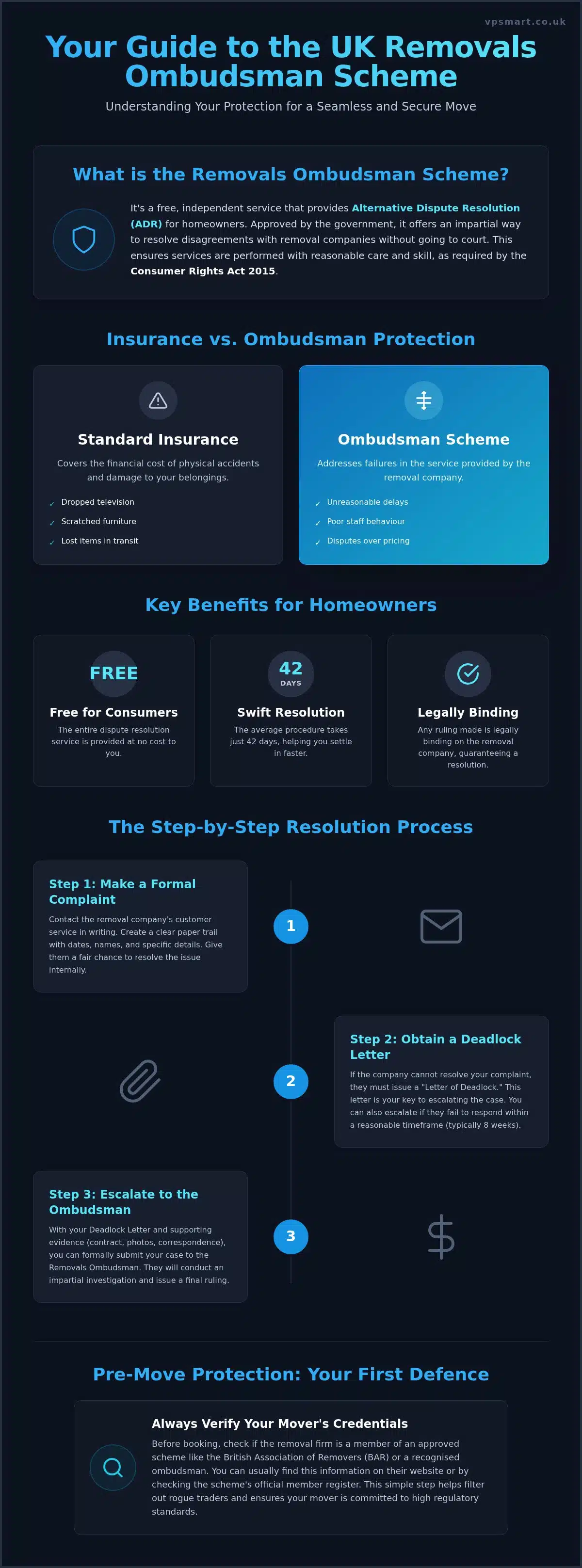
The removals ombudsman scheme uk serves as a vital regulatory pillar, ensuring that the transition between homes remains a controlled and professional experience. At its core, an ombudsman is an independent body designed to provide Alternative Dispute Resolution (ADR). This mechanism allows homeowners to resolve disagreements with service providers without the stress or financial burden of legal proceedings. By operating under the Alternative Dispute Resolution for Consumer Disputes Regulations 2015, the scheme offers a government-approved framework that prioritises fairness and transparency.
This protection is deeply rooted in the Consumer Rights Act 2015, which mandates that all services, including house removals, must be performed with reasonable care and skill. When a removal company fails to meet these statutory standards, the ombudsman acts as an impartial referee. Professional movers choose to join these schemes because it demonstrates a commitment to accountability. It signals to the customer that the business is not just a service provider, but a dependable partner that welcomes independent oversight of its operational quality.
The Difference Between Insurance and the Ombudsman
It’s common to confuse ombudsman protection with standard transit insurance, yet they serve distinct functions in your moving strategy. Insurance is designed to cover the financial cost of physical accidents, such as a dropped television or a scratched sideboard. In contrast, the ombudsman addresses service failures, including unreasonable delays, poor staff behaviour, or disputes regarding transparent pricing models. These two systems work in tandem to safeguard your household; whilst insurance protects your physical assets, the ombudsman protects your consumer rights. Alternative Dispute Resolution (ADR) provides a faster, free alternative to the court system for resolving these complex service-related grievances.
Key Benefits for the UK Homeowner
Accessing the removals ombudsman scheme uk offers several practical advantages that elevate the moving experience from a source of anxiety to a well-managed process. The service is entirely free for consumers and provides an unbiased perspective on disputes, ensuring a fair outcome for both parties. While you remain free to pursue legal action if unsatisfied, any ruling made by the ombudsman is legally binding on the removal company, guaranteeing a resolution.
Knowing an independent expert is available to review your case provides immense peace of mind during high-value relocations. With an average procedure length of just 42 days, the scheme offers a swift resolution that helps you settle into your new home with confidence and emotional security. This oversight ensures that your removal team adheres to the highest regional quality benchmarks, treating your possessions as helpful household entities rather than mere cargo.
The Step-by-Step ADR Process: Resolving Moving Disputes
When a relocation doesn’t go according to plan, the path to resolution should be logical and transparent. The removals ombudsman scheme uk provides a structured roadmap that ensures your voice is heard without the aggression of legal confrontation. This process is designed to restore the balance between homeowner and service provider, ensuring that accountability remains the central theme of your moving experience.
Stage 1: Internal Complaint Procedures
The first step in any dispute is to give the removal firm a fair opportunity to rectify the issue. You must formalise your grievance by contacting their customer service team in writing. A clear, chronological paper trail is your most powerful asset during this phase. Include dates, names of staff members you spoke with, and specific details of the service failure. Most professional movers aim to resolve these issues internally within a few weeks, often providing a final viewpoint letter that outlines their position.
Whilst you wait for a response, it’s vital to maintain oversight of your documentation. Keep your original contract, inventory lists, and any transparent pricing agreements close at hand. If the company fails to respond or provides a solution that doesn’t meet your expectations, you’ve established the necessary foundation for escalation.
Stage 2: Escalating to the Ombudsman
If you cannot reach an agreement, or if eight weeks have passed since your initial complaint, it’s time to involve The Removals Ombudsman Scheme. To proceed, you’ll typically need a “Letter of Deadlock.” This is a formal statement from the mover confirming that neither party can agree on a resolution. This letter acts as the trigger that allows the ombudsman to take charge of the case.
When you fill out the dispute form, accuracy is paramount. The ombudsman seeks to determine what is “fair and reasonable” based on industry benchmarks and the evidence provided. You’ll need to submit:
- High-resolution photos of any damaged items or property.
- Signed inventory lists from both the start and end of the move.
- Copies of all correspondence between you and the mover.
- The original service agreement and any subsequent invoices.
The ombudsman then conducts a thorough review of the facts. Their decision is based on whether the mover followed the established code of practice and fulfilled their statutory duties. Choosing a team that prioritises expert packing services often prevents these disputes from arising, as professional handling significantly reduces the risk of damage. Once the review is complete, the final decision is issued, providing a binding resolution that allows you to move forward with peace of mind.
Comparing ADR Schemes: BAR, CTSI, and Independent Ombudsmen
Understanding the specific regulatory landscape is vital for any homeowner seeking complete oversight of their relocation. While the removals ombudsman scheme uk provides a robust safety net, it exists alongside other essential frameworks like the British Association of Removers (BAR) and the Chartered Trading Standards Institute (CTSI). These organisations don’t just resolve disputes; they set the technical benchmarks that prevent problems from occurring in the first place. Knowing which scheme governs your mover determines the exact path you’ll take if a disagreement arises.
The BAR Code of Practice
The British Association of Removers (BAR) operates a code of practice that is strictly monitored by the CTSI, with the latest audit completed in June 2026. This code isn’t a mere suggestion; it’s a mandatory set of requirements for its 354 members. It dictates the technical specifications for vehicle maintenance and the strength of packing materials, ensuring your possessions are cradled in a well-managed environment. Staff must be trained in specialist furniture handling and disassembly, treating your items with the care they deserve. This commitment to quality is often reflected in a company’s financial clarity, and reviewing a transparent pricing guide can help you see how these professional standards translate into honest, fixed-price models.
Government-Approved ADR Entities
Impartiality is the most critical asset in any dispute resolution process. The UK government monitors ADR entities to ensure they remain neutral referees between the consumer and the business. To achieve “Approved Code” status, a removals firm must demonstrate a consistent history of fair trading and high operational standards. The word “Independent” in any ombudsman’s title is your guarantee that the adjudicator is not a part of the removal company’s internal hierarchy.
For example, as of April 1, 2018, all unresolved complaints against BAR members are handled exclusively by The Furniture & Home Improvement Ombudsman (FHIO). This ensures that the person reviewing your case has no vested interest in the mover’s profitability. This layer of independent oversight provides the emotional security necessary for a stress-free move. It transforms the removals industry from a fragmented market into a regulated service that prioritises the lived experience of the homeowner. By verifying which government-approved scheme your mover belongs to, you empower yourself as the person in charge of your own domestic environment.
Pre-Move Protection: How to Verify Your Mover’s Membership
Securing your move starts long before the first van arrives at your door. To benefit from the protection offered by the removals ombudsman scheme uk, you must first verify that your chosen provider is a legitimate member of a recognised body. Whilst many websites display professional logos, these visual markers can sometimes be misleading. True oversight requires you to cross-reference these claims against official registers to ensure your domestic well-being is genuinely protected.
Due Diligence Checklist for Homeowners
A professional mover should be transparent about their affiliations. Start by checking for the Removals Industry Ombudsman Scheme (RIOS) or British Association of Removers (BAR) logos on their homepage. However, you shouldn’t stop there. Visit the official ombudsman register and search for the company’s registered legal name, as this may differ from their trading name. This simple step ensures that you have access to Alternative Dispute Resolution (ADR) should any service failures occur. It acts as a digital handshake, confirming that the company welcomes accountability.
When researching, look beyond simple star ratings. Focus on reviews that describe how the company handles setbacks. A provider that resolves a minor issue quickly and fairly is often more reliable than one with a perfect, yet possibly curated, record. For a deeper look at what to expect from a professional service, consult our comprehensive house removals guide. This level of research empowers you as the person in charge of your own environment, turning a complex relocation into a well-managed transition.
Red Flags: When to Be Wary
Identifying rogue traders is an essential skill for the modern homeowner. One of the most significant red flags is a company that demands cash-only payments or refuses to provide a detailed written contract. Without a contract, you lack the technical evidence required to lodge a complaint with an ombudsman later. Be cautious of “ghost” movers who provide vague contact details or lack a physical business address; these entities often disappear once a deposit is paid. This lack of transparency is the opposite of the high standards we advocate for.
It’s also important to distinguish between a standard “Man and Van” service and a full removal firm. While many smaller operators are excellent, they may not always belong to the same ombudsman schemes as larger, established companies. Always scrutinise the Terms and Conditions for specific mentions of ADR procedures. If a company claims membership but doesn’t appear on the official register, it is a clear sign of dishonest trade practices. By remaining vigilant, you ensure your move is defined by effortless comfort rather than unnecessary risk.
Secure a transparent quote for your upcoming move
The VP Smart Approach: Why Accountability is at the Centre of Our Service
At VP Smart Removals, we view the removals ombudsman scheme uk not just as a regulatory requirement, but as a benchmark for the high standards we strive to exceed every day. We believe that a well-managed move is built on a foundation of absolute transparency. This starts with our transparent pricing models, which ensure that every homeowner has complete oversight of their relocation costs from the very first quote. By eliminating hidden fees and vague service agreements, we remove the primary triggers for disputes before they even arise.
Our technical expertise allows us to handle the most delicate household entities with precision. Whether it’s the specialist handling required for piano removals or the deployment of a hoisting service for complex architectural layouts, our team operates with a level of technical authority that ensures domestic well-being. We don’t just move boxes; we manage environments. This ensures your transition to a new home is as seamless as the technology within it, rooted in a sense of regional reliability and professional care.
Precision in Every Move
Damage prevention is a logical byproduct of intelligent management and oversight. Our experienced team specialises in furniture disassembly and reassembly, ensuring that bulky or intricate pieces are transported in their most secure state. Every project is underpinned by a detailed inventory list, providing a functional record that guarantees accountability at every stage of the journey. For those requiring a staggered transition, our managed storage services offer an extra layer of security, keeping your possessions safe until your new space is ready for occupation.
Reliability Across the UK
Whether you are undertaking a complex house removal or a high-stakes office relocation, our focus remains on performance and clear communication. We understand that the modern homeowner seeks more than just a transport service; they require a visionary partner who can alleviate the anxieties of moving day. Our commitment to reliability ensures you remain the person in charge throughout the process. By combining technological capability with approachable domestic warmth, we turn the stress of relocation into a predictable and trustworthy flow that guides you toward your new life.
Book your stress-free move with VP Smart Removals
Secure Your Future Home with Professional Oversight
Moving to a new home should be a milestone of domestic well-being, not a source of financial anxiety. By understanding the removals ombudsman scheme uk, you’ve gained the technical oversight needed to manage your relocation with absolute confidence. You now know how to verify trade credentials, navigate the ADR process, and distinguish between basic insurance and regulatory protection. This knowledge ensures you remain the person in charge of your environment throughout the entire transition.
Our team brings this philosophy of accountability to every project. We specialise in high-difficulty tasks like delicate piano removals and provide comprehensive packing and secure storage solutions tailored to your household’s unique rhythm. With transparent pricing and no hidden surcharges, we ensure your move is as predictable as it is comfortable.
Your next chapter deserves a seamless beginning. Trust in professional standards and enjoy the peace of mind that comes with a well-managed move.
Frequently Asked Questions
Is the removals ombudsman scheme free for consumers to use?
Yes, the removals ombudsman scheme uk is entirely free for consumers to use. There are no fees for submitting a complaint or undergoing the Alternative Dispute Resolution process. This ensures that every homeowner has access to impartial justice regardless of their financial situation. By removing cost barriers, the scheme encourages professional movers to maintain high standards of service and accountability throughout the relocation journey.
How long does a removals ombudsman dispute typically take to resolve?
A dispute typically takes an average of 42 days to resolve once the ombudsman has accepted the case. This timeframe is significantly faster than pursuing a claim through the traditional court system. The process begins after you’ve exhausted the mover’s internal complaint procedure and received a final viewpoint letter. This efficient schedule allows you to settle into your new home without the lingering stress of an unresolved disagreement.
Can I use the ombudsman if I didn’t have a written contract with the mover?
While the ombudsman can review disputes without a formal written contract, it’s significantly more challenging to prove service failures. Under the Consumer Rights Act 2015, verbal agreements are legally binding, but the lack of technical documentation often leads to disputes over specific terms. We always recommend securing a written service agreement to ensure complete oversight and to provide the ombudsman with a clear benchmark for professional performance.
What kind of compensation can the removals ombudsman award?
The ombudsman can award financial compensation to cover the cost of physical damage, loss of items, or the failure to provide a service as described. Beyond material costs, they may also award payments for significant distress and inconvenience caused by the mover’s actions. These decisions are designed to restore the homeowner to the position they would’ve been in had the service been performed with reasonable care and skill.
Does the ombudsman cover international removals from the UK?
Yes, the removals ombudsman scheme uk covers international removals, provided the company is a registered member and the contract was signed within the UK. This protection is vital for complex relocations across Europe, where the risks and costs are higher. At VP Smart Removals, we facilitate international moves with the same focus on reliability and transparent pricing that defines our domestic services, ensuring your possessions are protected across every border.
What happens if a removal company ignores the ombudsman’s decision?
If a removal company ignores a binding decision, they face serious consequences, including expulsion from the ombudsman scheme and any associated trade bodies. Because the decision is legally binding on the trader, you can also take the ombudsman’s final report to a court to have it enforced as a legal judgement. This safety net ensures that the ombudsman’s oversight has real power to protect your domestic well-being and financial interests.
Can I complain to the ombudsman about a man and van service?
You can only complain about a man and van service if the individual or company is a registered member of an approved ombudsman scheme. While many smaller operators provide excellent service, they don’t always opt into independent oversight. We recommend verifying membership before booking any labour or transportation service. Choosing a registered provider ensures that you have a formal route for redress if the service doesn’t meet professional benchmarks.
What evidence do I need to provide for a removals dispute?
To build a strong case, you must provide a comprehensive paper trail of your relocation. Essential evidence includes high-resolution photos of damages, the original signed inventory list, and all written correspondence with the mover. You should also include your contract and any documents related to transparent pricing agreements. This technical data allows the adjudicator to make a fair and reasonable decision based on the facts of your specific moving journey.
Disclaimer
Some links in this article may be affiliate links, which means we may earn a small commission if you make a purchase through them, at no additional cost to you. We only recommend products or services we believe provide value to our readers.
Sep 15, 2026
84% of the UK’s projected household growth is now driven by the over-65s, yet less than 10% of our homes meet even the most basic accessibility standards. This data highlights why moving house with elderly parents uk has become a vital yet daunting task for modern families. You’re likely facing the dual pressure of managing a lifetime of possessions whilst worrying about how the transition might impact your parents’ health and emotional well-being. It’s a significant undertaking that requires a blend of logistical precision and genuine compassion.
At VP Smart Removals, we understand these complexities and are here to help you regain oversight of this process. This guide provides a structured framework to navigate the complexities of late-life relocation, from understanding the frozen £325,000 inheritance tax thresholds to managing the physical demands of downsizing. We’ll outline how to coordinate a safe, injury-free move and share strategies to ensure the new space feels like home immediately. By the end of this article, you’ll have a clear roadmap for a transition that prioritises both financial optimisation and your family’s domestic happiness.
Key Takeaways
- Learn how to manage the emotional impact of moving by involving your parents early and using the “One Room at a Time” rule for gentle downsizing.
- Navigate the specific financial and legal requirements of moving house with elderly parents uk, including 2026 updates to Council Tax and Power of Attorney.
- Keep move day stress-free by establishing a “Safe Zone” for your parents, ensuring they remain comfortable whilst the heavy lifting happens.
- Ensure your parents feel settled quickly by using our “Instant Familiarity” strategy to recreate the comfort of their previous living space.
Navigating the Emotional Landscape of Moving Elderly Parents
Relocating is rarely just about boxes and vans; it’s a significant transition of identity. When you’re moving house with elderly parents, you’ll likely encounter the “Grief of Relocation”. This is a genuine psychological response to leaving a sanctuary filled with decades of memories. Validating these feelings is the first step toward a successful transition. Instead of dismissing their fears, acknowledge that leaving a family home can feel like losing a piece of personal history. You’re not just moving furniture; you’re helping them navigate a change in their life story.
Involving your parents early makes the move a shared project. When they feel like active participants rather than subjects of a plan, resistance often shifts into cooperation. This approach is vital for the “Sandwich Generation”, those people balancing the needs of their children and their aging parents. Managing this stress requires you to look after your own mental health whilst coordinating the complex logistics of house removals. Identifying the right time to move is equally critical. Look for concrete indicators like frequent falls, social isolation, or an inability to manage basic home maintenance. A proactive move is always safer than a reactive one triggered by a health crisis.
Communicating the Need for Change
Start conversations using “I” statements to reduce defensiveness. Instead of saying “You don’t manage these stairs well”, try “I feel worried about your safety when you use these stairs”. This shifts the focus to your concern rather than their perceived failings. Organise a family meeting to discuss options without immediate pressure. Focus on the benefits of a new environment, such as a warmer home or better proximity to local amenities, rather than the loss of the old property. This helps parents see the move as an upgrade to their lifestyle rather than a retreat from it.
Assessing Quality of Life and Safety
Evaluate the current environment for technical flaws that hinder daily life. Steep stairs, high-threshold baths, and poor lighting are significant trip hazards. Whilst many individuals value the concept of Aging in place, right-sizing involves moving to a property that is intentionally designed for your parents’ current and future needs to ensure long-term wellbeing. A well-chosen new home can actually increase independence by providing an accessible environment that requires less physical effort to manage. This transition allows them to focus on their social life and health rather than the burdens of an unsuitable building.
UK Legal and Financial Considerations for 2026
Financial oversight is crucial when moving house with elderly parents uk. With the average Band D council tax in England reaching £2,392 for the 2026-27 period, every saving counts. One common trap is the loss of the 25% Single Person Discount if a parent moves into your home or vice versa. You’ll need to calculate whether this cost is offset by shared utility bills or reduced maintenance outgoings. It’s also a vital time to review benefit eligibility. From April 2026, Attendance Allowance rates have risen to £76.70 for the lower rate and £114.60 for the higher rate. Ensuring these are correctly registered at the new address provides essential liquidity for ongoing care costs.
Benefits and Council Tax Implications
Relocation often triggers a review of Pension Credit and Carer’s Allowance, which stands at £86.45 per week as of April 2026. If you’re moving parents into a dedicated annex, check if the local authority treats it as a separate dwelling for council tax purposes. To manage the immediate costs of the transition, consult a pricing guide to build a realistic relocation budget. This oversight prevents mid-move financial surprises and allows you to focus on your parents’ wellbeing. It’s helpful to remember that whilst some benefits are portable, others require a fresh assessment based on the new local authority’s criteria.
Legal Safeguards and Power of Attorney
A Lasting Power of Attorney (LPA) for Property and Financial Affairs is an indispensable tool for this transition. It empowers you to sign contracts and manage bank transfers on your parents’ behalf if their health declines or if they find the paperwork overwhelming. Without an LPA, you might face significant delays in booking a professional moving company or finalising property sales. Be mindful of the “Deprivation of Assets” rules. If a home is sold and the proceeds are gifted to family members, local authorities may still count that capital when assessing care home funding in the future. Transparency with your solicitor is the best way to avoid these legal hurdles.
Beyond the legal paperwork, consider the practicalities of Adapting the New Home to ensure it meets safety standards immediately. If downsizing leaves you with excess furniture that holds sentimental value but won’t fit the new layout, storage services can provide a temporary solution whilst you decide which legacy items to keep. This balanced approach ensures your parents’ financial interests are protected whilst their physical environment remains secure and comfortable.
The Art of Gentle Downsizing: Sorting a Lifetime
Deciding what to keep after forty years in a family home is a profound emotional challenge. When you’re moving house with elderly parents uk, the sheer volume of “lifetime” possessions can lead to a paralysis of choice. To navigate this, we recommend the “One Room at a Time” rule. Start with low-stakes areas like the utility room or guest cupboard to build confidence. This steady progression allows your parents to maintain oversight of the process without feeling overwhelmed by the scale of the task.
Distinguish between “Legacy” and “Utility” to help parents prioritise. Legacy items are those with deep sentimental value, whilst utility items are strictly functional. If a parent struggles to part with physical documents or bulky photo albums, digital archiving provides a high-tech solution. Scanning these items preserves the memory whilst reclaiming vital floor space. Consulting Age UK’s housing advice can also help you understand which furniture pieces are truly necessary for different types of supported living or right-sized environments. This clarity ensures that every item in the new home serves a purpose or brings joy.
A Compassionate 4-Box Sorting Method
Implementing a structured sorting system creates a predictable flow for decision-making. Label four distinct areas to categorise every item in the room:
- Keep: Items that fit the new floor plan and provide essential emotional comfort.
- Gift/Donate: Treasures passed to family members now, allowing parents to see their legacy enjoyed by the next generation.
- Sell: Unneeded high-value items that can be converted into funds for the relocation.
- Storage: For “undecided” items, secure storage offers a managed environment to prevent move-day delays.
Planning the New Layout
Accurate measurement is the foundation of a successful transition. Use a detailed floor plan of the new property to determine exactly which furniture pieces will fit. Prioritise familiar items, such as a favourite armchair or bedside table, to create an instant sense of belonging and domestic well-being. This visual continuity reduces the disorientation often felt during the first few nights in a new space. Ensure a “Safe Passage” by maintaining 90cm clear walkways throughout the home to accommodate mobility aids or walking frames safely. This technical foresight ensures the new environment is ready-to-live and supports long-term independence.
Managing Move Day: Ensuring Comfort and Safety
The actual transition day represents the peak of physical and emotional exertion. When moving house with elderly parents uk, your primary objective is to maintain a sense of calm and oversight amidst the inevitable activity. Creating a “Safe Zone” is an effective tactic. Designate one quiet room in the old house where your parents can stay comfortably with their favourite chair and refreshments. This keeps them away from the chaos of moving boxes. It ensures they aren’t overwhelmed by the sight of their home being dismantled. Once the van is ready, consider whether they should travel in a private car or taxi rather than a packed family vehicle. This helps them arrive at the new property feeling refreshed rather than fatigued.
Handing over the physical labour to professional movers and packers allows you to focus entirely on your parents’ needs. This division of labour ensures that heavy lifting and logistics are managed with technical authority, whilst you provide the emotional support necessary for a smooth transition. To facilitate immediate comfort, prepare a “First Night Box” containing essential medications, a kettle, their favourite tea, and nightwear. This simple preparation ensures that the most basic domestic needs are met the moment they step through the new door, without the stress of searching through dozens of cartons.
Book professional removals for a stress-free transition
Logistical Tactics for a Calm Transition
A strategic approach to packing can significantly reduce disorientation. We recommend packing the elderly person’s bedroom last at the old property and ensuring it is the first room unpacked at the new one. This visual continuity helps them settle into a familiar environment immediately. Assigning a “Family Liaison” whose sole responsibility is to sit and converse with your parents provides a vital emotional buffer. Utilising expert packing services ensures that sentimental or delicate items are secured professionally, providing peace of mind that their most cherished possessions are in safe hands.
Health and Medication Management
Maintaining health oversight is paramount during the move. Keep at least a seven-day supply of all essential medications in a clearly marked, hand-carried bag that never leaves your side. It’s also vital to notify the GP of the move date in advance and ensure that emergency contact details are updated on all medical records. Throughout the day, monitor your parents’ hydration and stress levels closely. Plan for regular rest breaks in a quiet space. The sensory overload of a move can lead to exhaustion. By prioritising these health markers, you ensure the transition is not just efficient, but safe for everyone involved.
Settling In: Adapting the New Home for Wellbeing
The first 48 hours in a new property are critical for emotional stabilisation. This is the period when Relocation Stress Syndrome, characterised by confusion or heightened anxiety, is most likely to manifest. When moving house with elderly parents uk, we recommend the “Instant Familiarity” strategy. Replicate the living room layout from the previous home as closely as possible. Position the favourite armchair, side table, and cherished photos in the same relative locations. This visual continuity provides immediate comfort and reduces the cognitive load required to navigate a new environment, helping your parents feel settled from the moment they arrive.
Home Safety and Oversight Technology
Modern safety is a byproduct of intelligent management and technical foresight. Install motion-sensor smart lighting in hallways and bathrooms to prevent night-time falls. These helpful household entities provide automatic illumination, removing the need for parents to fumble for switches in an unfamiliar layout. Complement these digital solutions with physical adaptations like grab rails and non-slip flooring. To ensure the environment is safe immediately, prioritise professional furniture assembly. This ensures that all wardrobes and shelving units are stable whilst removing the trip hazards of half-unpacked boxes. You might also consider personal alarms or GPS trackers as part of a digitally integrated lifestyle that balances independence with complete oversight.
Building a New Social Routine
Once the physical space is secure, focus on rebuilding a sense of community. Register with a new GP practice immediately to ensure medical records are transferred and care continuity is maintained. Explore local community groups or “Silver Sunday” events to help your parents build a fresh social network. Identify a short, level route to the nearest chemist or newsagent for gentle daily walks. These small, predictable routines foster a sense of agency and belonging in the new neighbourhood. Introducing your parents to neighbours early also creates a local support network, providing an extra layer of reassurance when you aren’t physically present.
Monitor your parents’ behaviour closely during the first week for signs of withdrawal or persistent fatigue. A quiet “Housewarming Tea” with a few close family members can serve as a positive milestone, celebrating the successful transition and the start of a new chapter. By combining technical safety adaptations with a focus on social wellbeing, you create a well-managed environment where your parents can enjoy effortless comfort and long-term security.
Empowering a Seamless Family Transition
Successfully moving house with elderly parents uk relies on a precise blend of emotional validation and logistical oversight. By implementing the “One Room at a Time” downsizing rule and securing legal safeguards like a Lasting Power of Attorney, you’ve established a foundation for a safe, predictable relocation. The focus now shifts from the anxiety of the move to the comfort of a well-managed environment where your parents can thrive. Our expert packing services protect your family’s most cherished sentimental items, whilst our included furniture assembly ensures the new space is ready-to-live immediately.
Get a Fixed-Price Quote for Your Family’s Move
With reliable national UK coverage and fixed-price certainty, we’re here to alleviate the physical burden of the transition. You’ve prioritised your parents’ happiness and safety; we provide the technical authority to make that vision a reality. It’s time to look forward to a future of effortless comfort in a home designed for long-term well-being.
Frequently Asked Questions
What is Relocation Stress Syndrome in the elderly?
Relocation Stress Syndrome is a psychological or physiological disturbance that occurs when an individual moves from one environment to another. Symptoms often include anxiety, confusion, and agitation, particularly in the first 48 hours. To mitigate this, maintain consistent daily routines and involve your parents in every decision. Replicating familiar furniture layouts in the new home provides essential visual cues that reduce disorientation, helping your parents feel secure and settled in their new well-managed environment.
How do I convince my parents to downsize their home?
Convince your parents by reframing the move as “rightsizing” for a lifestyle upgrade rather than a loss of their family home. Highlight the reduction in maintenance burdens and the financial optimisation of lower utility bills. Use “I” statements to express your concern for their safety without sounding like you’re giving orders. Discussing the benefits of a digitally integrated, accessible home often shifts their perspective from a loss of independence to an increase in effortless comfort.
Should I move my parents into my home or a retirement flat?
This choice depends on the level of care required and your family’s need for privacy. Multi-generational living is the fastest-growing household type in the UK, but it requires clear boundaries and potential home adaptations. A retirement flat offers independent living with built-in accessibility and a ready-made social community. Evaluate the current property for trip hazards and isolation before deciding which option provides the best domestic well-being and long-term security for your parents’ specific needs.
How much does a professional removal service for seniors cost in the UK?
Costs vary significantly based on the volume of items and the level of service required. Factors like packing materials, furniture assembly, and specialised handling for delicate items impact the final price. For budget certainty, look for providers offering fixed-price relocation project fees rather than just hourly rates. This oversight helps manage financial anxiety, especially when coordinating complex moves that involve downsizing or secure storage for excess possessions during the transition.
Do I need to notify the DWP when my parents move house?
You must notify the Department for Work and Pensions (DWP) immediately to ensure benefit continuity and avoid payment delays. This is critical for Attendance Allowance, which rose to £76.70 per week for the lower rate in April 2026. Failing to update records can lead to overpayments that must be repaid later. You should also inform the local authority to manage Council Tax changes and any potential adjustments to Carer’s Allowance, which is currently £86.45 weekly.
Can I use my parents’ Blue Badge during the moving process?
You can only use a Blue Badge if the badge holder is travelling in the vehicle with you or is being collected or dropped off. It is a criminal offence for anyone else to use the badge, even for move-related tasks. During the transition, the badge is a helpful tool for ensuring your parents can park closer to the new entrance, reducing physical fatigue. Always ensure the badge is displayed correctly to avoid penalties and ensure complete oversight.
What are the tax implications of my parents selling their home to move in with me?
Selling a primary residence usually qualifies for Private Residence Relief, meaning no Capital Gains Tax is due. However, you must consider the “Deprivation of Assets” rules if proceeds are gifted to family. Additionally, the nil-rate band for Inheritance Tax remains frozen at £325,000 for 2026/27. Consult a solicitor to understand how moving house with elderly parents uk affects the residence nil-rate band of £175,000 when properties are passed to children or grandchildren.
How do I find a removal company that specialises in moving the elderly?
Find a specialist provider by looking for a company that offers comprehensive services like expert packing and furniture assembly. A suitable firm should demonstrate technical authority in handling delicate legacy items and provide fixed-price quotes for budget certainty. Check for national UK coverage and a history of managing sensitive domestic relocations. Choosing a visionary pragmatist in the removals industry ensures the physical move is as stress-free as the lived experience of your new home.
Disclaimer
Some links in this article may be affiliate links, which means we may earn a small commission if you make a purchase through them, at no additional cost to you. We only recommend products or services we believe provide value to our readers.
Sep 15, 2026
What if the most anxiety-inducing phase of your relocation, the gap between leaving your old house and entering the new one, could actually be the secret to a more organised and effortless transition? It’s a common concern amongst homeowners that utilising temporary furniture storage when moving means risking damage from damp or pests whilst doubling your logistical workload. You likely feel the weight of this pressure, fearing the complexity of opaque pricing or the physical strain of handling heavy items multiple times without a clear strategy in place.
We believe that your furniture isn’t just hardware; it’s the foundation of your domestic well-being. This complete 2026 guide provides the complete oversight you need to protect your investment and simplify your journey. You’ll discover the functional benefits of managed storage over traditional self-service options, learn how to calculate the precise space required for your household, and establish a clear plan for professional furniture protection. By the end of this article, you’ll have the technical knowledge and practical confidence to manage your relocation with total precision, ensuring your move is as refined and comfortable as the home you’re building.
Key Takeaways
- Understand the technical differences between managed warehouse facilities and self-storage to ensure your belongings receive the highest level of environmental protection.
- Learn how to properly prepare your items through thorough cleaning and strategic disassembly to prevent mould growth and maximise space efficiency.
- Discover the most effective methods for estimating volume in cubic metres to select the right capacity for temporary furniture storage when moving.
- Identify the critical security features, including intruder alarms and fire monitoring, that offer peace of mind whilst your furniture is in transition.
- Explore how professional packing and furniture assembly services provide complete oversight, turning a complex relocation into a seamless domestic upgrade.
Understanding Your Options for Temporary Furniture Storage
Temporary storage acts as a strategic buffer during the often unpredictable transition between properties. It refers to a short-term holding phase, typically lasting from a few weeks to several months, designed to keep your household inventory secure whilst your final destination is prepared. Utilising temporary furniture storage when moving provides you with the breathing room needed to manage property chains or unexpected delays without the pressure of an immediate move-in deadline.
Choosing professional facilities over domestic garages or garden sheds is a decision rooted in preservation. Whilst a shed might seem convenient, it lacks the technical oversight required to prevent environmental damage. Professional units utilise climate-controlled environments to maintain stable temperature and humidity levels. This is vital for protecting the structural integrity of solid wood furniture, which can warp in damp conditions, and fabric upholstery, which is susceptible to mould and stale odours in unventilated spaces.
Managed Storage vs. Self-Storage: Which Is Best?
The industry generally splits into two distinct categories. To understand what self-storage is, think of it as a DIY solution where you rent a unit and manage the transport, loading, and inventory yourself. It offers 24/7 access, which is helpful if you need to retrieve items frequently. However, it places the logistical burden entirely on your shoulders, requiring you to hire vehicles and handle heavy lifting multiple times.
In contrast, storage services provided by a managed facility offer a more refined, low-effort experience. Here, your removals team handles the inventory and placement within a secure warehouse. This approach provides complete oversight of your belongings, as the same professionals who disassembled your furniture are responsible for its safe-keeping. Whilst self-storage involves ongoing weekly rental fees and multiple trips, managed storage often proves more cost-effective for those who prefer a single, professional handling process from start to finish.
Common Scenarios Requiring Short-Term Storage
Several practical situations make a storage buffer essential. Delayed property completions are a frequent driver, where a gap of a few days or weeks occurs between moving out and receiving your new keys. Downsizing also requires a temporary solution, giving you the time to sell or gift unwanted heirlooms without cluttering your new living space. Finally, many homeowners use temporary furniture storage when moving to protect their belongings whilst decorating or renovating a new property. Keeping furniture away from paint fumes and construction dust ensures your interior remains pristine until the work is finished.
How to Prepare Your Furniture for a Storage Facility
The success of temporary furniture storage when moving depends heavily on the technical rigour applied before the items ever leave your home. Proper preparation acts as a safeguard against environmental factors, ensuring that your investment remains in pristine condition. By following a structured protocol, you maintain complete oversight of your belongings and eliminate the anxiety associated with the storage phase.
Cleaning and Drying: The Essential First Step
Moisture is the primary enemy of stored goods. Before wrapping any item, you must ensure it is entirely free from dust, oils, and humidity. For wooden furniture, apply a high-quality polish or wax to create a protective barrier that prevents the wood from drying out or absorbing ambient moisture. Upholstered items, such as sofas and armchairs, require a thorough vacuuming to remove organic particles that could attract pests or encourage fungal growth.
It is vital that fabric is 100% dry before it is enclosed in any protective covering. Storing damp items in a sealed environment is a recipe for mould and persistent stale odours. Expert advice on preparing furniture for storage emphasises that even a small amount of trapped condensation can damage delicate fibres over time. Always allow professionally cleaned items at least 48 hours to air out in a well-ventilated room before they are packed for transport.
Expert Wrapping and Packing Techniques
Protection requires a strategic choice of materials. Whilst thick plastic wrap is excellent for preventing dust, it can trap moisture against wooden surfaces, leading to rot or finish damage. Instead, utilise breathable furniture covers or moving blankets that allow for air circulation. For high-impact areas, such as the corners of dining tables or the edges of wardrobes, use corrugated cardboard or bubble wrap to provide a physical buffer against accidental knocks during the transition.
Disassembly is an equally important part of the process. Large items like bed frames and wardrobes should be carefully broken down to save space and reduce the risk of structural stress on joints during handling. To ensure a stress-free reassembly, secure all screws, bolts, and small components in clearly marked, heavy-duty bags taped directly to the corresponding furniture piece. If you require technical assistance or high-grade supplies, you can order professional packing materials delivered directly to your door. This methodical approach ensures that your transition to a new home remains an experience of effortless comfort. For those who prefer a completely hands-off experience, our movers and packers can manage this entire preparation phase on your behalf, providing the ultimate level of domestic oversight.
Choosing the Right Storage Unit Size and Security
Selecting the correct environment for temporary furniture storage when moving is a critical step in maintaining complete oversight of your domestic assets. It isn’t just about finding an empty room; it’s about matching the technical specifications of a facility to the specific needs of your household items. A well-chosen unit ensures that your relocation remains a stress-free transition rather than a logistical burden. By understanding the data behind volume and security, you position yourself as the person in charge of your own environment.
Calculating Your Storage Requirements
Estimating volume requires a shift from floor space thinking to cubic capacity. For a typical 1-bedroom flat, you generally require approximately 250 to 400 cubic feet of space. A larger 3-bedroom family home often scales up to 800 or 1,200 cubic feet. To help you plan your budget effectively, you can check our storage services and pricing to see how these volumes translate into practical, cost-effective solutions.
Professional loaders prioritise stackability to maximise every inch of your unit. By utilising the vertical height of a secure container, you significantly reduce your recurring storage rental fees. This efficiency is a hallmark of managed storage, where experts organise your inventory to minimise wasted space. Unlike self-storage, where items are often left in a disorganised heap, managed placement ensures that your furniture remains stable and protected from structural stress.
Assessing Security and Environment Quality
Security must be proactive rather than reactive. When evaluating a facility, look for 24/7 CCTV, individual intruder alarms, and advanced fire monitoring systems. Managed facilities offer a superior level of protection because access is strictly controlled by the removals team. This differs from self-storage, where hundreds of different customers may have access to the corridors daily. High-level industry standards, such as those highlighted by the American Trucking Associations’ Moving & Storage Conference, emphasize that rigorous pest control protocols and climate-controlled environments are essential for preserving the lived experience of your furniture.
Finally, ensure you understand the insurance requirements for your belongings. Professional storage providers typically require comprehensive coverage for both goods in transit and items in situ. This creates a vital safety net that protects your financial interests whilst your furniture is out of your direct sight. By choosing a facility that balances high-tech security with a well-managed environment, you ensure your belongings return to you in the same condition they left.
Logistics: Moving Your Furniture into Storage Safely
The physical transition of your assets from a domestic setting into a warehouse environment is a high-stakes phase that requires technical precision. Choosing the right partner for temporary furniture storage when moving ensures that your belongings aren’t just stored, but are transitioned with complete oversight. DIY transport often introduces unnecessary risks, from structural damage caused by improper lifting to the cosmetic scuffs that occur when heavy items are moved without specialised protection.
Managing the logistics of temporary furniture storage when moving requires a deep understanding of the equipment needed to protect delicate surfaces. Professional movers mitigate these risks through a combination of high-tech hardware and refined handling protocols. Floor runners protect your carpets and hardwood from grit, whilst heavy-duty transit blankets provide a cushioned barrier for every item. One of the most significant advantages of managed storage is the “store-to-door” model. This reduces handling. Unlike self-storage, which requires multiple handling stages, a managed service often involves loading a container directly at your property. This reduces the number of times your furniture is touched, significantly lowering the probability of accidental damage.
Professional Handling and Transportation
Moving heavy or delicate items like pianos and solid oak wardrobes requires more than just muscle; it requires specialised hardware. Professional removals teams utilise hydraulic tail-lifts and non-slip ramps to transition heavy assets into the vehicle safely. Inside the van, the focus shifts to loading density and pressure management. Items are secured using tie-down points to prevent shifting during transit, ensuring that weight is distributed evenly to avoid pressure damage on delicate legs or frames. To understand how these technical standards improve your moving day, you can learn about our professional house removals and the equipment we use to safeguard your home.
Retrieving Your Belongings: The Exit Strategy
A successful storage plan always includes a clear exit strategy. In a managed warehouse environment, retrieval is a coordinated event rather than a spontaneous trip. You’ll typically need to provide a short notice period to allow the team to prepare your inventory for delivery. This structured approach allows for a seamless transition, as you can schedule the arrival of your furniture to coincide with the moment your new property is ready for occupation.
Before your items arrive, ensure the new property is prepared for furniture reassembly. Professional movers can then efficiently re-build bed frames and wardrobes in their designated rooms, restoring your domestic comfort immediately. Maintaining a detailed inventory list throughout the process ensures that every component is accounted for, providing you with the ultimate peace of mind as you settle into your new environment.
Discover our secure storage solutions
Simplifying Your Move with VP Smart Removals
Choosing a partner for temporary furniture storage when moving requires a balance between technical authority and approachable domestic warmth. We understand that your belongings are more than just inventory; they are the essential components of your home life. By providing a service that blends high-tech logistics with a dependable, human-centric approach, we ensure that your transition is characterised by effortless comfort rather than operational stress. Our managed storage solutions offer the complete oversight you need to feel confident whilst your assets are in our care.
Technical precision is at the heart of our service offering. Our specialised furniture assembly service is designed to save you significant time and physical effort, ensuring that complex wardrobes and bed frames are reconstructed with structural integrity in your new property. For those with high-value or delicate items, our expertise in piano removals provides the specialised equipment and handling protocols required to move heavy, sensitive instruments without risk. This level of oversight extends to our financial structure, where we offer transparent, recurring storage rental fees that allow for precise budget management without hidden costs.
A Tailored Approach to Your Relocation
Our personality as a visionary pragmatist ensures that every relocation is logically planned and grounded in practical household needs. We eliminate the confusion of dealing with multiple contractors by acting as your single point of contact for both removals and storage. This integrated model means the same team that packs your items is responsible for their safety in the warehouse and their eventual delivery. To see how this holistic approach improves the moving experience, read our guide to stress-free relocation.
Ready to Organise Your Storage?
Taking control of your environment starts with accurate data. We recommend scheduling a site survey, which allows us to perform a detailed inventory assessment and provide a fixed-price relocation project fee. This transparency ensures you know exactly what to expect, allowing you to focus on the excitement of your new home rather than the logistics of the move. Our team is ready to help you plan a transition that prioritises performance, visual appeal, and your domestic well-being.
Get a quote for your move and storage today
Securing Your Transition to a More Refined Home
Relocating shouldn’t be a source of domestic friction. By choosing temporary furniture storage when moving, you create a necessary buffer that preserves the integrity of your belongings whilst providing the time needed to perfect your new environment. We’ve explored how technical preparation and professional managed facilities offer far greater protection than unmonitored self-storage units. With complete oversight of the logistics chain, you can move with the confidence that your furniture remains in pristine condition throughout every phase of the journey.
Our approach ensures your domestic well-being through secure, managed warehouse facilities and professional furniture disassembly included as standard. We maintain financial transparency through a structure with no hidden surcharges, allowing you to plan your relocation with absolute precision and oversight. This visionary pragmatism ensures that your transition to your new property is as efficient and high-performing as the home you’re building. It’s about more than just moving boxes; it’s about safeguarding your lived experience.
Request a bespoke quote for removals and storage
Your journey toward a more organised and comfortable lifestyle begins with a well-managed move. We look forward to helping you create a future of effortless comfort in your new home.
Frequently Asked Questions
How much does temporary furniture storage cost per week in the UK?
Weekly rates for temporary furniture storage when moving are typically calculated based on the volume of your inventory in cubic feet. Whilst prices fluctuate across the UK depending on facility quality and regional demand, most providers offer tiered structures for standard unit sizes. It’s important to factor in additional costs such as insurance and potential collection fees if you aren’t using a managed service that bundles transport and storage into a single project fee.
Can I store my sofa and mattress in a storage unit without them getting mouldy?
Preserving upholstered items like sofas and mattresses requires strict environmental oversight. You can prevent mould by ensuring every item is professionally cleaned and 100% dry before it enters the unit. Utilising climate-controlled managed storage is the most effective way to maintain stable humidity levels. Avoid airtight plastic wrapping, which traps condensation; instead, use breathable fabric covers that allow for natural air circulation throughout the storage period.
Is my furniture insured whilst it is in a temporary storage facility?
Most professional facilities require your belongings to be insured before they accept them into storage. You should check if your existing homeowner’s policy covers off-premises belongings, as these often have a cap, typically around 10% of the total personal property limit. Alternatively, managed storage providers often facilitate comprehensive coverage specifically designed for goods in transit and storage, providing financial security against unforeseen environmental or transit-related issues.
What is the minimum duration for renting a furniture storage unit?
The minimum rental period for temporary furniture storage when moving varies between providers but generally starts at one week. For managed warehouse facilities, a one-month minimum is common to ensure the logistical process remains efficient for both parties. This flexibility allows you to use storage as a short-term buffer during property chain delays or as a longer-term solution whilst undertaking extensive home renovations or decorating projects.
Should I wrap my wooden furniture in plastic bubble wrap for storage?
You should avoid wrapping wooden furniture directly in plastic bubble wrap for long-term storage. Plastic can trap moisture against the wood’s surface, potentially leading to warping, rot, or damage to the varnish. A superior technical approach involves using professional moving blankets or breathable fabric covers. These materials protect against physical scuffs whilst allowing the wood to breathe, maintaining its structural integrity and visual appeal in a temperature-controlled environment.
How do I calculate what size storage unit I need for a 3-bedroom house?
A typical three-bedroom family home usually requires between 800 and 1,200 cubic feet of storage space. To calculate your specific requirements, you must account for large appliances, disassembled wardrobes, and boxed sundries. The most accurate method is to request a professional site survey, where an expert can assess the stackability of your furniture. This technical oversight ensures you don’t pay for unused space whilst guaranteeing all items fit securely.
Can removal companies move my furniture directly into their own storage?
Professional removal companies frequently offer an integrated service where they move your furniture directly into their own managed warehouse facilities. This model provides complete oversight of the entire logistics chain, as the same team handles the disassembly, transport, and inventory placement. It significantly reduces the risk of damage by minimising the number of times your items are handled compared to traditional self-storage methods where you manage the transport yourself.
What items are prohibited from being kept in furniture storage units?
Safety regulations strictly prohibit certain items from being kept in storage units to protect the facility and other customers’ belongings. Prohibited items include:
- Flammable liquids, gases, or combustible materials
- Perishable food items and living plants
- Hazardous chemicals or radioactive substances
- Illegal goods or unlicensed firearms
- Living creatures or biological matter
Adhering to these standards ensures a secure, pest-free environment for your domestic assets and maintains the overall safety of the warehouse facility.
Disclaimer
Some links in this article may be affiliate links, which means we may earn a small commission if you make a purchase through them, at no additional cost to you. We only recommend products or services we believe provide value to our readers.