
What if the extra fee on your removal quote wasn’t a hidden penalty, but a calculated investment in the safety of your most prized possessions? It’s perfectly natural to feel a sense of frustration when you spot a moving company stair charge on your estimate, especially whilst managing the logistical whirlwind of a relocation. You want to ensure every penny is accounted for and that you aren’t being overcharged for what feels like standard labour. We understand that transparency is the foundation of a stress-free move, and seeing unexpected costs can trigger unnecessary anxiety about your final bill.
This guide will help you decode the industry logic behind these surcharges, transforming a point of confusion into a tool for better resource planning. You’ll learn exactly how floor levels influence pricing and discover practical ways to organise your belongings to reduce physical labour. By the end, you’ll have the complete oversight needed to ensure you’re paying a fair price for even the most difficult access moves, allowing you to focus on the excitement of your new home rather than the technicalities of the transition.
Key Takeaways
- Understand how a moving company stair charge reflects the additional labour, time, and safety protocols necessary for navigating complex property access.
- Learn how removal firms apply a “floor tier” system to ensure pricing is proportionate to the physical effort and volume of goods involved.
- Explore the benefits of a hoisting service as a premium, efficient alternative to traditional stair carries for heavy or awkward items.
- Discover actionable ways to minimise surcharges by reducing item volume and utilising professional packing materials to speed up the move.
- Ensure complete budget certainty by requesting a site survey, which allows for a precise and transparent assessment of your specific access challenges.
What is a Moving Company Stair Charge and Why Does it Exist?
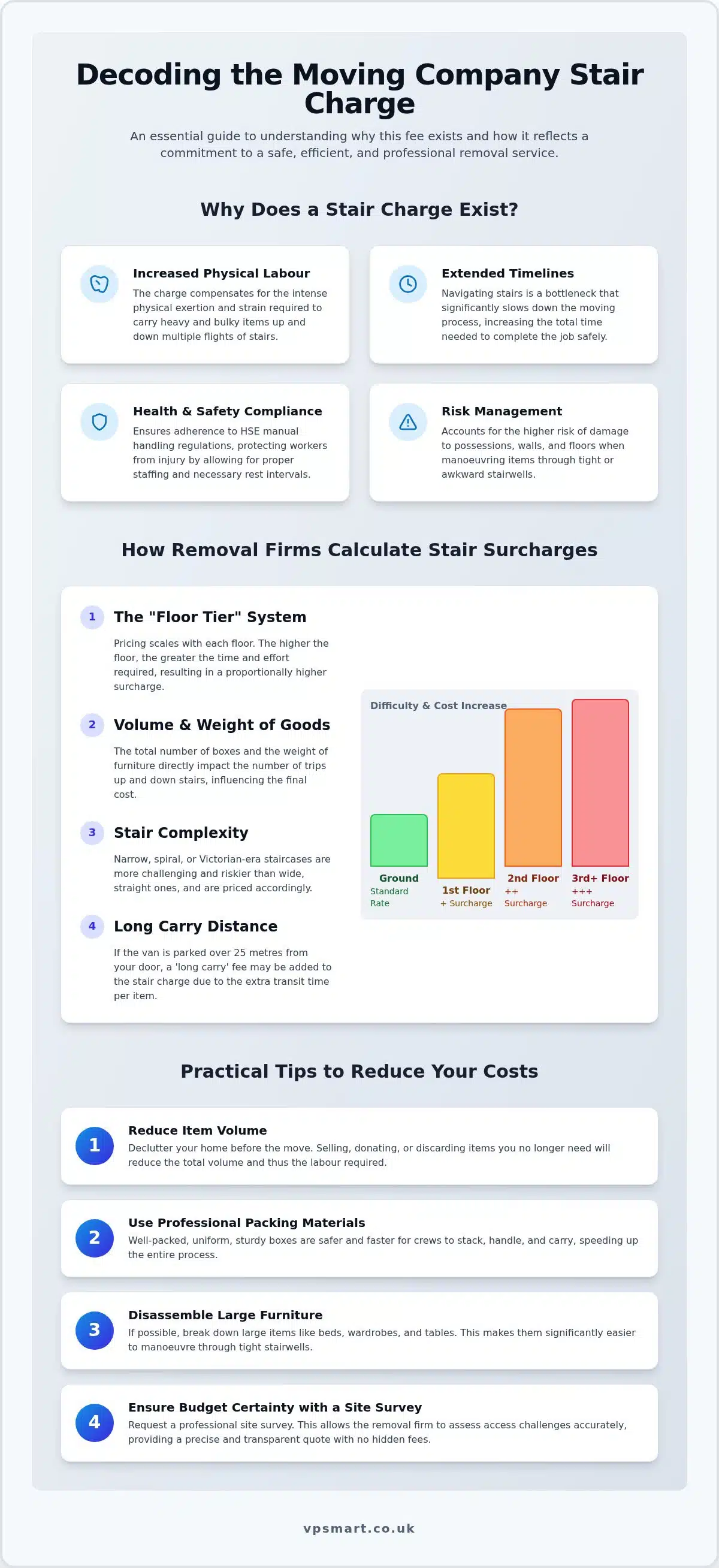
A moving company stair charge is essentially a surcharge applied when a removal crew must navigate multiple flights of stairs to transport your belongings. While it might seem like an unwelcome addition to your quote, it’s a transparent reflection of the physical demands placed on the removal team. In the professional moving company sector, these fees exist to ensure that every transition is managed with the precision and care your home deserves. Carrying heavy furniture up several storeys isn’t just physically taxing; it slows the overall pace of the move and increases the risk of fatigue-related accidents.
By applying this charge, firms can adhere to Health and Safety Executive (HSE) guidelines regarding manual handling. These regulations are designed to protect workers from musculoskeletal disorders, which are a common risk in high-intensity labour. When a removal firm accounts for stairs in their initial pricing, they’re ensuring the crew is adequately staffed. This might mean adding an extra team member to rotate heavy lifting duties or scheduling more frequent rest intervals. This strategic resource planning ensures that the movers who arrive at your new property are just as fresh and capable as they were at the start of the day, protecting both their well-being and your possessions.
The Impact of Stairs on Removal Timelines
Stairs act as a natural bottleneck in any relocation project. Every flight adds significant time to each individual trip a mover makes between the van and your front door. On an average eight-hour moving day, these extra minutes accumulate quickly. A ground-floor flat might be cleared in a few hours, but a third-floor walk-up requires constant vertical travel, which can easily double the loading time. This isn’t just about walking; it’s about the careful manoeuvring required to pivot large items around tight corners without compromising the structural integrity of your furniture or the property itself.
Risk Management and Insurance Factors
The complexity of a move directly influences the risk profile of the task. Insurance premiums for removal firms often reflect the difficulty of the access routes they navigate. Narrow stairwells and steep gradients increase the likelihood of wall scuffs, carpet snags, or furniture damage. By acknowledging these risks through a formal charge, firms can maintain the high standards of protection you expect for your domestic environment. A moving company stair charge is a resource-allocation fee for high-intensity labour, ensuring that your move remains a well-managed experience from start to finish.
How Removal Firms Calculate Stair Surcharges
Understanding the arithmetic of a move requires looking at the “Floor Tier” system. Most firms categorise properties into ground floor, first floor, and high-rise levels. Each level represents a different resource requirement. A moving company stair charge isn’t just a flat fee; it scales based on the volume of goods. Carrying ten boxes up two flights is a different operational challenge than moving a solid oak wardrobe up a narrow stairwell. The cumulative weight of your inventory dictates the number of trips required, meaning a high-volume move naturally incurs a higher surcharge to account for the increased time and physical exertion.
You should also account for “Long Carry” fees. These often appear alongside stair surcharges when the distance from the removal van to the property entrance exceeds a standard limit, typically around 20 to 25 metres. If a mover has to traverse a long walkway before even reaching the first step, the labour intensity spikes. To avoid surprises, be alert for extra fees by providing a precise inventory during your initial consultation. An accurate list of items allows for better resource planning and ensures your removal quote remains fixed and transparent.
Tiers of Difficulty: Not All Stairs are Equal
Architectural complexities are a primary reason why a moving company stair charge varies between properties. Wide, straight communal stairs in modern apartment blocks allow for a steady, efficient pace. In contrast, narrow Victorian stairwells or tight spiral designs demand a higher premium. These architectural features require specialised manoeuvres and, in some cases, furniture disassembly to ensure safe passage. External stairs can also be more complex. If weather conditions make surfaces slippery, the crew must take extra precautions, which may involve additional protective coverings or a slower, more deliberate pace to maintain safety standards.
The “Lift Breakdown” Contingency
If your property has a lift, it’s vital to confirm its operational status. Lifts can fail. A sudden breakdown on moving day can transform a standard job into a high-intensity stair carry. We recommend checking maintenance schedules with your building manager well in advance of your move date. Most professional contracts include a “Stair Clause” to address these contingencies. This ensures that if the lift is out of order, the crew is still fairly compensated for the sudden increase in physical labour. This transparency protects both your budget and the physical well-being of the removal team, maintaining the flow of your move even when technology fails.
Stairs vs. Lifts vs. Hoisting: Which is Best?
Deciding between manual labour and mechanical assistance is a pivotal moment in any relocation plan. While a moving company stair charge covers the physical effort of the crew, there’s a threshold where manual carries become inefficient for both your timeline and your budget. Understanding how moving companies price stair access helps you identify the tipping point where equipment hire might actually save you time. Modern removals rely on specialised tools to bridge the gap between architectural constraints and the lived experience of a smooth move.
The trade-off between labour costs and equipment hire is often a matter of technical oversight. Equipment like hoists involves a fixed setup cost, whereas manual labour is typically scaled by volume or time. For a fifth-floor move without a lift, the speed of mechanical assistance can drastically reduce the hours on the clock. This efficiency ensures your environment remains calm and well-managed, avoiding the prolonged disruption of a team traversing stairs for an entire afternoon. It’s a pragmatic choice that prioritises performance and the safety of your belongings.
When to Choose a Hoisting Service
Hoisting involves using an external mechanical lift to transport items through windows or balconies, bypassing internal stairwells entirely. This is the superior choice for high-value or oversized pieces like grand pianos, solid wood wardrobes, or deep-seated sofas that refuse to pivot around tight corners. By choosing the VP Smart Removals hoisting service, you eliminate the risk of scuffing narrow hallway walls or straining the crew on high-rise jobs. It’s a premium solution that prioritises the safety of your belongings whilst accelerating the overall timeline of the move.
Small Lift Limitations
Having a lift in your building doesn’t always guarantee a waiver of the moving company stair charge. If your furniture exceeds the internal dimensions of the lift car, the crew must revert to the stairs, triggering the associated surcharge. Before moving day, it’s wise to verify the following details:
- Measure the height, width, and depth of the lift car to ensure large furniture fits.
- Check the diagonal clearance for long items like headboards or mattresses.
- Verify the weight capacity, as residential lifts often have lower limits than dedicated goods lifts.
If items must be split between the lift and the stairs, the surcharge will typically be adjusted to reflect the specific volume of goods handled manually. This ensures you’re only paying for the precise level of resource required for your property’s specific layout. By managing these technical details in advance, you maintain control over your final bill and ensure a seamless transition into your new home.
How to Minimise Stair Charges and Prepare Your Property
Reducing the financial impact of a move is often a matter of proactive management. While a moving company stair charge is a standard industry practice for high-intensity labour, you have the agency to influence the final bill. One of the most effective strategies is “staging” your belongings. If you have the capacity to move lighter, non-fragile items to a ground-floor staging area or a garage before the team arrives, you directly decrease the number of vertical trips the crew must perform. This level of oversight allows the professionals to focus their energy on the technical, heavy items that truly require their expertise, ensuring a faster and more cost-effective transition.
Utilising professional packing and box delivery services also plays a critical role in streamlining the process. When items are secured in standardised, high-quality containers, they’re far easier to stack and carry safely. This prevents the awkward, time-consuming handling often associated with mismatched containers or overfilled bags. By investing in the right materials, you improve the lived experience of the move for both yourself and the removal team.
Efficient Packing for Stair Access
Movers maintain a much steadier pace when they aren’t struggling with inconsistent weight distributions. We recommend a strict weight limit for any box destined for a stair carry to ensure the crew can navigate the incline with total confidence. A useful guideline is the “Small Box” rule: always pack heavy items like books, records, or kitchenware into smaller boxes. This prevents the containers from becoming unmanageable and significantly reduces crew fatigue over the course of the day. Well-organised boxes reduce the total number of trips required, which directly translates to a more efficient use of billable time.
Clearing the Path: Safety First
The physical environment of your stairwell can either hinder or help the removal process. Before the team arrives, take the time to remove any rugs, loose wires, or wall decorations that could pose a trip hazard or restrict movement. It’s equally important to secure a parking space as close to the property entrance as possible. A shorter walk from the door to the van means the crew spends less time on the “long carry” mentioned previously, allowing them to maintain their momentum. Don’t forget to notify your neighbours in advance; ensuring communal areas are clear of bikes or prams allows the crew to maintain a continuous, uninterrupted flow throughout the property.
Book professional movers and packers
Transparent Pricing with VP Smart Removals
At VP Smart Removals, we believe that financial clarity is as vital as the physical safety of your belongings. We’ve built our reputation on a foundation of honest, upfront communication, ensuring that your initial estimate is a true reflection of the resources required. For complex apartment relocations, we highly recommend a professional site survey. This proactive step allows our experts to assess the architectural nuances of your property firsthand, identifying potential bottlenecks before moving day arrives. By providing this level of complete oversight, we eliminate the anxiety of hidden surprises, allowing you to focus on the lived experience of settling into your new home. You can explore our pricing page for a detailed breakdown of how we structure our various service tiers.
Expert Handling for High-Difficulty Moves
Since our founding in 2016, we’ve focused on becoming a dependable partner for even the most technically demanding relocations. Our crew undergoes rigorous, specialised training to master the mechanics of high-intensity carries, ensuring that every moving company stair charge is backed by genuine expertise. We view our specialised equipment not just as tools, but as helpful partners that ensure the safety of your domestic environment. This proficiency is particularly vital when handling delicate, high-value items like pianos in confined urban spaces. Because we offer a fully integrated suite of services, including furniture disassembly and a professional hoisting service, we can pivot between methods as the situation demands. This versatility ensures that your move never stalls due to an oversized item or a narrow corridor, maintaining a steady and predictable rhythm throughout the day.
Requesting Your Bespoke Quote
To provide you with the most accurate assessment of your needs, we encourage you to share as much detail as possible about your property’s access. Knowing the exact number of floor levels, the width of the stairwells, and the proximity of the parking area allows us to allocate the perfect team for the job. We offer both hourly-rate and fixed-price relocations, giving you the flexibility to choose a model that aligns with your financial goals. A fixed-price quote is often the superior choice for moves involving a moving company stair charge, as it provides total budget certainty regardless of the time required for manual carries. Our goal is to provide a future of effortless comfort, starting with a transparent and fair agreement that puts you firmly in control of your own environment.
Secure a Seamless and Transparent Transition
Navigating property access challenges shouldn’t be a source of stress or financial ambiguity. We’ve explored how a moving company stair charge acts as a vital tool for accurate resource planning, ensuring your removal crew is correctly equipped and rested for high-intensity labour. By utilising proactive strategies like ground-floor staging and professional packing, you can actively manage these costs whilst protecting the structural integrity of your most delicate possessions. This approach allows you to maintain complete oversight of your budget, transforming a technical requirement into a well-managed logistical advantage.
Since 2016, our team has refined the art of the complex relocation, providing a dependable service that balances technical precision with approachable domestic warmth. We offer specialised handling for pianos and fine art, alongside comprehensive hoisting services for properties with restricted internal access. This commitment to transparency and performance ensures that your transition is defined by effortless comfort rather than logistical anxiety. We believe that a well-managed environment begins with an honest partnership, rooted in regional reliability and professional expertise.
Get a transparent, fixed-price removal quote today
Your new home marks the beginning of a fresh chapter, and we’re here to ensure the journey there is as smooth and rewarding as the destination itself.
Frequently Asked Questions
Is a stair charge standard in the UK removal industry?
Yes, a moving company stair charge is a standard industry practice across the United Kingdom. It ensures that removal firms can allocate the necessary resources and additional manpower required for high-intensity labour. By accounting for the physical strain and extended timelines associated with multiple floors, companies can maintain a safe working environment whilst providing a transparent and accurate quote for their customers, reflecting the true complexity of the task.
How many flights of stairs typically trigger an extra charge?
Most removal firms apply a surcharge for any property located above the first floor when a lift is unavailable. Ground floor and first-floor access are often included in standard rates, but second-floor walk-ups and higher typically trigger a tiered fee structure. This reflects the cumulative fatigue and time delay involved in traversing multiple storeys, allowing for better resource planning and team rotation throughout the moving day to ensure consistent performance.
Does the stair charge apply if there is a working lift?
If a working lift is available and accessible, a stair charge is usually waived. However, surcharges may still apply if specific oversized items, such as large sofas or wardrobes, cannot fit inside the lift car and must be carried manually. It’s also important to check if the lift has weight restrictions or limited operating hours, as these factors can influence the final resource allocation and logistics of your relocation project.
What happens if my sofa doesn’t fit through the stairwell?
When items are too large for internal stairwells, we often utilise a professional hoisting service to transport furniture through windows or balconies. Alternatively, our team can provide expert furniture disassembly and reassembly to navigate narrow passages. These specialised solutions ensure that your belongings reach their destination without damage to the property or the items themselves, maintaining a high standard of safety and efficiency even during the most challenging access moves.
How can I avoid paying a stair charge on moving day?
You can minimise these fees by reducing the volume of goods that require manual carrying. Staging lighter, non-fragile boxes on the ground floor before the crew arrives is an effective strategy. Additionally, ensuring that lifts are booked for exclusive use and that parking is secured as close to the entrance as possible reduces the total labour time. Proactive organisation allows the professionals to focus solely on the heavy items that require their expert handling.
Will the movers still carry items if the lift breaks down?
Our team will continue the move to ensure your transition is completed, even if technical equipment fails unexpectedly. In such scenarios, a contingency “stair clause” in the contract typically activates to compensate for the sudden increase in physical exertion and time. This ensures the crew is fairly supported for the additional labour, maintaining the flow of the move whilst upholding our commitment to reliability and worker safety under difficult and changing conditions.
Are stair charges applied per item or as a flat fee?
Pricing models vary, but most firms apply a tiered fee based on the number of floors and the total volume of inventory. This isn’t usually a per-item charge unless you are moving a single heavy object like a piano. Instead, a moving company stair charge is a resource-allocation fee that covers the entire team’s effort across the duration of the project, providing a more transparent and predictable cost structure for the modern homeowner.
Can I reduce the fee by helping the movers with smaller boxes?
For health and safety reasons, as well as insurance compliance, customers shouldn’t assist with the physical carry on the day. However, you can significantly reduce the billable time by pre-organising your belongings. Staging items in an accessible ground-floor area or using professional packing services to create uniform, stackable boxes allows the crew to work much faster. This efficiency naturally lowers the overall labour costs without compromising the safety of the removal environment.
Disclaimer
Some links in this article may be affiliate links, which means we may earn a small commission if you make a purchase through them, at no additional cost to you. We only recommend products or services we believe provide value to our readers.