
What if the removal firm you trusted with your family’s most precious belongings leaves you with a £600 repair bill and a wall of silence? It’s a frustrating reality for many homeowners who find themselves facing property damage or hidden surcharges just as they should be settling into their new environment. If you’re currently dealing with unresponsive customer service or broken furniture, filing a complaint against a moving company in the UK requires a systematic approach rather than an emotional one.
We understand that your home is more than just a collection of assets; it’s a carefully managed space where you deserve complete oversight. You likely feel that professional standards should be a guarantee, not a gamble. This 2026 guide promises to clarify your legal standing and provide the precise steps needed to secure a formal apology, a refund, or a successful compensation claim. We will explore the vital hierarchy of dispute resolution, starting from internal procedures and moving through to the technicalities of UK consumer law and the Small Claims Court.
Key Takeaways
- Learn how the Consumer Rights Act 2015 protects your move as a professional service. You’ll gain the legal standing to demand reasonable care and skill throughout the process.
- Master the internal dispute hierarchy to expedite your resolution; filing a complaint against a moving company uk is most effective when initiated within the critical seven-day damage notification window.
- Identify the role of trade bodies like the British Association of Removers. We’ll explain how Alternative Dispute Resolution provides a stress-free path to compensation without the need for a courtroom.
- Understand the 2026 Small Claims Court thresholds and the Money Claim Online system. This is vital for holding independent operators accountable for service failures or contract breaches.
- Discover how to prevent future disputes by prioritising technical oversight. Detailed site surveys and professional packing services significantly mitigate transit risks and provide clear evidence for any claims.
Understanding Your Consumer Rights for Removals in the UK
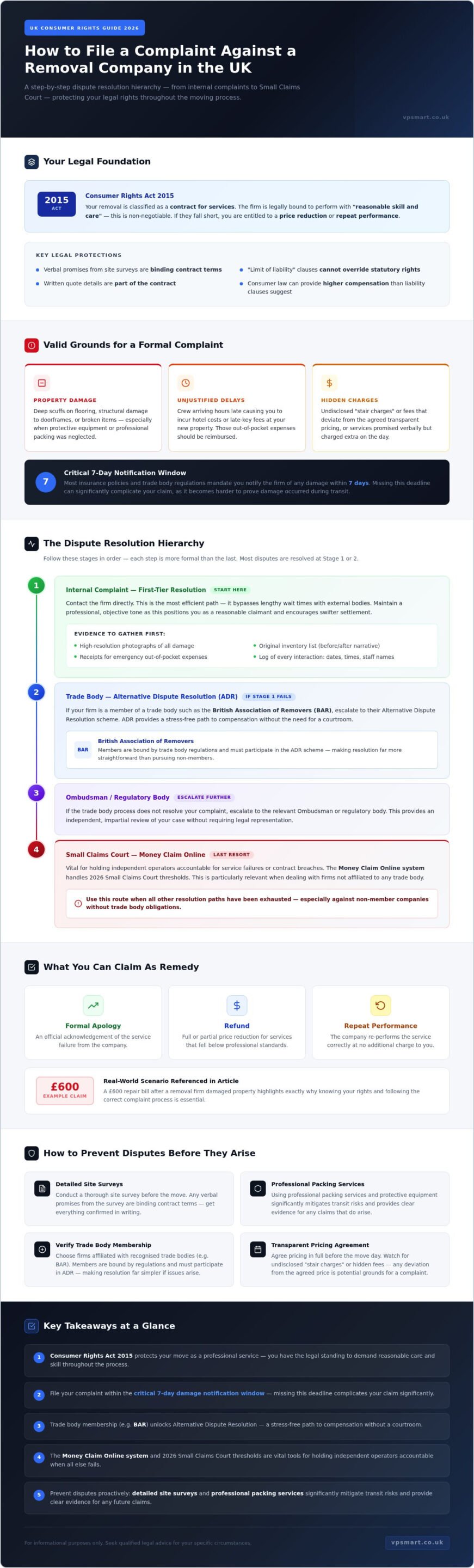
The UK legal system treats your home move as a contract for services, which provides you with specific, non-negotiable protections. When a firm handles your furniture assembly or piano removals, they’re legally bound to perform the work with “reasonable skill and care”. This benchmark isn’t just a suggestion; it’s a technical requirement. If a removal team fails to meet this standard, you aren’t just stuck with the bill; you have the right to a legal remedy that restores your domestic peace of mind.
The Consumer Rights Act 2015 and Your Move
Under the Consumer Rights Act 2015, your removal project is classified as a service. This distinction is vital because it entitles you to a price reduction or a repeat performance if the quality falls below professional standards. Any verbal promises made during your site survey or written details in your initial quote are considered binding contract terms. If a representative told you that a hoisting service was included and then charged extra on the day, they’ve breached these terms. This legislation ensures you maintain oversight of the moving process, which is essential when filing a complaint against a moving company uk to rectify a breach of service.
Valid Grounds for a Formal Complaint
Knowing exactly when to escalate is the first step in filing a complaint against a moving company uk. Valid grounds aren’t limited to broken plates; they encompass the entire service delivery. Physical damage to your property, such as deep scuffs on flooring or structural damage to doorframes, amongst the most common claims, often occurs when professional packing services or protective equipment are neglected. Unjustified delays also provide strong grounds for a claim. If a crew arrives hours late, causing you to incur hotel costs or late-key fees at your new property, those expenses should be reimbursed. Additionally, watch for undisclosed “stair charges” or hidden fees that deviate from your transparent pricing agreement.
Most firms include “limit of liability” clauses in their terms and conditions. Whilst these may seem restrictive, they cannot override your statutory rights. If a company claims they’re only liable for £40 per item, but their negligence caused the damage, consumer law often provides a path to higher compensation. If direct negotiations stall, you can seek alternative dispute resolution to find a fair middle ground without the complexity of a full court hearing. This structured approach helps alleviate the anxieties of a move, ensuring your financial interests are as well-managed as your furniture.
The Internal Complaint Process: Resolving Issues Directly
Resolving a dispute directly with your provider is often the most efficient path to securing a refund or repair. This “First-Tier” resolution bypasses the lengthy wait times associated with external bodies, allowing you to regain control over your home environment quickly. Timing is everything; most insurance policies and trade body regulations mandate a critical 7-day window for notifying a firm of any damage. Missing this deadline can complicate your claim, as it becomes harder to prove that the damage occurred during transit rather than after the crew departed.
Maintaining a professional, objective tone is your strongest asset. Whilst it’s natural to feel frustrated by property damage or unexpected surcharges, a calm approach positions you as a reasonable claimant. This clarity of communication often encourages a swifter settlement, as it demonstrates that you are prepared to follow a logical process. If you’ve already checked our transparent pricing and found a discrepancy, presenting this data clearly will speed up the internal review.
Step 1: Gathering Indisputable Evidence
A successful claim relies on data, not just descriptions. Start by cross-referencing high-resolution photographs of the damage with your original inventory list. This provides a clear “before and after” narrative that is difficult to dispute. You should also collect receipts for any emergency out-of-pocket expenses, such as temporary storage or hotel stays, caused by the company’s failure. Keep a detailed log of every interaction, noting dates, times, and the names of staff members you spoke with. This level of oversight ensures that when filing a complaint against a moving company uk, your case is built on a foundation of documented facts.
Step 2: Drafting the Formal Letter of Complaint
Your formal letter should be a precise document that leaves no room for ambiguity. Explicitly state that you are filing a complaint against a moving company uk under the Consumer Rights Act 2015. This technical reference signals that you understand your legal standing. Clearly specify your desired outcome: do you require a partial refund, a professional repair, or a full replacement of an item? Set a firm but reasonable deadline, typically 14 days, for the company to provide a substantive response. If this internal route fails, you may eventually need to consider making a small claims court claim in the UK, but a well-structured letter often prevents the need for such escalation.
Escalating the Dispute: Trade Bodies and the Ombudsman
If your formal letter doesn’t yield a satisfactory response, the next logical step is to check for trade body membership. Professional oversight is a hallmark of a dependable mover, and membership in organisations like the British Association of Removers (BAR) or the National Guild of Removers and Storers provides a vital safety net. Filing a complaint against a moving company uk is most effective when you can leverage these regulatory frameworks, as member firms are required to adhere to strict codes of practice that prioritise consumer protection and service quality.
Alternative Dispute Resolution (ADR) serves as a modern solution to the anxieties of litigation. It offers a structured path to a resolution without the emotional and financial strain of a courtroom. These schemes are designed to be approachable, ensuring that the domestic well-being of the homeowner is protected through a transparent, evidence-based process. This layer of protection is often the difference between a lingering dispute and a successful compensation claim.
Using the British Association of Removers (BAR) ADR
BAR members provide their customers with access to a free, independent ombudsman service. This technical mechanism ensures that your case is reviewed by a neutral third party with industry expertise. One of the most significant benefits is the Advanced Payment Guarantee. This feature protects your deposit and advance payments if a firm ceases trading before your move is complete. The conciliation process acts as a helpful middle ground, using logic and fairness to settle disputes over property damage or service failures whilst avoiding the sterile coldness of legal proceedings.
The Role of the Furniture & Home Improvement Ombudsman
When internal complaints fail to resolve the issue, the Furniture & Home Improvement Ombudsman provides a final, authoritative decision. This independent body has the power to award compensation for both direct financial losses and the distress caused by a sub-standard move. Their decisions are legally binding on the removal company, which ensures a high level of accountability. When you are filing a complaint against a moving company uk, the ombudsman’s role is to act as the final arbiter of fairness. Whilst the company must follow the ruling, you as the consumer generally retain the oversight to decide whether to accept the decision or pursue further legal action. This system empowers you to hold companies accountable for their performance, ensuring your home environment remains well-managed and secure.
Legal Recourse for Complaints Against Non-Member Companies
While association membership is a helpful quality benchmark, thousands of independent operators and “Man and Van” services operate outside these bodies. When filing a complaint against a moving company uk that isn’t a member of BAR or the National Guild, you must rely on statutory legal frameworks. You still have complete oversight of the situation, but the process moves from industry conciliation to formal regulatory reporting and legal action. This path ensures that even smaller, independent firms are held to the same professional standards as larger competitors.
First, verify the firm’s insurance coverage. Public Liability insurance protects your home’s structure, whilst Goods in Transit insurance covers your specific belongings. If an independent mover remains unresponsive, checking their insurance status provides a technical route to compensation. If their insurer denies the claim due to the mover’s negligence, you can hold the company directly liable for the loss. This proactive oversight is a vital part of managing your domestic environment during a transition.
Reporting to Trading Standards
Trading Standards teams investigate commercial practices that cross the line into criminal behaviour, such as fraud or aggressive sales tactics. If you’ve been hit with unexpected surcharges not in your contract or faced intimidation, report the company via the Citizens Advice consumer helpline. Whilst Trading Standards usually focuses on prosecution rather than individual refunds, your report builds a case against rogue operators. This helps protect the regional quality benchmarks that dependable local firms work hard to maintain, ensuring a safer market for every homeowner.
Initiating a Small Claims Court Action
For claims under £10,000 in England and Wales, the Small Claims Court is a logical, instructional path to recovery. Before using the Money Claim Online system, you must issue a “Letter Before Action”. This is a final, formal warning that provides the mover with a final 14-day window to settle the dispute. If they refuse, the court fee structure is tiered based on the claim value. Judges apply a “reasonableness” test, evaluating whether the mover exercised the care expected of a professional service. Documented evidence is your primary tool when filing a complaint against a moving company uk through the court system.
Secure a transparent and fixed-price removal quote
How to Prevent Moving Disputes: Choosing a Reliable Partner
Prevention is the most effective way to avoid the stress of filing a complaint against a moving company uk. It begins with selecting a partner that values technical oversight as much as domestic comfort. A reliable mover doesn’t just transport boxes; they manage an environment through detailed site surveys and digital risk assessments. This proactive approach identifies potential hurdles, such as narrow stairwells or the need for specialised piano removals, before the moving day begins. By addressing these technical specifications early, you ensure a future of effortless comfort in your new home.
Before signing any agreement, verify the mover’s insurance credentials. Adequate Goods in Transit and Public Liability cover are essential safety nets that provide emotional security. A dependable provider will be transparent about their policy limits and excess amounts, ensuring your assets are protected. This professional expertise differentiates a visionary pragmatist from a rogue operator, positioning you as the person in charge of your own environment.
The Importance of Transparent Pricing
Financial optimisation is a core pillar of a well-managed move. You should understand the mechanics of your quote, specifically the difference between hourly rates and fixed-price relocation fees. Hourly models can sometimes lead to disputes if traffic or access issues cause unexpected delays, whereas fixed-price models offer predictable oversight. Avoid any operator that refuses to provide a written inventory or a formal contract. You should also ask about potential surcharges for stairs or difficult access upfront. By securing these details in writing, you eliminate the ambiguity that often leads to homeowners filing a complaint against a moving company uk.
VP Smart Removals: A Commitment to Excellence
Choosing a specialist ensures that your belongings are treated as helpful household entities rather than just cargo. Our house removals services prioritise the careful handling of delicate items, utilising specialised equipment like hoisting services for difficult access points. Data suggests that engaging professional movers and packers significantly lowers the statistical likelihood of transit damage. Our teams use high-quality packing materials and technical packing methods to secure your items for the journey. This level of professional oversight ensures every detail is organised to prevent the need for complaints, allowing you to settle into your digitally integrated lifestyle with total confidence.
Securing Your Future Domestic Peace of Mind
Securing a resolution when a service fails is about reclaiming oversight of your home environment. We’ve explored how the Consumer Rights Act 2015 provides a technical safety net, whilst the internal complaint process remains the fastest route to a refund or repair. Whether you are navigating trade body arbitration or pursuing the Small Claims Court, your success depends on maintaining a documented, objective record of every interaction. Filing a complaint against a moving company uk doesn’t have to be an emotional burden when you follow a steady, logical progression.
By choosing a partner that prioritises transparent performance, you can avoid these anxieties entirely. Our experienced team specialises in high-stakes tasks like delicate piano removals and expert furniture disassembly and reassembly. With comprehensive Goods in Transit insurance included as standard, we ensure your domestic well-being is protected from the very first site survey.
Get a Fixed-Price Quote for a Stress-Free Move
Your transition to a new home should be defined by effortless comfort and professional reliability. Take charge of your next move with a service designed to deliver complete peace of mind and technical excellence.
Frequently Asked Questions
How long do I have to file a complaint against a moving company in the UK?
You typically have up to six years to bring a legal claim for breach of contract, but most removal firms require notification of damage within seven days. This shorter window is a technical requirement for insurance claims and trade body regulations. Filing a complaint against a moving company uk immediately ensures that the evidence is fresh and the link between the move and the damage is indisputable and well-documented.
Can I complain if the moving company arrived late or took too long?
Yes, you can complain if a delay causes financial loss or violates the “reasonable time” requirement of the Consumer Rights Act 2015. If a late arrival leads to additional hotel costs or late-key charges from your solicitor, the firm may be liable for these expenses. Ensure you’ve documented the arrival time and any subsequent costs to support your request for a price reduction or a formal refund.
What should I do if the moving company is refusing to pay for damages?
If a company rejects your internal claim, you should escalate the dispute to an independent body like the British Association of Removers (BAR) or the Furniture & Home Improvement Ombudsman. These organisations provide Alternative Dispute Resolution (ADR) to find a fair middle ground. If the company is not a member of a trade body, your next logical step is issuing a formal “Letter Before Action” followed by a court claim.
Does a “limit of liability” clause mean I cannot claim the full value of my items?
A “limit of liability” clause often attempts to cap payouts at a specific amount per item, but it cannot override your statutory rights. If the mover failed to use reasonable skill and care, they may be liable for the full repair or replacement cost regardless of their contract terms. You should challenge any cap that feels unfair or does not reflect the actual loss incurred during your relocation project.
Is it worth taking a moving company to the Small Claims Court?
Taking a mover to court is often worth it for claims between £500 and £10,000 where the evidence of negligence is clear. The Money Claim Online system makes the process instructional and steady, though you should weigh the tiered court fees against your potential recovery. Most cases settle before reaching a hearing once a formal “Letter Before Action” is issued, as companies prefer to avoid the record of a judgment.
How do I check if a removal company has valid insurance?
You should request a copy of the company’s insurance certificate to verify they have both Public Liability and Goods in Transit cover. A dependable firm will provide these documents during the site survey to offer you emotional security. Check that the policy is current and the limit of indemnity is high enough to cover the total value of your belongings, especially for specialised tasks like piano removals.
What happens if I didn’t sign a contract with the mover?
Even without a signed physical document, a binding contract exists through your exchange of emails, text messages, or verbal agreements. The Consumer Rights Act 2015 applies to any service agreement, meaning the company must still perform the move with reasonable skill and care. When filing a complaint against a moving company uk in this situation, your digital trail of quotes and booking confirmations serves as the technical evidence of your agreement.
Can I stop payment if I am unhappy with the service on moving day?
Stopping payment is generally not advised as it can be viewed as a breach of contract on your part, potentially leading to debt collection actions. It’s legally safer to pay the invoice and then immediately initiate a formal complaint to seek a partial refund. This approach maintains your oversight of the situation and ensures you remain the reasonable party if the dispute eventually requires escalation to an ombudsman or court.
Disclaimer
Some links in this article may be affiliate links, which means we may earn a small commission if you make a purchase through them, at no additional cost to you. We only recommend products or services we believe provide value to our readers.