Aug 25, 2026
Why spend your Saturday navigating a hired van through the Congestion Zone, only to risk a strained back or a scuffed wardrobe? For many homeowners, the DIY approach to furniture storage london feels like a logical way to save money, yet the reality often involves hidden ULEZ charges and the high-stakes stress of tight city streets. You likely agree that your furniture represents more than just wood and fabric; these are the anchors of your domestic well-being that deserve professional protection rather than a risky weekend haul.
This ultimate 2026 guide promises to simplify the transition by explaining the mechanism of managed storage, where expert collection and technical disassembly replace the chaos of traditional self-storage. We will detail how to accurately assess your space requirements, prepare delicate items for long-term protection, and ensure you maintain complete oversight of your environment without ever lifting a heavy box. From handling narrow stairwells to the precision of professional hoisting, you’ll discover how a more intelligent approach to storage can optimise your home life and your peace of mind.
Key Takeaways
- Learn why managed storage is the superior, stress-free alternative to DIY units by removing the physical strain and logistical burden of van hire.
- Discover how professional furniture storage london services offer complete oversight of your belongings through expert disassembly and secure warehouse transit.
- Master the technique of room-by-room volume estimation to achieve financial optimisation and ensure you never pay for redundant space.
- Understand the technical cleaning and preparation required to protect wood, leather, and fabrics from environmental factors during long-term storage.
- Gain clarity on navigating London’s specific access challenges, including ULEZ compliance and the use of professional hoisting services for complex apartment moves.
Understanding Your Furniture Storage Options in London
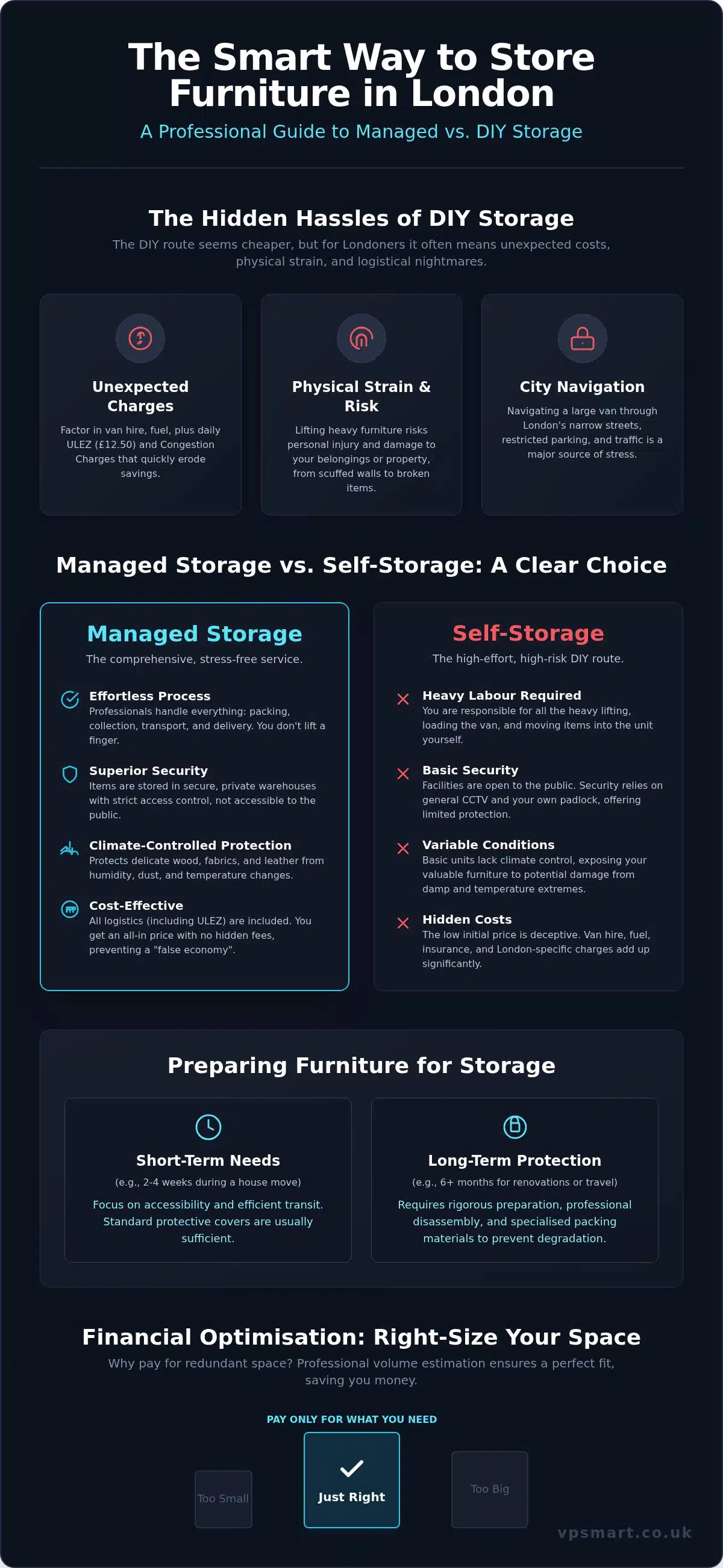
Furniture storage london is more than just renting a lockable room; it’s a managed ecosystem designed to preserve the integrity of your household assets. While Understanding Self-Storage provides a baseline for the industry’s history, modern residents are increasingly opting for “managed” solutions. This shift stems from a desire for complete oversight without the physical burden of the traditional DIY model. Whether you’re orchestrating a complex move, refreshing your interiors through renovation, or downsizing to a sleek city apartment, a managed facility provides a climate-controlled environment that shields delicate timbers and fabrics from the city’s humidity and dust.
Common life transitions often dictate the need for this professional buffer. You might be moving abroad for a fixed-term contract or perhaps you’ve found the perfect home but face a gap between tenancies. In these moments, the priority shifts from mere space to high-performance security and professional logistics. Choosing a partner that integrates collection and delivery ensures your furniture never leaves expert hands. This removes the risk of transit damage that often occurs during amateur attempts at loading and securing heavy items.
Short-term vs. Long-term Storage Needs
Your timeline significantly influences the technical preparation required for your belongings. Short-term needs, such as a two-week overlap during House Removals London, focus on accessibility and rapid transit. Conversely, long-term storage demands a more rigorous standard of protection. Items staying for a year or more require specialised packing materials and professional disassembly to prevent material degradation over time. Flexibility is equally vital; property completion delays are a staple of the London market, so your storage solution must be agile enough to adapt to shifting dates without compromising the safety of your environment.
Why London Logistics Require a Different Approach
The capital’s geography presents unique hurdles that make DIY furniture storage london a logistical gamble. Navigating the Ultra Low Emission Zone (ULEZ) and the Congestion Charge in a hired van adds immediate financial friction and administrative complexity. Beyond the costs, the physical reality of parking a large vehicle in boroughs like Fulham or Wandsworth is often a source of intense anxiety for the modern homeowner. Managed storage removes these variables from your equation. Professional teams handle the permits, the narrow street navigation, and the ULEZ compliance, allowing you to focus on your transition whilst they manage the heavy lifting and technical transport.
Managed Storage vs Self-Storage: Which is Right for Your Move?
Choosing the right furniture storage london requires a clear understanding of your personal priorities: do you value the perceived control of a DIY unit, or the high-performance efficiency of a managed warehouse? Self-storage is essentially a property rental for your belongings. You manage the logistics, the heavy lifting, and the security of your own padlock. In contrast, managed storage is a comprehensive service where experts handle the entire lifecycle of your items. When entering these agreements, it’s vital to Know Your Consumer Rights to ensure you’re protected against unfair terms and service standards.
While self-storage rates might appear lower on paper, the “false economy” of the DIY model often emerges when you factor in the hidden costs of London life. Van hire, fuel, and the £12.50 daily ULEZ charge quickly erode any initial savings. Beyond the finances, the security profile of a managed warehouse offers a more robust solution. Rather than relying on building-wide CCTV and individual unit alarms that anyone in the facility can access, managed storage utilizes strict warehouse access control. This ensures your assets are held in a secure, professional environment that is closed to the general public.
The Convenience Factor for Busy Londoners
London life is fast-paced, and your time is a finite resource. Spending a weekend shuttling between your home and a storage centre is rarely the best use of your energy. Managed storage provides complete oversight from your living room. Professional teams arrive at your door, inventory your items, and transport them directly to a secure facility. This eliminates the physical strain of moving heavy wardrobes or sofas, protecting both your health and your home’s interior from the scuffs and scrapes common with amateur transport.
Safety and Professional Handling
Delicate items demand technical expertise that goes beyond simply stacking boxes. Our movers and packers are trained to prevent structural damage through precise disassembly and protective wrapping. This is particularly crucial for specialised pieces like pianos or antique wood, which are susceptible to moisture and temperature fluctuations. Managed warehouses are designed as helpful household entities that maintain a stable environment, preventing the dust and moisture build-up common in less-regulated self-storage units. If you’re ready to transition to a more efficient way of managing your home’s contents, exploring professional storage services in London is the logical next step for a stress-free move.
Calculating the Right Storage Size for Your Belongings
A common friction point for homeowners is the confusion between floor space and total volume. In a city where every square inch is at a premium, understanding how furniture storage london utilises vertical height is the key to financial optimisation. Traditional self-storage guides often lead you to rent more floor space than you actually need because they assume a 2D layout. In contrast, a managed warehouse environment treats space as a three-dimensional resource, stacking items safely to ensure you aren’t paying for “dead air” above your belongings.
Generic online calculators frequently overestimate requirements by failing to account for the unique geometry of your home. A professional room-by-room inventory is far more precise. By auditing each helpful household entity, from the bulky wardrobe to the nested coffee tables, you gain complete oversight of your storage footprint. This data-driven approach ensures that the transition to storage is as efficient as possible, preventing the unnecessary costs associated with oversized units.
Common Furniture Size Benchmarks
Visualising space requirements helps ground the planning process in reality. A standard three-piece suite combined with a king-size bed frame and roughly fifteen to twenty medium boxes typically forms the core of a one-bedroom flat’s inventory. To put this into perspective, a 35 sq ft storage space provides roughly the same capacity as a small transit van load when packed to its full height. Recognising these benchmarks allows you to communicate more effectively with your service provider and avoid the logistical anxiety of underestimating your needs.
Maximising Space Through Professional Packing
The mechanism of space-saving lies in technical preparation and the use of high-performance packing materials. When items are wrapped correctly, they can be stacked without the risk of structural compromise. Storing sofas and mattresses in an upright position is a simple yet transformative tactic that drastically reduces the required floor area. This level of care is a central part of Preparing Furniture for Storage, ensuring that your assets remain in pristine condition whilst occupying the smallest possible footprint.
Disassembly remains the most effective method for reducing volume. Removing legs from dining tables or breaking down large bed frames turns awkward, space-consuming shapes into flat, stackable components. This pragmatic strategy not only lowers your recurring storage costs but also makes the physical transport through narrow London hallways significantly safer. By focusing on volume rather than just floor area, you transform storage from a passive expense into a well-managed asset protection strategy.
How to Prepare Your Furniture for Long-Term Storage
Preparation is the technical foundation that ensures a future of effortless comfort when you eventually retrieve your items. It begins with a rigorous cleaning phase. Dust particles are surprisingly abrasive; over months of storage, they can settle into finishes and cause micro-scratches. Similarly, skin oils and organic residues on upholstery can oxidise, leading to permanent staining or material degradation. By removing these elements before the transition, you maintain complete oversight of your furniture’s condition and longevity.
Material-specific care is the next logical step in this professional consultation. Wood surfaces benefit from a light application of high-quality wax to maintain their internal moisture balance, preventing the timber from shrinking or cracking. Leather items require a specialised conditioner to ensure the hide remains supple whilst in a controlled environment. For fabric pieces, a deep vacuum and a light spray of fabric protector provide a high-performance barrier against environmental factors. This linguistic layering of care ensures your assets are treated as helpful household entities rather than just inert objects.
Choosing the correct protective layers is vital for long-term safety. Breathable furniture blankets are superior to bubble wrap for large surfaces because they allow air to circulate, preventing the moisture trap that leads to mildew. Bubble wrap should be reserved for the vulnerable corners of tables or the delicate legs of chairs, providing a physical buffer against impact during the moving process. Every item should be clearly inventoried and labelled, ensuring you know exactly which wardrobe or chest of drawers is positioned at the rear of your furniture storage london solution.
The Art of Furniture Disassembly
Bed frames, dining tables, and large wardrobes should always be taken apart to protect their structural integrity. Disassembly turns awkward, high-volume shapes into flat, manageable components that are far less likely to suffer stress during transit. Use the “bag and tape” method: place all screws, brackets, and specialised fixings into a heavy-duty bag and tape it securely to a hidden surface of the corresponding item. VP Smart Removals integrates this precision into their storage services, ensuring that reassembly is just as seamless as the initial move.
Navigating London Access Challenges
Moving furniture from upper-floor apartments in boroughs like Kensington or Islington presents unique logistical friction. Narrow hallways and Victorian stairwells often make traditional transport impossible for bulky items like grand pianos or oversized sofas. When the lift is too small, a professional hoisting service becomes the most efficient mechanism for a safe exit. We also manage the administrative burden of parking suspensions and stair charges, providing the regional reliability that modern Londoners expect from a premium provider.
Secure your managed storage solution with a professional assessment today
Why VP Smart Removals is London’s Favourite Storage Partner
VP Smart Removals stands as the visionary pragmatist in a market often cluttered with disconnected services. Whilst many providers offer a room for rent, we provide a high-performance logistics partnership that manages the entire lifecycle of your household assets. This single point of contact approach eliminates the common anxiety of coordinating between independent movers and faceless storage facilities. By integrating our technical expertise in removals with secure furniture storage london, we ensure that your belongings remain under our complete oversight from the moment they are inventoried until the day they are redelivered to your new hallway.
Our regional reliability is built on a foundation of professional excellence across Greater London. Whether you’re moving from a riverside property in Richmond or a period apartment in Chiswick, our teams bring the hardware and the heart required for complex transitions. We specialise in the high-stakes handling of delicate items, including professional piano removals, where the mechanism of transport requires both physical strength and technical precision. This commitment to domestic well-being ensures that your most cherished items are treated as helpful household entities, not just cargo.
Our Managed Storage Process
The journey begins with a comprehensive site survey to establish a precise inventory of your needs. This data-driven approach allows for financial optimisation, ensuring you only pay for the exact volume your furniture occupies. Once collected, your items are held in our secure managed warehouse facilities, where climate control and strict access protocols preserve their condition. When you’re ready to settle into your new London home, our flexible redelivery options ensure your furniture returns in the exact same condition it left, making the final stage of your move as effortless as the first.
Beyond Storage: A Complete Relocation Suite
Our service philosophy extends beyond the warehouse doors to support every facet of your transition. We offer a seamless move-out experience by integrating professional end-of-tenancy cleaning, allowing you to hand back your keys with total confidence. For those embarking on broader horizons, our long-term storage solutions provide a dependable anchor during international moves to Europe. This holistic oversight ensures that no matter where your life leads, your environment remains perfectly managed and your assets remain secure.
Get a quote for your furniture storage in London today
Elevating Your Storage Experience in the Capital
Transitioning to a managed environment ensures you maintain complete oversight of your assets whilst avoiding the logistical friction of city transport. By prioritising technical preparation and professional disassembly, you protect the structural integrity of your furniture and optimise your recurring costs through precise volume management. These high-performance strategies transform furniture storage london from a simple space rental into a comprehensive asset protection plan that fits your digitally integrated lifestyle.
Our secure managed warehouse facilities utilise 24/7 monitoring to provide a level of protection that generic self-storage units simply can’t match. With expert collection and delivery services available across the capital, the physical burden of moving heavy items is entirely removed from your schedule. It’s a pragmatic approach to domestic well-being that ensures your belongings return to you in pristine condition, exactly when you need them.
Request a Fixed-Price Furniture Storage Quote
Embracing a managed solution allows you to focus on your next chapter with the confidence that your home’s anchors are in expert hands. We look forward to helping you create a more spacious and organised future.
Frequently Asked Questions
How much does furniture storage cost in London?
Furniture storage london costs depend on the volume of your inventory and the duration of the stay. Unlike DIY units, our managed service includes professional collection and expert handling, which eliminates hidden expenses like van hire and ULEZ charges. We focus on financial optimisation by conducting a detailed site survey. This ensures you receive a transparent, fixed-price quote tailored to the exact space your belongings occupy within our secure facility.
What is the difference between managed storage and self-storage?
The primary difference lies in the level of service and oversight provided. Managed storage is a “done-for-you” model where professionals handle collection, inventory management, and secure warehouse placement. Self-storage is a DIY property rental where you are responsible for transport and physical loading. For busy Londoners, managed storage offers a more efficient mechanism for protecting valuable furniture without the physical strain or logistical complexity of traditional units.
Is my furniture insured whilst in your storage facility?
Protecting your assets is a core pillar of our service. Most reputable facilities require insurance, and we provide comprehensive coverage options to safeguard your furniture whilst it remains in our managed warehouse. This ensures that your helpful household entities are protected against unforeseen circumstances. By integrating insurance into our professional consultation process, we alleviate the anxieties often associated with long-term storage, providing you with total peace of mind and domestic security.
Do I need to disassemble my furniture before you collect it?
You aren’t required to disassemble your items. Our team specialises in the technical breakdown and reassembly of complex furniture, including large wardrobes and bed frames. This professional intervention ensures that each piece is prepared for transit and storage in the most space-efficient manner possible. By managing this process for you, we prevent the structural stress that often occurs during amateur disassembly, maintaining the long-term integrity and visual appeal of your furniture.
Can I store a piano in your London storage facility?
We provide specialised piano removals and storage solutions designed for these delicate instruments. Pianos are sensitive to environmental shifts, so they require the stable, climate-controlled conditions found in our managed warehouse. Our technical expertise ensures that your piano is wrapped, transported, and held using professional equipment that prevents damage to the timber or internal mechanisms. This level of care is essential for preserving the performance and value of such high-priority household assets.
How much notice do I need to give to access my furniture?
Accessing your furniture storage london typically requires 24 to 48 hours’ notice. Managed facilities are high-security environments closed to the general public, which is a key mechanism for ensuring the safety of your belongings. Whilst this differs from the 24/7 access of self-storage, it provides a superior level of warehouse access control. When you are ready for redelivery, we simply coordinate a time that fits your schedule for a seamless transition.
Do you provide packing materials for furniture storage?
We supply a comprehensive suite of high-performance packing materials to ensure your furniture remains protected. Our inventory includes breathable blankets, specialised bubble wrap for corners, and heavy-duty boxes that facilitate safe vertical stacking. Using professional-grade materials is a vital step in preventing dust accumulation and material degradation over time. By providing these tools, we empower you to prepare your environment for a successful transition whilst ensuring the visual appeal of every item is maintained.
What happens if my move-in date to my new home changes?
Flexibility is a standard feature of our managed service. We understand that London property completions often face delays, so we make it easy to extend your storage duration as needed. If your move-in date changes, your items simply remain in our secure facility until you are ready for redelivery. This adaptable approach ensures you maintain complete oversight of your relocation journey without the stress of rigid timelines or logistical complications.
Disclaimer
Some links in this article may be affiliate links, which means we may earn a small commission if you make a purchase through them, at no additional cost to you. We only recommend products or services we believe provide value to our readers.
Aug 24, 2026
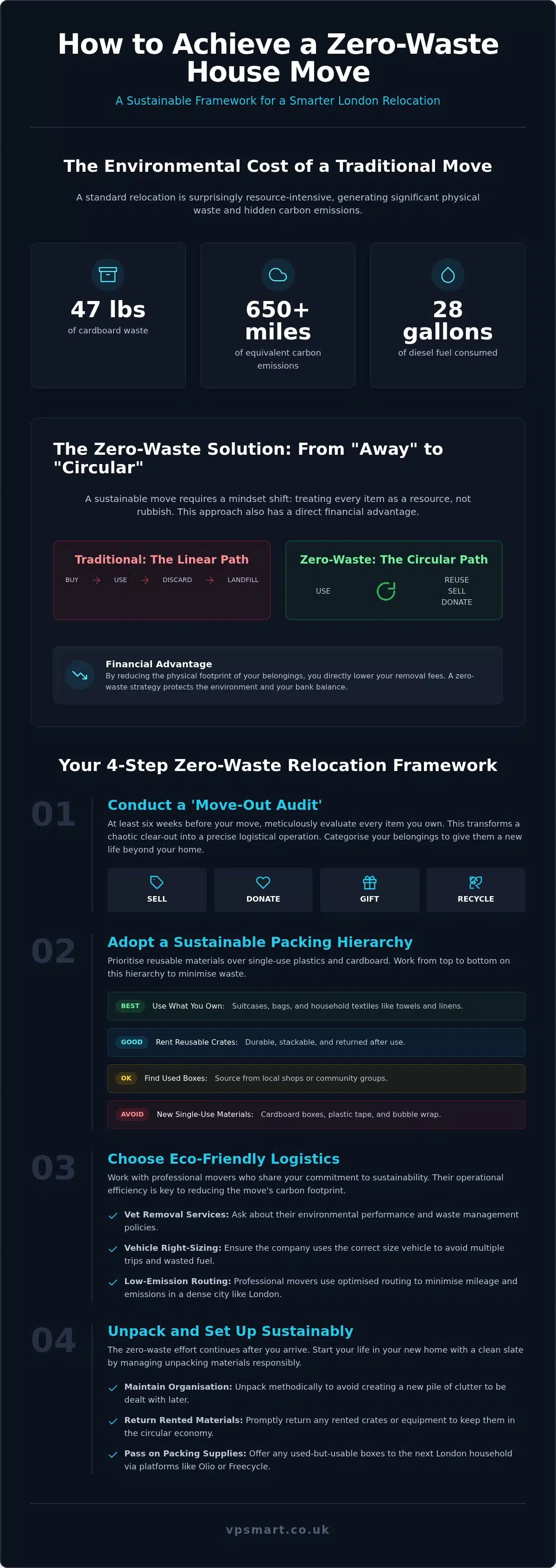
Did you know that the average residential move generates 47 pounds of cardboard waste and emits carbon equivalent to driving over 650 miles? For many Londoners, the excitement of a new home is often dampened by the sight of overflowing bins and the guilt of sending usable items to a landfill. Mastering how to have a zero waste house move isn’t just a lifestyle choice for the environmentally conscious; it’s a logical framework for a more efficient, high-performance relocation.
Moving house is often a logistical headache, especially when you’re trying to coordinate multiple charity donations and sustainable packing whilst managing a demanding career. It’s frustrating to pay for expensive rolls of tape and boxes that only serve a single purpose. We’re here to help you achieve a waste-free relocation that reduces your moving costs through intelligent downsizing. This guide provides a clear roadmap to relocate without the rubbish by following our expert-led, sustainable framework designed for London homes. We’ll explore the technical side of reusable containers, explain how to support the local circular economy, and ensure your next move is as clean as your new floorboards.
Key Takeaways
- Understand how a circular economy approach transforms your relocation from a waste-generating event into a resource-efficient transition.
- Master the “Move-Out Audit” to categorise belongings effectively, ensuring items are gifted or recycled rather than discarded.
- Learn how to have a zero waste house move by implementing a packing hierarchy that prioritises existing household textiles and rented crates over single-use plastics.
- Discover how to vet professional removal services for environmental performance and the importance of vehicle right-sizing for low-emission routing.
- Implement sustainable unpacking strategies that maintain domestic organisation and ensure moving materials are responsibly passed on to the next London household.
What is a Zero Waste House Move and Why Does it Matter?
Learning how to have a zero waste house move is a logistical exercise in the circular economy, not just a lifestyle choice. A zero waste move is a relocation that prioritises keeping materials in use and out of landfills. It functions by treating every item and packing material as a valuable resource rather than a disposable commodity. The 2026 Zero Waste Hierarchy for house removals prioritises the prevention of waste through meticulous inventory management and the reuse of durable materials before any recycling occurs.
Beyond the ethical satisfaction of a clean move, there is a clear financial advantage. Most house removals services calculate costs based on volume and time. By reducing the physical footprint of your belongings, you directly lower your removal fees. This results in a leaner, more efficient relocation that protects both the environment and your bank balance. Implementing a strategy for how to have a zero waste house move allows you to identify these hidden costs early, ensuring your budget remains as tidy as your packing.
The Environmental Cost of Traditional Relocations
Traditional moving methods are surprisingly resource-intensive. A standard three-bedroom home relocation can generate significant debris, including 47 pounds of cardboard waste and vast quantities of non-recyclable single-use plastics like bubble wrap. This physical waste is only part of the problem. Inefficient planning often leads to multi-trip moves, where the hidden waste of fuel emissions adds up. A typical move consumes 28 gallons of diesel fuel, producing carbon emissions equivalent to driving over 650 miles. This is why transparent pricing and efficient routing are essential for a sustainable transition.
In a dense city like London, the impact is visible on our streets. Abandoned furniture left on pavements creates a burden for local council waste services and contributes to urban blight. Professional movers and packers now use technical oversight to avoid these pitfalls, ensuring that every piece of hardware is accounted for and safely transported without leaving a trail of rubbish behind.
The Mindset Shift: From “Away” to “Circular”
The first step toward a sustainable move is acknowledging that “away” doesn’t exist. In London, every item you discard goes somewhere, whether it is a specialised recycling centre or a landfill. To succeed, you must reverse engineer your move. This means deciding on the final destination of every item before it even enters a box. If an item doesn’t have a clear place in your new home, it should be directed into the circular economy through resale or donation.
View your relocation as a comprehensive sustainability audit of your lifestyle. It’s a rare opportunity to evaluate your possessions and ensure they align with your current needs. By taking complete oversight of your inventory, you transition from a passive consumer to an active manager of your domestic environment. This forward-thinking approach ensures your new home starts with a foundation of efficiency and domestic well-being, rooted in regional reliability and environmental care.
Decluttering with Purpose: The Circular Economy Approach
The first step in understanding how to have a zero waste house move is conducting a thorough ‘Move-Out Audit’ at least six weeks before your removal date. This technical evaluation allows you to oversee every item in your inventory, ensuring that nothing is mindlessly packed or discarded. By categorising your belongings into Sell, Donate, Gift, or Specialty Recycle, you transform a chaotic clear-out into a precise logistical operation. This proactive management reduces the volume of goods to be transported, which directly improves the efficiency of your relocation.
London’s circular economy is exceptionally robust, providing numerous avenues for items that no longer serve your lifestyle. Digital platforms like Olio and Freecycle are invaluable for hyper-local gifting, whilst Facebook community groups often connect you with neighbours who can repurpose specific household hardware. If you find the volume of belongings daunting, booking a professional house removals service early gives you the structural support to focus on this essential sorting process without the pressure of a looming deadline.
Strategic Selling and Gifting in London
For items with residual value, London’s resale market is thriving. Apps such as Vinted and Depop are perfect for fashion, whilst eBay remains the standard for specialised equipment and furniture. If you prefer a more social approach, consider hosting a ‘Moving Out’ party. This allows friends to adopt items you no longer need, ensuring your possessions transition directly into new homes. Another effective method is the ‘Freebie’ box on your doorstep. This is a great way to engage with the local community, but you must remain mindful of council regulations. Ensure boxes don’t obstruct pavements or create trip hazards, and always bring in any uncollected items at the end of the day to prevent urban littering.
Responsible Disposal for Non-Donatable Items
Mastering how to have a zero waste house move also requires knowing where to take items that cannot be sold or gifted. Certain household materials require specialised handling to avoid environmental damage. Expired paint, old mattresses, and broken electronics cannot simply be left for the bin men. London’s Reuse and Recycling Centres (RRCs) are equipped to handle these ‘hard-to-recycle’ materials efficiently. When disposing of old IT equipment, look for WEEE (Waste Electrical and Electronic Equipment) recycling points to ensure heavy metals are recovered safely. Finally, leaving your old property in a pristine state is a core tenet of sustainability. Investing in professional end-of-tenancy cleaning ensures the space is immediately ready for its next occupants, preventing the need for unnecessary waste or aggressive chemical treatments by future tenants.
Sustainable Packing Materials: Ditch the Single-Use Plastics
Achieving a waste-free relocation requires a disciplined hierarchy of materials. When planning how to have a zero waste house move, your first priority should always be the containers you already own. Suitcases, hampers, and even dresser drawers act as helpful household entities that can transport your belongings without requiring additional resources. If your existing storage is insufficient, the next logical step is to explore rental options before finally considering recycled cardboard. This structured approach ensures you maintain complete oversight of your environmental footprint whilst avoiding the unnecessary expense of new supplies.
Plastic bubble wrap is often viewed as a moving essential, but it is actually a significant environmental liability. It is difficult to recycle and frequently ends up in London landfills. By adopting a “one-in, one-out” rule for box procurement, you ensure that no excess material enters your home. Every container brought into the property must have a confirmed destination or a plan for immediate reuse. This prevents the common post-move anxiety of dealing with a mountain of discarded plastic and tape.
The Case for Plastic Crate Hire
Rented plastic crates represent the pinnacle of moving hardware. These containers offer superior structural integrity compared to cardboard, providing a secure environment for your most delicate items. From a lifecycle perspective, the data is compelling. Whilst a cardboard box might survive three or four uses before losing its rigidity, a single rental crate can endure 400 to 500 individual moves. Their uniform shape also allows for perfect stackability, which optimises the space inside the removal vehicle and reduces the risk of transit damage. For tailored advice on the precise volume of materials required for your home, our packing services experts can provide a technical assessment to ensure you don’t over-order.
Eco-Friendly Alternatives to Bubble Wrap and Tape
Replacing plastic doesn’t mean sacrificing protection. Honeycomb paper wrap provides the same impact resistance as traditional bubble wrap but remains fully recyclable with your standard kerbside paper collection. For filling voids in boxes, starch-based biodegradable packing peanuts are an excellent choice as they dissolve completely in water. We also recommend transitioning to paper tape with a water-activated adhesive. This creates a permanent bond with cardboard boxes that is easy to recycle, unlike standard vinyl tapes that must be stripped away. To secure your most fragile glassware, use the “Burrito Wrap” technique. Simply roll each item in a clean towel or bedsheet. This method leverages your existing textiles as high-performance padding, ensuring your move is both secure and entirely free of single-use rubbish.
Eco-Friendly Logistics: Working with Professional Movers
Selecting the right partner is critical when executing a plan for how to have a zero waste house move. It’s not enough to pack sustainably if the logistics phase is inefficient and resource-heavy. When vetting a removal company, ask specific questions about their waste diversion protocols and vehicle maintenance standards. Look for providers who prioritise “right-sizing” their fleet for every job. Sending a vehicle that is too small leads to multiple, high-emission trips, whilst an oversized truck represents a poor use of fuel. A professional site survey allows for a technical, accurate volume estimation, ensuring the logistics are as lean and efficient as possible.
Briefing your moving crew on move day is equally important for maintaining your environmental standards. Clearly state your zero-waste goals and point out the reusable materials you’ve prepared to avoid any accidental use of disposables. Professional furniture assembly also plays a vital role in long-term sustainability. When hardware is handled by experts, it prevents the structural damage that often leads to items being discarded prematurely. By ensuring your furniture is correctly dismantled and rebuilt, you extend its lifecycle and avoid the environmental cost of replacement.
Choosing a Local London Specialist
Opting for local London movers, such as those specialising in Richmond or Twickenham, significantly reduces your move’s carbon footprint. These specialists possess deep regional route knowledge, allowing them to navigate London’s complex low-emission zones and traffic patterns with precision. They can often provide consolidated loads for smaller moves, further maximising vehicle efficiency. Booking a house removals London service with local heritage ensures your relocation is grounded in regional reliability rather than international guesswork.
Get a transparent quote for your sustainable London move
Professional Handling to Prevent Waste
The ultimate form of moving waste is a broken possession that must be replaced. Expert packing services act as a protective barrier against damage, ensuring that your items arrive in a reusable state. This is particularly vital for delicate items like pianos, which require specialised transit techniques to avoid catastrophic failure. Instead of relying on single-use shrink wrap, professional teams use high-quality, reusable transit blankets. These helpful household entities provide superior cushioning and can be used for hundreds of relocations, completely eliminating the need for disposable plastic films during transit.
Setting Up Your New Home Sustainably
The final phase of how to have a zero waste house move involves transitioning from a temporary logistical state into a permanent, well-managed home environment. It’s tempting to unpack at maximum speed to regain a sense of normalcy, but this often leads to poor organisational choices and unnecessary waste. By prioritising technical oversight and a “slow unpacking” philosophy, you ensure that every item finds a functional place. This deliberate approach allows you to establish robust domestic systems, such as dedicated recycling zones and efficient waste management, from the very first week.
Successfully executing how to have a zero waste house move requires a commitment that extends beyond the moving day itself. Your new property is a blank canvas for resource efficiency. By integrating your sustainability goals into your daily routine, you ensure that the effort spent on a waste-free relocation translates into a long-term lifestyle of domestic well-being. This isn’t just about avoiding rubbish; it’s about creating a future of effortless comfort through intelligent management and oversight of your environment.
The Post-Move Box Hand-Off
Once you’ve emptied your containers, the priority shifts to ensuring these helpful household entities remain within the circular economy. If you followed our earlier advice on rented crates, the process is simple: notify the provider for a collection. For cardboard boxes, flatten them carefully to preserve their structural integrity for the next user. Platforms like Nextdoor or specialised “Box Exchange” groups are ideal for local gifting. Providing these resources to another Londoner prevents them from buying new, effectively doubling the environmental benefit of your initial procurement. Our team at VP Smart Removals can often advise on regional material reuse schemes to help you clear your space responsibly.
Sustainable Furnishing and “Slow Unpacking”
A common pitfall in new homes is the “panic buy”, which involves purchasing new furniture immediately to fill empty rooms. This often results in low-quality acquisitions that don’t suit the space’s long-term needs. Instead, live in your new environment for several weeks to understand its natural light and flow. London is home to exceptional second-hand markets and upcycling centres where you can find high-quality hardware with local heritage. If you find yourself with surplus furniture that doesn’t fit the new layout, utilise secure storage whilst you decide on its future. This prevents hasty disposals and gives you the oversight needed to sell or gift items through the London-specific platforms mentioned earlier in this guide. This patient strategy ensures your home remains a sanctuary of domestic well-being and resource efficiency.
Your Blueprint for a Cleaner London Relocation
Relocating in a city as dynamic as London doesn’t have to result in a trail of single-use plastic and discarded furniture. By implementing a rigorous “Move-Out Audit” and prioritising high-performance reusable hardware, you transition from a passive consumer to an active manager of your environment. We’ve shown that mastering how to have a zero waste house move is a logical byproduct of intelligent planning and resource efficiency. Success relies on three pillars: precise inventory oversight, the adoption of a circular economy mindset, and the selection of a logistics partner committed to regional reliability.
Our London-wide coverage ensures low-emission routing through expert local knowledge, whilst our professional packing services act as a safeguard against breakage waste. By utilising expert furniture assembly, you ensure the longevity of your belongings and avoid the environmental cost of hasty replacements. Your move is an opportunity to reset your domestic habits and start life in your new home with complete oversight of your environmental footprint.
Get a Fixed-Price Quote for Your Sustainable London Move
Take charge of your next transition. With a forward-thinking approach, your relocation becomes a seamless bridge to a more sustainable and well-managed lifestyle.
Frequently Asked Questions
Is it really possible to have a completely zero waste house move?
Yes, achieving a waste-free relocation is possible by prioritising the circular economy and using durable, reusable systems. It requires complete oversight of every material entering and leaving your property. Whilst “zero” is an ambitious target, focusing on 100% diversion from landfills through gifting, specialised recycling, and reuse creates a high-performance relocation. The goal is to ensure no single-use plastics or non-recyclable debris remain after your domestic transition is complete.
Where can I find free moving boxes in London?
Local community hubs and supermarket distribution centres are excellent sources for salvaged cardboard. You can also check with local pharmacies or independent bookshops, as their inventory often arrives in sturdy, high-quality boxes that are perfect for heavier items. Using digital community platforms like Nextdoor or Olio allows you to locate neighbours who have recently finished their own relocation. This peer-to-peer exchange is a cornerstone of a healthy regional circular economy.
What is the most eco-friendly alternative to bubble wrap?
Honeycomb paper wrap and existing household textiles are the most sustainable options for protecting delicate hardware. Unlike plastic, paper-based alternatives are fully recyclable and biodegradable. For fragile items, using your own towels and linens provides superior cushioning without generating additional waste. This technical approach leverages items you already own, improving your domestic well-being whilst eliminating the need for expensive, single-use petroleum-based products that often end up in London landfills.
Can I recycle moving tape?
Standard vinyl or plastic tapes are generally not recyclable and must be removed from cardboard before disposal. However, water-activated paper tape is a high-tech alternative that can be recycled along with the box. Switching to this sustainable adhesive ensures your packing materials remain within the recycling stream. Understanding how to have a zero waste house move involves these small technical shifts that significantly reduce your relocation’s long-term environmental impact.
How do I dispose of items that charity shops won’t accept?
Utilise London’s specialised Reuse and Recycling Centres (RRCs) for non-donatable goods. Many items rejected by charity shops, such as stained textiles or broken electronics, can be processed through textile recycling banks or WEEE collection points. For larger pieces of hardware, some London councils offer bulky waste collections that prioritise material recovery. This ensures that even “end-of-life” items are managed responsibly rather than being abandoned on the pavement or sent to landfill.
Are plastic moving crates better for the environment than cardboard boxes?
Yes, when utilised within a rental system, plastic crates are significantly more sustainable than traditional cardboard. A single heavy-duty crate can survive hundreds of individual moves, whereas cardboard boxes often degrade after just a few uses. This durability ensures a lower carbon footprint over the product’s entire lifecycle. Their stackable design also improves vehicle efficiency, allowing for a more stable and secure transit environment for your valuable household belongings.
How does hiring a professional mover help reduce waste?
Professional movers use technical expertise to prevent breakage, which is the primary source of moving-related waste. By ensuring items are correctly secured with reusable transit blankets, they eliminate the need for disposable plastics. An experienced team also provides accurate volume estimations, ensuring the “right-sizing” of the removal vehicle. This precision reduces fuel consumption and prevents the logistical waste associated with multiple trips or inefficient routing across London’s complex road network.
What should I do with my leftover packing materials after I unpack?
Utilise London’s specialised Reuse and Recycling Centres (RRCs) for non-donatable goods. Many items rejected by charity shops, such as stained textiles or broken electronics, can be processed through textile recycling banks or WEEE collection points. For larger pieces of hardware, some London councils offer bulky waste collections that prioritise material recovery. For redundant exterior fixtures, Dish Goodbye provides professional removal of old satellite dishes and antennas to ensure they are recycled correctly. This ensures that even “end-of-life” items are managed responsibly rather than being abandoned on the pavement or sent to landfill.
Disclaimer
Some links in this article may be affiliate links, which means we may earn a small commission if you make a purchase through them, at no additional cost to you. We only recommend products or services we believe provide value to our readers.
Aug 21, 2026
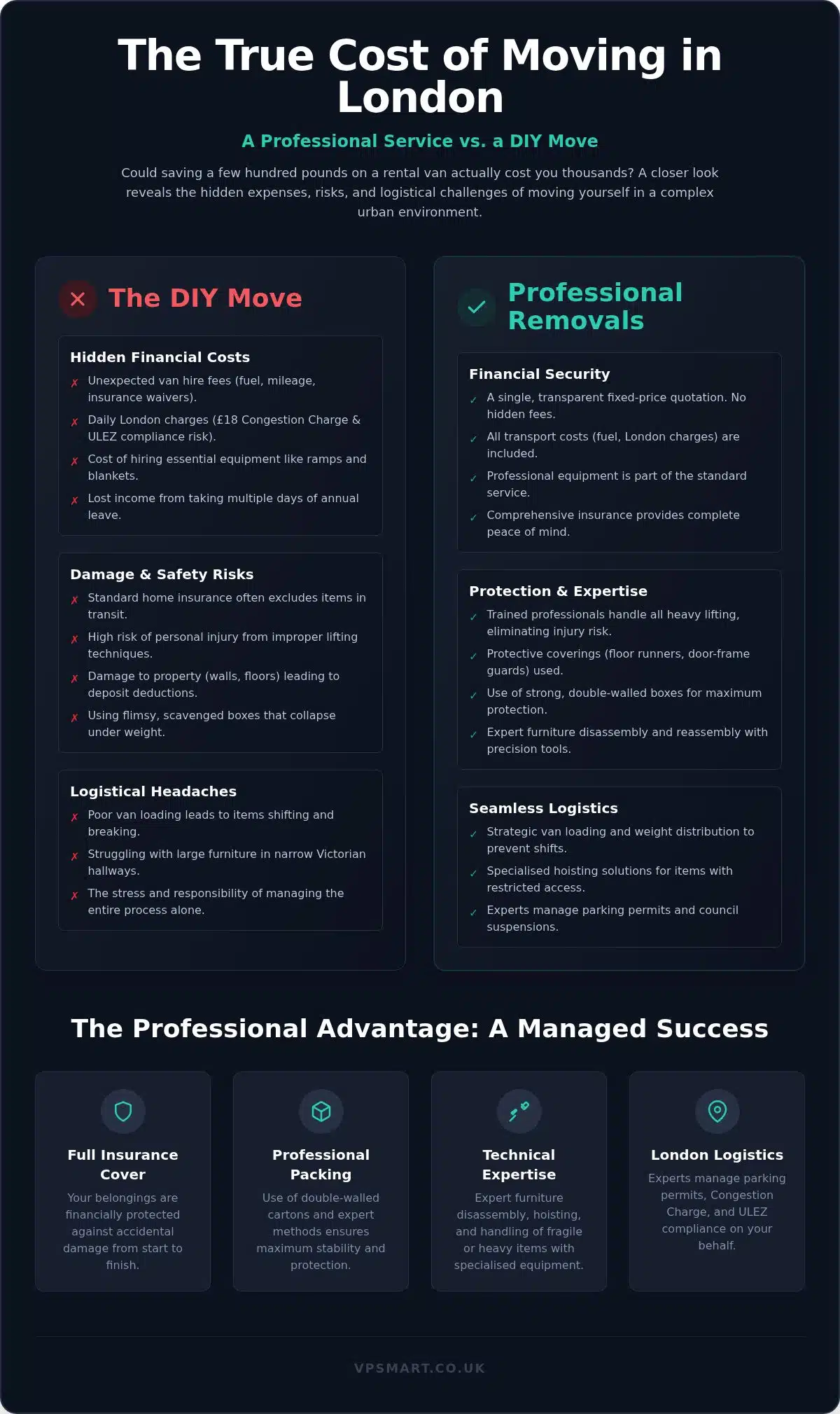
Could saving a few hundred pounds on a rental van actually cost you thousands in hidden penalties and damaged heirlooms? While the DIY approach seems cost-effective, the 2026 reality involves navigating an £18 daily Congestion Charge and strict ULEZ standards that can catch even the most diligent drivers off guard. Understanding the benefits of using a professional removal company is no longer just about convenience; it’s about protecting your lifestyle and your budget in a complex urban environment.
We know that moving house is one of life’s most taxing events, fraught with anxieties about fragile items and London’s unforgiving traffic. This article demonstrates how professional movers mitigate these risks through technical expertise and specialised equipment like hoisting services. You’ll learn how fixed-price relocation models and expert packing services provide the financial security and physical relief that a self-drive move simply cannot match. We’ll preview the logistical mastery required to manage parking permits and furniture assembly, ensuring your transition to a new home is a predictable, well-managed success rather than a series of expensive surprises.
Key Takeaways
- Identify the hidden financial risks of DIY moves, from unexpected ULEZ penalties to the high cost of equipment hire and insurance waivers.
- Discover the technical benefits of using a professional removal company, such as expert furniture disassembly and specialised hoisting for restricted access.
- Ensure the safety of fragile items through professional packing methods that provide maximum stability and protection during transit.
- Navigate London’s complex logistical landscape by letting experts manage council parking suspensions and Congestion Charge compliance on your behalf.
- Secure your investment with comprehensive insurance and fixed-price models that offer financial transparency and complete oversight of your relocation.
The Real Cost of DIY: Why a “Cheap” Move Often Ends Up More Expensive
Many homeowners view van hire as a budget-friendly shortcut. It isn’t. When you strip back the surface-level price, a DIY move reveals a complex web of logistical expenses. You’re responsible for escalating fuel costs, expensive insurance waivers, and the rental of essential equipment. One of the key benefits of using a professional removal company is that they integrate these elements into a single, transparent fee, ensuring you aren’t caught out by hidden hire-desk charges. These hidden DIY costs typically include:
- High-octane fuel and mileage surcharges
- Collision Damage Waiver (CDW) premiums
- Rental fees for transit blankets and loading ramps
- Parking permit administrative fees
Physical exhaustion is a silent budget-killer. Attempting heavy lifting without specialised training often leads to muscle strain or dropped valuables. These incidents don’t just cause physical pain; they result in lost productivity and unforeseen medical costs. By outsourcing the physical labour to a professional moving company, you reclaim your most valuable asset: time. Consider the opportunity cost of your relocation. If a DIY move consumes three days of your annual leave, the financial impact often outweighs the cost of professional intervention.
Risk Assessment: The Cost of Accidental Damage
Standard home insurance policies frequently exclude items in transit if they aren’t handled by registered professionals. One of the primary benefits of using a professional removal company is the immediate activation of professional accountability. Scuffed skirting boards or a gouged hallway wall in a rental property can lead to significant deposit deductions. Professional teams use floor runners and door-frame protectors to maintain the pristine condition of your environment.
Transit liability is a professional framework that ensures your belongings are financially protected against accidental damage from the moment they are lifted until they are safely positioned in your new home.
Packing Material Quality and Efficiency
Scavenging for grocery store boxes is a common mistake that compromises the safety of your possessions. These thin, single-walled containers lack the structural integrity required for stacking in a moving van. Investing in professional packing materials, such as double-walled cartons, is a foundational requirement for a damage-free transition. These specialised boxes prevent structural collapse, ensuring that the pressure of a loaded vehicle doesn’t crush fragile items at the bottom of the stack. This technical approach to packing turns a volatile cargo into a stable, well-managed environment.
Technical Expertise: Handling Fragile, Heavy, and Specialised Items
Loading a vehicle is a precise science that extends far beyond simply filling available space. One of the most significant benefits of using a professional removal company is the technical oversight they apply to van organisation. By calculating weight distribution and using high-tension tie-down points, movers ensure that your possessions remain immobile even during heavy braking or sharp turns. This technical approach prevents the structural collapse of boxes and ensures that heavy items don’t shift and crush fragile containers.
London’s architectural heritage often creates logistical bottlenecks. Victorian properties, with their narrow hallways and steep staircases, weren’t designed for modern king-size beds or oversized wardrobes. Expert teams provide furniture disassembly as a standard part of the process, using professional-grade tools to dismantle and reassemble items with millimetre precision. This ensures your belongings fit through every entrance without a single scuff on the wallpaper or damage to the furniture’s joints.
Specialised hardware acts as a force multiplier for safety. Tail lifts, piano dollies, and heavy-duty ramps are helpful household entities that turn impossible tasks into managed procedures. Floor runners and door-frame protectors act as a shield for your property, maintaining the pristine condition of both your old and new environments. This layer of protection is something that a standard DIY van hire simply cannot provide.
Specialised Hoisting and Access Solutions
When internal access is physically impossible, professional hoisting services provide a sophisticated alternative. This technical solution involves lifting heavy or bulky items through windows or over balconies using external pulleys or platforms. Professional hoisting protects the item from the stress of being forced through tight spaces whilst ensuring the property structure remains entirely untouched by heavy impacts. This is particularly vital for top-floor flats where lift access is restricted or non-existent.
Expert Piano and Fine Art Removals
Delicate instruments and high-value artwork require more than just a strong pair of arms. They need a climate-controlled approach and vibration-dampening materials to survive the journey. Our piano removals and fine art services utilise bespoke crating and specialised suspension techniques to protect against the slightest environmental shift. This level of technical care is essential for preserving the longevity of your most cherished possessions.
Delegating the handling of sentimental heirlooms to a technical team allows you to focus on the emotional transition of your move. If you’re planning a complex relocation, exploring our movers and packers service can provide the comprehensive oversight your home deserves.
Financial Security and Professional Accountability
One of the core benefits of using a professional removal company is the immediate transition from personal risk to professional accountability. When you undertake a DIY move, you are the sole guarantor of your inventory’s safety. In contrast, a registered professional service provides a formal framework of protection that safeguards your assets. This isn’t just about moving boxes; it’s about providing a future of effortless comfort through a managed environment where every item is accounted for and every risk is mitigated.
Understanding the layers of insurance is vital for modern homeowners. Goods in Transit insurance provides a specific safety net for your physical belongings whilst they are in motion. Public Liability insurance is equally critical, as it protects the structural integrity of both your departing property and your new home. If a heavy wardrobe scuffs a communal hallway or damages a door frame, a professional company carries the financial responsibility. This creates a sense of complete oversight, allowing you to focus on your new lifestyle rather than potential repair bills.
Fixed-Price vs. Hourly Rates
Many “Man and Van” services rely on hourly rates, which can quickly become a “slow mover” trap. Delays in London traffic or unforeseen difficulties with a narrow staircase can cause costs to spiral. Professional efficiency is built on a different model. By conducting a detailed site survey, experts assess the volume of your goods and any access challenges before the move begins. This data-driven approach allows for a fixed-price relocation project fee. You gain total budget certainty, knowing that the price agreed upon is the price you pay, regardless of how long the London congestion takes to clear.
Managed Storage for Flexible Timelines
Property chains are notoriously unpredictable, often leaving a gap between move-out and move-in dates. Professional storage services offer a more sophisticated solution than standard self-storage pods. Managed warehouse facilities provide enhanced security and climate control, ensuring that your furniture and electronics aren’t exposed to damp or temperature fluctuations. This integrated lifestyle philosophy means your belongings are kept in a secure, professional environment until your new home is ready for setup. It bridges the gap in your transition with the same level of technical care applied to the move itself.
Navigating London Logistics: The Professional Advantage
London’s transport network is a dynamic environment that penalises the unprepared. One of the most practical benefits of using a professional removal company is their mastery of the capital’s regulatory landscape. As of January 2, 2026, the daily Congestion Charge stands at £18, whilst the Ultra Low Emission Zone (ULEZ) charge adds a further £12.50 for non-compliant vehicles. Even electric vehicles (EVs) now face a tiered system; electric vans receive a 50% discount if registered for Auto Pay. DIY movers often overlook these shifting rules, only to be met with a £180 penalty notice days later. Professionals utilise compliant fleets and automated payment systems to ensure your move remains within budget and legally sound.
Managing London Parking Suspensions
Richmond and Wandsworth represent some of the most challenging boroughs for heavy vehicle access. Securing a legal parking suspension is a complex administrative task that requires coordination with local councils well in advance of your move date. Our experts manage this red tape on your behalf, preventing the £130 Penalty Charge Notices (PCNs) that frequently plague DIY attempts. This regional expertise is a hallmark of our removals Richmond service, where we transform a chaotic street-side loading process into a calm, authorised operation.
Urban Access Challenges
Period properties in North and South London often feature narrow hallways and steep, winding staircases. These architectural quirks necessitate a multi-person crew and, in many cases, a “Stair Charge” to account for the increased physical demand and technical difficulty. Route planning is equally vital; local knowledge helps avoid low bridges and weight-restricted residential roads that can trap an unguided rental van. Professional drivers use specialised GPS systems designed for commercial vehicles, ensuring they don’t encounter dead ends or narrow streets that are amongst the hardest to navigate. By delegating these logistical hurdles, you ensure a rapid, efficient loading process that respects both your neighbours and your timeline.
Secure your London relocation with our expert logistics team
Why VP Smart Removals is the Strategic Choice for Your Move
Choosing a relocation partner is a strategic decision that defines the quality of your first night in a new home. VP Smart Removals operates at the intersection of technical authority and domestic warmth, ensuring that your transition is as efficient as it is comfortable. One of the primary benefits of using a professional removal company is the elimination of the “hidden surcharge” culture often found in the London market. We provide a comprehensive suite of services, from precise packing to expert furniture reassembly, all delivered with a commitment to 2026’s evolving professional standards.
Our philosophy treats your belongings as helpful household entities rather than mere cargo. This mindset drives our technical team to apply the same level of care to a box of kitchenware as they do to a grand piano. By integrating advanced logistics with a helpful, forward-thinking persona, we alleviate the modern homeowner’s anxieties regarding technical setup and financial transparency. You aren’t just hiring a crew; you’re securing a managed environment where performance and reliability are the baseline.
Our Approach to Stress-Free Relocation
We believe in providing complete oversight of every moving variable. This central theme ensures that from the moment our crew arrives, you’re in charge of your environment without having to manage the physical burden. When considering the long-term benefits of using a professional removal company, the value of a dedicated London-based team becomes clear. Our regional quality benchmarks are rooted in a deep local heritage, allowing us to navigate the capital with a precision that international competitors often lack. This regional reliability is the cornerstone of our house removals London service, where we transform complex logistical puzzles into a predictable, steady rhythm.
Get Started with a Professional Survey
Transparency begins with data. A detailed site survey allows us to create an exhaustive inventory, which is the only way to generate an accurate fixed-price quote. This process removes the guesswork from your relocation, providing the financial optimisation you need during a high-spend period. Booking your 2026 move with us is a straightforward step toward domestic well-being. We invite you to experience an effortless transition where technical capability meets approachable service, ensuring your new chapter begins with total peace of mind.
Secure a Predictable Transition for Your New Home
Relocating in 2026 demands a sophisticated logistical strategy that prioritises both technical precision and financial security. We’ve explored how the benefits of using a professional removal company extend far beyond simple heavy lifting. By leveraging specialised hoisting and piano removal services, you ensure that even the most complex architectural hurdles are managed with expert oversight. This technical capability, backed by comprehensive Goods in Transit and Public Liability insurance, transforms a potentially volatile event into a well-managed investment in your future comfort.
Our London-based experts have been setting regional quality benchmarks since 2016. We understand that a successful move relies on a blend of technical authority and approachable domestic warmth. By choosing a partner that offers fixed-price certainty and managed storage solutions, you reclaim your time and protect your emotional well-being. Your transition deserves a professional framework that respects both your belongings and your budget.
Get a Fixed-Price Quote for Your London Move
We’re ready to guide you through every stage of your journey with confidence and complete oversight.
Frequently Asked Questions
Is it cheaper to hire a van or use a removal company?
Whilst van hire appears cheaper initially, the 2026 reality includes an £18 daily Congestion Charge and strict ULEZ penalties. One of the key benefits of using a professional removal company is the avoidance of these administrative traps and high insurance waivers. Professionals provide a fixed-price project fee that integrates all logistical overheads, ensuring your budget remains stable. This technical approach prevents the hidden costs of DIY moves from escalating into a financial burden.
What insurance do professional removal companies provide?
Reputable firms provide two distinct layers of protection: Goods in Transit insurance and Public Liability insurance. Goods in Transit covers your physical inventory against damage or loss whilst in motion. Public Liability protects the property structure of both your old and new homes. This dual-layered framework ensures complete oversight and financial accountability, which is essential for modern homeowners seeking to mitigate the risks associated with high-value household assets during a transition.
Do removal companies help with packing and unpacking?
Yes, comprehensive packing services are a core offering designed to alleviate the physical and emotional strain of relocation. Professional packers use double-walled cartons and technical wrapping techniques to stabilise fragile items. This service ensures that your belongings are organised for maximum safety during transit. By delegating this task, you ensure that your domestic environment is managed by experts who understand the structural requirements of safe, long-distance transport and efficient unpacking.
How far in advance should I book a professional removal company?
You should aim to book your move at least four to six weeks in advance, especially for Friday or month-end relocations. Early booking allows the technical team to conduct a thorough site survey and secure necessary parking suspensions with local councils. This lead time is vital for managing London’s complex logistics and ensures that specialised equipment, such as hoisting hardware or piano dollies, is reserved and ready for your specific moving date.
Will a removal company dismantle and reassemble my furniture?
Expert furniture assembly and disassembly are standard features of a professional service. Modern wardrobes and bed frames often require technical precision to dismantle without compromising their structural integrity. Professional teams arrive with the necessary tools to handle complex items, ensuring they fit through narrow Victorian doorways and are safely reconfigured in your new home. This service maintains the longevity of your furniture and simplifies your first night in the new property significantly.
What happens if something gets broken during a professional move?
If an item is damaged, the company’s insurance framework provides a clear path for resolution. Unlike DIY moves where you bear the total cost of breakage, a professional firm accepts accountability. You would typically notify the team immediately to initiate a claim through their Goods in Transit policy. This professional accountability is one of the major benefits of using a professional removal company, offering a safety net that protects your financial interests and your belongings.
Do professional movers handle specialised items like pianos or antiques?
Specialised items require specific handling protocols and dedicated equipment. Piano removals involve the use of heavy-duty dollies and protective covers to manage weight and protect delicate internal mechanisms. Antiques often require bespoke crating and climate-controlled environments to prevent damage from vibration or temperature shifts. Professional teams possess the technical expertise to manage these helpful household entities with the respect and precision their value and history demand, ensuring they arrive in pristine condition.
How do removal companies handle parking permits in London?
Professional firms coordinate directly with local authorities in boroughs like Richmond or Wandsworth to secure authorised parking suspensions. This proactive management prevents the risk of heavy fines and ensures the removal van has legal, close-proximity access to your property. By handling the council red tape on your behalf, professionals eliminate a significant source of moving-day anxiety and ensure the loading process remains efficient and compliant with local urban regulations and 2026 environmental standards.
Disclaimer
Some links in this article may be affiliate links, which means we may earn a small commission if you make a purchase through them, at no additional cost to you. We only recommend products or services we believe provide value to our readers.
Aug 20, 2026
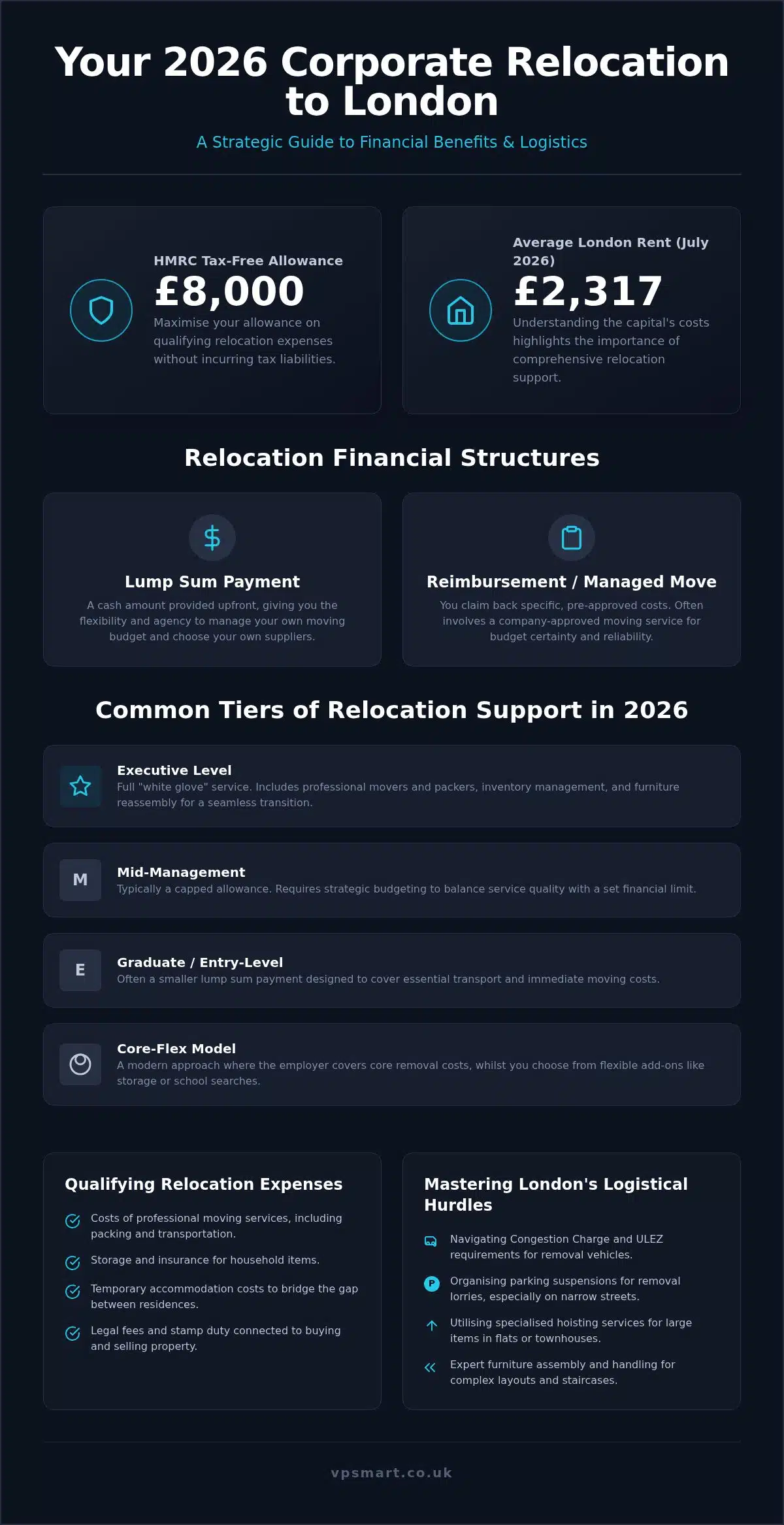
What if the £8,000 tax-free allowance from HMRC wasn’t just a regulatory cap, but the foundation of a perfectly managed transition into your new London life? Relocating to the capital is undeniably expensive, especially with average monthly rents hitting £2,317 as of July 2026. Most professionals feel the weight of coordinating complex logistics whilst trying to hit the ground running in a demanding new role. By leveraging expert business relocation services London professionals trust, you can transform this overwhelming transition into a streamlined, high-performance experience. We understand that a well-managed move is the first step toward domestic well-being and professional success.
You probably agree that the stress of a move shouldn’t overshadow the excitement of a career milestone. This guide promises to clarify exactly how to navigate corporate relocation packages, claim essential tax relief, and organise a seamless transition with professional financial assistance. We’ll provide a clear framework for negotiating a better moving package and help you identify a reliable mover that fits your corporate budget. From understanding the 2026 Skilled Worker visa salary thresholds to mastering your relocation oversight, you’re about to gain complete control over your move to London.
Key Takeaways
- Understand the HMRC £8,000 tax-free exemption for 2026 to ensure you maximise your relocation allowance without incurring unnecessary tax liabilities.
- Learn how to evaluate business relocation services London providers to secure the fixed-price certainty and technical reliability required for corporate budget approval.
- Discover the specific qualifying expenses, from professional packing to legal fees, that can be included in your relocation financial aid package.
- Master the logistical challenges of the capital by identifying when specialised solutions like hoisting services or parking suspensions are necessary for a smooth move.
- Gain a clear framework for negotiating a comprehensive relocation package that includes expert movers and packers to eliminate the stress of starting a new role.
Financial Assistance for Relocating for a New Job
At its core, a relocation package is a strategic financial benefit provided by employers to cover the logistical and personal costs of moving for work. In the competitive 2026 landscape, securing high-calibre talent often hinges on the quality of this support. Selecting the right business relocation services London professionals rely on is critical for maintaining productivity during such a significant life transition. We view these packages not merely as a perk, but as an essential tool for domestic well-being, ensuring you can focus on your new role whilst your household environment is expertly managed.
Forward-thinking companies offer these incentives because they understand that a stressed employee is an unproductive one. By removing the financial friction of a move, firms ensure their new hires are ready to perform from day one. In 2026, we’ve seen these packages evolve to include more than just a moving van; they now often encompass comprehensive support systems designed to alleviate the anxieties of relocating to one of the world’s most dynamic cities.
Financial structures typically follow two models: lump sum payments or reimbursement models. A lump sum provides cash up front, giving you the agency to oversee your own budget, whereas reimbursement requires you to claim back specific costs. Regardless of the model, the HMRC tax-free limit remains at £8,000 for qualifying expenses in 2026. This threshold is a vital technical specification to keep in mind when negotiating your contract, as any amount exceeding this figure becomes a taxable benefit.
The Key Components of a Relocation Package
A standard corporate agreement should cover the physical moving costs, including transportation and insurance. High-value moves often require white-glove treatment, relying on professional movers and packers to ensure every asset is catalogued and protected. Beyond the boxes, packages often include temporary accommodation to bridge the gap between residences. With average monthly rents in London reaching £2,317 in July 2026, this support is a cornerstone of financial optimization. Many firms now outsource these complexities to specialised employee relocation services to manage transitions, school searches, and legal fees effectively.
Why London Requires a Bespoke Financial Approach
The capital presents unique logistical hurdles that demand a specific financial strategy. You must factor in London-specific overheads such as the Congestion Charge and ULEZ requirements for removal vehicles, which can quickly inflate a basic budget. Professional business relocation services London experts use fixed-price quotes to provide HR departments with the budget certainty they require. This transparency eliminates the risk of hidden fees often associated with narrow residential streets or complex stair handling. By utilising specialised hoisting services and expert furniture assembly, you ensure your new home is functional and comfortable the moment you step through the door.
Common Corporate Relocation Packages in 2026
Corporate relocation packages in 2026 have shifted toward precision and personalisation. Understanding the tier of support you are offered is the first step in maintaining your domestic well-being during a transition. Executive-level packages typically provide a full-service, “white glove” experience. These agreements often include professional movers and packers who manage the entire logistical chain, from inventorying assets to furniture reassembly in your new London residence. This high-tech, high-touch approach ensures that senior leaders maintain complete oversight of their environment without the physical burden of the move.
Mid-management support usually operates on capped allowances. This model requires a visionary pragmatist’s approach to budgeting, where you must balance service quality against a set financial limit. In contrast, graduate or entry-level assistance is often delivered as a smaller lump sum intended for essential transport and immediate costs. A growing trend in the capital is the Core-Flex model. Here, employers provide the essential removals and insurance as a core benefit, whilst allowing employees to choose flex options, such as specialised storage or school search assistance, to suit their specific lifestyle needs.
Lump Sum vs. Managed Move: Which is Better?
Choosing between a lump sum and a managed move depends on your desire for agency versus ease. A lump sum offers a single cash payment, giving you the freedom to choose your own business relocation services London providers. However, this places the entire logistical burden on your shoulders. A managed move, where your employer pays the removal firm directly, offers a future of effortless comfort. For those needing to secure HR approval, presenting a fixed-price quote is a powerful tool. It provides the budget certainty that corporate finance departments demand, ensuring a predictable and trustworthy flow from the initial planning stages to the final delivery.
Negotiating Your Relocation Assistance
Negotiation should begin the moment a job offer is on the table. Don’t wait until the contract is signed to discuss the technical setup of your move. Beyond the basic removal costs, ask for often-overlooked items such as secure managed storage fees or stair charges for London townhouses. You can leverage professional quotes to demonstrate the actual market conditions of London logistics. It is also wise to reference UK tax relief on relocation expenses during these discussions to show you understand the HMRC £8,000 limit. If you need a clear breakdown of costs for your negotiation, requesting a transparent quote can provide the technical authority you need to secure a better package.
Navigating Tax Relief and Relocation Expenses in the UK
Securing a comprehensive corporate relocation package is only half the battle; the other half is ensuring it’s structured for maximum tax efficiency. For 2026, the HMRC tax-free relocation allowance remains capped at £8,000. This figure is a critical technical threshold for both the employer and the employee. Any qualifying expenses under this amount don’t need to be reported as a benefit, allowing you to settle into your new London life without an immediate tax burden.
Qualifying expenses generally fall into four categories: your old home’s disposal, the acquisition of a new residence, the physical transport of belongings, and travel costs. This includes packing services, insurance, and even some legal fees associated with property purchase. However, it’s vital to identify non-qualifying expenses early. Items like redirecting mail, council tax bills, or new furniture don’t qualify for relief. These are treated as a “benefit in kind” and will be taxed at your standard rate, potentially leading to an unexpected bill if your budget isn’t meticulously managed. Total oversight of these details ensures your financial transition is as smooth as your physical one.
How to Maximise Your Tax-Free Allowance
To make the most of the £8,000 limit, you should prioritise high-cost qualifying items such as professional house removals. Since these services represent a significant portion of your budget, using your tax-free allowance here provides the best financial optimisation. You must also adhere to the strict time limit; qualifying expenses must be incurred before the end of the tax year following the one in which you started your new job. If you’re coordinating an international move from Europe, consulting a tax professional ensures your oversight remains total and compliant, protecting your domestic well-being from regulatory surprises.
The Role of the Employer in Tax Compliance
Companies have a regulatory duty to report relocation expenses via P11D forms. This is where the technical authority of your moving provider becomes invaluable. By choosing business relocation services London firms that provide transparent, line-itemed quotes, you give your HR department the exact data they need for accurate reporting. Clear record-keeping is your best defence against audit anxieties. You should keep every receipt from your removal company, as these documents prove that the funds were used for qualifying purposes and help maintain the predictable, trustworthy flow of your relocation project.
Planning Your London Move: Logistical Hurdles and Solutions
Planning a transition to the capital requires more than just a date on a calendar; it demands a comprehensive technical inventory. This document serves as the blueprint for your move, ensuring that the business relocation services London professionals provide are based on data rather than guesswork. By cataloguing every asset, from ergonomic office chairs to delicate home electronics, you provide your HR department with the fixed-price certainty they need for budget authorisation. This oversight prevents the “hidden cost” anxiety that often plagues unmanaged moves, allowing for a predictable and trustworthy flow into your new environment.
London’s unique geography presents challenges that require regional expertise. Narrow residential streets and strict parking regulations can stall a move if not managed with visionary pragmatism. Coordinating parking suspensions with local councils is a technical necessity that ensures your removal vehicle has legal access to your property. Furniture assembly is another critical component often overlooked. Modern London flats frequently feature compact layouts where disassembly is the only way to navigate tight corners. Expert handling ensures your helpful household entities are rebuilt correctly, providing immediate functionality in your new space whilst you focus on your career transition.
Overcoming Access Issues in Central London
Upper-floor apartments in Central London often feature restricted entryways that make traditional moving methods impossible. In these scenarios, booking a hoisting service is the logical solution for transporting bulky items through windows or balconies. Understanding the mechanism of stair charges is also vital for your relocation budget. By identifying these hurdles during the initial consultation, you maintain complete oversight of the project costs. Early coordination with building managers regarding lift access and parking permits ensures your move-in day is a model of resource efficiency and effortless comfort.
The Importance of Professional Packing
Whilst DIY packing might seem like a cost-saving measure, it’s often a false economy in corporate moves. Utilising professional packing services ensures that your belongings are protected by industry-standard materials and covered by comprehensive transit insurance. Expert packers understand how to maximise space, which can reduce the overall volume and subsequent cost of your relocation. This technical proficiency not only safeguards your assets but also accelerates the unpacking process, restoring your domestic well-being in record time. We manage the timeline perfectly to ensure zero downtime between your move-out and move-in dates.
Get a fixed-price quote for your London relocation
Why VP Smart Removals is the Strategic Choice for Corporate Moves
Choosing the right partner for your transition is a decision that impacts both your professional performance and your domestic well-being. Whilst many firms offer property search assistance, VP Smart Removals provides the technical authority and physical reliability required to meet strict corporate standards. We position ourselves as the logistical backbone of your move, ensuring that every asset is handled with visionary pragmatism. By integrating advanced business relocation services London professionals can rely on, we transform a complex project into a predictable and trustworthy flow.
Our commitment to transparency is best demonstrated through our fixed-price quotes. We understand that HR departments require budget certainty to authorise relocation funds, and our detailed project fees eliminate the anxiety of unexpected surcharges. Whether you are moving high-value IT equipment that requires specialised technical handling or a family heirloom such as a piano, we treat your belongings as helpful household entities that deserve expert care. Our comprehensive service extends beyond the capital, covering the wider UK and international moves to Europe with the same level of oversight and performance.
Tailored Solutions for Every Professional Move
We recognise that no two relocations are identical. For those requiring a more agile approach, our Man and Van service provides a flexible solution for flat moves or smaller transitions. Larger family relocations benefit from our full-scale managed projects, which can include secure storage solutions for professionals caught between property completion dates. Our deep-rooted local knowledge allows us to navigate the specific logistical quirks of every borough, from the leafy streets of Richmond to Fulham, ensuring that regional quality benchmarks are always met.
Start Your Professional Relocation Today
The first step toward a future of effortless comfort is a detailed corporate moving plan. We invite you to request a site survey, where our experts will assess your specific requirements and identify potential logistical hurdles before they become pain points. By choosing business relocation services London experts trust, you gain the peace of mind that comes with a zero-downtime office or home move. This proactive approach ensures you can settle into your new role with total oversight of your environment, rooted in regional reliability.
Get a fixed-price quote for your corporate relocation
Secure Your Future with a Managed London Transition
Mastering your move to the capital requires a blend of financial optimisation and logistical oversight. You now understand that staying within the HMRC £8,000 tax-free threshold is essential for a compliant, cost-effective start. Whether you’re navigating an executive white-glove move or a mid-management allowance, the right support ensures you arrive ready to perform. By choosing expert business relocation services london professionals trust, you eliminate the friction of narrow streets and upper-floor access.
VP Smart Removals has provided this regional reliability since 2016. We understand that HR departments require fixed-price certainty to approve relocation budgets. Our comprehensive insurance and expert packing services protect your domestic well-being whilst you focus on your career. We manage every technical detail to ensure your transition is seamless and stress-free.
Request a Fixed-Price Corporate Relocation Quote
Your new chapter in London deserves a foundation of effortless comfort and professional oversight. Take the first step toward a perfectly managed move today.
Frequently Asked Questions
Is relocation assistance for a new job taxable in the UK?
Relocation assistance is taxable only if the total value exceeds the HMRC threshold of £8,000 for the 2026 tax year. Any qualifying expenses under this limit are exempt from tax and National Insurance. If your employer provides a package worth more than this, the excess amount is treated as a benefit in kind. This means it’s reported on a P11D form and taxed at your normal income rate. Always keep precise records to maintain oversight.
What is typically included in a corporate relocation package?
A standard corporate relocation package typically includes physical removal costs, professional packing services, and transit insurance. Many firms also cover temporary accommodation for up to three months whilst you secure a permanent residence. Other common components include legal fees for property purchase, estate agency costs, and school search assistance for families. High-tier packages often feature comprehensive business relocation services london experts provide, ensuring a seamless transition with zero downtime for the employee.
Can I negotiate my relocation allowance after accepting a job offer?
You can negotiate your relocation allowance, though it’s most effective during the initial offer stage before the contract is signed. If you’ve already accepted, you can still request adjustments by presenting concrete data on London’s specific logistical costs. Use a fixed-price quote to demonstrate the technical requirements of your move, such as hoisting or specialised furniture assembly. Employers are often willing to expand support if they see it as an investment in your immediate productivity.
How much does a professional removal company in London cost for a corporate move?
The cost of a corporate move depends on the volume of goods, the distance travelled, and the level of service required. Factors like specialised handling for IT equipment or pianos, stair charges for London townhouses, and the need for hoisting services will influence the final fee. To ensure budget certainty for HR approval, it’s best to request a transparent, fixed-price quote. This provides total oversight of the project costs and prevents unexpected financial surprises during your transition.
What qualifies as a qualifying relocation expense under HMRC rules?
HMRC defines qualifying expenses as costs directly related to the disposal of an old residence and the acquisition of a new one. This includes professional house removals, packing materials, and travel costs for you and your family. Legal fees for buying or selling a home, as well as stamp duty in certain circumstances, also qualify. However, everyday living costs or new furniture are non-qualifying. Maintaining a clear inventory is the best way to ensure your claims remain compliant.
Do companies pay for temporary storage during a relocation?
Many employers include secure managed storage in their relocation packages to bridge the gap between move-out and move-in dates. This is particularly common in the fast-moving London market where property chains can be unpredictable. Storage provides a safe environment for your helpful household entities whilst you finalise your new living arrangements. It’s a strategic tool for financial optimisation, preventing the need for multiple moves and ensuring your domestic well-being remains a priority throughout the transition.
What happens if I leave my job shortly after receiving relocation assistance?
Most relocation agreements include a “clawback” clause requiring you to repay a portion of the assistance if you leave within a specific timeframe, usually 12 to 24 months. These clauses are typically tiered; the repayment amount decreases the longer you stay with the firm. It’s a standard technical safeguard for employers to protect their investment. Always review the fine print of your contract to understand your financial obligations and ensure you maintain oversight of your career mobility.
How far in advance should I book my London removal company for a corporate move?
You should ideally book your London removal company four to six weeks in advance of your move date. London’s high-demand environment means that reputable business relocation services london providers fill their schedules quickly, especially during peak seasons. Booking early allows time for a detailed site survey and the coordination of essential logistics like parking suspensions or hoisting permits. This forward-thinking approach ensures a predictable and trustworthy flow for your relocation, providing the effortless comfort you deserve.
Disclaimer
Some links in this article may be affiliate links, which means we may earn a small commission if you make a purchase through them, at no additional cost to you. We only recommend products or services we believe provide value to our readers.
Aug 19, 2026
Imagine it is 3:00 AM in a house filled with half-packed crates, and you are balancing a crying infant whilst trying to soothe a toddler who is distraught because their favourite teddy is buried in a box. Moving is famously one of life’s most taxing experiences, but when you add the unpredictable nature of young children, it can feel like a recipe for total exhaustion. You aren’t alone in feeling that the lack of sleep is clouding your judgement or that the impending change is triggering more tantrums than usual.
This guide offers the comprehensive moving house with a baby and toddler support you need to transform a chaotic transition into a managed, successful relocation. We promise to show you how to navigate this move using parent-tested strategies that prioritise your family’s well-being and safety. You will discover our “First-In, Last-Out” essential kit, learn how to maintain strict sleep routines amidst the upheaval, and understand why professional furniture assembly is the technical solution for ensuring cots are ready for that vital first night. By the end of this article, you will have a clear, instructional roadmap for a seamless move into your new home.
Key Takeaways
- Start preparations eight weeks in advance by decluttering and organising a central folder to manage London-specific administrative transfers and health visitor updates.
- Access comprehensive moving house with a baby and toddler support by adopting the “First-In, Last-Out” strategy for nursery essentials and packing a dedicated 48-hour survival kit.
- Arrange for off-site childcare or an extra nursery day to maintain complete oversight of the removals team whilst they navigate narrow London streets and stairwells.
- Use professional furniture assembly services to ensure cots and beds are fully operational on the first evening, preserving vital sleep schedules for the whole family.
- Establish a sense of belonging immediately by prioritising the children’s bedrooms and conducting a thorough childproofing sweep before allowing toddlers to explore the new environment.
Preparing for the Move: A Timeline for Busy Parents
Successful relocation starts long before the first box is taped. For parents, the key to maintaining control is a structured countdown that begins at least eight weeks before your move date. This early start allows you to provide the necessary moving house with a baby and toddler support without the pressure of a looming deadline. By spreading the workload, you preserve the emotional energy required to keep your children calm and settled.
Create a physical or digital “moving folder” immediately. This isn’t just for receipts; it’s a command centre for your family’s transition. Use it to track London school applications, notify health visitors of your change of address, and store your fixed-price removal quotes. Having all documentation in one place ensures you maintain oversight of the administrative side whilst managing the daily needs of your little ones.
Secure your professional house removals as soon as your date is confirmed. In the competitive London market, booking early ensures you get a team that understands the technicalities of narrow corridors and parking permits. This technical reliability acts as a foundation for your move, leaving you free to focus on the emotional aspects of the transition.
The Eight-Week Declutter Strategy
Audit your inventory at the eight-week mark. Focus on outgrown baby clothes, bulky nursery equipment, and toys that no longer serve a purpose. Selling or donating these items now preserves your energy levels for the heavy lifting later. Identify complex items like wardrobes or multi-stage cots that will require professional disassembly. This foresight ensures that your removal day is streamlined and efficient, reducing the time children spend in a disrupted environment.
Emotional Preparation for Toddlers
Establishing a stable emotional foundation is a core part of moving house with a baby and toddler support. Relocation is a significant life event that can trigger anxiety in young children. Understanding Childhood Stress is vital when managing a toddler’s reaction to change. Use positive, empowering language to frame the move as a “big adventure” rather than a loss of their current home.
- Read storybooks about moving to normalise the process and introduce the concept of a “new house”.
- Visit local London parks or playgrounds near your new neighbourhood to build familiarity and excitement.
- Let your toddler “help” pack a box of non-essential toys using colourful stickers to give them a sense of agency.
Childcare Strategies: Deciding Who Supports You on the Day
Selecting the right level of moving house with a baby and toddler support is a critical logistical decision that dictates the rhythm of your entire relocation. Whilst it is tempting to keep the family together, the presence of young children in a high-traffic environment filled with heavy equipment and open doors can escalate stress levels. Research into the Long-Term Effects of Moving suggests that the quality of parental support during the transition significantly influences how children adapt to their new surroundings. Consequently, your childcare strategy should focus on providing a stable, predictable environment whilst the technical aspects of the move proceed.
For many London families, booking an additional day at a local nursery is a pragmatic investment. With inner London nursery costs for children under two currently ranging between £85 and £95 per day, the financial cost is often outweighed by the operational freedom it provides. If you are relying on grandparents, establish clear boundaries regarding their role. It is usually more effective to have them focus entirely on childcare at a separate location rather than attempting to assist with packing. This ensures your children remain in a calm environment, away from the disruption of moving vans and shifting furniture.
The Case for Off-Site Childcare
Removing children from the property during the most intensive hours of the move reduces environmental anxiety for everyone involved. If you choose this route, ensure the “handover bag” is packed with technical precision. It must contain their absolute favourite snacks, comfort items, and enough nappies for 48 hours to account for any unforeseen delays. If a baby must remain on-site, designate a quiet, “box-free” room with a portable white noise machine to help them maintain their nap schedule despite the external noise of the removal team.
Keeping Toddlers Involved and Safe
If your toddler is present, safety oversight is your primary objective. Create a “safe zone” in a specific room that is emptied last and remains gated. You can empower your toddler by assigning “special jobs”, such as being the “Chief Sticker Officer” for certain boxes. This keeps them occupied and out of busy hallways whilst the movers work. Utilising professional movers and packers is a highly effective way to reclaim your time, allowing you to focus entirely on parenting whilst the technical labour is handled by experts. If the logistics feel overwhelming, you might consider booking professional packing services to ensure you are fully prepared before the children even wake up on moving day.
Packing with Purpose: The Nursery and Essentials Strategy
Achieving a seamless transition requires a technical approach to box management. The “First-In, Last-Out” principle ensures that the items most critical to your children’s routine are the last to leave your old home and the first to be unloaded. This method provides the moving house with a baby and toddler support needed to re-establish a familiar environment within minutes of arrival. Using high-quality professional packing materials is essential here. Double-walled boxes and acid-free tissue paper protect delicate nursery monitors and sentimental toys during transit across London’s varied terrain.
Organisation is the key to maintaining domestic well-being during the move. Implement a colour-coding system for your boxes, assigning a specific colour to the baby’s nursery and another to the toddler’s bedroom. This visual oversight allows the removal team to identify exactly where each item belongs without constant parental direction. It reduces the “where is the teddy?” panic that often triggers toddler tantrums during the first few hours in a new space.
The Ultimate Moving Day Survival Kit
Most guides suggest packing for 24 hours, but a pragmatic parent knows that delays happen. Prepare for 48 hours. For the baby, this means a surplus of formula, sterilised bottles, and wipes. For the toddler, focus on distraction and blood sugar management. Pack low-mess snacks like rice cakes or dried fruit, and ensure a tablet is fully charged with their favourite shows downloaded for offline viewing. Don’t forget a small bag for yourselves containing a kettle, coffee, and mugs. Having the ability to make a hot drink immediately provides a much-needed sense of comfort and oversight amidst the boxes.
Packing the Nursery for a Fast Setup
The cot must be the final item loaded onto the removals van. By positioning it at the rear, it becomes the first item offloaded at your new property. This allows you to prioritise the assembly of the sleeping area immediately. Keep bedding, blackout curtains, and a nightlight in a clearly marked “Open First” box. If you have complex nursery technology, such as integrated baby monitors or multi-piece play gyms, photograph the cable configurations before dismantling them. This simple step ensures a rapid, error-free setup in the new room, helping you maintain a consistent sleep schedule from the very first night.
Moving Day Logistics: Safety, Sanity, and Support
Moving day represents the functional peak of your relocation, where meticulous planning meets the reality of physical transit. Maintaining a sense of complete oversight is paramount during this phase to ensure that your children remain safe whilst the environment is in a state of flux. Safety protocols must be strictly enforced; ensure that toddlers are never left unattended in hallways or near stairwells where movers are carrying bulky items. To facilitate this, designate a “Base Camp” room in the new property immediately upon arrival. This should be a secure, childproofed space where your little ones can play or rest away from the heavy lifting and open doors. This focused approach provides the moving house with a baby and toddler support necessary to keep the most vulnerable members of your household calm and protected throughout the day.
Working with Your Removals Team
Effective coordination with your removal team is essential, particularly when navigating the logistical hurdles of London’s narrow streets and multi-storey period homes. Before the first box is moved, communicate your priorities clearly to the crew leader. Emphasise that the nursery and toddler’s room should be the first areas set up. Managing 2026 London parking permit regulations is another technicality your removal team should handle, but your oversight ensures the van is positioned to minimise the distance children have to walk across busy pavements. By opting for professional furniture assembly services, you delegate the technical burden of reconstructing cots and bed frames to experts. This ensures that the children’s sleeping environments are operational by early evening, allowing you to focus on emotional support rather than hardware assembly.
Get a fixed-price quote for your London move today
Maintaining the Routine
Predictability acts as an emotional anchor for young children during a move. Whilst your surroundings are changing, your daily schedule should remain as static as possible. Adhering to regular meal times and nap schedules provides a necessary sense of continuity. A consistent and familiar routine is the best defence against a toddler meltdown because it signals to the child that their core needs will still be met despite the unfamiliar environment. If the baby normally naps at 11:00 AM, ensure they are in their pram or a quiet corner of the Base Camp at that exact time.
For your first night, consider the “Picnic on the Floor” strategy. By laying a blanket in the living room and serving a simple, favourite meal, you transform a potentially stressful lack of furniture into a memorable family adventure. This proactive management helps your children feel excited rather than overwhelmed by their new home. It allows the family to decompress together, reinforcing the idea that the new house is a place of comfort and joy from the very first hour.
Settling In: The First 48 Hours in Your New London Home
The first 48 hours after your move are a critical period for establishing emotional security. Whilst the technical labour of the relocation is complete, the moving house with a baby and toddler support you provide now shifts towards domestic integration. Prioritising the children’s bedrooms above the kitchen or living area is a strategic choice that immediately signals safety and belonging. By ensuring their space is functional and familiar, you mitigate the “new house” anxiety that often disrupts sleep patterns and behaviour. It’s about transforming a house into a home through purposeful, child-centric organisation.
Many London properties, especially Victorian conversions or modern apartments, feature narrow staircases and multiple floors that can feel daunting with little ones. Utilising storage services allows you to keep non-essential inventory off-site, giving you the physical space to unpack at a slower, more manageable pace. This oversight ensures your main living areas remain clear of boxes, reducing the risk of accidents whilst your toddler explores their new environment. It’s a pragmatic way to maintain a calm atmosphere during the initial transition.
Immediate Childproofing Checklist
Before letting your toddler loose in the new property, conduct a swift but thorough technical sweep of each room. London flats on upper floors require particular attention; verify that all windows have functional safety catches and restrictors. In the kitchen, check for loose wires from previous appliances and ensure cupboard latches are secure. You should also take a moment to locate the nearest 24-hour pharmacy and local park within your borough, as knowing these locations provides an extra layer of security for your family.
- Install baby gates at the top and bottom of stairs before the first night’s sleep.
- Check for unsecured blind cords that could pose a hazard in the nursery.
- Ensure all heavy furniture or bookcases are secured to the walls to prevent tipping.
Creating a Sense of Home
Visual comfort is a powerful tool for emotional regulation. Unpack the “favourite things” box first, displaying familiar toys and photos exactly where the children can see them. Environmental anchoring is a technique for helping toddlers adjust to a new bedroom by placing familiar objects in the same relative positions as the old room to maintain a sense of spatial continuity. Even if the room’s dimensions have changed, keeping the lamp or a specific rug on the same side of the cot as before can provide vital reassurance.
Stick to your established bedtime rituals without deviation. The technical setup of the room might be different, but the sequence of a bath, book, and bed should remain identical. This consistency, combined with the professional furniture assembly you utilised on moving day, ensures that your children feel secure in their new surroundings from the very first evening. By focusing on these small details, you create a digitally integrated and emotionally stable environment that allows the whole family to thrive.
Secure Your Family’s Future Comfort
A successful relocation with young children is built on a foundation of technical oversight and emotional stability. It’s about more than just moving boxes. By implementing a structured eight-week timeline and the “First-In, Last-Out” packing strategy, you eliminate the chaos that often disrupts domestic well-being. Prioritising the nursery setup and maintaining familiar sleep schedules ensures your children feel secure from the very first night in their new London home.
Accessing expert moving house with a baby and toddler support transforms a complex logistical challenge into a managed, stress-free experience. Our expert London removals team provides Red Dot-style professional care for your belongings, ensuring every delicate item arrives safely. With specialised furniture assembly for nurseries, we guarantee that cots and beds are ready for use immediately, protecting your family’s vital rest. You deserve a transition that prioritises your children’s safety and your own peace of mind.
Get a Fixed-Price Quote for Your Family Move
Take the first step toward your new beginning with confidence. Your well-managed environment is just a professional consultation away.
Frequently Asked Questions
Is it better to move house with a baby during the day or at night?
Moving house with a baby and toddler support is most effective during daylight hours. A daytime move allows you to maintain better oversight of the removals team and ensures that technical equipment is handled under optimal lighting. Whilst a night move might seem quieter, the disruption to a baby’s circadian rhythm can lead to prolonged sleep regression. Daylight also facilitates easier navigation of London’s borough-specific parking restrictions and narrow access points.
How do I keep my toddler safe during the removals process?
Safety is best managed by creating a “Safe Zone” in a room that is emptied last. Use a pressure-fit baby gate to restrict access to hallways where movers are carrying heavy furniture. Assigning a dedicated adult to supervise the toddler away from the main activity is the most reliable way to prevent accidents. This operational oversight ensures that your child remains calm whilst the technical labour of the house removal proceeds safely.
What should I pack in a baby’s moving day essentials bag?
Your essentials bag should contain enough supplies for 48 hours to account for any logistical delays. Include nappies, wipes, pre-measured formula, and several changes of clothes. Pack a few familiar toys and low-mess snacks to keep the children occupied during transit. Don’t forget any necessary medications and a portable white noise machine. This kit acts as a helpful household entity, providing immediate comfort before your main crates are unpacked.
Should I hire professional packers if I have young children?
Hiring professional packers is a significant sanity-saver for parents with young children. It allows you to maintain your focus on parenting whilst experts handle the technical requirement of securing delicate nursery items. Professional teams use specialised materials to protect your belongings, which reduces the risk of damage during the move. By delegating this task, you ensure that you aren’t exhausted before the physical relocation even begins.
How do I help my toddler adjust to their new bedroom?
Helping a toddler adjust requires a combination of environmental anchoring and strict routine. Unpack their favourite toys immediately to provide visual comfort in the new space. Position their bed in a similar orientation to their previous room to maintain spatial continuity. Stick to their established bedtime ritual, as the familiarity of the sequence is more important to a child than the physical walls surrounding them. This approach builds trust and emotional security.
What if the moving van is delayed and it’s past my baby’s bedtime?
If a delay occurs, rely on your 48-hour survival kit to provide the necessary moving house with a baby and toddler support. Use a pram or a portable travel cot in a quiet corner of the new house to allow the baby to sleep whilst the movers finish unloading. Having pre-sterilised bottles and pre-measured feeds ready ensures you can meet their needs without needing access to the kitchen immediately. Stay calm to avoid transferring anxiety.
Can I move a cot without taking it apart?
It’s rarely advisable to move a cot without taking it apart because most London doorways are too narrow to accommodate a fully assembled frame. Moving an assembled cot can also compromise its structural integrity due to the vibrations of the removals van. Utilising a professional furniture assembly service ensures that the cot is dismantled correctly and reconstructed with technical precision. This provides a safe sleeping environment for your baby on their first night.
How soon should I childproof my new house after moving?
You should conduct a preliminary childproofing sweep before the children enter the property on moving day. Focus on immediate hazards such as loose wires, unsecured cupboards, and window catches. Install baby gates at the top and bottom of stairs before the first evening. A more comprehensive technical audit can be completed over the following 48 hours, but the primary safety barriers must be operational before your toddler is allowed to explore the new environment.
Disclaimer
Some links in this article may be affiliate links, which means we may earn a small commission if you make a purchase through them, at no additional cost to you. We only recommend products or services we believe provide value to our readers.