Sep 1, 2026
What if the most taxing part of securing storage South London offers wasn’t the monthly rate, but the logistical nightmare of navigating a bulky rental van through the South Circular? For many residents from Wandsworth to Croydon, the traditional self-storage model has become a source of unnecessary friction, often defined by hidden contract fees and the physical strain of DIY relocation. It’s natural to feel protective of your belongings, especially when delicate items like pianos or antiques are involved, and the uncertainty of a cold, unmonitored unit can be genuinely unsettling.
You deserve a storage experience that feels like a seamless extension of your home rather than an industrial chore. This 2026 guide shows you how to reclaim your living space using managed solutions that handle the heavy lifting and technical oversight on your behalf. We’ll examine how climate-controlled environments and transparent, fixed-price structures provide complete oversight of your domestic assets. By the end of this article, you’ll understand how to transition your items into a secure, professionally managed facility without ever having to lift a box or worry about the fine print.
Key Takeaways
- Distinguish between traditional DIY self-storage and the modern managed warehouse model to reclaim your home space without the physical strain of moving.
- Understand the technical security standards, including monitored CCTV and fire suppression, that offer complete oversight and protection for your domestic environment.
- Evaluate the logistical benefits of utilising storage south london hubs to avoid urban congestion whilst accessing more spacious, climate-controlled facilities.
- Discover how integrating professional packing and furniture assembly services ensures your belongings are handled with expert precision from door to door.
- Learn the essential criteria for storing delicate items like pianos and antiques to maintain their value and condition in a secure, professional setting.
The Landscape of Storage in South London for 2026
South London homes are evolving. As residential footprints tighten across the borough, residents increasingly view their floor plans as premium assets that shouldn’t be sacrificed to clutter. This shift has turned storage south london into a strategic tool for maintaining a high-quality domestic environment. In 2026, the demand for space is no longer just about moving house; it’s about optimising the lived experience of your current home by moving non-essential items into a secure, external environment.
To understand your options, you must look at the three primary categories available. First, consider the traditional model. What is self-storage? It is essentially a DIY locker where you manage the transport, the heavy lifting, and the padlock yourself. Second, container storage offers a rugged, often outdoor solution for industrial needs. Finally, managed warehouse storage provides a high-tech, hands-off experience where professional teams handle the inventory and environment on your behalf, ensuring your belongings are treated as valued household entities rather than forgotten boxes.
Why South Londoners are Decluttering
In areas like Wandsworth and Clapham, the conversion of spare rooms into permanent, high-performance home offices has necessitated a rethink of physical possessions. Amongst the silver economy in Richmond and Kingston, downsizing is no longer just about moving to a smaller house; it’s about curating a flexible lifestyle. Modern storage acts as an “external wardrobe” or seasonal loft. This allows homeowners to cycle items like winter sports gear, bulky hobby equipment, or garden furniture in and out of their living space as the seasons change. It’s a visionary approach to urban living that prioritises domestic well-being over the accumulation of “stuff”.
The Logistics of the South Circular
Navigating the A205, or the South Circular, remains one of the most significant barriers to traditional storage. The combination of narrow Victorian terrace streets and heavy urban traffic makes driving a large rental van a high-stress endeavour that many wish to avoid. By 2026, stricter ULEZ boundaries and evolving Congestion Charge regulations mean that a simple trip to a storage unit can result in unexpected fines for the uninitiated. Choosing a storage service in London that includes professional collection removes these risks entirely. Our expert drivers understand the local heritage of South London, ensuring your belongings are transported safely whilst you maintain complete oversight of your schedule from the comfort of your home.
Managed Storage vs. Self-Storage: A 2026 Comparison
Choosing the right storage south london solution often comes down to a choice between personal labour and professional oversight. Traditional self-storage operates on a DIY philosophy. You are responsible for hiring a van, navigating urban traffic, and physically loading your items into a unit. In contrast, managed warehouse storage functions as a comprehensive domestic service. We collect your belongings, provide expert packing, secure them in a climate-controlled environment, and deliver them back to your door whenever you require. This model transforms storage from a logistical burden into an effortless extension of your home management.
Whilst self-storage may appear flexible, it often comes with a suite of hidden complexities. Adhering to UK storage industry standards ensures safety, but the customer frequently bears the cost of specialised padlocks, secondary insurance premiums, and the fluctuating rates of van hire. Managed storage removes these variables. It is the favourite choice for long-term holds and delicate items because it eliminates the risk of amateur handling. When you entrust your possessions to professionals, you aren’t just renting a room; you’re investing in a secure, well-managed environment that prioritises the longevity of your assets.
The Convenience Factor
Managed storage is a sophisticated door-to-door service that completely removes the need for independent van hire or heavy lifting. Beyond the physical ease, professional inventory management provides a level of oversight that a dark, distant storage unit simply cannot match. By utilising professional packing services, we maximise the storage volume of every square foot. This efficiency reduces your monthly fees whilst ensuring that every item, from a vintage armchair to a delicate heirloom, is protected by high-grade materials and expert technique.
Cost-Benefit Analysis
Budgeting for a relocation or renovation requires a clear-eyed look at the total expenditure. Whilst self-storage might have a lower entry price, the cumulative costs of transport and your own time quickly mount up. Managed warehouse storage leverages warehouse density to offer competitive recurring fees. For those undertaking large-scale moves, our fixed-price relocation projects offer a visionary pragmatism that guarantees financial certainty. You can check our pricing structure to see how this transparency helps you avoid the “bill shock” often associated with self-storage contracts. Ultimately, the managed storage south london provides is about more than just square footage; it’s about the peace of mind that comes from professional guardianship. If you want to experience a truly hands-off transition, exploring our storage services in London is the logical next step for your household.
Prioritising Security and Oversight in South London
Security isn’t just about high fences and sturdy locks; it’s about a well-managed environment where technical precision meets domestic warmth. Standard protocols like 24/7 monitored CCTV and fire suppression systems act as helpful household entities that guard your assets whilst you focus on your daily life. We combine this high-tech surveillance with constant human oversight to provide a visionary level of safety that DIY units simply cannot match. By monitoring London’s economic and business data, we understand the local security benchmarks required to protect high-value domestic items in an ever-evolving urban setting.
The damp British climate is a silent enemy to wooden furniture, delicate textiles, and paper archives. Our facilities utilise advanced climate control mechanisms to maintain stable humidity and temperature levels throughout the year. This technical specification ensures your belongings remain in peak condition, avoiding the warping, mildew, or structural degradation often found in unheated self-storage containers or damp lofts. It’s a pragmatic approach that prioritises the longevity of your possessions and your emotional security.
Protecting Delicate Assets
We specialise in the complex logistics required for high-value items that demand a soft touch. Pianos and antiques require a strategic approach to both transit and rest, which is why our teams provide expert furniture disassembly and reassembly. This prevents structural strain and ensures every component is protected during its journey into storage south london. By using professional packing and moving techniques, we utilise acid-free paper and bespoke crates that far exceed the protective capabilities of standard DIY boxes. This hardware quality is essential for preserving the local heritage of your family heirlooms.
Digital Inventory and Access
Complete oversight means knowing exactly what you have in storage without ever needing to visit the site or sift through dark boxes. We organise your belongings into a logical, digital inventory that makes the retrieval process effortless and predictable. This system allows you to manage your home environment remotely, confident that your domestic well-being is backed by comprehensive insurance coverage. It’s a helpful, forward-thinking solution for the modern homeowner who values both technological capability and a sense of regional reliability. When your possessions are stored within a secure facility for storage south london, you retain agency over your own environment whilst we manage the technical complexities of safety and organisation.
Navigating South London Storage: Locations and Logistics
Physical distance in London is often a deceptive metric. Whilst a facility might be only three miles away, the transit time through Wandsworth or along the South Circular can vary wildly depending on the hour. This is why we focus on strategic hubs like Wimbledon and Croydon. These locations offer the “South London Advantage”, providing access to expansive warehouse environments that maintain a stable, climate-controlled atmosphere for your belongings. Choosing the right hub for storage south london means balancing accessibility with the technical quality of the facility. Wimbledon, for instance, provides a perfect middle ground for those who need periodic access without the congestion of the inner city.
Navigating the logistics of a collection requires more than just a GPS. You must account for the intricate web of red routes, evolving ULEZ boundaries, and the specific parking permit regulations of each borough. Our local knowledge ensures that we don’t just show up; we arrive prepared with the correct permissions and vehicle sizes to handle the narrowest Victorian streets. This foresight is particularly vital as parking permit costs and enforcement levels in boroughs like Merton or Bromley continue to adapt. This level of oversight removes the stress of potential fines and logistical delays, allowing you to focus on the transition of your home environment.
Wandsworth and Battersea Logistics
Wandsworth and Battersea present a unique challenge, blending modern high-rise apartments with traditional narrow terraces. For residents in these areas, our house removals in South London often involve complex access requirements. When a grand piano or a bespoke sofa won’t fit through a standard Victorian stairwell, we deploy a professional hoisting service. This technical capability ensures that your most valued items are moved safely and efficiently, regardless of architectural constraints.
Richmond, Kingston, and Twickenham
In the leafy suburbs of Richmond, Kingston, and Twickenham, storage needs are often driven by large-scale house renovations or international moves. These families require a premium, white-glove approach that treats their furniture as helpful household entities. We tailor our managed storage solutions to provide flexibility, allowing you to clear entire floors for building work whilst maintaining complete oversight of your inventory. It’s a pragmatic way to protect your domestic well-being during periods of significant change.
Secure your South London storage solution today
VP Smart Removals: Your Professional Storage Partner
VP Smart Removals operates as a visionary pragmatist in the domestic service sector. We don’t just provide space; we offer a comprehensive management system for your household assets. By integrating removals and storage into a single, cohesive workflow, we eliminate the friction points that typically cause anxiety for homeowners. You benefit from a single point of contact who understands the specific history and requirements of your items, from the initial site survey to the final secure placement. Our expertise in storage south london ensures that your items are housed in facilities that meet the highest regional quality benchmarks whilst providing the domestic warmth of a dedicated home service provider.
Reliability is built on a foundation of technical authority and transparent communication. We believe that a well-managed environment is the byproduct of intelligent management and efficiency. This philosophy extends to our pricing structures, where we avoid the sterile coldness of industrial contracts in favour of clear, benefit-driven agreements. Whether you are navigating a complex office relocation or simply reclaiming a spare room, our team provides the agency and oversight you need to feel in charge of your own environment. We treat every box and piece of furniture as a helpful household entity that deserves precision care and professional guardianship.
The Full-Service Experience
Choosing a managed service means your belongings never leave professional hands. We combine expert packing, precision removals, and high-tech storage into one stress-free package. This continuity is especially critical for specialised tasks like piano removals. A piano is a complex piece of engineering that requires specific technical knowledge to move and store without compromising its internal mechanisms. By trusting a partner that handles both the transport and the environment, you ensure your delicate instruments are treated with the respect they deserve. You can explore our secure storage services in London to see how we maintain these standards for every client across the city.
Book Your South London Storage Today
Starting your journey toward a decluttered home is a logical, instructional process. We begin with a detailed inventory assessment to ensure your quote reflects the true volume of your needs. Our commitment to transparent, fixed-price relocation projects means you won’t encounter the hidden fees or sliding scales common in traditional self-storage contracts. For long-term clients, our recurring fees for storage south london provide financial optimisation whilst your goods remain in a climate-controlled, secure environment. This predictability allows you to manage your budget with the same confidence you manage your home.
Get your storage quote from VP Smart Removals
Reclaiming Your Domestic Space with Confidence
Reclaiming your home doesn’t have to be a logistical burden. Transitioning to a managed environment is a pragmatic step towards a more organised, digitally integrated lifestyle. By choosing professional storage south london residents can avoid the hidden costs and physical toll of traditional self-storage. You gain the benefit of 24/7 monitored security and the expertise of delicate item specialists who treat your furniture as valued household entities.
This visionary approach provides fixed-price certainty and complete oversight, ensuring your most precious belongings, from family heirlooms to grand pianos, are preserved in a climate-controlled sanctuary. It’s about more than just square footage; it’s about the emotional security that comes from knowing your domestic environment is in expert hands. We’re here to guide you through every step of this transition, ensuring your move is as effortless as it is secure.
Secure your South London storage space with a professional quote
It’s time to enjoy the effortless comfort of a well-managed home. We look forward to helping you create a future where your space works for you.
Frequently Asked Questions
How much does storage cost in South London in 2026?
The cost of storage south london depends on the volume of your belongings and the duration of your stay. Industry rates in 2026 are influenced by facility location and the level of security provided. Managed services typically offer better value by integrating collection and professional packing into a recurring fee. We recommend requesting a site survey for a fixed-price quote. This provides budget certainty and ensures you only pay for the specific space your household requires.
Is managed storage better than self-storage for house moves?
Managed storage is often superior for house moves because it eliminates the logistical burden of van hire and physical lifting. Our team handles the collection, professional packing, and secure placement in our warehouse. This door-to-door service ensures your furniture is treated as a helpful household entity, protected by experts. Unlike self-storage, you don’t need to navigate the South Circular in a rental van, providing a stress-free transition that prioritises your domestic well-being.
Can you store a piano in your South London facilities?
Yes, we specialise in piano removals and the secure storage of delicate instruments. Pianos require stable, climate-controlled environments to protect their internal mechanisms from the damp British climate. Our team uses specialised equipment and technical expertise to disassemble and transport your piano safely. Once in our managed warehouse, your instrument remains under 24/7 monitored security, ensuring its long-term performance and value are meticulously preserved for your home and your peace of mind.
Do you provide packing materials for items going into storage?
We offer a comprehensive range of professional packing materials designed for long-term protection. This includes high-grade boxes, bubble wrap, tape, and acid-free paper for delicate items. You can choose to purchase these materials for DIY packing or utilise our expert packing services. Our team uses these supplies to maximise storage volume and ensure every item is cushioned against transit damage, providing complete oversight of your belongings’ safety throughout their entire journey into storage.
How do I access my belongings once they are in managed storage?
Access to managed storage is organised through our professional delivery service. Because we maintain a digital inventory of your items, you simply request the specific pieces or boxes you need, and we deliver them directly to your door. This hands-off approach removes the need for you to visit a cold, industrial site. It’s a visionary solution that treats your storage unit as a remote, well-managed extension of your own domestic environment, accessible with total ease.
Is my furniture insured whilst in your storage facility?
Your possessions are protected by comprehensive insurance coverage whilst they are in our care. This includes protection during transit and throughout their stay in our secure warehouse. We prioritise your domestic well-being by ensuring every item is covered against the unexpected. Our facilities also feature 24/7 monitored CCTV and fire suppression systems, providing a multi-layered security protocol that adheres to the highest UK storage industry standards for complete and reassuring peace of mind.
Do you offer storage for office relocations in South London?
We provide dedicated storage solutions for office removals across South London, catering to businesses of all sizes. Whether you’re downsizing your physical footprint or managing a phased relocation, our warehouse facilities offer secure space for desks, IT equipment, and archives. We understand the need for technical precision in commercial settings. Our team organises your assets for easy retrieval, ensuring your business operations remain efficient and your professional environment stays clutter-free and well-managed.
What happens if I need my items delivered to a different location later?
We facilitate deliveries to any new location, whether it’s within London, across the UK, or even internationally. Our integrated removals and storage service ensures a seamless transition from our warehouse to your new address. You simply notify us of the change, and we coordinate the logistics, including any necessary furniture reassembly. This flexibility is a core pillar of our service, allowing you to move with confidence and complete agency over your own environment.
Disclaimer
Some links in this article may be affiliate links, which means we may earn a small commission if you make a purchase through them, at no additional cost to you. We only recommend products or services we believe provide value to our readers.
Aug 31, 2026
What if the most expensive part of your move isn’t the transport, but a single overlooked parking sign or a scratched banister in a narrow Victorian conversion? We understand that relocating in this part of the capital feels like a logistical puzzle, especially when you’re balancing the strict ULEZ requirements against the physical constraints of historic architecture. Finding a reliable removals company north london is about more than just hiring a van; it’s about securing complete oversight of a complex transition. You’ve likely felt the anxiety of watching a heavy sofa navigate a tight landing or the dread of a potential £180 ULEZ penalty charge arriving in the post.
It’s entirely possible to achieve a move that’s defined by effortless comfort rather than chaos. This 2026 expert guide provides the technical clarity you need to manage your environment during a relocation. We’ll show you how to navigate borough-specific parking suspensions in places like Haringey, ensure your vehicle meets Euro 6 diesel standards to avoid daily charges, and protect your most delicate items with professional packing strategies. By the end of this article, you’ll have a clear roadmap for a move with transparent pricing and zero hidden surcharges, allowing you to focus on the excitement of your new home whilst we handle the heavy lifting.
Key Takeaways
- Learn how to navigate the architectural complexities of North London’s Victorian conversions with specialist hoisting and furniture protection techniques.
- Gain complete oversight of your moving budget by comparing fixed-price quotes and hourly rates to avoid hidden surcharges and financial anxiety.
- Secure your moving day by understanding the specific parking suspension notice periods required by local councils in Camden, Islington, and Haringey.
- Ensure a seamless transition by partnering with a removals company north london that maintains full ULEZ compliance and expert knowledge of local access restrictions.
- Discover how professional packing services and specialist equipment for bulky items like pianos can transform a high-stress relocation into a period of effortless comfort.
Navigating the Unique Challenges of Moving in North London
North London presents a unique tapestry of logistical hurdles that distinguish it from the broader UK relocation market. Whether you’re transitioning between the leafy avenues of Highgate or the bustling streets of Islington, the density of the urban environment demands a higher level of technical precision. Choosing a specialist removals company north london ensures that you aren’t just hiring labour, but rather securing complete oversight of a complex transition. The emotional toll of a move often stems from the fear of the unknown; will the van fit on the street? Will the wardrobe clear the landing? Addressing these anxieties requires a visionary approach that balances practical hardware solutions with a genuine understanding of domestic well-being.
A professional moving company in the capital must act as a visionary pragmatist, anticipating obstacles before they manifest. In a high-density area like London, success is found in the details of “logistical oversight,” a philosophy where every regulatory boundary and physical constraint is mapped out long before the first box is packed. This structured approach replaces modern homeowner anxiety with a sense of predictable progress.
The Victorian Terrace Dilemma: Narrow Halls and Stairs
Victorian architecture defines much of the North London aesthetic, but its narrow hallways and steep, winding staircases present significant technical challenges. Modern life often involves bulky furniture that simply wasn’t accounted for in 19th-century designs. To overcome these physical barriers, we utilise professional furniture disassembly and reassembly, ensuring that large items are managed with surgical care. In cases where internal access is impossible, our hoisting services provide a sophisticated external solution, lifting heavy items safely to upper-floor windows and avoiding the risk of damage to delicate period plasterwork.
Congestion and Timing: Moving with the Rhythm of the City
Timing is the heartbeat of a successful relocation. The rhythm of the city, dictated by the North Circular and the arterial routes through Camden and Haringey, can easily derail an uncoordinated plan. A professional removals company north london doesn’t just drive; they synchronise. By utilising real-time traffic data and local knowledge of “School Street” camera traps, we ensure that your belongings arrive precisely when expected. Urban relocation logistics in 2026 is the art of navigating regulatory constraints and physical limitations without compromising the comfort of the client’s experience. This proactive planning transforms a potentially chaotic day into a steady, logical progression toward your new front door.
Essential Services for a Seamless North London Relocation
A successful relocation isn’t merely a transport task; it’s a managed environment designed to preserve your daily rhythm. While some see a list of inventory items, a leading removals company north london sees a household’s heritage and future comfort. Our services are engineered to protect this domestic well-being through technical excellence and a reassuring presence. By providing complete oversight of the packing and transit phases, we transform a complex logistical event into a period of effortless transition. This approach ensures your new home feels like a sanctuary from the moment the first box arrives.
Professional Packing: More Than Just Boxes
Packing is your first line of defence against the rigours of transit. Standard DIY methods often rely on single-walled boxes that buckle under pressure, but our professional movers and packers utilise specific layering and cushioning techniques. We provide high-quality packing materials, including double-walled corrugated cardboard and bespoke wrapping for fragile ceramics, ensuring that the structural integrity of your belongings remains uncompromised. This technical precision isn’t just about safety; it’s about efficiency. An organised packing system dramatically accelerates the unpacking process, allowing you to settle into your new space without the usual clutter or confusion.
Specialist Removals: Pianos, Art, and Antiques
Handling a grand piano or a collection of Regency antiques requires a blend of mechanical oversight and a delicate touch. Our teams utilise specialist skids, heavy-duty covers, and hoisting equipment where necessary, treating these items as helpful household entities rather than mere freight. This level of care aligns with the professional standards established by the Consumer Rights Act 2015, which mandates that services are provided with reasonable care and skill. For the modern homeowner, this technical authority provides the emotional security needed to trust a removals company north london with their most prized possessions.
Our commitment to your domestic well-being means we treat every item as if it were our own, combining technical hardware with a warm, helpful attitude. If you’re currently planning your budget, you might find it useful to review our guide to transparent pricing to see how we can tailor these essential services to your specific needs.
Removal Costs and Quotes: Navigating the North London Market
Financial transparency is the cornerstone of a well-managed relocation. When searching for a removals company north london, many homeowners encounter a confusing array of pricing models that can lead to significant budget anxiety. We believe in providing complete oversight of your costs from the initial consultation. This isn’t just about finding the lowest number; it’s about financial optimisation and ensuring that the service level matches your domestic needs. A visionary pragmatist understands that a cheap quote often hides technical inadequacies that could lead to damage or delays during the move.
Fixed-Price vs. Hourly Rates: Which Is Smarter?
Hourly rates are often the most logical solution for smaller transitions, such as a Man and Van service for a studio flat. They offer flexibility for those with minimal inventory. However, for a full house removal, fixed-price quotes provide essential financial security. London traffic is notoriously unpredictable. A fixed-price model protects you from paying for time spent stationary on the North Circular or stuck in Camden’s side streets. You can review our detailed breakdown of these options on our pricing page to determine which structure best supports your move.
Understanding Surcharges: Access and Complexity
Transparency in budgeting requires a deep dive into the specific logistical challenges of your property. Specific fees like “stair charges” are a common technical necessity for Victorian conversions or modern apartment blocks without lift access. These fees account for the increased physical labour and time required to navigate narrow landings safely. Similarly, “long-carry” fees apply when the removal van cannot park directly outside your front door, often due to local council restrictions or the proximity of the Ultra Low Emission Zone (ULEZ) affecting vehicle positioning.
To ensure your chosen removals company north london provides an accurate quote, provide a comprehensive inventory during your site survey. This technical audit allows us to allocate the correct team size and equipment, ensuring a steady, logical progression on the day. Comparing quotes effectively means looking beyond the bottom line; ensure every potential surcharge is documented so your transition remains a source of effortless comfort rather than financial stress.
Master the Logistics: Parking, Access, and ULEZ Requirements
Moving day success is often won or lost in the regulatory details of the borough. In North London, the physical constraints of narrow streets are compounded by a complex layer of parking permits and emission standards. A professional removals company north london acts as your logistical partner, navigating these hurdles with technical precision. By implementing a clear access plan, we ensure that the van’s arrival is a moment of relief rather than a source of neighbourhood friction. This visionary approach to urban management allows for a steady, logical progression from your old front door to the new one.
Securing Your Parking Suspension
A parking suspension is a technical necessity for any move involving a large van. In boroughs like Camden, Islington, and Haringey, you must apply for a dedicated space at least 10 to 14 days in advance. This ensures that a van-sized area, typically around 10 to 12 metres, is legally reserved outside your property. Whilst it’s the homeowner’s responsibility to arrange and pay for these permits, which generally range from £30 to £100 per day, we provide the technical specifications required for the application. To secure your space, follow this logical sequence:
- Contact your local council’s parking department at least two weeks before the move.
- Specify the exact location and the length of the suspension required for the vehicle.
- Confirm the payment to trigger the physical signage installation by council contractors.
- Notify your neighbours as a courtesy to maintain domestic well-being on the street.
ULEZ and Emission Standards in 2026
The Ultra Low Emission Zone (ULEZ) now covers all of Greater London, making vehicle compliance a non-negotiable standard for any modern fleet. To avoid a daily £12.50 charge or a potential £180 penalty, professional removal vehicles must meet Euro 4 petrol or Euro 6 diesel standards. Choosing a compliant removals company north london ensures that these operational costs aren’t passed on to you as hidden surcharges. Our commitment to using modern, efficient hardware is a byproduct of our pragmatist philosophy, protecting both your budget and the local environment. This oversight allows you to focus on the lived experience of your new home whilst we manage the technical complexities of London’s roads.
Plan your North London relocation with an expert team
VP Smart Removals: Your Trusted Partner for North London
Selecting the right removals company north london is the final, most critical piece of your relocation puzzle. It’s about finding a partner that understands the technical hardware of a move whilst never losing sight of the domestic warmth required to make a new house feel like a home. At VP Smart Removals, we don’t just transport inventory; we manage your transition with a visionary pragmatism that anticipates every urban hurdle. By combining high-tech logistical planning with a dependable home service attitude, we ensure your move is defined by effortless comfort rather than traditional moving day stress.
Our commitment to your domestic well-being extends across every phase of the journey. Whether you require expert packing of delicate heirlooms or secure storage for items during a phased renovation, our team provides the technical authority needed to protect your belongings. We treat every piece of furniture as a helpful household entity, ensuring it arrives in your new space ready to support your lifestyle from day one.
Why We Are the Smart Choice for North London
Our “complete oversight” philosophy is what truly differentiates the VP Smart experience. We believe that a well-managed environment is a prerequisite for a happy home. Because we know North London intimately, we don’t just guess at routes or parking restrictions; we apply regional quality benchmarks to every street in Camden, Islington, and beyond. This local heritage allows us to navigate narrow Victorian conversions and modern apartment complexes with equal ease, positioning you as the person in charge of your own environment throughout the process.
To provide a total moving solution, we also offer professional end-of-tenancy cleaning. This service ensures your previous property meets the highest standards of cleanliness, facilitating a smooth deposit return and allowing you to close one chapter with the same technical precision used to open the next. It’s a logical byproduct of our focus on efficiency and financial optimisation.
Get Started with Your Free Site Survey
The journey toward a stress-free move begins with a professional site survey. This technical audit is designed to alleviate financial anxiety by providing a transparent, fixed-price quote with no hidden surcharges. During the survey, we identify the specific equipment needed, from hoisting tools to specialist packing materials, ensuring a predictable and trustworthy flow on the day. We invite you to experience a relocation where your comfort is the primary metric of our success.
Secure Your Future Comfort in North London
Achieving a seamless relocation in the capital requires more than just physical strength; it demands a visionary pragmatist who balances technical urban logistics with a deep commitment to your domestic well-being. By prioritising complete oversight of parking suspensions, ULEZ compliance, and professional packing, you transform a high-pressure transition into a period of effortless comfort. It’s about ensuring that narrow stairwells and regulatory hurdles are managed with precision so you can stay in charge of your environment.
As a trusted removals company north london founded in 2016, we bring a decade of regional expertise to your doorstep. We safeguard your belongings with comprehensive Goods in Transit insurance up to £50,000 and utilise specialist equipment for hoisting and piano removals. This blend of technical authority and domestic warmth ensures your transition is steady, logical, and entirely transparent from the first box to the final furniture assembly.
We look forward to helping you settle into your new space with the professional care and reliability your home deserves.
Frequently Asked Questions
How much does a removals company in North London typically cost?
Removal costs are determined by the volume of goods and the choice between hourly rates or a fixed-price relocation project fee. For smaller transitions, an hourly rate with a three-hour minimum provides flexibility. Larger residential moves typically benefit from a fixed-price quote based on a site survey. This ensures budget certainty and allows the removals company north london to allocate the correct crew size for your specific architectural challenges.
Do I need to book a parking suspension for my move in Islington or Camden?
Booking a parking suspension is essential for properties within Controlled Parking Zones in Islington or Camden. You should apply to the relevant local council at least 10 to 14 days before your moving date to secure a dedicated space. While homeowners manage the application and payment, we provide the technical vehicle dimensions required. This proactive oversight prevents delays and ensures the van remains as close to your front door as possible.
What happens if my furniture doesn’t fit through the door of my North London flat?
If bulky items cannot navigate narrow internal hallways, we utilise a professional hoisting service to move furniture through windows or balconies. Our team also specialises in furniture disassembly and reassembly, which is often the most efficient solution for large wardrobes or beds in period conversions. These technical interventions ensure that your belongings are handled with care whilst protecting the structural integrity of your property’s doorframes and stairwells.
Are removal companies in London ULEZ compliant?
Reputable removal firms must maintain ULEZ-compliant fleets to operate within Greater London without incurring daily penalties. Our vehicles meet the necessary Euro 4 petrol or Euro 6 diesel standards, ensuring your move is environmentally responsible and free from hidden emission surcharges. Choosing a compliant removals company north london protects your budget from the £12.50 daily charge and reinforces our commitment to the local air quality standards of 2026.
Do you offer packing materials if I want to pack myself?
We provide high-quality packing materials for purchase, including double-walled boxes, bubble wrap, and specialist tape. Our service includes the delivery of these supplies to your home well in advance of your moving day, allowing you to organise your belongings at your own pace. Using professional-grade hardware is a logical step for any homeowner looking to ensure the structural safety of their items during the transit phase of a relocation.
How far in advance should I book my North London removal company?
You should aim to book your relocation at least four to six weeks in advance, especially during peak summer months. This lead time is vital for coordinating logistical details such as parking suspensions, which require a minimum of 10 days for council processing. Securing your date early allows us to conduct a thorough site survey and provide a fixed-price quote, giving you complete oversight of your moving schedule and financial planning.
Is insurance included in my removal quote?
Every quote we provide includes comprehensive Goods in Transit insurance to protect your belongings against unforeseen damage. Our coverage typically extends up to £50,000, offering the emotional security and financial protection required for a high-value domestic transition. This insurance is a core component of our professional service, ensuring that your furniture and personal items are treated as helpful household entities that deserve the highest level of technical protection.
Can you move a piano in a North London Victorian conversion?
Moving a piano within the tight constraints of a Victorian property is a specialist task that we handle with dedicated equipment. We utilise piano skids, heavy-duty covers, and, where necessary, external hoisting to ensure the instrument is moved safely without damaging period features. This technical authority allows us to manage the weight and fragility of the piano whilst maintaining the domestic well-being of your home environment during the process.
Disclaimer
Some links in this article may be affiliate links, which means we may earn a small commission if you make a purchase through them, at no additional cost to you. We only recommend products or services we believe provide value to our readers.
Aug 28, 2026
Could the narrow, cobbled streets of Chelsea or the red-route restrictions of Islington be the biggest hurdle between you and your new life in Europe? While most people focus on the thousands of miles ahead, the first fifty yards of international removals London often present the steepest logistical climb. It’s a daunting prospect to trust your entire household to a shipping container while navigating the evolving post-Brexit customs landscape. You need a transition that feels less like a gamble and more like a well-managed project.
You likely believe that a successful relocation should be defined by technical precision and emotional peace of mind rather than hidden fees or transit delays. We agree that your belongings aren’t just cargo; they’re the foundation of your future home. This 2026 guide provides the expert clarity you need to master global logistics with complete confidence. We’ll explore how to secure a damage-free journey through specialised packing, demystify the latest HMRC export requirements, and explain why a fixed-price model is essential for your financial oversight. You’ll gain the tools to manage your move with authority, ensuring every item arrives exactly where it belongs.
Key Takeaways
- Learn how to navigate London’s unique urban constraints, including ULEZ and parking permits, to ensure your departure is as smooth as your arrival.
- Discover the most efficient transit methods for your volume and budget, from rapid road freight to eco-conscious sea shipping options.
- Master the complexities of post-Brexit documentation, including HMRC declarations and the Transfer of Residence (ToR) process for international removals london.
- Follow our comprehensive 12-week countdown to organise your utilities and documentation, eliminating the stress of last-minute logistical hurdles.
- Understand the “Smart Oversight” approach to relocation, which prioritises transparent, fixed-price project fees and specialised handling for your most delicate items.
Navigating International Removals from London in 2026
The landscape of international removals London has shifted significantly in 2026. With net migration reaching new highs and global mobility becoming more digitised, the demand for sophisticated logistics has never been greater. Moving from a London terrace to a villa in Spain or an apartment in Berlin isn’t just about the distance; it’s about navigating a high-density urban environment before you even reach the motorway. The emotional weight of the process of moving house is often compounded by the technical hurdles of the capital’s strict regulatory framework.
A successful relocation requires a “Smart Oversight” approach. This means blending technical authority with the approachable warmth of a dependable home service. You need to feel in charge of your environment while experts handle the complexities of global transit. In 2026, this involves more than just lifting boxes. It requires a visionary pragmatist who understands both the cutting edge of logistics and the practical, everyday needs of a household in transition. By focusing on resource efficiency and transparent communication, we ensure that your move from London is the start of a comfortable new chapter rather than a logistical nightmare.
London Exit Logistics: Parking and Access
Successful departures depend on mastering local details that international competitors often overlook. If you’re moving from Richmond or the leafy streets of Chiswick, you’ll need to arrange parking bay suspensions well in advance to avoid fines and delays. London’s 2026 environmental road zones require all removal vehicles to meet stringent emission standards, making compliant fleet management a necessity. Large removal vehicles often struggle with narrow Victorian residential roads. We solve this through precise site surveys and specialised equipment, ensuring that international removals london are executed with surgical precision from the moment we arrive at your door.
The Visionary Pragmatist Approach to Moving
We believe in a philosophy that combines high-tech planning with the comforting reliability of a local partner. You shouldn’t have to choose between a digital-first experience and a team that understands the stress of relocating your life. By integrating digital oversight and clear communication, we provide the agency you need over your belongings. A local London base is vital for this coordination. It allows us to manage global freight while remaining grounded in the practicalities of your current home. This balance of technical capability and domestic care ensures your transition is efficient, transparent, and rooted in regional reliability.
Choosing Your Transit: Sea, Air, and Road Freight
Selecting the optimal transit method for international removals london requires a balance of technical logistics and personal urgency. Your choice dictates not only the arrival date of your belongings but also the total financial commitment of the project. In 2026, the industry has embraced more eco-conscious shipping options, utilising low-emission vessels and optimised routing to reduce the carbon footprint of global relocation. Whether you are moving the entire contents of a townhouse or just a few cherished heirlooms, understanding the mechanics of freight ensures you remain in control of the journey.
Before committing to a transit method, it’s wise to consult the official government guidance regarding your specific destination to ensure your timeline aligns with visa and residency requirements. This oversight prevents costly storage fees at the destination port if your documentation isn’t ready for your goods’ arrival.
Sea Freight vs. Air Freight for Londoners
Sea freight remains the dependable workhorse for long-haul moves. You can choose between a Full Container Load (FCL), where you have exclusive use of a 20ft or 40ft container, or a Less than Container Load (LCL). For smaller households, “groupage” allows you to share container space with other movers, significantly reducing costs whilst maintaining professional handling standards. Air freight, by contrast, is the solution for urgent relocations or high-value items. While the price per kilogramme is higher, the rapid transit time often justifies the investment for those who need to establish their new home immediately. We recommend a cost-benefit analysis that weighs the duration of sea transit against the immediate comfort provided by air freight.
Road Freight: The London to Europe Connection
For moves to France, Germany, or Spain, road freight is frequently the favourite choice for London residents. It offers a seamless “door-to-door” experience, bypassing the complex handling involved in sea or air ports. Direct van removals provide a dedicated service for smaller households, functioning much like a “Man and Van” service but on an international scale. This method utilises the Channel Tunnel or ferry crossings to maintain a steady, predictable rhythm. By choosing road transit, you gain greater flexibility with delivery dates and can often accompany your goods more closely through digital tracking. To ensure your European move is financially optimised, consider our transparent, fixed-price project fees which provide budget certainty from the outset. Regardless of the route, transit insurance is essential to protect your favourite belongings against the unforeseen, providing a final layer of emotional and financial security.
Customs Clearance and Documentation Post-Brexit
Managing the regulatory transition is the most technical aspect of your relocation. Since the UK established its independent customs system, every item crossing the border requires a digital footprint. For international removals london, this means your household goods are no longer just personal effects; they’re formal imports and exports that must comply with the Customs Declaration Service (CDS). HMRC and destination customs authorities work in tandem to monitor these movements, prioritising security and tax compliance. By understanding the mechanism of these border controls, you can ensure your belongings transit without the friction of unexpected delays or additional fees.
The role of professional movers and packers is vital in this context. Border agents frequently scrutinise self-packed boxes more closely, as they lack the standardised inventory and professional assurance of a regulated removals firm. Engaging experts ensures that every carton is inventoried with the precise terminology required for customs approval, providing the “Smart Oversight” needed to navigate complex checkpoints. This systematic approach transforms a potentially chaotic paperwork trail into a streamlined digital record that satisfies both UK and international regulations.
Essential Documentation for EU Moves
The “Transfer of Residence” (ToR) process remains the cornerstone of tax-free relocation to Europe in 2026. You must apply for this relief before your goods arrive at the border to avoid standard VAT and duty charges. It’s also essential to recognise the July 2026 EU de minimis rule change; the previous €150 duty-free exemption has been removed, and a fixed duty now applies to lower-value goods. Prohibited items, such as certain plant species, perishable foods, and restricted chemicals, can trigger immediate impoundment. We provide the technical guidance to help you filter your inventory, ensuring you only transport items that honour the regulations of your new home country.
The Importance of a Detailed Inventory
A meticulous packing list is the primary tool for customs clearance. It functions as a roadmap for officials, allowing them to verify the contents of a shipping container without requiring a physical inspection of every box. Digital inventory management provides real-time oversight, allowing you to track which items have cleared customs and which are still in transit. The Bill of Lading stands as the most critical transport document for sea freight, acting as both a receipt for your cargo and a formal contract of carriage. By maintaining high standards of documentation and professional packing, you demonstrate a visionary pragmatism that border authorities respect, significantly reducing the risk of transit bottlenecks.
The Ultimate International Relocation Checklist
Organising a global move requires a rhythmic progression of tasks that transforms a daunting logistical project into a series of manageable, logical steps. A successful exit from the capital demands more than just packing boxes; it requires a complete oversight of your domestic and legal obligations. You’ll need to identify every “Who to Notify” in the UK, from your local council and utility providers to HMRC, ensuring no legacy financial obligations follow you across the border. This proactive management alleviates the anxieties often associated with modern relocation, allowing you to focus on the lived experience of your new environment.
Three Months Before: The Planning Phase
The transition begins with a professional pre-move survey. This consultation serves as the mechanism for a fixed-price quote, providing the budget certainty that every visionary pragmatist requires. During this phase, you should ruthlessly declutter your London home, deciding which items are essential for your new life and which should remain behind. If certain heirlooms or seasonal items aren’t ready for the journey, our Secure storage facilities offer a helpful and reliable transitional solution. This is also the time to finalise visa applications and secure any specific permits required for your destination country.
Two Weeks Before: Packing and Preparation
As the departure date approaches, the physical transition intensifies. Commencing a professional packing service ensures your belongings are cushioned by high-quality materials and expert techniques, significantly reducing the risk of transit damage. For those with complex requirements, such as Piano removals or the transport of fine art, specialised handling is a technical necessity. We manage the disassembly of large furniture entities during this window, ensuring they’re optimised for the constraints of international shipping containers whilst confirming all final transit dates and customs declarations are in order.
On your final day in the city, the focus shifts to London-specific logistical hurdles. You must ensure that all parking bay suspensions are active and that the removal vehicles are compliant with the latest ULEZ standards to prevent unnecessary penalty charges. This level of detail ensures your international removals london project concludes its UK phase with the same precision and reliability with which it began. By maintaining agency over these final details, you ensure a seamless hand-off to the global logistics network.
Get budget certainty for your move with our transparent project fees
Why VP Smart Removals is Your Partner for Global Moving
Relocation is a complex mechanical process that requires a human touch to be truly successful. Our “Smart Oversight” philosophy ensures you remain the person in charge of your own environment, even when that environment is currently in transit across a continent. We’ve replaced the anxiety of the unknown with a steady, instructional flow of information and technical precision. By providing transparent, fixed-price project fees, we remove the financial volatility often associated with international removals london. This commitment to budget certainty allows you to plan your future without the fear of hidden surcharges or fluctuating logistics costs, grounding your move in fiscal reality.
We approach every move as a visionary pragmatist would, balancing the cutting edge of logistics technology with the practical, everyday needs of a household. You deserve a transition that feels less like an industrial operation and more like a well-managed lifestyle upgrade. Our team doesn’t just transport cargo; we facilitate the lived experience of a new beginning, ensuring every technical specification serves the ultimate goal of your domestic well-being.
Local London Expertise, Global Reach
Our operations are rooted in a sense of regional reliability that larger, international conglomerates often lack. Whether you’re moving from a penthouse in Central London or a family home in South London, we understand the specific urban constraints of every postcode. We’ve mastered the logistics of the capital, from ULEZ compliance to the narrowest residential access points. This local mastery is the foundation of our global reach. Our dedicated European network functions as a helpful household entity, ensuring a rhythmic and predictable delivery schedule. You’ll benefit from a single point of contact throughout the journey, providing a consistent bridge between your London exit and your global arrival.
Commitment to Quality and Care
We believe that high-quality materials are the silent guardians of your domestic well-being. Our team utilises professional-grade packing materials designed to withstand the unique rigours of international transit, from humidity changes in sea containers to the vibrations of long-haul road freight. We don’t just move boxes; we manage the transition of your most cherished possessions. This includes specialised handling for high-value furniture and piano removals, where technical expertise meets delicate care. Our staff are trained to treat your belongings as helpful household entities rather than mere inventory.
Upon arrival, our service continues with expert furniture assembly to help you settle into your new lifestyle immediately. We’ve designed our process to be as digitally integrated as it is physically robust, allowing for remote management and total transparency. This approach ensures that your move is logistically sound and emotionally reassuring. By balancing high-tech innovation with approachable domestic warmth, we provide an international removals london experience that feels like a natural, effortless extension of your home life.
Secure Your Future with Complete Oversight
Relocating abroad is more than a logistical challenge; it’s a significant life transition that requires technical precision and emotional security. By mastering the nuances of London’s urban constraints and the complexities of post-Brexit customs, you ensure your belongings transit without friction. Our “Smart Oversight” philosophy provides the agency you need, transforming a global move into a well-managed project defined by performance and domestic well-being.
We specialise in the London-to-Europe corridor, bringing regional reliability and technical authority to every international removals london project. Whether you require specialist handling for a piano or the security of transparent, fixed-price project fees, we focus on the lived experience of your environment. You can move forward with confidence, knowing that your favourite items are protected by high-quality materials and visionary planning. This approach alleviates common anxieties, ensuring a transition that is as efficient as it is reassuring.
Get a Fixed-Price International Removal Quote
Your new life abroad starts with a single, well-managed step. We’re here to ensure that journey is defined by effortless comfort and the complete oversight you deserve.
Frequently Asked Questions
How much do international removals from London cost?
Costs for international removals london depend on volume, destination, and transit method. For moves to Europe, a part-load typically ranges between £1,500 and £5,000, whilst full container shipments to long-haul destinations like Australia can exceed £12,000. Because London is the most expensive UK city for removals, we recommend booking outside peak months to avoid the 20% seasonal price increase. We provide fixed-price project fees to ensure you have complete financial oversight from the start.
Do I need to pay customs duty when moving my belongings to the EU?
You don’t pay customs duty if you qualify for Transfer of Residence (ToR) relief. This process allows you to import household goods tax-free, provided you’ve owned them for at least six months and are moving your primary home. However, as of July 2026, the EU has removed the €150 duty-free exemption for smaller items. We manage the technical documentation and HMRC declarations to ensure your belongings clear the border without unexpected financial penalties or delays.
How long does an international move from London take?
Transit times vary based on the freight method and destination. Road freight to Western Europe usually takes between 3 and 7 days, providing a rapid and predictable rhythm for your relocation. Sea freight to long-haul destinations can take 6 to 12 weeks, depending on whether you choose a dedicated container or a shared “groupage” service. We provide a detailed timeline during your pre-move survey, ensuring you have total agency over your arrival schedule and domestic setup.
Is transit insurance necessary for international removals?
Transit insurance is an essential layer of protection for any global relocation. While we use high-quality packing materials and specialised handling techniques, the rigours of international transit involve multiple handling points and environmental shifts. Comprehensive insurance covers your favourite belongings against unforeseen events during sea, air, or road freight. This financial security allows you to focus on your new life abroad, knowing that your household assets are protected by a robust, helpful safety net.
Can I move my piano internationally with VP Smart Removals?
Yes, we specialise in the delicate handling and transport of pianos across international borders. These instruments are helpful household entities that require specific technical expertise, including custom crating and climate-aware logistics. Our team is trained in specialised hoisting and furniture disassembly to manage the constraints of narrow London streets and global shipping containers. By integrating this specialised service into your relocation plan, we ensure your piano arrives in perfect condition, ready for your new home.
What is groupage and is it right for my move?
Groupage is a cost-effective shipping method where your belongings share container space with other customers moving to the same region. It’s a logical choice for smaller households or individuals who don’t require a full 20ft container. While transit times might be slightly longer as the container is consolidated, the financial optimisation is significant. This method provides the same professional handling and oversight as a dedicated shipment but at a fraction of the total project cost.
How do I arrange parking permits for my removal day in London?
You should arrange parking suspensions through your local borough council at least two weeks before your move date. In high-density areas like Richmond or Chiswick, securing dedicated space for a removal vehicle is a technical necessity to avoid fines and logistical delays. We provide the specific dimensions of our vehicles to assist with your application. This proactive management ensures a steady flow on the day, allowing our international removals london team to focus on the safe transit of your belongings.
Disclaimer
Some links in this article may be affiliate links, which means we may earn a small commission if you make a purchase through them, at no additional cost to you. We only recommend products or services we believe provide value to our readers.
Aug 27, 2026
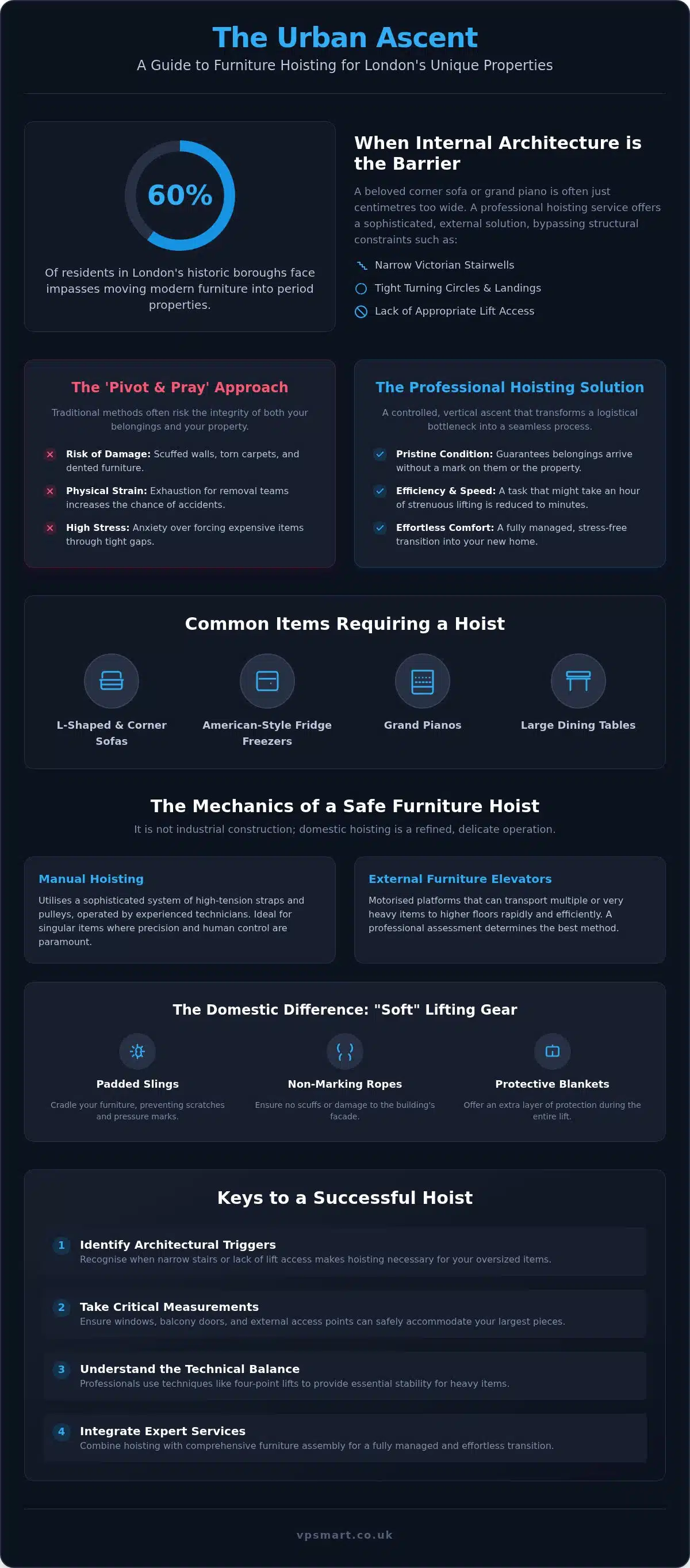
Did you know that approximately 60% of residents in London’s historic boroughs encounter a physical impasse when attempting to move modern furniture into period properties? It’s a common frustration to find that a beloved corner sofa or a grand piano is just a few centimetres too wide for a narrow Victorian stairwell. When the internal architecture of your home becomes a barrier, a professional hoisting service offers a sophisticated, external solution that bypasses these structural constraints entirely.
You likely feel a sense of anxiety at the thought of forcing expensive items through tight gaps, fearing scuffed walls or damaged upholstery. It’s a valid concern; traditional methods often risk the integrity of both your belongings and your property. This guide promises to show you how modern lifting technology provides a safer, more efficient alternative to the “pivot and pray” approach. We’ll examine the technical oversight required for high-access moves, the difference between industrial equipment and domestic furniture hoists, and the essential steps to ensuring your London relocation is defined by effortless comfort rather than logistical dread.
Key Takeaways
- Identify the architectural triggers, such as narrow Victorian stairwells or lack of lift access, that necessitate an external lifting strategy for your oversized belongings.
- Discover how a professional hoisting service employs specialised slings and protective blankets so it’s possible to bypass restricted internal spaces without risking damage.
- Learn the critical measurements required for windows and balcony doors to guarantee your largest items, like grand pianos or American-style fridge freezers, transition through safely.
- Understand the technical balance of four-point lifts, which provide the essential stability needed to transport heavy items to higher floors with complete oversight.
- Gain confidence in your move by integrating expert lifting with comprehensive furniture assembly for a fully managed and effortless transition into your new home.
What is a Furniture Hoisting Service in Removals?
A hoisting service is a specialised removal technique designed to transport bulky or heavy items into a property through external apertures, such as windows, balconies, or roof terraces. Whilst a hoist is a device traditionally associated with heavy industry or construction, its application in house removals in London is much more refined. It bypasses the physical limitations of a building’s interior, allowing for a seamless transition that internal corridors simply cannot accommodate.
There is a significant difference between manual hoisting and the use of external furniture elevators. Manual hoisting relies on a sophisticated system of high-tension straps and pulleys operated by experienced technicians. This method is ideal for specific, singular items where precision and human touch are paramount. In contrast, external furniture elevators are motorised platforms that can reach higher floors rapidly. Professional movers assess your property to determine which method offers the most complete oversight for your specific furniture and architectural layout.
The Distinction Between Industrial and Domestic Hoisting
It is a common misconception that residential hoisting requires the same invasive equipment as a building site. Domestic hoisting is a far more delicate operation. We don’t use heavy scaffolding or clunky industrial cranes that might disturb your neighbours or damage your property’s exterior. Instead, we utilise “soft” lifting gear, including padded slings and non-marking ropes. These materials ensure that your sofas, beds, and piano removals are handled with the same care as if they were being carried by hand, protecting both the item and the building facade from any structural impact.
When the Staircase is No Longer an Option
London’s architectural heritage often presents unique challenges. Many period properties in North and West London feature narrow Victorian hallways, tight spiral staircases, or landings with restricted turning circles. These spaces were never designed for modern, oversized furniture like L-shaped sofas or American-style fridge freezers. When an item cannot be dismantled without compromising its structural integrity, the staircase becomes a liability rather than a route.
Opting for a hoisting service eliminates the risk of wall scuffs, torn carpets, or “wedged” furniture that often occurs during high-pressure moves. By moving the operation outside, we transform a high-stress logistical bottleneck into a controlled, vertical ascent. This approach guarantees that your belongings arrive in your living space in pristine condition, maintaining the domestic well-being and effortless comfort you expect from a premium removal service.
When Do You Need an External Hoisting Service in London?
London’s architectural charm often hides a logistical dilemma. You might find that a contemporary corner sofa, an American-style fridge freezer, or a solid oak dining table simply exceeds the physical dimensions of your property’s internal access points. These “impossible” items are the primary reason homeowners seek a professional hoisting service. When an object cannot be dismantled and the turning circle of a Victorian landing is too tight, moving vertically through a window or balcony becomes the only viable path for a successful relocation.
Beyond physical necessity, safety and speed are compelling factors. Navigating ten flights of stairs with a heavy appliance is not only time-consuming but also physically exhausting for a removal team. This fatigue can lead to accidental slips or scuffs. By utilising a hoist, we reduce the manual handling time significantly. A task that might take an hour of strenuous lifting can be completed in minutes with a mechanical assist, ensuring your items arrive in your new living room without a single mark on the upholstery or the paintwork.
London Architecture and Access Challenges
Specific boroughs present unique hurdles. In areas like Fulham, Richmond, and Wandsworth, many large family homes have been converted into multiple occupancy flats. These conversions often result in narrow, winding staircases that were never intended for modern furniture. Similarly, the sleek, glass-fronted developments in House Removals in Central London often have strict service lift policies or corridors that make moving bulky items a challenge. A hoist provides a controlled bypass, allowing us to maintain complete oversight of the environment regardless of the building’s internal layout.
Specialist Items That Require a Lift
Delicate or high-value items often demand a zero-tilt approach. Antique wardrobes and heavy heirlooms can suffer structural stress if they are tilted at extreme angles to clear a low ceiling. This is particularly true for Expert Piano Removals in London; a grand or upright piano requires absolute stability during transit. To maintain the highest standards, all lifting operations must adhere to strict UK safety regulations, protecting both the technicians and your investment. If you are planning a move involving complex access, our team can help you coordinate a professional house removals strategy that includes the right equipment for your specific needs.
The Mechanics of a Safe Furniture Hoist
Executing a successful hoisting service requires a precise synergy of high-grade hardware and choreographed teamwork. It is a technical process where physics meets domestic care. We utilise specialised equipment, including heavy-duty slings, thick protective blankets, and high-efficiency pulleys to create a secure lifting environment. Unlike manual carries, a mechanical hoist allows for a vertical ascent that keeps the item perfectly level, reducing the risk of internal structural stress on your furniture.
Balance is the foundation of a safe lift. For smaller items, a “two-point” lift might suffice, but for bulky pieces like sofas or wardrobes, we always employ a “four-point” rigging system. This distributes the weight evenly across the frame, ensuring the centre of gravity remains stable throughout the journey. This operation is managed by two distinct units: the ground team, who oversee the initial rigging and ascent, and the balcony team, who guide the item into its final destination. Clear communication between these teams ensures the item never makes contact with the building’s exterior.
Environmental factors play a critical role in our safety protocols. High-quality house removals in London must account for the city’s unpredictable weather. We monitor wind speeds constantly; if gusts exceed safe operating limits, the operation is paused. This strict adherence to safety mirrors the UK’s Health and Safety Executive (HSE) regulations, which govern all professional lifting activities to protect both the public and your property.
The Importance of a Site Survey
A successful hoist begins long before the equipment arrives. We conduct a thorough site survey to assess the structural integrity of your balcony or window frames. This is especially vital for house removals in North London, where older period properties may have decorative but fragile stonework. We also map out external obstructions such as street lamps, overhanging trees, or low-hanging power lines to ensure a clear, vertical corridor for the lift.
Rigging and Securing Your Belongings
Protection is our primary objective. Before an item is rigged, it is wrapped in industrial-grade padding to prevent any surface marks. We then use high-tensile strength straps that are rated far beyond the actual weight of the furniture to guarantee zero slippage. Our technicians use guiding lines to keep the item a safe distance from the building facade, ensuring that even in a light breeze, your windows and brickwork remain completely untouched during the transition.
Preparing for a Hoisting Service: A Homeowner Checklist
Preparation is the bridge between a complex logistical challenge and a successful, stress-free relocation. Whilst our technicians handle the technical oversight, your role in preparing the domestic environment is vital for a smooth transition. Start by conducting precise measurements of your furniture and the intended entry point. It’s not enough to know the sofa fits in the room; you must ensure the window or balcony door frame provides at least five centimetres of clearance on all sides to allow for the protective padding we apply during the hoisting service.
A well-managed environment requires attention to external logistics as well as internal ones. You should notify your neighbours in advance, as the presence of a lifting platform can temporarily alter the flow of your street. If the equipment needs to be positioned on a public road or pavement, you’ll need a parking suspension from your local council. In many London boroughs, these applications must be made 7 to 14 days in advance to avoid fines. Finally, verify your insurance coverage; we provide “Goods in Transit” insurance with coverage up to £50,000, ensuring your high-value items are protected from the moment they are rigged until they are safely inside.
- Clear the landing zone: Remove all furniture, rugs, and fragile decor from the area immediately inside the entry window to give the balcony team ample space to manoeuvre.
- Secure the perimeter: Ensure children and pets are kept in a separate room whilst the lift is in progress to maintain a safe “drop zone” below.
- Check your power: Identify the nearest power outlets if the team is using motorised equipment, although many modern domestic hoists are self-powered.
Balcony and Window Safety Checks
Your property’s structural health is paramount. Before the move date, check that balcony railings are secure and free from significant rust or structural decay. If you’re using a window for access, confirm that the sashes can be fully removed or secured in an open position. Clear any external obstacles like heavy plant pots, hanging baskets, or outdoor furniture. This proactive approach prevents delays and ensures the lifting gear can be positioned with millimetre precision against the building facade.
Communication with Your Moving Team
Digital oversight begins at the quoting stage. Providing clear, high-resolution photos of your balcony, the street level below, and the specific furniture items allows us to identify potential challenges early. We use these details to determine the weight capacity and rigging style required for your inventory. Discussing these factors during your initial consultation helps us provide accurate Pricing and Quotes, ensuring there are no surprises on the day of your move.
Book your professional London removal service today
Why Choose VP Smart Removals for Your Hoisting Needs?
Selecting a partner for your relocation requires more than just a transit van; it demands a specialist who understands the intricate geometry of the city’s dwellings. At VP Smart Removals, we provide a hoisting service that functions as a high-tech extension of our standard care, ensuring that even the most challenging architectural barriers are overcome with precision. We don’t view lifting as a standalone mechanical task, but as a critical component of a digitally integrated move where every variable is managed with complete oversight.
Our comprehensive approach integrates lifting technology with our wider suite of offerings, including expert packing and furniture assembly. By managing the entire lifecycle of the move, we eliminate the need for third-party contractors, which reduces logistical friction and ensures a consistent standard of hardware quality. This holistic oversight means that once your items enter through a balcony or window, they are immediately unpacked and positioned by a team that already understands their specific assembly requirements, delivering a future of effortless comfort in your new home. We position ourselves as Professional Movers London residents can rely on for even the most daunting transitions.
Our Local London Knowledge
Our team possesses a deep-rooted understanding of the specific requirements of West London and South West London. Whether you are moving into a riverside apartment or a tall townhouse, our experience with Removals in Richmond, Twickenham, and Chiswick allows us to anticipate access issues before they arise. We navigate the complexities of local council pavement permits and Red Route restrictions with ease, ensuring your move complies with all regional quality benchmarks whilst maintaining a steady, logical rhythm from start to finish.
The Peace of Mind Guarantee
Financial optimisation and domestic well-being are at the core of our pricing structure. We offer transparent rates that include specialised handling surcharges for high-difficulty tasks, ensuring you only pay for the expertise your move requires. Our technicians are trained in advanced rigging and furniture protection, treating our lifting equipment as helpful household entities that deserve the same respect as the furniture they carry. This commitment to safety is backed by comprehensive insurance, giving you the confidence that your belongings are protected throughout their vertical journey. Our professional hoisting service is designed to alleviate modern homeowner anxieties, providing a dependable solution for a well-managed environment.
Get a Fixed-Price Quote for Your London Move
Overcoming the Vertical Challenges of Your London Move
Mastering the logistical hurdles of a city relocation requires more than just physical strength; it demands technical oversight and the correct equipment. By opting for a professional hoisting service, you transform a potentially damaging bottleneck into a controlled, effortless transition. We have explored how identifying architectural triggers early and preparing your landing zone can eliminate the anxiety often associated with narrow Victorian stairwells and restricted access points.
Our team brings years of experience in London period property moves, offering specialised expertise in both hoisting and piano removals. We believe in transparent, fixed-price relocation fees, allowing you to plan your transition with complete financial oversight and zero surprises. By prioritising safety and precision, we ensure your most cherished items arrive in your new home exactly as they left, ready for you to enjoy a life of effortless comfort and domestic well-being.
Book your stress-free London move with VP Smart Removals
Take the first step towards a well-managed relocation today and let our specialists handle the high-access lifting for you. We’re ready to ensure your move is defined by regional reliability and professional excellence.
Frequently Asked Questions
Is it safe to hoist a heavy sofa through a window?
It’s entirely safe to hoist a heavy sofa through a window when the operation is managed by a specialist team using certified equipment. Our technicians utilise industrial-grade padded slings and high-tensile straps to distribute the weight evenly, ensuring the sofa remains level throughout the ascent. This method often provides better protection for your furniture than forcing it through a narrow corridor, as it eliminates the risk of structural stress or surface abrasions during the move.
Do I need a special permit for a furniture hoist in London?
You’ll require a parking suspension or pavement permit if the hoisting equipment needs to be positioned on a public highway or council-owned pavement. These applications are handled by your local London borough council and typically require between 7 and 14 days’ notice to process. Whilst we provide the technical oversight for the move, securing these permits in advance ensures that the removal vehicle has a dedicated, legal space to operate safely and efficiently on the day.
How much does a hoisting service cost as part of a move?
The cost of integrating a hoisting service into your relocation depends on several technical factors, including the number of items being lifted and the specific floor level of your property. We apply specialised handling surcharges for these high-difficulty tasks to reflect the additional equipment and expert technicians required. For an accurate reflection of the financial investment for your specific move, we recommend requesting a fixed-price quote that accounts for your unique architectural access challenges.
Can any balcony be used for a furniture hoist?
Not every balcony is suitable for furniture lifting; the structure must possess the integrity to support the weight of the items and the technicians involved. During our initial assessment, we check for signs of structural decay, such as rust on railings or crumbling stonework. We also require a clear landing zone and sufficient clearance for the item to pass through the balcony doors without obstruction, ensuring a seamless transition into your living environment without compromising safety.
What happens if the weather is too bad for hoisting on moving day?
Safety remains our primary objective, so we monitor weather conditions closely on the day of your move. If wind speeds exceed safe operational limits or if heavy rain compromises the grip of our rigging, the hoisting operation will be paused. In such scenarios, we coordinate with you to reschedule the lift for the next safe window, ensuring that your domestic well-being and the integrity of your belongings are never compromised by unpredictable environmental risks or high gusts.
Can you hoist a piano to a third-floor flat?
We can certainly hoist a piano to a third-floor flat using specialised lifting techniques that maintain the instrument’s delicate internal balance. Pianos require a zero-tilt approach to protect their mechanical components and tuning stability. By utilising a professional lifting strategy, we bypass narrow staircases entirely, lifting the piano vertically and guiding it through a window or balcony with millimetre precision to ensure it arrives in your new home in pristine, playable condition.
Do I need to dismantle my furniture before it is hoisted?
You only need to dismantle furniture if its external dimensions exceed the width of the window or balcony door frame. One of the primary benefits of a professional lift is that it often allows large items, like solid wardrobes or L-shaped sofas, to be moved in one piece. If disassembly is required for the item to fit through the aperture, our experienced team can handle the furniture disassembly and reassembly as part of your comprehensive removal package.
Will a hoisting service damage my window frames?
A professional hoisting service is designed to be completely non-invasive, protecting your property’s facade and window frames from any contact. We use soft lifting gear and guiding lines held by our ground team to ensure the furniture remains at a safe distance from the building during its ascent. This technical oversight prevents scuffs or structural impact, allowing your home’s exterior to remain untouched whilst providing a high-tech solution for moving bulky items into restricted spaces.
Disclaimer
Some links in this article may be affiliate links, which means we may earn a small commission if you make a purchase through them, at no additional cost to you. We only recommend products or services we believe provide value to our readers.
Aug 26, 2026
What if a single humid afternoon in a standard storage unit could permanently alter the voice of your Steinway or Bechstein? You’ve likely spent years perfecting your touch and investment, so the thought of London’s erratic weather or narrow Victorian corridors damaging your instrument is genuinely stressful. Finding reliable piano storage London musicians can trust involves more than just a locked door. It requires a managed environment that respects the delicate nature of spruce and iron whilst shielding it from the city’s atmospheric shifts.
We understand that your piano is both a financial asset and a source of domestic well-being. This guide shows you how to protect your instrument with London’s most reliable climate-controlled piano storage and specialist transport services. You’ll learn exactly how we maintain a stable humidity level to prevent wood warping and why our precision hoisting equipment makes light work of the capital’s most challenging access points. We will also break down our transparent storage terms, giving you complete oversight of your instrument’s safety without any hidden surprises or technical anxieties. By the end, you’ll have a clear roadmap for a seamless, secure transition.
Key Takeaways
- Understand why maintaining 45-55% relative humidity is the industry gold standard for preventing wood warping and protecting delicate internal felt.
- Discover how specialist hoisting services and precision equipment safely navigate the narrow Victorian hallways and tight stairwells common across Greater London.
- Identify the essential security protocols required to maintain complete oversight and ensure your instrument remains in a stable, secure environment.
- Learn how to select a professional piano storage london solution that avoids the risks of fluctuating temperatures and dampness found in standard self-storage units.
- Explore the advantages of a full-service removal partner who combines expert handling with transparent, reliable logistics for a stress-free experience.
Why Specialist Piano Storage in London is Essential
A piano is an intricate assembly of thousands of moving parts, many of which are crafted from organic materials like seasoned spruce, maple, and wool felt. Unlike a wardrobe or a standard sofa, it reacts to its environment with a sensitivity that can be startling. For residents seeking piano storage london offers many generic options, but a standard metal container or a cold basement simply won’t suffice. Specialist storage is an essential insurance policy for your instrument’s longevity. It’s a managed ecosystem designed to preserve the delicate tension of the strings and the structural integrity of the soundboard.
The Risks of Conventional Self-Storage
Standard self-storage facilities often lack the sophisticated environmental controls required for professional Piano maintenance. Metal units are particularly problematic because they are prone to rapid temperature swings. These fluctuations lead to internal condensation, which is a piano’s greatest enemy. Moisture causes tuning pins to slip and wooden joints to swell, often leading to permanent soundboard cracks. Without proper ventilation, fine construction dust accumulates within the action, whilst unmanaged facilities may expose your heirloom to pests that find wool hammers particularly attractive. Many owners don’t realise that standard insurance policies for general self-storage frequently exclude high-value musical instruments, leaving you financially vulnerable if the environment fails.
Common Scenarios for Piano Storage
London’s unique property market and architecture often create a need for professional storage services that go beyond the basics. By choosing a specialist facility, you ensure your instrument remains in a stable environment during major life transitions.
- Victorian Renovations: The “dust factor” during a terrace house refurbishment is often underestimated. Microscopic debris from plasterwork can settle in the strings and keys, requiring expensive professional cleaning.
- Property Chain Gaps: When property sales in the capital don’t align perfectly, you need a secure, climate-stable holding bay for your instrument between moves.
- International Assignments: If you’re moving abroad temporarily, your piano deserves a consistent home until your return, rather than being left in an unheated house or a draughty garage.
Whether it’s a family heirloom or a concert grand, the instrument represents both a significant financial asset and a source of domestic well-being. Entrusting it to a specialist ensures that when it eventually returns to your home, it retains its performance quality and visual appeal. This level of oversight provides the peace of mind that your investment is being treated with the technical respect it deserves.
The Science of Piano Care: Climate Control Explained
Think of your piano not as a piece of furniture, but as a living organism. Its heart is the soundboard, usually a vast sheet of spruce that breathes and moves with the air around it. Because wood is hygroscopic, it constantly absorbs and releases moisture, causing it to expand and contract. For anyone requiring piano storage london facilities must offer more than security; they must provide a managed atmosphere. The industry gold standard is a relative humidity (RH) level of 45-55%. Maintaining this precise range ensures the wood remains stable, preventing the catastrophic structural failures that occur when an instrument is left in an unmanaged environment.
Humidity and the Soundboard
London’s climate presents unique challenges for delicate instruments. In the damp autumn months, wood swells, increasing the crown of the soundboard and pushing the strings sharp. Conversely, when central heating kicks in during winter, humidity levels in a standard room can plummet to below 20%. This rapid drying causes the wood to shrink, leading to loose tuning pins and, eventually, permanent cracks. According to National Park Service guidelines regarding the care of wood products, consistent thermoregulation is vital for preventing the “cycling” effect that fatigues the timber. By stabilising the environment, we protect the tension of the strings and the clarity of the instrument’s voice.
Professional Packing and Protection
Environmental stability isn’t just about the air in the room; it’s about the immediate micro-climate surrounding the instrument. We avoid using non-breathable plastic wraps, which can trap moisture against the varnish and cause “blooming” or heat rash. Instead, we utilise heavy-duty, breathable transit blankets. These specialised covers act as a thermal buffer, shielding the high-gloss finish and internal action from London’s particulate matter and microscopic dust. This layer of protection is particularly important for the keyboard and the delicate wool hammers, which are sensitive to both moisture and airborne pollutants.
Our approach ensures that every component, from the cast-iron frame to the smallest felt bushing, remains in peak condition. If you’re planning a move or renovation, choosing our climate-stable storage services provides the technical oversight needed to keep your instrument’s performance quality intact. Regular condition checks are part of our commitment to transparency, giving you peace of mind that your piano is resting in a perfectly calibrated home away from home.
Navigating London Piano Transport Logistics
London’s architecture is beautiful but notoriously difficult for large instruments. Whether you’re in a Kensington townhouse or a Canary Wharf penthouse, the logistics of piano storage london collections require precision engineering. We don’t just “move” a piano; we design a transit path that accounts for every centimetre of clearance. This process begins long before we arrive at your door. It involves navigating complex Red Routes and securing the necessary parking permits from local councils to ensure our specialised vehicles are positioned safely for a controlled, steady load.
Handling Difficult Access in London
We frequently encounter narrow Victorian hallways where a standard turn is physically impossible. In these scenarios, specialist equipment like piano shoes and skids becomes essential. These tools allow our team to move the instrument on its side safely, shielding the delicate internal action from vibration. If your property has multiple floors, you’ll likely encounter a “Stair Charge” in your pricing. This isn’t just a fee; it’s a safety protocol that covers the extra manpower and heavy-duty dollies required for a secure ascent. In cases where communal stairwells are too tight, our professional hoisting service provides a high-tech alternative, lifting your piano through a window or balcony with complete oversight.
Insurance and Liability During Transit
Trust is built through transparency and detail. Every collection for our storage services begins with a comprehensive pre-move inventory and condition report. This document acts as a baseline, ensuring your instrument returns to you in the exact state it left. It’s vital to distinguish between Public Liability, which covers your home’s walls and floors, and Goods in Transit insurance, which specifically covers the piano itself. Professional movers provide a level of technical security that DIY attempts simply can’t replicate. By choosing an expert team, you’re investing in a risk-free transition that protects both your instrument’s performance and its long-term financial value.
Our goal is to make the entire process feel effortless. By combining local heritage knowledge with modern equipment, we navigate the capital’s most challenging postcodes with confidence. You’re kept in charge of your environment whilst we handle the heavy lifting, ensuring your piano arrives at our secure facility ready for its period of rest.
How to Evaluate a London Piano Storage Facility
Selecting the right environment for your instrument requires a methodical approach that balances technical specifications with practical accessibility. You shouldn’t settle for a basic lock-up when searching for piano storage london. A high-quality facility serves as an extension of your home, offering a level of technical oversight that general warehouses cannot match. Modern, purpose-built storage centres are generally superior to legacy industrial buildings because they are designed from the ground up to maintain thermal stability. These facilities use advanced insulation and ventilation systems to prevent the dampness often found in older London basements.
Security and Peace of Mind
Your instrument represents a significant emotional and financial investment. To ensure complete peace of mind, look for facilities featuring 24/7 CCTV monitoring and multi-layered gated access. Modern fire suppression systems are equally critical; they protect your piano without the risk of water damage associated with traditional sprinklers. Professional secure storage facilities in London UK operate on an “authorised access only” basis. This protocol ensures your piano is never moved or handled unnecessarily by unauthorised personnel, keeping it in the exact condition it arrived. Complete oversight is the key to a stress-free experience.
Comparing Storage Providers
Transparency is the hallmark of a reliable service provider. When vetting potential piano storage london options, ask for evidence of their climate logs. A professional partner should be able to demonstrate a consistent history of humidity and temperature control, proving they understand the science of wood preservation. You should also scrutinise the pricing structure for “hidden” costs. Whilst weekly rates are standard, check for additional surcharges such as insurance premiums, handling fees, or exit costs that might not be immediately apparent. Evaluating a company’s reputation through local London reviews will often reveal the truth about their customer service and reliability.
Consider how much notice you need to give to retrieve your piano. Some facilities require weeks of planning, whilst others offer more flexible transitions for those in moving chains. A visionary provider understands that your schedule may change and offers terms that adapt to your practical needs. By choosing a partner that prioritises both security and transparency, you ensure your piano’s future is in safe hands and its performance quality remains perfectly preserved.
View our secure storage options for London pianos
Seamless Piano Storage with VP Smart Removals
Entrusting your instrument to a professional partner means moving beyond the logistics of a simple transport service. At VP Smart Removals, we view piano storage london as a comprehensive lifecycle service that prioritises your instrument’s health and your own peace of mind. We aren’t just moving a heavy object; we’re managing a delicate environment. Our approach strikes a precise balance between technical authority and domestic warmth, ensuring that your heirloom or professional tool is treated with the respect it deserves. By choosing a full-service partner, you gain complete oversight of the process, from the first lifting strap to the final climate-controlled bay.
Our Integrated Moving and Storage Strategy
We don’t just pick up your instrument; we integrate its transition into your broader life changes. Whether you’re coordinating House removals London families depend on or simply making room for a home renovation, our strategy focuses on a seamless flow. We manage the entire timeline so you don’t have to juggle multiple contractors. Our team uses high-quality packing materials to create a protective buffer, shielding the high-gloss finish from the friction of transit. Every step is logical and instructional, guiding your piano from your living room into our secure warehouse with zero friction.
- Expert Disassembly: We specialise in the technical disassembly of grand piano legs and lyres to ensure safe passage through tight London apertures.
- Precision Packing: Utilising breathable transit blankets and custom-fit covers to maintain a stable micro-climate.
- Managed Transit: Our specialist teams are trained in delicate handling, using heavy-duty dollies and skids designed for London’s unique architecture.
The VP Smart Commitment to Quality
Our commitment to transparency means you’ll never face hidden London surcharges or unexpected fees. We provide a personalised service that respects the regional heritage of the capital, whether we’re collecting an upright in Fulham or a concert grand in Richmond. This regional reliability is our trust-building signature. We view our hardware and equipment as helpful household entities, working quietly to protect your investment whilst you focus on your move. It’s a forward-thinking way to manage your environment, framing protection not as a chore, but as a logical byproduct of intelligent management.
Taking the next step is straightforward. You can request a fixed-price quote that covers your specific requirements, ensuring you have a clear financial roadmap before we begin. Securing a quote for piano storage london musicians trust is the final step toward complete peace of mind. Let us provide the technical expertise and domestic care your instrument requires, allowing you to look forward to a future of effortless comfort and musical enjoyment.
Securing the Future of Your Musical Investment
Protecting the voice and value of your instrument requires more than just a locked door; it demands a managed environment where humidity and temperature are precisely calibrated. We have explored how specialist piano storage london services shield your investment from the structural risks of wood warping and tuning instability. From navigating narrow Victorian stairwells with professional hoisting to ensuring complete oversight through secure, monitored facilities, the right storage partner transforms a complex logistical challenge into a period of restful preservation.
By choosing a service rooted in regional reliability and technical expertise, you ensure your instrument returns to your home in peak performance condition. Our commitment to transparent, pre-agreed pricing and specialist piano handling expertise provides the financial and emotional security every modern homeowner deserves. It’s about more than storage; it’s about maintaining a lifestyle of effortless comfort and musical excellence. We look forward to providing the visionary care and practical support your piano requires during its stay.
Get a Fixed-Price Quote for Piano Storage and Removals
Frequently Asked Questions
Do I need to tune my piano before or after storage?
You should always tune your piano after it has been moved and settled into its new environment. Moving an instrument involves physical shifts and exposure to different atmospheric conditions, which inevitably affects the tension of the strings. We recommend waiting at least two to four weeks after delivery before calling a tuner. This period allows the wood and felt to reach equilibrium with the local humidity levels, ensuring the tuning remains stable for longer.
How much does it typically cost to store a piano in London?
Costs for piano storage london vary based on the instrument’s dimensions and the level of environmental control required. Generally, rates are calculated weekly, with grand pianos commanding a higher fee than upright models due to the larger footprint they occupy in the warehouse. You should also factor in the initial collection and final delivery charges, which depend on access difficulty. Requesting a fixed-price quote ensures you have complete oversight of your financial commitment.
Can you store a grand piano in your London facility?
Yes, our facilities are fully equipped to accommodate grand pianos of all sizes, from baby grands to full concert models. Our specialist team performs professional furniture disassembly, carefully removing the legs and lyre before securing the main body on a padded piano skid. This method ensures the instrument is stored vertically to optimise space whilst protecting the delicate internal action. We use breathable transit blankets to maintain a stable micro-climate for the high-gloss finish.
Is my piano insured while it is in your storage warehouse?
Your instrument is protected by comprehensive insurance coverage throughout its stay. This includes Goods in Transit insurance during the move and dedicated warehouse cover whilst it remains in our secure facility. We provide a detailed condition report and inventory before the move begins, giving you a documented baseline for complete peace of mind. This technical oversight ensures that your financial investment and sentimental heirloom are shielded against unforeseen circumstances during the storage period.
How do you prepare a piano for long-term storage?
Preparation involves a thorough cleaning followed by professional wrapping in non-plastic, breathable materials. We secure the keyboard lid and ensure all moving parts are stabilised to prevent internal friction during transit. When arranging piano storage london humidity is the primary concern, so we ensure the instrument is placed in a zone with 45-55% relative humidity. This proactive approach prevents the soundboard from drying out or the delicate wool hammers from absorbing excess moisture.
What is the minimum period for piano storage in London?
We offer flexible storage terms that cater to the fast-moving London property market. Whilst many clients require long-term solutions during overseas assignments, others only need temporary holding for a few weeks between property completions or home renovations. There is no rigid lock-in period; we tailor our agreements to your specific timeline. This adaptability allows you to manage your domestic environment with confidence, knowing your piano can return home exactly when you’re ready.
Can you handle piano removals from upper-floor flats without lifts?
Our team is highly experienced in navigating difficult access points, including upper-floor flats without lift access. We utilise specialist equipment like heavy-duty dollies and piano shoes to manage tight stairwells safely. In cases where the architecture makes internal transit impossible, we provide a professional hoisting service to lift the instrument through a window or balcony. A pre-move risk assessment ensures we select the most secure method for your specific London postcode and property type.
Should I use a climate-controlled facility for an older upright piano?
Climate control is arguably more important for older upright pianos than for modern ones. Aged wood has often survived decades of different heating systems and is more prone to cracking if suddenly exposed to London’s damp winters or dry summers. A managed environment with stable thermoregulation prevents the cycling effect that causes glue joints to fail and tuning pins to loosen. Investing in specialist storage preserves the structural integrity and unique character of your antique instrument.
Disclaimer
Some links in this article may be affiliate links, which means we may earn a small commission if you make a purchase through them, at no additional cost to you. We only recommend products or services we believe provide value to our readers.