
Imagine it is 3:00 AM in a house filled with half-packed crates, and you are balancing a crying infant whilst trying to soothe a toddler who is distraught because their favourite teddy is buried in a box. Moving is famously one of life’s most taxing experiences, but when you add the unpredictable nature of young children, it can feel like a recipe for total exhaustion. You aren’t alone in feeling that the lack of sleep is clouding your judgement or that the impending change is triggering more tantrums than usual.
This guide offers the comprehensive moving house with a baby and toddler support you need to transform a chaotic transition into a managed, successful relocation. We promise to show you how to navigate this move using parent-tested strategies that prioritise your family’s well-being and safety. You will discover our “First-In, Last-Out” essential kit, learn how to maintain strict sleep routines amidst the upheaval, and understand why professional furniture assembly is the technical solution for ensuring cots are ready for that vital first night. By the end of this article, you will have a clear, instructional roadmap for a seamless move into your new home.
Key Takeaways
- Start preparations eight weeks in advance by decluttering and organising a central folder to manage London-specific administrative transfers and health visitor updates.
- Access comprehensive moving house with a baby and toddler support by adopting the “First-In, Last-Out” strategy for nursery essentials and packing a dedicated 48-hour survival kit.
- Arrange for off-site childcare or an extra nursery day to maintain complete oversight of the removals team whilst they navigate narrow London streets and stairwells.
- Use professional furniture assembly services to ensure cots and beds are fully operational on the first evening, preserving vital sleep schedules for the whole family.
- Establish a sense of belonging immediately by prioritising the children’s bedrooms and conducting a thorough childproofing sweep before allowing toddlers to explore the new environment.
Preparing for the Move: A Timeline for Busy Parents
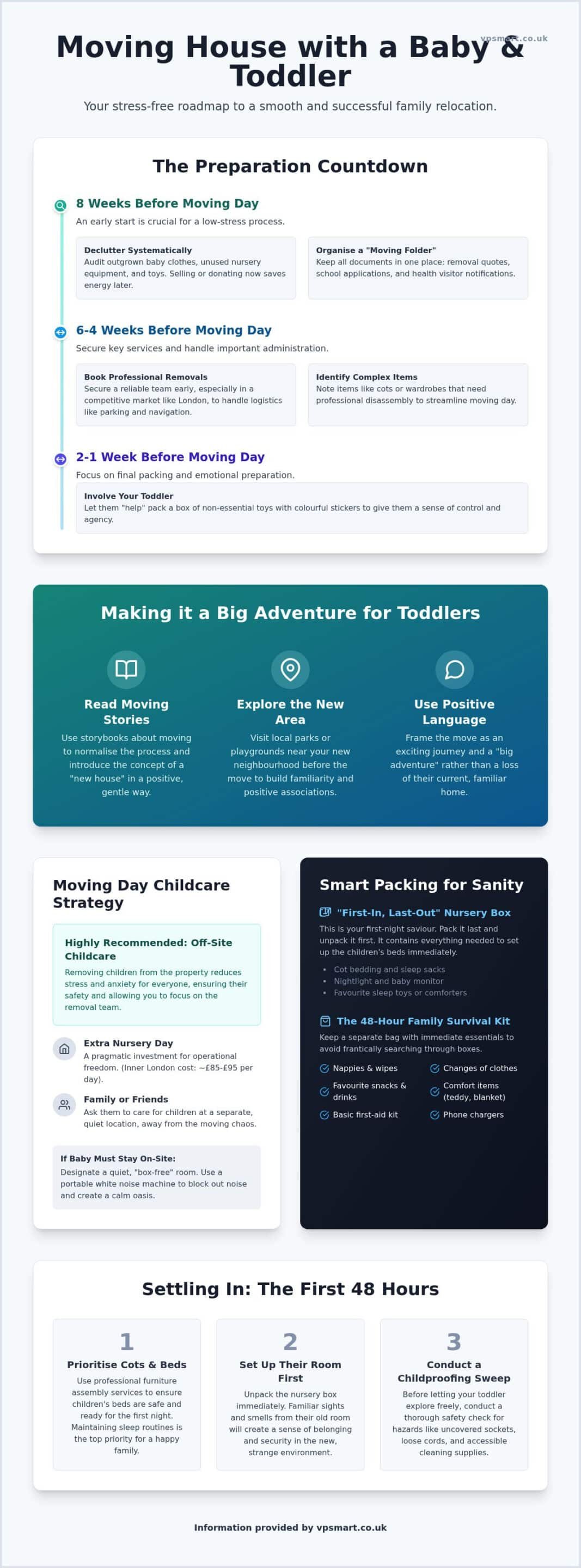
Successful relocation starts long before the first box is taped. For parents, the key to maintaining control is a structured countdown that begins at least eight weeks before your move date. This early start allows you to provide the necessary moving house with a baby and toddler support without the pressure of a looming deadline. By spreading the workload, you preserve the emotional energy required to keep your children calm and settled.
Create a physical or digital “moving folder” immediately. This isn’t just for receipts; it’s a command centre for your family’s transition. Use it to track London school applications, notify health visitors of your change of address, and store your fixed-price removal quotes. Having all documentation in one place ensures you maintain oversight of the administrative side whilst managing the daily needs of your little ones.
Secure your professional house removals as soon as your date is confirmed. In the competitive London market, booking early ensures you get a team that understands the technicalities of narrow corridors and parking permits. This technical reliability acts as a foundation for your move, leaving you free to focus on the emotional aspects of the transition.
The Eight-Week Declutter Strategy
Audit your inventory at the eight-week mark. Focus on outgrown baby clothes, bulky nursery equipment, and toys that no longer serve a purpose. Selling or donating these items now preserves your energy levels for the heavy lifting later. Identify complex items like wardrobes or multi-stage cots that will require professional disassembly. This foresight ensures that your removal day is streamlined and efficient, reducing the time children spend in a disrupted environment.
Emotional Preparation for Toddlers
Establishing a stable emotional foundation is a core part of moving house with a baby and toddler support. Relocation is a significant life event that can trigger anxiety in young children. Understanding Childhood Stress is vital when managing a toddler’s reaction to change. Use positive, empowering language to frame the move as a “big adventure” rather than a loss of their current home.
- Read storybooks about moving to normalise the process and introduce the concept of a “new house”.
- Visit local London parks or playgrounds near your new neighbourhood to build familiarity and excitement.
- Let your toddler “help” pack a box of non-essential toys using colourful stickers to give them a sense of agency.
Childcare Strategies: Deciding Who Supports You on the Day
Selecting the right level of moving house with a baby and toddler support is a critical logistical decision that dictates the rhythm of your entire relocation. Whilst it is tempting to keep the family together, the presence of young children in a high-traffic environment filled with heavy equipment and open doors can escalate stress levels. Research into the Long-Term Effects of Moving suggests that the quality of parental support during the transition significantly influences how children adapt to their new surroundings. Consequently, your childcare strategy should focus on providing a stable, predictable environment whilst the technical aspects of the move proceed.
For many London families, booking an additional day at a local nursery is a pragmatic investment. With inner London nursery costs for children under two currently ranging between £85 and £95 per day, the financial cost is often outweighed by the operational freedom it provides. If you are relying on grandparents, establish clear boundaries regarding their role. It is usually more effective to have them focus entirely on childcare at a separate location rather than attempting to assist with packing. This ensures your children remain in a calm environment, away from the disruption of moving vans and shifting furniture.
The Case for Off-Site Childcare
Removing children from the property during the most intensive hours of the move reduces environmental anxiety for everyone involved. If you choose this route, ensure the “handover bag” is packed with technical precision. It must contain their absolute favourite snacks, comfort items, and enough nappies for 48 hours to account for any unforeseen delays. If a baby must remain on-site, designate a quiet, “box-free” room with a portable white noise machine to help them maintain their nap schedule despite the external noise of the removal team.
Keeping Toddlers Involved and Safe
If your toddler is present, safety oversight is your primary objective. Create a “safe zone” in a specific room that is emptied last and remains gated. You can empower your toddler by assigning “special jobs”, such as being the “Chief Sticker Officer” for certain boxes. This keeps them occupied and out of busy hallways whilst the movers work. Utilising professional movers and packers is a highly effective way to reclaim your time, allowing you to focus entirely on parenting whilst the technical labour is handled by experts. If the logistics feel overwhelming, you might consider booking professional packing services to ensure you are fully prepared before the children even wake up on moving day.
Packing with Purpose: The Nursery and Essentials Strategy
Achieving a seamless transition requires a technical approach to box management. The “First-In, Last-Out” principle ensures that the items most critical to your children’s routine are the last to leave your old home and the first to be unloaded. This method provides the moving house with a baby and toddler support needed to re-establish a familiar environment within minutes of arrival. Using high-quality professional packing materials is essential here. Double-walled boxes and acid-free tissue paper protect delicate nursery monitors and sentimental toys during transit across London’s varied terrain.
Organisation is the key to maintaining domestic well-being during the move. Implement a colour-coding system for your boxes, assigning a specific colour to the baby’s nursery and another to the toddler’s bedroom. This visual oversight allows the removal team to identify exactly where each item belongs without constant parental direction. It reduces the “where is the teddy?” panic that often triggers toddler tantrums during the first few hours in a new space.
The Ultimate Moving Day Survival Kit
Most guides suggest packing for 24 hours, but a pragmatic parent knows that delays happen. Prepare for 48 hours. For the baby, this means a surplus of formula, sterilised bottles, and wipes. For the toddler, focus on distraction and blood sugar management. Pack low-mess snacks like rice cakes or dried fruit, and ensure a tablet is fully charged with their favourite shows downloaded for offline viewing. Don’t forget a small bag for yourselves containing a kettle, coffee, and mugs. Having the ability to make a hot drink immediately provides a much-needed sense of comfort and oversight amidst the boxes.
Packing the Nursery for a Fast Setup
The cot must be the final item loaded onto the removals van. By positioning it at the rear, it becomes the first item offloaded at your new property. This allows you to prioritise the assembly of the sleeping area immediately. Keep bedding, blackout curtains, and a nightlight in a clearly marked “Open First” box. If you have complex nursery technology, such as integrated baby monitors or multi-piece play gyms, photograph the cable configurations before dismantling them. This simple step ensures a rapid, error-free setup in the new room, helping you maintain a consistent sleep schedule from the very first night.
Moving Day Logistics: Safety, Sanity, and Support
Moving day represents the functional peak of your relocation, where meticulous planning meets the reality of physical transit. Maintaining a sense of complete oversight is paramount during this phase to ensure that your children remain safe whilst the environment is in a state of flux. Safety protocols must be strictly enforced; ensure that toddlers are never left unattended in hallways or near stairwells where movers are carrying bulky items. To facilitate this, designate a “Base Camp” room in the new property immediately upon arrival. This should be a secure, childproofed space where your little ones can play or rest away from the heavy lifting and open doors. This focused approach provides the moving house with a baby and toddler support necessary to keep the most vulnerable members of your household calm and protected throughout the day.
Working with Your Removals Team
Effective coordination with your removal team is essential, particularly when navigating the logistical hurdles of London’s narrow streets and multi-storey period homes. Before the first box is moved, communicate your priorities clearly to the crew leader. Emphasise that the nursery and toddler’s room should be the first areas set up. Managing 2026 London parking permit regulations is another technicality your removal team should handle, but your oversight ensures the van is positioned to minimise the distance children have to walk across busy pavements. By opting for professional furniture assembly services, you delegate the technical burden of reconstructing cots and bed frames to experts. This ensures that the children’s sleeping environments are operational by early evening, allowing you to focus on emotional support rather than hardware assembly.
Get a fixed-price quote for your London move today
Maintaining the Routine
Predictability acts as an emotional anchor for young children during a move. Whilst your surroundings are changing, your daily schedule should remain as static as possible. Adhering to regular meal times and nap schedules provides a necessary sense of continuity. A consistent and familiar routine is the best defence against a toddler meltdown because it signals to the child that their core needs will still be met despite the unfamiliar environment. If the baby normally naps at 11:00 AM, ensure they are in their pram or a quiet corner of the Base Camp at that exact time.
For your first night, consider the “Picnic on the Floor” strategy. By laying a blanket in the living room and serving a simple, favourite meal, you transform a potentially stressful lack of furniture into a memorable family adventure. This proactive management helps your children feel excited rather than overwhelmed by their new home. It allows the family to decompress together, reinforcing the idea that the new house is a place of comfort and joy from the very first hour.
Settling In: The First 48 Hours in Your New London Home
The first 48 hours after your move are a critical period for establishing emotional security. Whilst the technical labour of the relocation is complete, the moving house with a baby and toddler support you provide now shifts towards domestic integration. Prioritising the children’s bedrooms above the kitchen or living area is a strategic choice that immediately signals safety and belonging. By ensuring their space is functional and familiar, you mitigate the “new house” anxiety that often disrupts sleep patterns and behaviour. It’s about transforming a house into a home through purposeful, child-centric organisation.
Many London properties, especially Victorian conversions or modern apartments, feature narrow staircases and multiple floors that can feel daunting with little ones. Utilising storage services allows you to keep non-essential inventory off-site, giving you the physical space to unpack at a slower, more manageable pace. This oversight ensures your main living areas remain clear of boxes, reducing the risk of accidents whilst your toddler explores their new environment. It’s a pragmatic way to maintain a calm atmosphere during the initial transition.
Immediate Childproofing Checklist
Before letting your toddler loose in the new property, conduct a swift but thorough technical sweep of each room. London flats on upper floors require particular attention; verify that all windows have functional safety catches and restrictors. In the kitchen, check for loose wires from previous appliances and ensure cupboard latches are secure. You should also take a moment to locate the nearest 24-hour pharmacy and local park within your borough, as knowing these locations provides an extra layer of security for your family.
- Install baby gates at the top and bottom of stairs before the first night’s sleep.
- Check for unsecured blind cords that could pose a hazard in the nursery.
- Ensure all heavy furniture or bookcases are secured to the walls to prevent tipping.
Creating a Sense of Home
Visual comfort is a powerful tool for emotional regulation. Unpack the “favourite things” box first, displaying familiar toys and photos exactly where the children can see them. Environmental anchoring is a technique for helping toddlers adjust to a new bedroom by placing familiar objects in the same relative positions as the old room to maintain a sense of spatial continuity. Even if the room’s dimensions have changed, keeping the lamp or a specific rug on the same side of the cot as before can provide vital reassurance.
Stick to your established bedtime rituals without deviation. The technical setup of the room might be different, but the sequence of a bath, book, and bed should remain identical. This consistency, combined with the professional furniture assembly you utilised on moving day, ensures that your children feel secure in their new surroundings from the very first evening. By focusing on these small details, you create a digitally integrated and emotionally stable environment that allows the whole family to thrive.
Secure Your Family’s Future Comfort
A successful relocation with young children is built on a foundation of technical oversight and emotional stability. It’s about more than just moving boxes. By implementing a structured eight-week timeline and the “First-In, Last-Out” packing strategy, you eliminate the chaos that often disrupts domestic well-being. Prioritising the nursery setup and maintaining familiar sleep schedules ensures your children feel secure from the very first night in their new London home.
Accessing expert moving house with a baby and toddler support transforms a complex logistical challenge into a managed, stress-free experience. Our expert London removals team provides Red Dot-style professional care for your belongings, ensuring every delicate item arrives safely. With specialised furniture assembly for nurseries, we guarantee that cots and beds are ready for use immediately, protecting your family’s vital rest. You deserve a transition that prioritises your children’s safety and your own peace of mind.
Get a Fixed-Price Quote for Your Family Move
Take the first step toward your new beginning with confidence. Your well-managed environment is just a professional consultation away.
Frequently Asked Questions
Is it better to move house with a baby during the day or at night?
Moving house with a baby and toddler support is most effective during daylight hours. A daytime move allows you to maintain better oversight of the removals team and ensures that technical equipment is handled under optimal lighting. Whilst a night move might seem quieter, the disruption to a baby’s circadian rhythm can lead to prolonged sleep regression. Daylight also facilitates easier navigation of London’s borough-specific parking restrictions and narrow access points.
How do I keep my toddler safe during the removals process?
Safety is best managed by creating a “Safe Zone” in a room that is emptied last. Use a pressure-fit baby gate to restrict access to hallways where movers are carrying heavy furniture. Assigning a dedicated adult to supervise the toddler away from the main activity is the most reliable way to prevent accidents. This operational oversight ensures that your child remains calm whilst the technical labour of the house removal proceeds safely.
What should I pack in a baby’s moving day essentials bag?
Your essentials bag should contain enough supplies for 48 hours to account for any logistical delays. Include nappies, wipes, pre-measured formula, and several changes of clothes. Pack a few familiar toys and low-mess snacks to keep the children occupied during transit. Don’t forget any necessary medications and a portable white noise machine. This kit acts as a helpful household entity, providing immediate comfort before your main crates are unpacked.
Should I hire professional packers if I have young children?
Hiring professional packers is a significant sanity-saver for parents with young children. It allows you to maintain your focus on parenting whilst experts handle the technical requirement of securing delicate nursery items. Professional teams use specialised materials to protect your belongings, which reduces the risk of damage during the move. By delegating this task, you ensure that you aren’t exhausted before the physical relocation even begins.
How do I help my toddler adjust to their new bedroom?
Helping a toddler adjust requires a combination of environmental anchoring and strict routine. Unpack their favourite toys immediately to provide visual comfort in the new space. Position their bed in a similar orientation to their previous room to maintain spatial continuity. Stick to their established bedtime ritual, as the familiarity of the sequence is more important to a child than the physical walls surrounding them. This approach builds trust and emotional security.
What if the moving van is delayed and it’s past my baby’s bedtime?
If a delay occurs, rely on your 48-hour survival kit to provide the necessary moving house with a baby and toddler support. Use a pram or a portable travel cot in a quiet corner of the new house to allow the baby to sleep whilst the movers finish unloading. Having pre-sterilised bottles and pre-measured feeds ready ensures you can meet their needs without needing access to the kitchen immediately. Stay calm to avoid transferring anxiety.
Can I move a cot without taking it apart?
It’s rarely advisable to move a cot without taking it apart because most London doorways are too narrow to accommodate a fully assembled frame. Moving an assembled cot can also compromise its structural integrity due to the vibrations of the removals van. Utilising a professional furniture assembly service ensures that the cot is dismantled correctly and reconstructed with technical precision. This provides a safe sleeping environment for your baby on their first night.
How soon should I childproof my new house after moving?
You should conduct a preliminary childproofing sweep before the children enter the property on moving day. Focus on immediate hazards such as loose wires, unsecured cupboards, and window catches. Install baby gates at the top and bottom of stairs before the first evening. A more comprehensive technical audit can be completed over the following 48 hours, but the primary safety barriers must be operational before your toddler is allowed to explore the new environment.
Disclaimer
Some links in this article may be affiliate links, which means we may earn a small commission if you make a purchase through them, at no additional cost to you. We only recommend products or services we believe provide value to our readers.