Sep 27, 2026
What makes a removal estimate useful rather than surprising? Often, it starts with a well-measured inventory. Calculating the volume of your belongings for a move can seem straightforward until you reach an L-shaped sofa, a dismantled wardrobe or boxes in different sizes. Underestimate what needs moving and the vehicle or quote may not reflect your belongings. Overestimate, and your plans may be less clear.
It’s understandable to be unsure how to measure bulky furniture and awkward items. Your estimate doesn’t need to be perfect, but it should be consistent, detailed and clear enough to discuss with a removal team.
This guide explains how to measure belongings in cubic metres, use the same method for furniture and packed boxes, and handle items that are irregular or dismantled. You’ll also learn what to include in your inventory and why packing, storage and specialist handling matter beyond volume alone.
Key Takeaways
- Start with an inventory, measure each item and record its estimated volume in cubic metres.
- For a rectangular item, multiply its length, width and height in metres. Review your list for omissions and inconsistent measurements.
- Choose a method to suit the item: direct measurements are useful for furniture, while box counts can help with matching packed boxes.
- Record access details and dismantling needs alongside volume, as these can affect planning too.
- A detailed inventory can help you discuss your move with VP Smart Removals and may inform a fixed-price relocation project.
Why calculate the volume of your belongings before a move?
Moving volume is the amount of space your belongings occupy, usually recorded in cubic metres (m³). A measured estimate is a more useful starting point for discussing a move than a guess based on the number of rooms. Two homes with the same number of rooms can contain very different amounts of furniture, boxes and bulky possessions.
Calculating the volume of your belongings for a move can help you discuss vehicle planning, a removal quote and whether you may need storage. A removal company can consider the estimate alongside your inventory and the practical details of the move. Treat it as a planning aid, not a promise of vehicle capacity, a confirmed quote or a complete assessment of the work involved.
What does cubic metre volume mean for a household move?
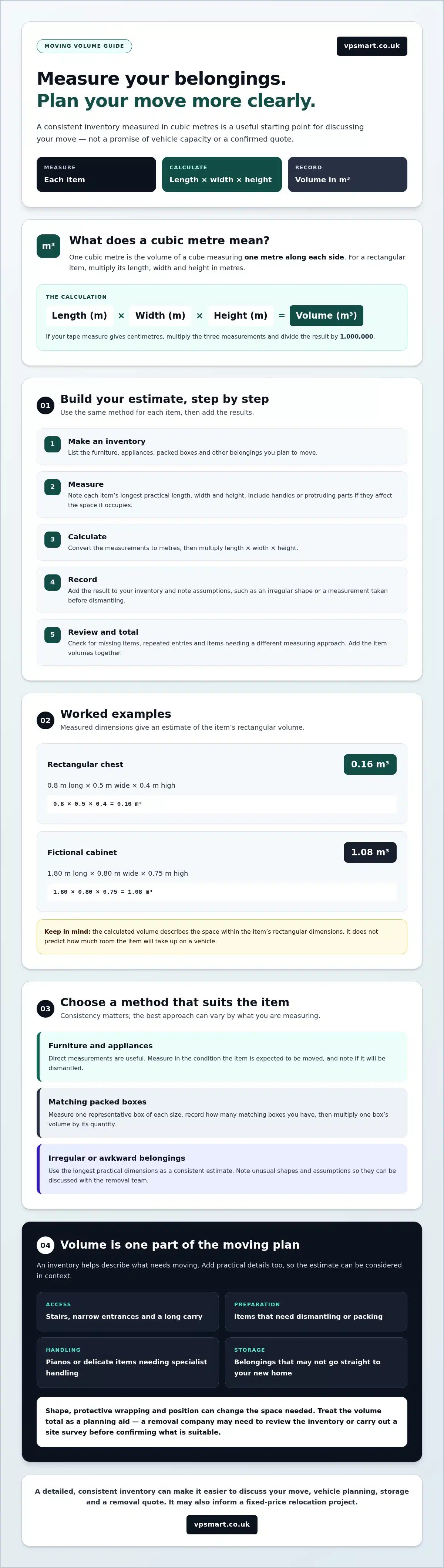
One cubic metre is the volume of a cube measuring one metre along each side. It’s one of the standard units for measuring volume. To estimate an item’s volume, measure its length, width and height in metres, then multiply the three measurements.
Example: A rectangular chest measuring 0.8 m long, 0.5 m wide and 0.4 m high has a measured volume of 0.16 m³. That figure describes the space within its rectangular dimensions, not how much room it will take up on a vehicle. Protective wrapping or an unusual shape may affect the space needed.
What can a volume estimate help you plan?
A consistent estimate helps you describe what needs moving and gives you a list to check against the move plan. It can also prompt a useful storage discussion if some belongings won’t be going straight to your new home. A clear inventory makes it easier to spot what still needs measuring instead of relying on a rough impression.
Volume is only one part of the picture. A tall wardrobe may need dismantling, while a piano or delicate item may need specialist handling. Stairs, narrow entrances or a long carry can affect access, and packing can change the space belongings occupy. Mention these details when discussing the move, so the volume estimate is considered in context.
Room count alone won’t show what’s inside cupboards, how many boxes you’ll pack or whether a bulky item will fit through an entrance. An inventory-based estimate gives more detail, but it’s still an estimate. A removal company may need to review your inventory or carry out a site survey before confirming what’s suitable for your move.
How to calculate the volume of your belongings step by step
Use the same method for each item, then add the results. This makes your estimate easier to check and more useful to share with a removal company.
- Make an inventory: List the furniture, appliances, packed boxes and other belongings you plan to move.
- Measure: Note each item’s longest practical length, width and height.
- Calculate: Convert the measurements to metres, then multiply them.
- Record: Add the result to your inventory and note any assumptions.
- Review: Check for missing items, repeated entries and belongings that need a different measuring approach.
How do you measure furniture and boxes consistently?
Measure each item in the condition it’s expected to be moved. If furniture will be dismantled, note that in your inventory and list the parts that will need moving. For boxes, measure one representative box of each size, then record how many matching boxes you have. This saves time while keeping the calculation easy to check.
Use the item’s longest practical dimensions, including handles or protruding parts if they affect the space it occupies. Measure in metres for a direct cubic metre calculation. If your tape measure gives centimetres, multiply the three measurements and divide the result by 1,000,000.
How do you total your inventory in cubic metres?
For a rectangular item, multiply its length in metres by its width in metres and its height in metres. For example, a fictional cabinet measuring 1.80 m long × 0.80 m wide × 0.75 m high has a calculated volume of 1.08 m³ (1.80 × 0.80 × 0.75).
This is an illustrative calculation, not a prediction of the space the cabinet will occupy on a vehicle. Its shape, protective wrapping and position can affect the space needed. A volume calculation reference can provide another point of comparison. Apply one consistent method throughout your inventory.
For repeated items, group matching entries in a spreadsheet or written list. Multiply one item’s volume by its quantity, then add that subtotal to the volumes of the other items. Note approximate figures, such as an irregular shape or a measurement taken before dismantling. These notes make assumptions clear when you review your estimate with a removal team.
A clear inventory can also help you discuss what needs packing or handling. If you’re exploring removal support, see VP Smart Removals’ moving and packing services.
Which measuring method works best for awkward belongings?
The best approach depends on what you’re measuring and how detailed an estimate you need. Direct measurement gives you a consistent starting point, while a box count can be quicker once belongings are packed. An inventory review or survey by a removal professional may help when the contents are difficult to assess remotely. No method captures every handling or access requirement on its own.
- Direct dimensions: Useful for furniture and larger objects you can measure. The result is a practical estimate, but it may not match the space the item occupies when loaded.
- Box-count estimate: Convenient for matching packed boxes. It depends on accurate box dimensions and won’t include loose belongings or furniture that still needs packing.
- Professional inventory or survey: Helpful if you’re unsure about your list or have bulky or delicate belongings. It allows the volume estimate to be considered alongside handling and access, but some uncertainty may remain.
How should you estimate irregular or oversized items?
For a sofa, wardrobe or other awkward item, note its widest and tallest points, its depth and any protruding parts. A sofa’s cushions and sloping arms, for example, can leave gaps when it’s placed beside other furniture. Don’t present the item as a perfectly measured cuboid. Record the dimensions as a guide and label the volume as an estimate. The cubic metre is the official SI unit of volume, but using a standard unit doesn’t make an irregular shape easier to pack.
If an item will be dismantled, record its assembled dimensions and note how it will be moved. Taking it apart can change the dimensions of its separate pieces and how they need to be handled. Flag pianos, delicate belongings and other items that may need specialist handling for separate discussion. Their volume alone doesn’t tell the whole story.
When is a professional inventory or survey more useful?
Consider discussing an inventory review or site survey with a removal company if your list feels incomplete, measurements are uncertain or the move includes bulky or delicate items. Share what you know, including access details and whether furniture will be dismantled, so the removal professional can consider more than the volume total.
Use your estimate as a planning tool, not as a final decision about vehicle suitability. The space required can depend on how items fit together, packing and handling needs, and access at each property. Mark approximate figures clearly so they aren’t mistaken for confirmed requirements.
How to turn your volume estimate into a practical moving plan
Your volume total is most useful as part of a clear inventory. Treat it as one planning detail, not a complete measure of how complex the move will be. Before adding everything together, separate belongings by destination: items going to your new home, items for storage, and anything you plan to donate or dispose of. This gives a removal team a clearer picture of what needs moving and where.
What details should accompany your volume estimate?
For each item or group, record the quantity, dimensions and whether it’s packed. Mark measurements you’re unsure about and note furniture that needs dismantling. Add access information for both properties, such as stairs, restricted collection access or a long carry between the entrance and where a vehicle can stop.
Flag belongings that may need specialist handling, including pianos and delicate items. Photographs can help explain an unusual shape, condition or access constraint that’s difficult to describe in a list. Keep them ready to share if a removal professional needs more context. If you’re preparing for a house move, VP Smart Removals’ house removal service information may help you explore the support available.
How can packing and storage change the plan?
Belongings can take up more space once they’re wrapped or packed into boxes, so distinguish measurements taken before packing from estimates of the packed load. Record the number and size of boxes where you can, and note whether packing is still to be done. If you’re considering professional packing help, see the information on packing and moving services.
Keep a separate storage list rather than combining those belongings with the items going to your new home. This makes it easier to discuss what needs transporting now and what may need storage, while reducing the chance that something is missed. Packing, storage and specialist handling can all affect arrangements beyond the cubic metre total.
Before discussing a quote, review your inventory and point out anything that has changed since you measured it. A volume estimate is a helpful starting point, but a detailed inventory, packing status and access notes provide context for a more informed conversation. If details are uncertain, say so rather than presenting a rough estimate as exact.
View removal pricing information
How VP Smart Removals can help refine your moving inventory
Your measurements are a useful starting point for a conversation with a removal team. A clear list shows what you plan to move, while notes about packing, access and special handling add context a cubic metre total can’t provide. VP Smart Removals offers house removals and packing services. A detailed inventory or site survey may inform a fixed-price relocation project.
You don’t need a perfect figure before asking for guidance. Share what you’ve measured, mark assumptions clearly and ask what else the team needs to understand your move. A tailored assessment may help clarify the plan, but an early estimate alone doesn’t confirm the final requirements or quote.
What can you share when discussing your move?
Prepare an item list with dimensions where available and an approximate count of packed or expected boxes. Be open about uncertainty: mark estimates that need checking, especially for unusually shaped or bulky belongings. Mention furniture that may need dismantling, delicate items or a piano, and whether any belongings may need storage.
Access details are useful too. Note stairs, restricted entrances, long carries or other constraints at either property. If a size or condition is difficult to explain in writing, keep a photograph available to illustrate it. This helps the removal team consider handling and access alongside volume, rather than treating a total as the whole story.
What happens after you request moving guidance?
An enquiry gives you the opportunity to discuss your inventory and services that may be relevant, such as house removals or packing. The team may ask for clarification about measurements, box numbers, access or items requiring particular care. Depending on the move, a detailed inventory or site survey may provide further planning information. It won’t remove every uncertainty or guarantee a particular vehicle or quote outcome.
Keep your list handy and update it if the belongings you plan to move change. Clear, honest notes show what’s known and what still needs discussion, without making your estimate seem more precise than it is.
Discuss your house removal
Make your moving estimate work for you
Calculating the volume of your belongings for a move gives you a practical starting point, especially when you work from an itemised inventory rather than room count alone. Measure consistently, total the cubic metres and mark approximations clearly. For awkward or bulky belongings, remember that shape, packing and handling can affect the space and planning involved.
Turn the figure into a useful moving plan by noting access, dismantling needs and which belongings are going to your new home or into storage. This context makes discussions with a removal team more informative. VP Smart Removals offers house removals, packing and storage. A detailed inventory or site survey may also inform a fixed-price relocation project.
Share the information you have and ask what else is needed to assess your move. Your estimate doesn’t need to be perfect to help you take a confident next step.
Frequently Asked Questions
How do you calculate the volume of belongings for a move?
Measure each item’s length, width and height in metres, then multiply the three measurements to estimate its volume in cubic metres. For centimetre measurements, multiply the dimensions and divide the result by 1,000,000. Repeat for each item. For matching boxes, multiply one box’s volume by the number of boxes, then add the results. Mark irregular shapes as estimates, since their actual packing space may differ.
What is the formula for calculating volume in cubic metres?
For a rectangular item, the formula is length × width × height, with all three measurements in metres. For example, an item measuring 1 m × 0.5 m × 0.5 m has a measured volume of 0.25 m³. This calculation describes the dimensions of a simple bounding box around the item. It may not equal the space the item occupies when packed, particularly if it has an irregular shape or needs protective wrapping.
Can I estimate moving volume by counting boxes?
Yes. Box counting can help if your belongings are packed in boxes of a consistent size. Measure one representative box, calculate its volume, then multiply that figure by the number of matching boxes. Treat the result as part of your estimate, not the whole inventory. It won’t include furniture, loose belongings, irregular items or things you haven’t packed yet. Listing those separately gives a fuller picture of the move.
Should I measure furniture before or after dismantling it?
Measure the furniture in the condition it’s expected to be moved, and note that condition in your inventory. If it’ll be dismantled, record the largest dimensions of the separate parts and identify which item they belong to. If it’ll stay assembled, measure its widest and tallest points. Include any dismantling needs, as access and handling can affect planning as much as volume.
How accurate does my moving volume estimate need to be?
A useful estimate should be consistent and clear enough for an initial planning conversation, but it isn’t a guaranteed measurement. Use actual dimensions where practical, count matching boxes carefully and flag guesses or awkward shapes. A removal professional may also need to review your full inventory, access arrangements and handling requirements before advising how the move should be organised. Be clear about what you’ve measured and what you’ve estimated.
Do removal companies need an inventory or a volume estimate?
An inventory describes what you plan to move, while a volume estimate summarises the space those belongings may occupy. Sharing both gives a removal company helpful context for discussing your move. Include bulky or delicate items, dismantling needs and access details, and identify uncertain measurements. Ask whether a more detailed inventory or site survey would help assess the project. Requirements depend on the move and its specific circumstances.
Disclaimer
Some links in this article may be affiliate links, which means we may earn a small commission if you make a purchase through them, at no additional cost to you. We only recommend products or services we believe provide value to our readers.
Sep 26, 2026
Finding somewhere for the sofa may be simpler than deciding who owns it. During a separation, furniture can become a source of worry: one person may fear it will be sold or damaged, while both need to make space for separate homes. Treat furniture storage during separation uk as two separate questions: first, clarify what is known about ownership; then decide how to protect the items while matters are resolved.
It’s understandable to feel unsure, especially when furniture was bought together, given as a gift or used by the whole household. This guide explains what information may help an ownership discussion, how to make a clear record and how to keep conversations practical. If you can’t yet agree who keeps an item, temporary storage may offer breathing space, provided you agree what will be stored and how access will work. A removals and storage provider can help with handling, but can’t determine legal ownership. Check collection, access, inventory and handling arrangements with the provider before making plans.
Key Takeaways
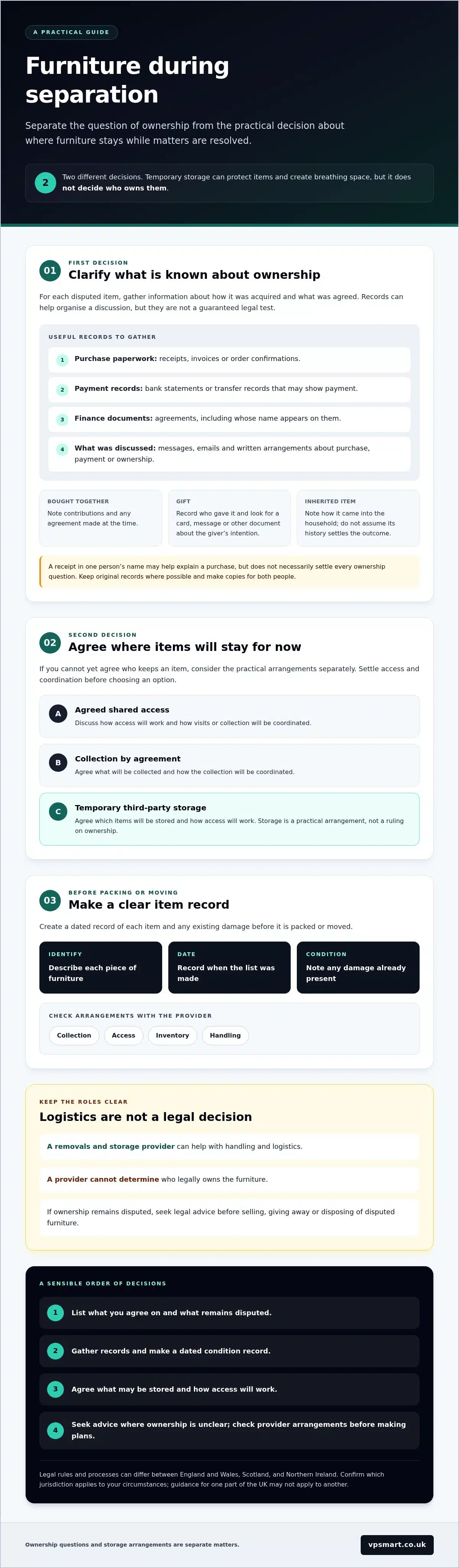
- Separate the question of who owns each item from the practical decision about where to keep it temporarily.
- Gather receipts, bank statements, finance agreements, messages and written arrangements to organise the facts for discussion. These are not a guaranteed legal test.
- Compare agreed shared access, collection by agreement and temporary third-party storage. Settle access and coordination before choosing an option.
- For furniture storage during separation uk, make a dated record of each item and any existing damage before packing or moving it.
- Agree what will be stored and how access will work. Seek legal advice if ownership remains disputed, as a storage provider handles logistics rather than deciding who owns the furniture.
Furniture storage during separation in the UK: what needs deciding first?
There are two separate decisions to make: who owns or should keep each piece of furniture, and where it can stay safely in the meantime. Temporary furniture storage is a practical arrangement, not a legal ruling. Putting a sofa or dining table into storage doesn’t, by itself, establish who owns it or decide what should happen to it later.
This distinction can bring some order to a difficult situation. You might agree to store a disputed wardrobe while you gather purchase records or seek advice. Before arranging this, agree which items are included and how access will work. A removals and storage provider can help with handling and logistics, but can’t determine ownership.
Does separation automatically decide who keeps the furniture?
No single assumption works for every item or relationship. Who paid, who uses a piece, whose name appears on a finance agreement, when it was acquired and any arrangements between you may all be relevant to a discussion. None should be treated here as a universal rule. Relationship status and the wider circumstances can affect how property questions are handled. If you need advice for your situation, speak to a family-law solicitor before selling, giving away or disposing of disputed furniture.
Which UK jurisdiction applies to a separation?
England and Wales, Scotland, and Northern Ireland have distinct legal jurisdictions, and relevant rules and processes can differ. Don’t assume that guidance written for one part of the UK applies to another. Confirm which jurisdiction is relevant to your circumstances and check current guidance or consult a solicitor qualified to advise there. The general Division of property laws overview includes a UK section, but it isn’t a substitute for tailored legal advice.
For furniture storage during separation uk, treat legal questions and practical arrangements as separate tasks. Note which items you agree on and which remain in dispute, then seek advice where ownership is unclear. Once you’ve agreed what may be stored and how access will work, you can consider a temporary storage option without presenting it as a final decision about who keeps the furniture.
Who owns furniture after a separation? Evidence and circumstances to consider
There isn’t one document or simple rule that settles every furniture disagreement. Gather information that helps both of you discuss how an item was acquired and what was agreed at the time. These records provide context, not a legal test or a guarantee of who will keep the furniture. A solicitor can explain how the evidence may apply to your circumstances and the relevant UK jurisdiction.
What records can help clarify who paid for an item?
For each disputed piece, note its description, approximate purchase date and the names shown on any available paperwork. Keep copies of:
- Receipts, invoices or order confirmations
- Bank statements or records of transfers that may show payment
- Credit or finance agreements, including whose name appears on them
- Messages or emails discussing the purchase, payment or ownership
- Any written arrangements made between you about furniture
A receipt in one person’s name may help explain a purchase, but it doesn’t necessarily settle every question about ownership. For example, one person may have paid upfront on behalf of both partners, or the furniture may have been bought using shared funds. Keep original records where possible and make copies so each person can refer to the same information.
How should jointly bought, gifted or inherited furniture be treated?
Make separate notes for furniture with a clearly documented individual purchase and items either of you says were bought together. Shared purchases may raise questions about contributions and any agreement made at the time. For a gift, record who gave it and look for a card, message or other document that may clarify the giver’s intention. Inherited furniture may raise different questions, so note how it came into the household without assuming its history alone decides the outcome.
If you’re married, in a civil partnership or cohabiting, your relationship status may be relevant to the advice you need. Citizens Advice explains some legal differences for cohabiting couples. Use general guidance as a starting point, then ask a family-law solicitor how the relevant rules apply to your situation.
Mark items you can’t agree about as unresolved in your notes. Keep copies of relevant records and avoid selling, giving away or disposing of disputed furniture while you seek advice. If you later agree that particular items need temporary storage, VP Smart Removals provides furniture storage services. Confirm arrangements directly, as a provider can handle logistics but can’t determine ownership.
Keeping disputed furniture: compare storage, shared access and an agreed collection
If neither of you has room for a large item, or you can’t yet agree who should keep it, there are practical ways to avoid rushing a final decision. Choose an arrangement that both parties understand and can manage. Moving furniture into storage doesn’t decide who owns it; it changes where it’s kept for the time being.
Compare the options before making arrangements:
| Option |
Practical benefit |
Coordination and questions to settle |
| Agreed shared access |
The furniture stays available for use in an agreed home. |
Who can use it, and when? How will you arrange access? Who will look after it and record its condition? |
| Collection by agreement |
One person takes an item they’ve agreed to keep, avoiding ongoing shared access. |
Confirm which items are being collected, the collection arrangements and what happens if either person needs to change the plan. |
| Temporary third-party storage |
Furniture is kept out of either home while you consider next steps. |
Agree who arranges and pays for storage, who can authorise access or collection, and when you’ll review the arrangement. |
When can temporary furniture storage make sense?
Storage may help when a shared home is being cleared, neither person has room for an item, or you need time to discuss its allocation. Agree the intended storage period and access arrangements in writing before anything is moved. Check the provider’s service terms, including who may authorise access or collection and what happens if plans change. Confirm available arrangements directly rather than assuming they’re included.
What should an agreement say before furniture is moved?
Make the plan specific enough that both parties can check what was agreed later. Identify every item, note its current condition, state the agreed storage location and record who arranged the move. Set out who can request access or collection, how storage responsibilities and costs will be handled, and how you’ll record changes. If consent to moving or disposing of an item is disputed, pause and seek legal guidance before proceeding.
A written agreement can reduce uncertainty without resolving the ownership question. For furniture storage during separation uk, agree the practical arrangements first, keep a copy of the plan and review it together if circumstances change. A removals and storage provider can help with handling and logistics once you agree what’s moving and how access will work. It can’t decide who owns the furniture.
How to document, pack and store furniture safely during a separation
A consistent record helps both parties see what’s being moved, its condition and where it’s going. Before packing starts, make sure the items and handling arrangements have been agreed. An inventory helps clarify the practical process, but it isn’t proof of who owns an item.
Build a shared furniture inventory
Use a shared list that both of you can check. Give each piece a clear description, such as “oak dining table with six chairs”, and add photographs, condition notes and any ownership evidence you’ve collected. Mark disputed items as unresolved rather than recording one person as the owner. Keep a copy accessible to both parties, and note who approved collection and the agreed destination.
Follow a clear preparation checklist
- 1. Agree the scope. Confirm which furniture may be packed or moved, and pause if consent is disputed.
- 2. Photograph each item. Take dated photographs before packing or collection, including close-ups of existing scratches, marks or other damage. Keep the images with the inventory.
- 3. Complete the inventory. Record descriptions, condition, any relevant ownership documents, approval for collection and the destination. Share the latest copy with both parties.
- 4. Prepare items carefully. Where appropriate, clean and dry furniture before wrapping it. Protect vulnerable surfaces and detachable parts, and label components so they can be matched to the right item.
- 5. Confirm storage arrangements. Check the provider’s terms, handling requirements, access arrangements and who can authorise collection. Ask about item-specific requirements before moving delicate, upholstered or wooden furniture.
Photograph furniture again before dismantling or wrapping if those steps could hide its condition. Keep fittings together and labelled, and avoid taking furniture apart unless it’s suitable to dismantle. For a delicate chair, check how its materials should be protected rather than assuming one wrapping method suits every item. Confirm handling or storage requirements with the provider before collection.
These checks support clearer furniture storage during separation uk: both parties can refer to the same item list, images and agreed arrangements. If you’d like practical help with handling, explore movers and packers services from VP Smart Removals. A removals or storage provider can assist with logistics, but can’t determine ownership.
To make the process smoother, you can easily arrange help with furniture handling through VP Smart Removals today.
Choosing a practical next step for furniture storage during separation
A clear sequence can help you move forward without confusing practical arrangements with decisions about ownership:
- Seek agreement on which items may be moved and where they’ll go.
- Document the plan, including item condition, access and who can authorise collection.
- Get legal advice if ownership or consent is disputed, or you’re considering disposal.
- Arrange the logistics once the storage plan is agreed.
A storage provider can move and hold furniture, but can’t decide who owns it. Keeping that boundary clear helps you choose the right support for each part of the process.
What should you ask a storage provider before arranging collection?
Check exactly what the provider can offer rather than assuming collection, inventory preparation, access or particular handling arrangements are included. Ask how access and collection instructions are authorised, and how changes are recorded. Read the current terms to understand responsibilities, including what happens if your plans change. Confirm these details before agreeing to a move, and make sure they match the written plan between you.
VP Smart Removals provides removals, packing and storage for residential customers across the UK. You can review its storage services, then confirm directly which arrangements are available for your furniture and circumstances.
When should you seek legal advice before moving furniture?
Pause for advice if you disagree about ownership, the other person hasn’t consented to moving an item, or either of you is considering selling or disposing of disputed furniture. A family-law solicitor can advise on your individual situation and the relevant jurisdiction. If there are urgent safety concerns or a court-related issue, seek support from an appropriately qualified professional before taking practical steps.
Once you’ve agreed what can be stored, the destination and access arrangements, you can discuss the move with a provider. Keep a copy of the agreement and confirm collection, handling and storage terms directly. This gives both parties a clearer record while the ownership question is addressed separately.
If you have an agreed storage plan, you can explore practical storage options and discuss the arrangements with VP Smart Removals.
Make your next move with a clear plan
Furniture storage during separation uk is easier to organise when ownership discussions and practical arrangements stay separate. Agree what can be moved, keep a shared record of the items and their condition, and get advice from a family-law solicitor if ownership or consent remains uncertain. Storage can protect furniture temporarily, but it doesn’t decide who will eventually keep it.
Once the plan is agreed, VP Smart Removals can support the practical side with UK-wide removals and storage services, plus packing and furniture-handling support. The company offers secure storage facilities. Confirm current collection, access, inventory and handling arrangements directly before booking, so the service fits the plan you’ve made.
A considered next step can ease pressure while decisions are still being resolved. With clear records and agreed logistics, you can focus on moving forward with greater confidence.
Frequently Asked Questions
Who gets the furniture when a couple separates in the UK?
There isn’t a reliable one-size-fits-all answer. Who keeps furniture can depend on the facts, available documents and the applicable UK jurisdiction. Having an item in your home is practical possession, not necessarily proof of ownership. Marriage, paying for an item or using it daily won’t automatically settle every case. Make an inventory of disputed pieces and relevant records, then ask a family-law solicitor familiar with the applicable jurisdiction how they may apply.
Can my ex-partner take furniture from our home without my agreement?
Whether an ex-partner can take furniture without agreement depends on ownership, the circumstances and the applicable law, so don’t rely on a blanket rule. Record the items in question and keep relevant messages, receipts and other documents. Get legal advice before removing or disposing of disputed belongings. If there’s an immediate safety concern, contact emergency services or an appropriate support professional, rather than asking a removal company to resolve it.
Does the person who paid for the furniture automatically own it?
Proof of payment may be relevant, but it doesn’t necessarily settle ownership on its own. The wider circumstances, other records and the rules in the applicable jurisdiction may also matter. Gather receipts, bank statements, finance documents and messages about the purchase or any agreement between you. A family-law solicitor can explain how those facts may apply to your situation. Don’t treat one payment record as a definitive legal test or a guaranteed outcome.
Can we put disputed furniture into storage while we decide who keeps it?
Temporary storage can be a practical option if you both agree what will be moved, how access will work, how costs and instructions will be handled, and what happens if plans change. For furniture storage during separation uk, keep the practical arrangement separate from the ownership decision: storage doesn’t determine who owns an item. Record the furniture and its condition, agree the plan in writing and check the provider’s terms. If consent is disputed, seek legal guidance before moving or disposing of belongings.
How should I document furniture before it goes into storage?
Create a dated inventory with clear descriptions, photographs and notes about each item’s condition, including existing marks or damage. Add any available purchase or gift records, and note who approved collection, where the furniture is going and who may access it. Keep copies available to both parties where appropriate. These records can make practical arrangements clearer, but they don’t independently establish ownership. Ask a family-law solicitor about items that remain disputed before arranging their move.
What should I check before choosing furniture storage during a separation?
Confirm which items will be stored, who can authorise collection, how access works, what handling the provider offers and how changes to instructions are recorded. Check the provider’s current terms and ask about requirements for particular items, such as delicate or upholstered furniture. Put responsibilities and agreed arrangements in writing. If ownership or consent is uncertain, seek legal advice rather than expecting a storage provider to settle the disagreement. The provider can handle logistics, not determine ownership.
Does furniture ownership work the same way across England, Wales, Scotland and Northern Ireland?
No single legal conclusion should be assumed to apply across all four. England and Wales, Scotland, and Northern Ireland are distinct legal jurisdictions, and relevant rules or processes may differ. First establish which jurisdiction applies to your circumstances, then seek current advice from a family-law solicitor qualified to advise there. Check that any legal guidance you rely on is accurate for that jurisdiction and up to date, especially before acting on a disputed item.
Disclaimer
Some links in this article may be affiliate links, which means we may earn a small commission if you make a purchase through them, at no additional cost to you. We only recommend products or services we believe provide value to our readers.
Sep 25, 2026
Could one overlooked loft, garden shed or awkward stairwell leave your removal team planning with only half the picture? Knowing how to prepare for a video removal survey helps you show what’s involved, so the team can make a more informed plan and quote.
It’s understandable to worry that a missed item, poor lighting or a patchy connection could affect the assessment. A little preparation puts you in control: make each room easy to view, check your camera and signal, and think ahead about bulky belongings and access at both properties.
This guide explains what to organise before the call, how to walk through your home clearly, and which details to point out, from stored-away items to stairs, narrow entrances and parking constraints. You’ll also find useful questions to ask about what the quote includes and what happens next. Video surveys aren’t available from every removals company, so confirm this option before arranging one. A clear walkthrough and complete inventory can help the removals team understand your needs and reduce the chance of important details being missed.
Key Takeaways
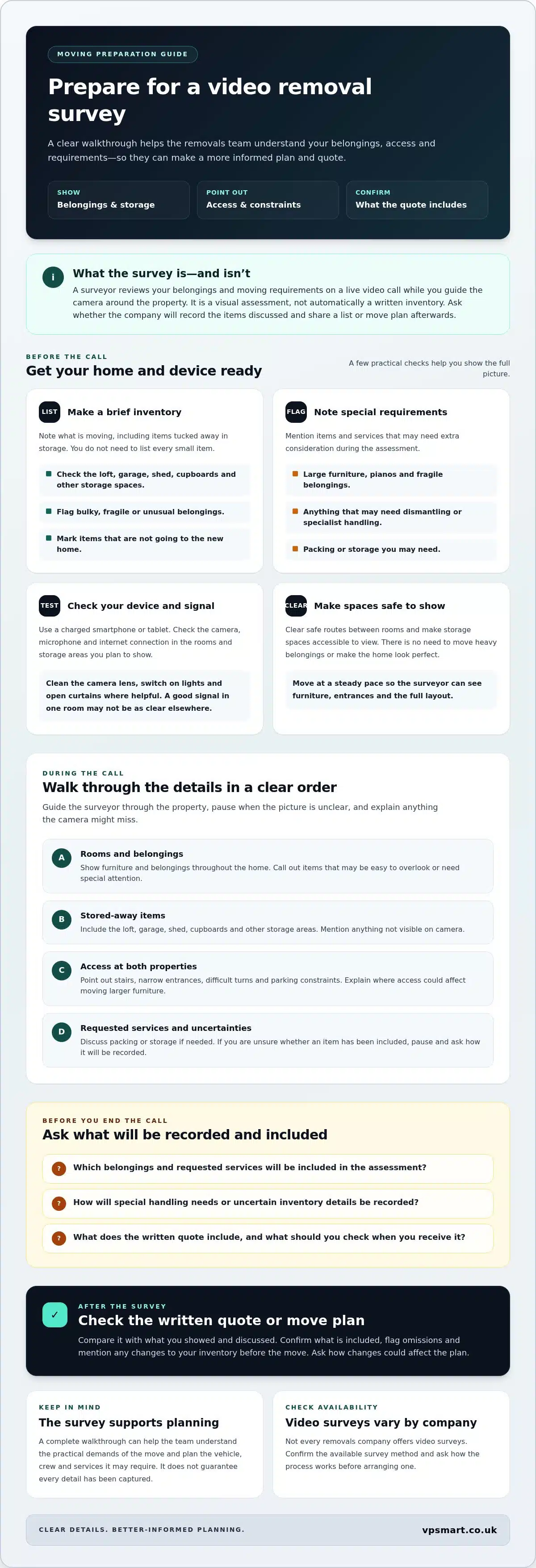
- Prepare a simple inventory to help the removals team understand the scale of your move.
- Follow a clear walkthrough order so the surveyor can assess your belongings and access points without missing important details.
- Ask which items and services are included, and how special handling needs or uncertain inventory details will be recorded.
- Check the written quote or move plan against what you showed, then flag omissions or changes before the move.
- Confirm that your chosen removals company offers video surveys before arranging one.
How to prepare for a video removal survey and why the details matter
A video removal survey is a remote walkthrough in which a surveyor reviews your belongings and moving requirements on a live video call. You guide the camera through the property, highlight items that need attention and answer questions about the move. The survey can give the company a clearer picture than a brief phone conversation, but you still need to point out anything the camera might miss.
A removal company may provide more than transport for household belongings. The range of moving company services helps explain why it’s useful to discuss specific requirements, such as packing or storage, during the assessment. Ask how the survey works before the appointment, as the rooms and details reviewed may vary between companies.
What does a video removal survey cover?
The surveyor will typically ask to see rooms, furniture, belongings, property access and any services you’ve requested. A video walkthrough is a visual assessment, not automatically a written inventory. Check whether the company will record the items discussed and share a list or move plan afterwards. A video survey also differs from an in-person site survey, where a representative visits the property. Confirm which survey method is available and what the resulting quote will include.
You’re not simply holding up a camera while someone else makes decisions. Guide the walkthrough, mention items stored out of sight, and explain any special handling needs. Pause if the picture is unclear or you’re unsure whether something has been included. A detailed assessment can support a more considered plan. VP Smart Removals can base fixed-price relocation projects on a site survey or detailed inventory, but confirm directly whether a video survey is available for your move.
Why a thorough walkthrough can make moving day smoother
An omitted shed, loft or bulky item can change the workload and the space required in the vehicle. Access matters too: stairs, narrow entrances or difficult turns may affect how the team plans to move larger furniture. Pointing these out helps the removals company understand the practical demands of the job and whether to discuss requested services, such as packing or storage.
Complete survey information gives the removals team a stronger basis for planning the vehicle, crew and services your move may require. It doesn’t guarantee that every detail has been captured, so check the written quote or move plan afterwards. Confirm what’s included, raise anything missing and ask how changes to your inventory could affect the plan before moving day.
What to check before your video removal survey starts
A few minutes of preparation can help you give the surveyor a clear view of the move, rather than relying on memory as you go from room to room. Make a brief inventory of what’s moving, including belongings in the loft, garage, shed, cupboards and other storage spaces. You don’t need to list every small item, but note anything bulky, fragile or unusual that could affect the plan.
Prepare your inventory and flag items needing special attention
Include large furniture, pianos, fragile belongings and anything that may need dismantling or specialist handling. Mark items that aren’t going to the new home too, so they aren’t accidentally counted as part of the move. If you need packing or storage, add that to your notes. It’s easier to discuss options while the surveyor is assessing your requirements.
Keep a short question list nearby. You might ask:
- Which belongings and requested services will be included in the assessment?
- How will special handling needs or uncertain inventory details be recorded?
- What does the written quote include, and what should I check when I receive it?
If packing may be useful, review the company’s packing services and ask which options are relevant to your move. Confirm directly whether your chosen removals company offers video surveys and how its process works.
Set up your device and rooms for a clear walkthrough
Use a charged smartphone or tablet, then test its camera, microphone and internet connection in the rooms and storage areas you’ll show. A strong connection in one room doesn’t always mean the signal will be as clear elsewhere. Check that the camera lens is clean, switch on lights and open curtains where helpful. Move at a steady pace so the surveyor can see furniture, entrances and the full layout.
Before the call, clear safe routes between rooms and make storage spaces accessible to view. You don’t need to move heavy belongings or create a perfect showroom. Make it possible to show the items and access points safely. If another household member is available, they could hold the device while you explain what’s in view, or take notes on answers and follow-up questions.
This checklist is a practical starting point for how to prepare for a video removal survey: know what’s moving, flag exceptions and make sure the camera can show the spaces clearly. If the connection becomes unreliable or an item can’t be shown, tell the surveyor rather than leaving it out of the discussion.
How to show every room and access point during the video survey
A consistent route helps the surveyor build a clear picture of your home without guessing what lies beyond the camera’s view. Start at the entrance, briefly explain the layout, then move through the living areas, kitchen and bedrooms before showing relevant storage spaces. Tell the surveyor when you’re moving between floors or into an outbuilding, and pause at each stop so they can ask questions or make notes.
Follow a simple room-by-room survey route
In each room, show the floor area and larger furniture, then open cupboards or storage areas if belongings inside are moving. A brief pan can reveal the overall layout, but linger on items that may be easy to miss, such as furniture behind a door or boxes stored under a bed. Include the loft, garage, shed or other outbuilding if its contents are part of the move. Say clearly if something isn’t moving.
Keep the order predictable rather than doubling back whenever you remember another item. This makes it easier for the surveyor to connect what they see with the room or storage area it belongs to. You’re in charge of the walkthrough, so ask for a moment to clarify details if the surveyor’s questions reveal something you haven’t shown.
Make access challenges and unusual items visible
Show access at both the property entrance and the rooms containing large belongings. Point out narrow doorways, tight turns, stairs or lifts where they may affect moving furniture. If there’s a long distance between the entrance and where a vehicle could stop, explain it. Show parking arrangements only where they’re relevant and safe to film. Don’t walk backwards, climb or put yourself at risk to capture a better angle.
For a piano, a large wardrobe or another awkward item, show its full shape from more than one angle if you can do so safely. Explain if it’s fragile, unusually heavy or difficult to reach. The camera may not show measurements or details clearly, so describe them and ask the surveyor how they’d like you to provide any extra information.
Clear views of your belongings and access points give the removals team more useful information for planning the move. That’s the practical aim of how to prepare for a video removal survey: not a perfect film, but a steady, complete walkthrough that leaves fewer unanswered questions. Before ending the call, check whether the surveyor has seen every room and relevant access point, and agree how to follow up on anything that couldn’t be shown.
What to ask during a video removal survey before ending the call
Before the call ends, check that the surveyor’s understanding matches what you showed and explained. A useful assessment depends on more than seeing each room: belongings, access details and requested services need to be recorded clearly enough to inform the written quote or move plan.
Clarify what the survey and quote include
Ask the surveyor to confirm which belongings and services they’ve included. If you may need packing, storage or specialist handling, make sure those requirements have been discussed rather than assumed. For furniture that may need dismantling or reassembly, ask what’s covered and whether you’ll need to arrange anything separately. VP Smart Removals offers furniture assembly, but check the specific scope for your move.
- Are all the rooms, storage areas and items we’ve shown included in the assessment?
- How have you recorded access details and any special handling requirements?
- What services are included in the quote, and what is excluded?
- How should I report changes to the inventory or moving requirements?
- When should I expect written confirmation, and which details will it set out?
Clear answers make it easier to compare the survey findings with the written quote later. If packing support is on your list, explore the company’s packing services and ask which options fit your requirements. Don’t assume packing or furniture work is included unless the company confirms it in writing.
Resolve uncertainties before the survey ends
Ask the surveyor to repeat any assumptions about item quantities, access or services. For example, check whether a bulky item in a loft has been counted or whether a difficult entrance has been noted. If something was missed or couldn’t be shown clearly, ask how to provide further information, such as a written description or photographs, and how it will be added to the assessment.
Knowing how to prepare for a video removal survey also means finishing with a clear record of what happens next. Note any details you’ve agreed to send and the company’s instructions for doing so. If an answer is unclear, ask again before ending the call. Resolving uncertainty now can help prevent different assumptions later.
What to do after a video removal survey
The walkthrough is only useful if its details carry through to the written quote or move plan. When it arrives, compare it with your survey notes and check that the rooms, storage spaces, belongings and access points you showed are represented. Look for easily missed items, such as contents in a shed or a large piece of furniture, as well as any special handling or services you discussed.
Check the written quote against your survey notes
Read the scope carefully. Confirm what’s included and excluded, including any agreed packing, storage or specialist handling. If furniture dismantling or reassembly was discussed, check how that requirement is described rather than assuming it’s covered. Make sure access details, such as stairs or a long carry, haven’t been lost between the survey and the paperwork.
Keep the written quote, inventory, survey notes and related messages together. This gives you a clear reference if something needs correcting. If an item is missing, a quantity seems wrong or your requirements have changed, contact the removals company promptly and ask for the documentation to be updated. Check how changes are handled too, so you know what to do if the inventory shifts before moving day.
Choose the next step for your move
Before accepting a quote or confirming arrangements, resolve any uncertainty about the work, the services included or the information used to prepare the plan. A survey informs the assessment, but the written scope lets you check exactly what has been allowed for. Don’t rely on an assumption discussed on camera if it isn’t reflected in the follow-up documentation.
VP Smart Removals can agree fixed-price relocation projects based on a site survey or detailed inventory. This doesn’t mean every video survey leads to a fixed price, so confirm the basis of your quote and whether video surveys are currently available for your move. For details about the company’s quotation approach, review its removals pricing information.
If the details are accurate and the scope is clear, you’ll be in a stronger position to decide what happens next. You can also explore the quotation process and discuss the appropriate next step for your move.
Make your next move with confidence
A clear inventory, steady room-by-room walkthrough and a few focused questions help turn a video survey into useful information for planning your move. Knowing how to prepare for a video removal survey also means checking the written quote against what you showed, then promptly correcting any omissions or changes.
VP Smart Removals provides removals across the UK, with packing, storage and specialist handling among its services. Fixed-price relocation projects can be based on a site survey or detailed inventory. If you’re considering a video survey, confirm its availability and the process directly with the company.
With the right details recorded and the next steps clear, you can move ahead feeling prepared and in control.
Frequently Asked Questions
How long does a video removal survey take?
The time needed depends on the size of your home, how many belongings need assessing and how many questions arise. Allow enough time to show each relevant room and storage area without rushing, including a loft, garage or shed if items there are moving. Ask the removals company how long to set aside when arranging the appointment. Mention unusual belongings or access concerns in advance, as these may need extra discussion.
Do I need to be at home for a video removal survey?
Someone should be able to show the belongings and access points included in the move and answer questions accurately. Ask the removals company whether you need to be present at the property, and what arrangements it accepts if another household member will lead or join the walkthrough. Agree who can confirm what’s moving, including items in storage spaces, and make sure they can access the relevant rooms during the appointment.
What should I show during a video removal survey?
Show every room and any loft, garage, shed or storage area containing belongings that are moving. Include larger furniture, fragile or specialist items, and relevant access features such as stairs, narrow doorways or a long carry. Explain which belongings aren’t moving, too. If an item or area can’t be shown clearly, tell the surveyor and ask how to provide the missing details so the assessment reflects your requirements.
Can a video removal survey provide an accurate quote?
A video survey can give the removals company useful information if you show the full inventory, access conditions and services you may need. The quote still depends on the details provided and the company’s assessment process. Review the written quote for its scope, assumptions and exclusions rather than relying on the walkthrough alone. If an item is missing or your plans change, contact the company and ask whether the quote or move plan needs updating.
What happens if I forget to show something during the survey?
Contact the removals company as soon as you notice the omission. Describe the item or area, such as boxes in a shed or a large piece of furniture, and provide an updated inventory or photographs if requested. Ask whether the new information changes the quote or move plan, then request written confirmation of any revision. Sharing accurate details promptly helps the company reassess the work and reduces uncertainty before moving day.
Should I empty cupboards before a video removal survey?
You don’t usually need to empty every cupboard, but belongings that are moving should be included in the assessment. Open relevant cupboards or storage spaces if their contents aren’t visible, and point out items that could be overlooked. You can ask the surveyor whether a closer look is needed or whether a separate written inventory would help. Make clear which cupboard contents are staying behind, so they aren’t mistaken for part of the move.
Can I ask about packing or storage during the survey?
Yes. Explain if you may need packing support, storage or specialist handling, such as for a piano, and ask whether those services are included or quoted separately. If furniture may need dismantling, check what the company can provide rather than assuming it’s covered. VP Smart Removals offers packing, storage and specialist handling, but confirm the services relevant to your move and check that agreed requirements appear in the written documentation.
Disclaimer
Some links in this article may be affiliate links, which means we may earn a small commission if you make a purchase through them, at no additional cost to you. We only recommend products or services we believe provide value to our readers.
Sep 24, 2026
Packing your belongings and leaving the matrimonial home before securing a financial consent order is one of the costliest mistakes you can make under UK law. In 2025, over half of divorcing couples concluded their divorces without a legally binding financial order in place, inadvertently leaving their long-term property rights unprotected. Establishing complete oversight of both your legal standing and your physical transition is essential. This moving house after divorce checklist uk bridges the gap between family court timelines and the practical logistics of establishing a new home.
It is completely natural to feel exhausted by the emotional friction of dividing personal possessions whilst managing conveyancing deadlines and independent packing on your own. You shouldn’t have to carry that uncertainty without a reliable plan. This guide provides total clarity on your legal property entitlements, asset division, and moving arrangements, ensuring you protect your future with calm confidence. Below is your chronological, step-by-step roadmap covering the essential legal notices, financial safeguards, and physical moving milestones required for a smooth transition.
Key Takeaways
- Understand your statutory rights under UK law to ensure vacating the family property does not compromise your legal or beneficial financial interest.
- Follow our step-by-step moving house after divorce checklist uk to synchronise family court consent orders, conveyancing timelines, and physical removal milestones.
- Differentiate personal non-matrimonial items from joint assets using an objective inventory to eliminate conflict during household division.
- Deploy flexible, secure storage as a tactical bridge to safeguard household goods whilst financial settlements and property sales finalise.
- Minimise emotional friction on moving day by utilising professional packing and furniture assembly services to manage the transition smoothly.
Understanding Property Rights and Legal Status Before You Move
One dangerous misconception in marital breakdown is that walking out forfeits your financial stake. Under English law, vacating the family home does not extinguish your beneficial interest. Leaving prematurely without statutory safeguards can severely weaken your day-to-day negotiating position. Before packing a single box or handing over keys, establishing complete oversight of your legal occupation rights protects your long-term housing security.
Married partners have automatic “home rights” under the Family Law Act 1996, giving both individuals a legal entitlement to enter and remain in the matrimonial home regardless of whose name appears on the title deeds. Where domestic friction turns severe, you can apply for an Occupation Order to regulate who lives on the premises, or a non-molestation order to secure personal safety. Neither order alters actual ownership; they manage physical occupation whilst legal representatives negotiate the wider division of property. Consulting a qualified family solicitor before altering your living arrangements remains the foundational item on any robust moving house after divorce checklist uk.
Home Rights and the Land Registry HR1 Notice
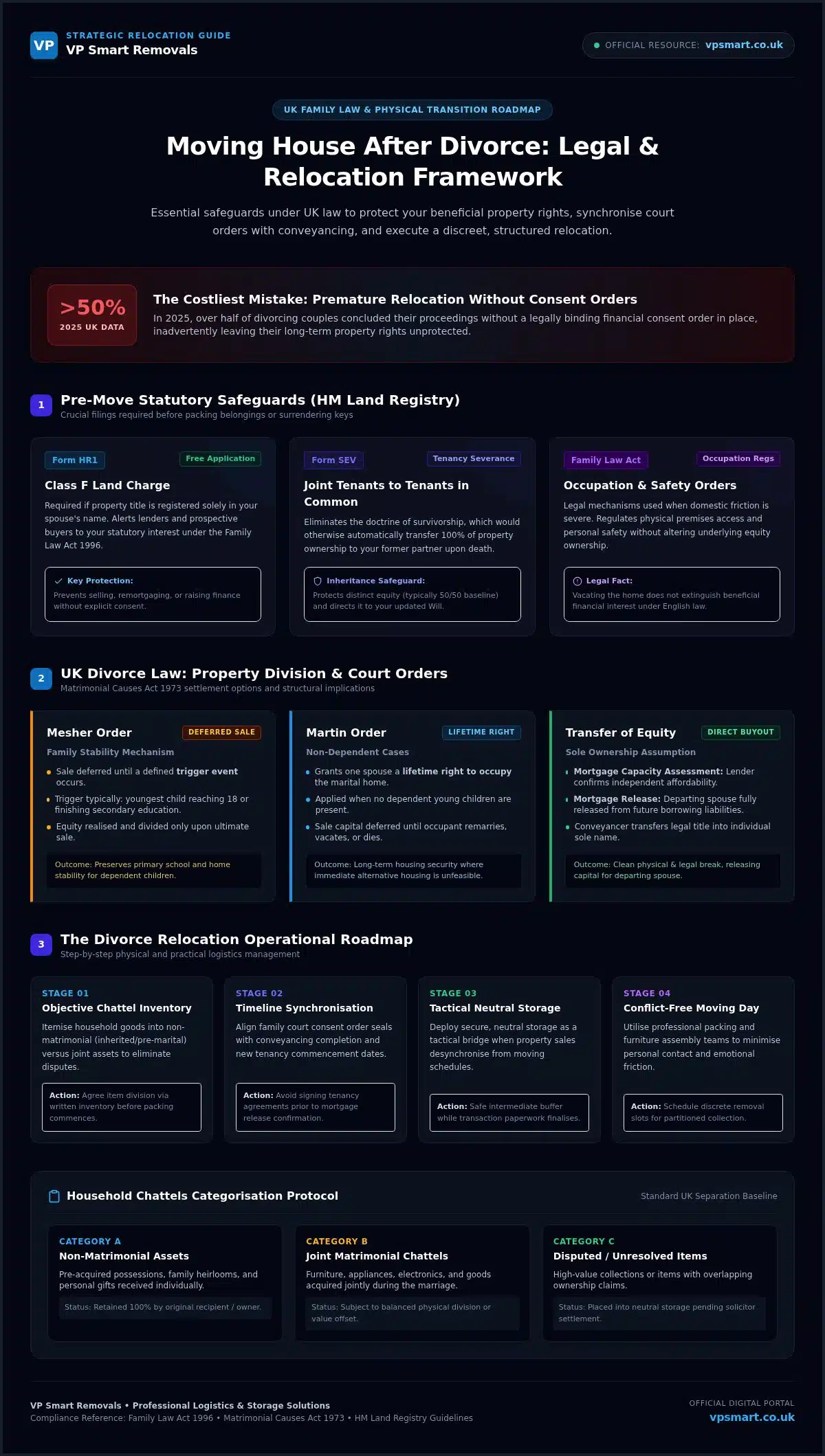
If the title deeds are registered solely in your spouse’s name, submit Form HR1 to HM Land Registry immediately. This free application registers a Class F land charge against the property, alerting lenders and prospective buyers to your statutory interest. It prevents your former partner from selling, remortgaging, or raising finance against the property without your explicit consent, safeguarding your beneficial stake until financial proceedings formally conclude.
Severing Joint Tenancies to Protect Inheritance
Most married couples purchase property as beneficial joint tenants, meaning the legal doctrine of survivorship automatically passes the entire house to the surviving spouse if one partner dies. During divorce, this setup exposes your intended beneficiaries to significant risk. Severing the joint tenancy converts your ownership into “tenants in common”, formalising distinct individual equity shares (typically 50/50 initially).
- Submit Form SEV: Send an application to HM Land Registry alongside written notice of severance served on your spouse.
- Update your Will: Your share of the equity no longer passes automatically to your ex-partner; it transfers strictly according to your updated testamentary instructions.
- Coordinate with Conveyancers: Align these registry adjustments with your broader moving house after divorce checklist uk so that prospective home purchases or equity buyouts proceed from a clearly partitioned baseline.
Financial Orders and Property Division Options in UK Divorce Law
Ending a marriage legally does not terminate your financial obligations. Under the Matrimonial Causes Act 1973, English courts possess wide discretion to redistribute property based on fairness, housing needs, and children’s welfare. Resolving these arrangements early ensures your physical relocation rests on firm financial foundations, avoiding disruptive disputes later.
A crucial stage of any moving house after divorce checklist uk is aligning legal settlement milestones with your moving schedule. Without synchronisation, you risk signing tenancy agreements or scheduling vans before mortgage releases complete. When house sales and completion dates desynchronise, booking flexible storage services provides valuable breathing space whilst your solicitor finalises transaction paperwork.
Mesher and Martin Orders: Deferred Property Sales
Courts do not always mandate an immediate open-market sale. A Mesher order retains the family property until a specified “trigger event” occurs, such as the youngest child turning 18 or completing secondary education. In contrast, a Martin order grants one spouse a lifetime right to occupy the home without dependent children present. Both mechanisms provide domestic stability, but defer capital release until the eventual sale.
Transfer of Equity and Property Buyouts
If one party retains the matrimonial residence, an equity transfer buyout is the standard legal vehicle. Key steps include:
- Mortgage Capacity Assessment: Lenders must formally confirm that the remaining spouse can shoulder borrowing liabilities independently before approving a transfer.
- Mortgage Release Procedures: The departing spouse must obtain an official release of liability, ensuring their borrowing capacity remains unencumbered for their next property purchase.
- Tax Exemptions: Property equity transferred pursuant to a formal court order or separation agreement is normally exempt from Stamp Duty Land Tax (SDLT).
Securing a Clean Break Consent Order
A Final Order (formerly Decree Absolute) dissolves the legal marriage; it does not dismiss future financial claims. For absolute legal protection, apply to the court for a Financial Consent Order (with an agreed fee of £62). This document creates a binding “clean break”, preventing your ex-spouse from claiming against future wealth, business growth, or inherited assets. Incorporating clear clearance deadlines into this order guarantees mutual oversight regarding when personal belongings must be removed from the property, keeping your moving house after divorce checklist uk on schedule.
The Comprehensive Moving House After Divorce Checklist
Separating the physical logistics of a move from the emotional friction of relationship breakdown requires methodical discipline. Legal proceedings establish the division of assets on paper; your moving checklist translates those court rulings into practical, controlled steps. Breaking your relocation into chronological milestones protects sensitive data, prevents financial disputes, and provides your children with stable domestic routines.
Using a structured moving house after divorce checklist uk gives you complete oversight across administrative, legal, and operational tasks. The timetable below keeps your transition on track.
Six to Eight Weeks Out: Legal Filings and Administrative Setup
Early preparation centres on ring-fencing your personal information and establishing financial independence. Begin with these core priorities:
- Redirect Personal Post: Set up an independent Royal Mail Redirection service immediately so confidential legal correspondence, bank statements, and court updates go straight to a private address or secure PO Box.
- Separate Banking and Digital Profiles: Open sole bank accounts, secure individual mobile contracts, and update account recovery passwords on personal email accounts.
- Notify Statutory Bodies: Inform HMRC, child benefit offices, and your children’s schools regarding individual primary contact details and residency changes.
- Review Professional Removals: Plan your moving resources by consulting trusted house removals guidance to reserve provisional dates that align with your expected legal exchange.
Two to Four Weeks Out: Logistics and Packing Preparations
With administrative foundations secure, shift your focus to property clearance and utility transfers. These logistical steps ensure a smooth exit:
- Book Moving Support: Confirm vetted movers once completion dates become legally enforceable.
- Arrange Municipal Changes: Notify your local authority to close joint council tax liability, and apply for the statutory 25% single-occupancy discount on your prospective new home.
- Source Packing Supplies: Order dedicated, heavy-duty packing materials to protect your assigned items and prevent disputes over damaged property.
- Schedule Disconnections: Arrange broadband transfers, energy accounts, and water services well ahead of move day.
Moving Week: Final Inspections and Key Handover
The final days demand meticulous evidence gathering to prevent retrospective claims. On departure day, take clear, timestamped photographs of all utility meters (gas, electricity, and water) alongside visual records of the vacated rooms. Hand over all sets of keys strictly according to agreed solicitor instructions, marking the final physical milestone on your moving house after divorce checklist uk.
Dividing Household Chattels and Utilising Neutral Storage
Arguments over household contents often generate more acrimony than dividing liquid capital. Disputing everyday furniture through solicitors quickly burns through thousands of pounds in legal fees over depreciating items. Structuring an objective division method early is an essential milestone on your moving house after divorce checklist uk, keeping domestic transitions dignified and cost-effective.
Creating an Objective Household Chattel Inventory
English family law distinguishes between non-matrimonial property and joint assets. Items owned before the marriage, personal gifts, and direct inheritances generally remain separate property, provided they were not intermingled into joint usage. For joint chattels, compile a shared digital spreadsheet detailing descriptions, photographs, and realistic second-hand replacement values rather than original purchase costs. Allocating items based on the actual floorplans of each party’s prospective home helps resolve disputes pragmatically without court intervention.
Bridge the Relocation Gap with Secure Storage
Property completions rarely align perfectly when untangling a joint household. When sales or purchases desynchronise, flexible storage services offer vital intermediate breathing room. Placing contested or surplus goods into managed storage prevents hasty sales, accidental damage, or premature disposal. Both parties retain complete oversight through itemised storage manifests, guaranteeing transparency until financial orders are signed.
Arrange secure storage facilities for your upcoming move
Professional Packing to Minimise Conflict
Packing up a family residence alone carries immense psychological weight and easily triggers interpersonal tension. Bringing in professional movers and packers acts as an effective, neutral buffer. Trained crews pack according to agreed inventories, record item conditions before transit, and apply distinct colour-coded labels to indicate which belongings travel to which destination. This structured handling eliminates accusations of improper packing, keeping your moving house after divorce checklist uk moving forward smoothly.
Executing a Discreet, Conflict-Free Moving Day
Moving day represents the physical reality of a concluded chapter. It can also bring intense emotional vulnerability. Without intentional boundaries, loading furniture easily triggers heated arguments over old grievances. Managing move day as an operational process rather than an emotional confrontation protects your dignity and keeps the physical relocation on schedule.
Positioning a professional removals crew on-site introduces an impartial presence that naturally diffuses tension. Moving teams focus entirely on efficient loading, inventory verification, and secure transit. With experienced personnel handling the manual labour, you retain complete oversight without being drawn into exhausting personal disputes. This operational safeguard is the final practical step in completing your moving house after divorce checklist uk.
Coordinating Move-Day Timings and Attendance
Direct contact between separating partners on move day should be minimised. Establish unambiguous boundaries early by confirming written collection hours through legal representatives or mediation services. Where possible, agree that your former spouse remains away from the property during the loading window. Children and pets should spend the day with trusted family or professional carers, shielding them from domestic upheaval.
Safeguarding Sensitive Legal and Personal Documents
Never entrust private legal and financial paperwork to the main removal vehicle. Separate your essential records before loading begins and keep them in your personal transit bag:
- Court Filings and Agreements: Financial remedy orders, Form E disclosures, sealed consent documents, and solicitors’ correspondence.
- Identity and Property Titles: Passports, original birth certificates, title register copies, and vehicle logbooks.
- Digital Assets: External hard drives, laptops, and encrypted storage devices containing backups of personal records.
Settling Seamlessly into Your New Residence
Arriving at your new property marks the beginning of your domestic independence. Focus on immediate comfort rather than tackling every unboxing task at once. Assemble children’s beds first to create a secure, welcoming environment on night one. You can also review transparent rates for professional furniture assembly services, ensuring bed frames, wardrobes, and substantial tables are reconstructed correctly without added exhaustion. For comprehensive operational planning, consult our proven house removals guidance to round off your moving house after divorce checklist uk with complete confidence.
Take Confident Control of Your Next Chapter
Navigating a marital separation requires both legal vigilance and methodical practical planning. By establishing statutory property rights prior to departure, securing an enforceable clean break consent order, and following a disciplined moving house after divorce checklist uk, you protect your hard-earned financial future whilst shielding yourself from unnecessary personal conflict.
VP Smart Removals provides nationwide moving and storage logistics tailored specifically for complex life transitions. Our dedicated, neutral packing and inventory services minimise household friction, providing intermediate breathing room and dependable hands to shoulder the physical demands of relocation.
Request a discreet, professional moving quote
Stepping across the threshold of your independent home is an empowering milestone. With sound legal safeguards and reliable logistical support in place, you can turn the page with complete clarity and lasting peace of mind.
Frequently Asked Questions
Can my spouse legally stop me from moving house with our children?
Yes, your spouse can apply to the family court for a Prohibited Steps Order if your proposed relocation disrupts established schooling or co-parenting routines. Both parents with parental responsibility must consent to any significant domestic relocation. If mutual agreement cannot be reached, you must apply for a Specific Issue Order. The court evaluates your request purely based on the children’s welfare under the Children Act 1989.
Do I lose rights to the matrimonial house if I move out?
No, moving out does not surrender your legal or beneficial property rights under UK matrimonial law. Your financial stake in the property remains fully protected until a court grants an enforceable Financial Order. However, leaving prematurely can impact temporary living arrangements and daily negotiation leverage. Reviewing your rights forms a vital first step on your moving house after divorce checklist uk before surrendering house keys.
How do I divide furniture and personal belongings fairly during divorce?
Begin by cataloguing all items on an objective inventory spreadsheet, distinguishing separate non-matrimonial property from joint purchases. Value everyday furnishings at second-hand resale value rather than original purchase costs. Allocate furniture logically based on the floorplans of your respective new homes. Avoid disputing lower-value items through legal channels, as solicitor fees rapidly eclipse the actual monetary replacement value of standard household goods.
What is a Home Rights Notice and when should I register it?
A Home Rights Notice is an official Land Registry entry that protects a spouse whose name does not appear on the property deeds. You should submit Form HR1 to HM Land Registry as soon as relationship breakdown occurs. This free statutory registration alerts prospective lenders and buyers to your legal interest, preventing your spouse from selling, transferring, or remortgaging the matrimonial residence without your formal consent.
Who is responsible for paying mortgage and utility bills after one partner moves out?
Both borrowers remain jointly and individually liable to the mortgage lender for regular monthly payments, irrespective of who resides in the property. If payments stop, the bank holds both individuals accountable. For council tax and energy bills, operational liability usually transfers to the resident spouse once suppliers are notified of departure, though interim financial support agreements often address these domestic outgoings during divorce proceedings.
Can I change the locks on the family home after my ex moves out?
You cannot legally change the locks if your ex-partner is a joint property owner or holds registered Home Rights, unless you possess an Occupation Order. Taking unilateral action risks urgent court applications and financial penalties for unlawfully restricting access. If domestic safety is an issue, instruct a family solicitor to apply for an Occupation Order granting you exclusive occupation rights before altering physical entry points.
How can secure temporary storage help during a high-conflict divorce move?
Secure storage acts as a neutral tactical bridge when property sale and purchase dates desynchronise. Moving disputed or excess items into managed storage facilities prevents hasty disposals, removes friction from the family home, and ensures full transparency through itemised inventory logs. Professional removal teams can pack and transfer designated belongings directly to storage, keeping your moving house after divorce checklist uk strictly focused on practical execution.
Disclaimer
Some links in this article may be affiliate links, which means we may earn a small commission if you make a purchase through them, at no additional cost to you. We only recommend products or services we believe provide value to our readers.
Sep 23, 2026
Over four million older adults across the UK want to move, yet research from the Centre for Ageing Better shows that barely 3.4% actually relocate each year. The sheer dread of rushed packing, physical exhaustion, and parting with a lifetime of memories often halts the process before it begins. Securing genuine compassionate removals for the elderly requires far more than booking basic transit logistics; it demands patient pacing, emotional attunement, and absolute respect for personal dignity.
You already know that orchestrating a move in later life is profoundly personal. You need certainty that sentimental heirlooms will stay safe, vital medication schedules won’t be disrupted, and your loved one will avoid physical strain. In this 2026 buying guide, you will discover how to evaluate specialist removal firms, verify robust handling practices, and leverage managed packing and furniture assembly to protect domestic well-being. We examine the critical criteria checklist to vet dependable providers, ensuring you maintain complete oversight and secure a gentle, turnkey transition.
Key Takeaways
- Understand why genuine compassionate removals for the elderly prioritise emotional pacing and dignity over rapid transit logistics.
- Discover the critical vetting criteria to select providers offering full packing services and furniture assembly that prevent senior injury.
- Evaluate the hidden physical and emotional costs of standard moving options compared to fully managed relocation care.
- Learn a structured, room-by-room downsizing framework designed to protect cherished memories whilst maintaining familiar daily routines.
- See how coordinated planning and flexible storage facilities ensure complete oversight and an immediate, turnkey settling-in experience.
What Are Compassionate Removals for the Elderly?
Standard removals focus almost entirely on speed, loading vans rapidly to meet rigid transit schedules. In contrast, compassionate removals for the elderly reshape relocation into an empathetic, supportive service centered around personal dignity, emotional well-being, and absolute safety. Leaving a home inhabited for thirty, forty, or fifty years carries profound emotional weight. When conventional crews rush through rooms and pack heirlooms indiscriminately, they strip away an older adult’s sense of control. Compassionate moving balances meticulous technical organisation with deep patience, ensuring individuals retain complete oversight throughout every phase of the transition.
The Emotional and Psychological Dimension of Later-Life Moves
Downsizing represents far more than simple decluttering; it is a sensitive reckoning with personal history. Navigating the complex emotional aspects of downsizing for seniors requires sufficient space to pause, reflect, and make unhurried choices about what to keep, gift, or pass forward. Dedicated teams recognise the grief and anxiety tied to parting with familiar surroundings. By maintaining clear, patient dialogue, experienced movers and packers protect an older adult’s personal agency, transforming what could feel like a destabilising event into an empowering step toward a safer, low-maintenance home.
Physical Safeguarding and Health Considerations
Beyond emotional support, senior relocations require rigorous physical safeguards to eliminate fatigue and fall hazards. Experienced crews systematically manage the living space to protect domestic safety from start to finish:
- Hazard management: Keeping primary transit corridors completely clear of tape, packing materials, and loose boxes.
- Vital access: Safeguarding immediate availability to mobility aids, daily prescriptions, and basic comfort items throughout the day.
- Sanctuary preservation: Leaving a comfortable armchair and resting area intact until the final loading stage so routines remain steady.
Maintaining familiar routines prevents physical exhaustion and cognitive disorientation. When older adults know their essential items are secure and accessible, anxiety drops dramatically, making compassionate removals for the elderly an indispensable support system for families.
Key Criteria for Choosing an Elderly Moving Specialist
Selecting the right moving partner requires scrutinising operational habits rather than just transport fleet capacity. Delivering genuine compassionate removals for the elderly hinges on a team’s interpersonal empathy, bespoke pacing, and full-spectrum practical support. By establishing clear vetting benchmarks upfront, families can protect their loved ones from unneeded disruption and physical vulnerability.
Crew Temperament and Clear Communication
Patience isn’t an optional extra during a later-life move; it’s the core operational requirement. Assess whether the company assigns a single, dedicated move coordinator who takes time to understand individual preferences and anxieties. Crews must possess the interpersonal training required to accommodate physical limitations, honour requests, and listen patiently without displaying frustration or urging haste.
Comprehensive Service Breadth and Practical Assistance
A gentle move demands an end-to-end operational framework that eliminates all heavy lifting for older adults. Look for specialists capable of managing every physical task seamlessly:
- Professional wrapping: Deploying specialist packing services to safeguard fragile china, glassware, and sentimental heirlooms.
- Technical handling: Complete disassembly and reassembly of complex furniture, ensuring beds and wardrobes are functional on arrival.
- Interim space: Providing access to secure storage facilities so families can phase downsizing rather than making hurried disposals.
Leaving furniture assembly and unpacking to older adults dramatically raises fall risks. Partnering with a full-service team ensures the new home is immediately functional, comfortable, and safe from day one.
Contract Certainty and Transparent Pricing
Financial ambiguity generates acute stress for older individuals on fixed incomes. Open-ended hourly arrangements frequently cause anxiety if traffic or access delays occur during transit. Instead, choose providers that conduct comprehensive upfront surveys to assess stairways, access constraints, and specialist items before issuing a contract.
Reputable firms provide fixed-price project agreements rooted in clear pricing structures, giving you total budget certainty and complete oversight from initial consultation to final placement. If you are coordinating a relocation for an older relative, exploring full-service house removals provides the transparent framework and practical support needed for a seamless transition.
Comparing Moving Options: Standard Removals vs Compassionate Care
Relocating later in life involves unique challenges that standard transport services simply aren’t equipped to manage. Choosing the right support requires weighing physical risk, emotional well-being, and operational thoroughness across different moving models.
| Relocation Model |
Physical Burden |
Sentimental Care |
Settling-In Speed |
| Self-Managed (DIY) |
Severe; high risk of injury and exhaustion |
High risk of breakages from improper packing |
Slow; leaves boxes unpacked for weeks |
| Standard Removals |
Moderate; basic loading without tailored pacing |
Variable; focused primarily on speed and volume |
Basic; cartons placed in designated rooms |
| Compassionate Relocations |
Zero; complete crew management and lifting |
Methodical protective wrapping and labelled care |
Immediate; complete furniture assembly and setup |
Self-Managed Moves vs Professional Full-Service Relocations
Attempting a DIY move places immense physical strain on older adults and their adult children. Hauling heavy cartons, repeatedly bending to tape boxes, and lifting awkward furniture quickly lead to muscular injury or serious falls. Chaotic packing also causes deep distress when everyday essentials vanish into unmarked containers. Opting for full-service assistance protects family relationships. When trained teams take over the physical logistics, family members can step away from manual labour and focus on offering calm, continuous emotional support.
Assessing Dedicated Senior Removals Against Basic Man-and-Van Services
Budget alternatives like basic man-and-van hire provide transit rather than care. Leaving stacked cartons at the kerbside or inside the front doorway creates immediate hazards for an older individual living alone. In stark contrast, compassionate removals for the elderly incorporate thoughtful, room-by-room replication.
Experienced crews assemble bed frames, position favourite armchairs, and reconnect essential lamps before departing. Cherished porcelain, antique dressers, and generational heirlooms receive individual, protective wrapping rather than basic stacking. By rebuilding a familiar domestic layout on day one, this methodical approach removes disorientation and turns an unfamiliar property into a safe, reassuring home.
How to Plan and Pace a Later-Life Move Step by Step
Rushing downsizing into an intense weekend is the fastest route to physical exhaustion and distress. Structuring the relocation across several deliberate weeks ensures complete oversight and preserves emotional stamina. True compassionate removals for the elderly treat preparation as a steady progression, giving older adults the time they need to process changes comfortably.
Empathetic Downsizing and Sorting Possessions
Tackle one room at a time, beginning with neutral utility areas rather than spaces laden with memories. Limit sorting sessions to sixty minutes daily to prevent cognitive fatigue. Group items methodically into four clear categories: retain, gift to family, donate, or place into interim storage. If cherished heirlooms won’t fit into a smaller footprint, taking photographs creates a lasting visual keepsake without crowding walkways.
Floor Planning and Accessibility Preparation
Precise spatial planning eliminates moving-day surprises. Map the dimensions of the new residence against retained furniture, ensuring corridors and door frames remain clear for walking aids or wheelchairs. Less than 10% of UK homes meet basic accessibility standards, so wide, uncluttered pathways are vital for preventing slips. Confirm that central heating, electricity, and water supplies are fully operational prior to arrival, and arrange the safe disconnection and reconnection of essential white goods.
Managing Moving Day for Optimal Calm
On the day itself, maintain familiar domestic anchors to minimise confusion and protect wellbeing:
- Designate a sanctuary room: Keep an armchair and tea station in one quiet room undisturbed until the final loading phase.
- Pack an essentials bag: Keep daily prescriptions, important documents, fresh linens, toiletries, and favourite teacups in a separate bag that travels with family.
- Prioritise reassembly: Instruct the crew to assemble the bed and arrange familiar bedroom items first so resting space is ready immediately.
When tasks are paced methodically, the entire household feels protected and supported.
Find an experienced team of house movers near you
Partnering with VP Smart Removals for a Dignified Transition
Transitioning into a new residence should mark the beginning of an effortless, comfortable chapter rather than a period of physical exhaustion. VP Smart Removals delivers comprehensive, empathetic moving solutions designed specifically around later-life relocations. By blending methodical technical planning with approachable domestic warmth, our crews ensure every move preserves personal dignity, familiar routines, and emotional well-being.
Bespoke Packing, Furniture Reassembly, and Placement
We eliminate physical strain entirely by managing every stage of packing and setting up the living space. Our experienced teams use high-grade protective materials to secure delicate china, framed portraits, and generational heirlooms against transit vibrations. Each carton is catalogued logically so everyday belongings can be found effortlessly in the new home.
Arrival at the property focuses on immediate domestic reconstruction. We assemble bed frames, rebuild wardrobes, and position favourite armchairs exactly where requested. For delicate musical instruments and weighty heirlooms, our personnel carry out specialised piano removals using dedicated transit techniques, guaranteeing irreplaceable possessions arrive undamaged and ready to enjoy.
Clear Project Management and Dependable Support
Communication remains steady and reassuring from initial consultation to the final placed item. Move coordinators keep clients and their families informed at every stage, answering questions patiently so there isn’t any guesswork or confusion. This collaborative approach preserves personal agency whilst taking the logistical strain off family members.
To prevent the financial anxiety that often accompanies hourly moving rates, we conduct thorough pre-move surveys to inspect narrow corridors, flight access, and specialist items upfront. We then supply transparent, fixed-price project agreements that guarantee complete budget certainty with no surprise surcharges on moving day. You maintain complete oversight over your environment while our crew shoulders the physical workload.
Arranging dependable, compassionate removals for the elderly starts with an unhurried conversation. Reach out to our team today to organise a comprehensive pre-move assessment and secure a calm, dignified transition for your loved one.
Securing Peace of Mind for Your Loved One’s Next Chapter
A successful relocation in later life is measured by preserved well-being rather than the hours logged on a transit van. By choosing genuine compassionate removals for the elderly, you ensure that every phase of the move honours personal dignity, familiar routines, and domestic safety. Comprehensive packing and unpacking solutions remove all physical strain from family members, safeguarding against senior fatigue and fall risks, whilst expert furniture assembly ensures bedrooms and living areas are fully reconstructed from day one. Transparent fixed-price project agreements eliminate moving-day friction and deliver total budget certainty without unexpected surcharges, keeping you firmly in control of the entire process.
Step forward with complete confidence. With patient coordination, methodical handling, and dependable domestic care, you can turn what felt like a daunting transition into an effortless, reassuring settling-in experience that helps your loved one feel instantly at home.
Frequently Asked Questions
How far in advance should an elderly person start planning a move?
Families should ideally begin planning eight to twelve weeks prior to the intended moving date. Spacing tasks over several months allows older adults to sort possessions gradually without mental or physical exhaustion. Early planning also provides ample time to book an in-home site assessment, measure entryways in the new residence, and secure preferred moving dates with a dedicated coordinator.
What is included in a full-service compassionate removal package?
A full-service package covers the entire physical relocation from start to finish. This includes providing all packing materials, wrapping fragile heirlooms, loading, and secure transit. At the destination, the team unpacks cartons, assembles beds and wardrobes, and arranges furniture according to pre-agreed floor plans. This turnkey approach delivers genuine compassionate removals for the elderly by eliminating domestic disruption.
How can adult children help elderly parents downsize without causing upset?
Adult children should focus on active listening and preserve their parent’s final decision-making power. Break decluttering into short, manageable sessions lasting under an hour, focusing on utility spaces before tackling sentimental items. Framing the process around curating a comfortable gallery of favourite belongings, rather than getting rid of possessions, helps parents maintain emotional agency and reduces moving friction.
What happens if cherished furniture cannot fit into the new home?
Valued furniture that exceeds the floor plan of the new property can be placed into secure storage facilities. Rather than forcing hasty decisions during a high-stress week, interim warehouse storage gives families time to offer pieces to relatives or arrange private sales later. Dedicated removal teams can transport these surplus items directly into storage on moving day.
Can removal teams disassemble and rebuild specialist beds or mobility furniture?
Yes, experienced crews possess the technical tools and expertise to disassemble, transport, and reassemble complex furniture, including heavy bed frames, large wardrobes, and mobility-assisted pieces. Our movers ensure essential sleeping and seating furniture is reconstructed and safely positioned immediately upon arrival, eliminating fall hazards and making the bedroom comfortable from the very first night.
How do compassionate movers support clients living with dementia or memory loss?
Movers support individuals experiencing memory loss by maintaining absolute environmental consistency and calm communication. Crews carefully replicate familiar furniture layouts, placing bedside tables, lamps, and cherished photos in identical orientations within the new home. Teams also work unobtrusively around a dedicated quiet space, ensuring familiar daily routines and tea breaks continue uninterrupted throughout the day.
Is transit insurance included when moving delicate antiques and sentimental heirlooms?
Professional removal companies operate with comprehensive goods-in-transit insurance to protect household possessions against unforeseen damage. When arranging compassionate removals for the elderly, firms conduct detailed pre-move surveys to log delicate antiques, artwork, or musical instruments. This process ensures the correct specialist wrapping techniques, transit securing methods, and appropriate cover levels apply across every mile of the journey.
Disclaimer
Some links in this article may be affiliate links, which means we may earn a small commission if you make a purchase through them, at no additional cost to you. We only recommend products or services we believe provide value to our readers.