
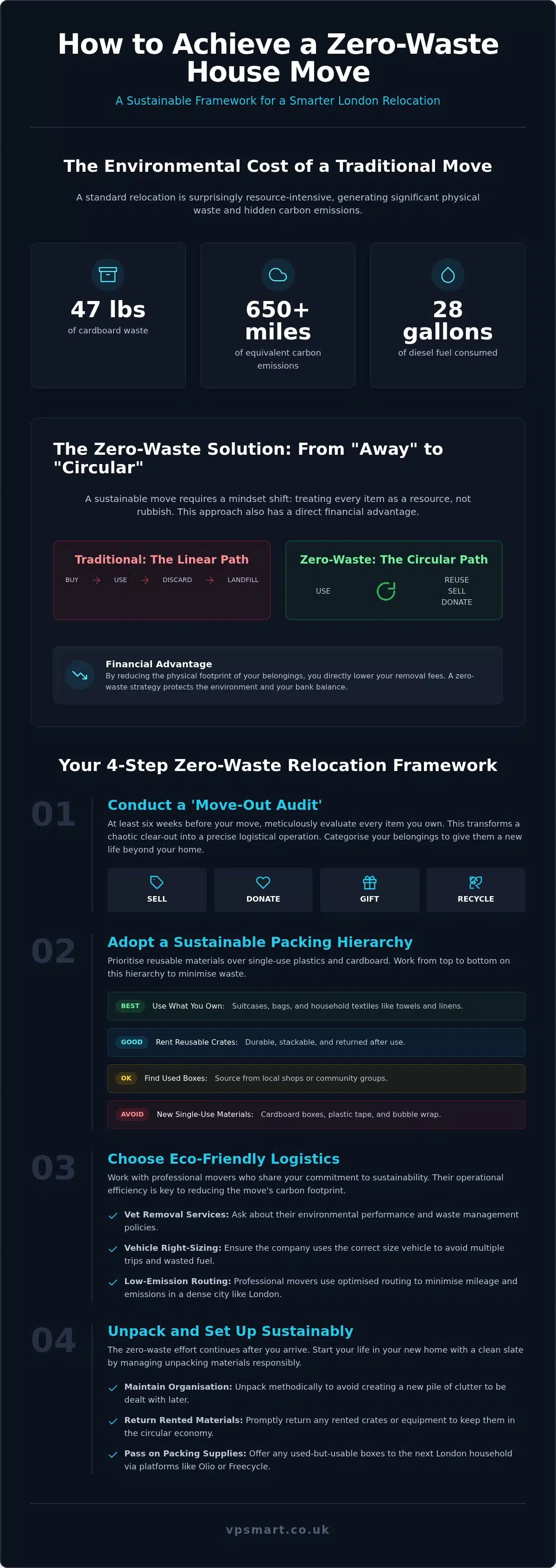
Did you know that the average residential move generates 47 pounds of cardboard waste and emits carbon equivalent to driving over 650 miles? For many Londoners, the excitement of a new home is often dampened by the sight of overflowing bins and the guilt of sending usable items to a landfill. Mastering how to have a zero waste house move isn’t just a lifestyle choice for the environmentally conscious; it’s a logical framework for a more efficient, high-performance relocation.
Moving house is often a logistical headache, especially when you’re trying to coordinate multiple charity donations and sustainable packing whilst managing a demanding career. It’s frustrating to pay for expensive rolls of tape and boxes that only serve a single purpose. We’re here to help you achieve a waste-free relocation that reduces your moving costs through intelligent downsizing. This guide provides a clear roadmap to relocate without the rubbish by following our expert-led, sustainable framework designed for London homes. We’ll explore the technical side of reusable containers, explain how to support the local circular economy, and ensure your next move is as clean as your new floorboards.
Key Takeaways
- Understand how a circular economy approach transforms your relocation from a waste-generating event into a resource-efficient transition.
- Master the “Move-Out Audit” to categorise belongings effectively, ensuring items are gifted or recycled rather than discarded.
- Learn how to have a zero waste house move by implementing a packing hierarchy that prioritises existing household textiles and rented crates over single-use plastics.
- Discover how to vet professional removal services for environmental performance and the importance of vehicle right-sizing for low-emission routing.
- Implement sustainable unpacking strategies that maintain domestic organisation and ensure moving materials are responsibly passed on to the next London household.
What is a Zero Waste House Move and Why Does it Matter?
Learning how to have a zero waste house move is a logistical exercise in the circular economy, not just a lifestyle choice. A zero waste move is a relocation that prioritises keeping materials in use and out of landfills. It functions by treating every item and packing material as a valuable resource rather than a disposable commodity. The 2026 Zero Waste Hierarchy for house removals prioritises the prevention of waste through meticulous inventory management and the reuse of durable materials before any recycling occurs.
Beyond the ethical satisfaction of a clean move, there is a clear financial advantage. Most house removals services calculate costs based on volume and time. By reducing the physical footprint of your belongings, you directly lower your removal fees. This results in a leaner, more efficient relocation that protects both the environment and your bank balance. Implementing a strategy for how to have a zero waste house move allows you to identify these hidden costs early, ensuring your budget remains as tidy as your packing.
The Environmental Cost of Traditional Relocations
Traditional moving methods are surprisingly resource-intensive. A standard three-bedroom home relocation can generate significant debris, including 47 pounds of cardboard waste and vast quantities of non-recyclable single-use plastics like bubble wrap. This physical waste is only part of the problem. Inefficient planning often leads to multi-trip moves, where the hidden waste of fuel emissions adds up. A typical move consumes 28 gallons of diesel fuel, producing carbon emissions equivalent to driving over 650 miles. This is why transparent pricing and efficient routing are essential for a sustainable transition.
In a dense city like London, the impact is visible on our streets. Abandoned furniture left on pavements creates a burden for local council waste services and contributes to urban blight. Professional movers and packers now use technical oversight to avoid these pitfalls, ensuring that every piece of hardware is accounted for and safely transported without leaving a trail of rubbish behind.
The Mindset Shift: From “Away” to “Circular”
The first step toward a sustainable move is acknowledging that “away” doesn’t exist. In London, every item you discard goes somewhere, whether it is a specialised recycling centre or a landfill. To succeed, you must reverse engineer your move. This means deciding on the final destination of every item before it even enters a box. If an item doesn’t have a clear place in your new home, it should be directed into the circular economy through resale or donation.
View your relocation as a comprehensive sustainability audit of your lifestyle. It’s a rare opportunity to evaluate your possessions and ensure they align with your current needs. By taking complete oversight of your inventory, you transition from a passive consumer to an active manager of your domestic environment. This forward-thinking approach ensures your new home starts with a foundation of efficiency and domestic well-being, rooted in regional reliability and environmental care.
Decluttering with Purpose: The Circular Economy Approach
The first step in understanding how to have a zero waste house move is conducting a thorough ‘Move-Out Audit’ at least six weeks before your removal date. This technical evaluation allows you to oversee every item in your inventory, ensuring that nothing is mindlessly packed or discarded. By categorising your belongings into Sell, Donate, Gift, or Specialty Recycle, you transform a chaotic clear-out into a precise logistical operation. This proactive management reduces the volume of goods to be transported, which directly improves the efficiency of your relocation.
London’s circular economy is exceptionally robust, providing numerous avenues for items that no longer serve your lifestyle. Digital platforms like Olio and Freecycle are invaluable for hyper-local gifting, whilst Facebook community groups often connect you with neighbours who can repurpose specific household hardware. If you find the volume of belongings daunting, booking a professional house removals service early gives you the structural support to focus on this essential sorting process without the pressure of a looming deadline.
Strategic Selling and Gifting in London
For items with residual value, London’s resale market is thriving. Apps such as Vinted and Depop are perfect for fashion, whilst eBay remains the standard for specialised equipment and furniture. If you prefer a more social approach, consider hosting a ‘Moving Out’ party. This allows friends to adopt items you no longer need, ensuring your possessions transition directly into new homes. Another effective method is the ‘Freebie’ box on your doorstep. This is a great way to engage with the local community, but you must remain mindful of council regulations. Ensure boxes don’t obstruct pavements or create trip hazards, and always bring in any uncollected items at the end of the day to prevent urban littering.
Responsible Disposal for Non-Donatable Items
Mastering how to have a zero waste house move also requires knowing where to take items that cannot be sold or gifted. Certain household materials require specialised handling to avoid environmental damage. Expired paint, old mattresses, and broken electronics cannot simply be left for the bin men. London’s Reuse and Recycling Centres (RRCs) are equipped to handle these ‘hard-to-recycle’ materials efficiently. When disposing of old IT equipment, look for WEEE (Waste Electrical and Electronic Equipment) recycling points to ensure heavy metals are recovered safely. Finally, leaving your old property in a pristine state is a core tenet of sustainability. Investing in professional end-of-tenancy cleaning ensures the space is immediately ready for its next occupants, preventing the need for unnecessary waste or aggressive chemical treatments by future tenants.
Sustainable Packing Materials: Ditch the Single-Use Plastics
Achieving a waste-free relocation requires a disciplined hierarchy of materials. When planning how to have a zero waste house move, your first priority should always be the containers you already own. Suitcases, hampers, and even dresser drawers act as helpful household entities that can transport your belongings without requiring additional resources. If your existing storage is insufficient, the next logical step is to explore rental options before finally considering recycled cardboard. This structured approach ensures you maintain complete oversight of your environmental footprint whilst avoiding the unnecessary expense of new supplies.
Plastic bubble wrap is often viewed as a moving essential, but it is actually a significant environmental liability. It is difficult to recycle and frequently ends up in London landfills. By adopting a “one-in, one-out” rule for box procurement, you ensure that no excess material enters your home. Every container brought into the property must have a confirmed destination or a plan for immediate reuse. This prevents the common post-move anxiety of dealing with a mountain of discarded plastic and tape.
The Case for Plastic Crate Hire
Rented plastic crates represent the pinnacle of moving hardware. These containers offer superior structural integrity compared to cardboard, providing a secure environment for your most delicate items. From a lifecycle perspective, the data is compelling. Whilst a cardboard box might survive three or four uses before losing its rigidity, a single rental crate can endure 400 to 500 individual moves. Their uniform shape also allows for perfect stackability, which optimises the space inside the removal vehicle and reduces the risk of transit damage. For tailored advice on the precise volume of materials required for your home, our packing services experts can provide a technical assessment to ensure you don’t over-order.
Eco-Friendly Alternatives to Bubble Wrap and Tape
Replacing plastic doesn’t mean sacrificing protection. Honeycomb paper wrap provides the same impact resistance as traditional bubble wrap but remains fully recyclable with your standard kerbside paper collection. For filling voids in boxes, starch-based biodegradable packing peanuts are an excellent choice as they dissolve completely in water. We also recommend transitioning to paper tape with a water-activated adhesive. This creates a permanent bond with cardboard boxes that is easy to recycle, unlike standard vinyl tapes that must be stripped away. To secure your most fragile glassware, use the “Burrito Wrap” technique. Simply roll each item in a clean towel or bedsheet. This method leverages your existing textiles as high-performance padding, ensuring your move is both secure and entirely free of single-use rubbish.
Eco-Friendly Logistics: Working with Professional Movers
Selecting the right partner is critical when executing a plan for how to have a zero waste house move. It’s not enough to pack sustainably if the logistics phase is inefficient and resource-heavy. When vetting a removal company, ask specific questions about their waste diversion protocols and vehicle maintenance standards. Look for providers who prioritise “right-sizing” their fleet for every job. Sending a vehicle that is too small leads to multiple, high-emission trips, whilst an oversized truck represents a poor use of fuel. A professional site survey allows for a technical, accurate volume estimation, ensuring the logistics are as lean and efficient as possible.
Briefing your moving crew on move day is equally important for maintaining your environmental standards. Clearly state your zero-waste goals and point out the reusable materials you’ve prepared to avoid any accidental use of disposables. Professional furniture assembly also plays a vital role in long-term sustainability. When hardware is handled by experts, it prevents the structural damage that often leads to items being discarded prematurely. By ensuring your furniture is correctly dismantled and rebuilt, you extend its lifecycle and avoid the environmental cost of replacement.
Choosing a Local London Specialist
Opting for local London movers, such as those specialising in Richmond or Twickenham, significantly reduces your move’s carbon footprint. These specialists possess deep regional route knowledge, allowing them to navigate London’s complex low-emission zones and traffic patterns with precision. They can often provide consolidated loads for smaller moves, further maximising vehicle efficiency. Booking a house removals London service with local heritage ensures your relocation is grounded in regional reliability rather than international guesswork.
Get a transparent quote for your sustainable London move
Professional Handling to Prevent Waste
The ultimate form of moving waste is a broken possession that must be replaced. Expert packing services act as a protective barrier against damage, ensuring that your items arrive in a reusable state. This is particularly vital for delicate items like pianos, which require specialised transit techniques to avoid catastrophic failure. Instead of relying on single-use shrink wrap, professional teams use high-quality, reusable transit blankets. These helpful household entities provide superior cushioning and can be used for hundreds of relocations, completely eliminating the need for disposable plastic films during transit.
Setting Up Your New Home Sustainably
The final phase of how to have a zero waste house move involves transitioning from a temporary logistical state into a permanent, well-managed home environment. It’s tempting to unpack at maximum speed to regain a sense of normalcy, but this often leads to poor organisational choices and unnecessary waste. By prioritising technical oversight and a “slow unpacking” philosophy, you ensure that every item finds a functional place. This deliberate approach allows you to establish robust domestic systems, such as dedicated recycling zones and efficient waste management, from the very first week.
Successfully executing how to have a zero waste house move requires a commitment that extends beyond the moving day itself. Your new property is a blank canvas for resource efficiency. By integrating your sustainability goals into your daily routine, you ensure that the effort spent on a waste-free relocation translates into a long-term lifestyle of domestic well-being. This isn’t just about avoiding rubbish; it’s about creating a future of effortless comfort through intelligent management and oversight of your environment.
The Post-Move Box Hand-Off
Once you’ve emptied your containers, the priority shifts to ensuring these helpful household entities remain within the circular economy. If you followed our earlier advice on rented crates, the process is simple: notify the provider for a collection. For cardboard boxes, flatten them carefully to preserve their structural integrity for the next user. Platforms like Nextdoor or specialised “Box Exchange” groups are ideal for local gifting. Providing these resources to another Londoner prevents them from buying new, effectively doubling the environmental benefit of your initial procurement. Our team at VP Smart Removals can often advise on regional material reuse schemes to help you clear your space responsibly.
Sustainable Furnishing and “Slow Unpacking”
A common pitfall in new homes is the “panic buy”, which involves purchasing new furniture immediately to fill empty rooms. This often results in low-quality acquisitions that don’t suit the space’s long-term needs. Instead, live in your new environment for several weeks to understand its natural light and flow. London is home to exceptional second-hand markets and upcycling centres where you can find high-quality hardware with local heritage. If you find yourself with surplus furniture that doesn’t fit the new layout, utilise secure storage whilst you decide on its future. This prevents hasty disposals and gives you the oversight needed to sell or gift items through the London-specific platforms mentioned earlier in this guide. This patient strategy ensures your home remains a sanctuary of domestic well-being and resource efficiency.
Your Blueprint for a Cleaner London Relocation
Relocating in a city as dynamic as London doesn’t have to result in a trail of single-use plastic and discarded furniture. By implementing a rigorous “Move-Out Audit” and prioritising high-performance reusable hardware, you transition from a passive consumer to an active manager of your environment. We’ve shown that mastering how to have a zero waste house move is a logical byproduct of intelligent planning and resource efficiency. Success relies on three pillars: precise inventory oversight, the adoption of a circular economy mindset, and the selection of a logistics partner committed to regional reliability.
Our London-wide coverage ensures low-emission routing through expert local knowledge, whilst our professional packing services act as a safeguard against breakage waste. By utilising expert furniture assembly, you ensure the longevity of your belongings and avoid the environmental cost of hasty replacements. Your move is an opportunity to reset your domestic habits and start life in your new home with complete oversight of your environmental footprint.
Get a Fixed-Price Quote for Your Sustainable London Move
Take charge of your next transition. With a forward-thinking approach, your relocation becomes a seamless bridge to a more sustainable and well-managed lifestyle.
Frequently Asked Questions
Is it really possible to have a completely zero waste house move?
Yes, achieving a waste-free relocation is possible by prioritising the circular economy and using durable, reusable systems. It requires complete oversight of every material entering and leaving your property. Whilst “zero” is an ambitious target, focusing on 100% diversion from landfills through gifting, specialised recycling, and reuse creates a high-performance relocation. The goal is to ensure no single-use plastics or non-recyclable debris remain after your domestic transition is complete.
Where can I find free moving boxes in London?
Local community hubs and supermarket distribution centres are excellent sources for salvaged cardboard. You can also check with local pharmacies or independent bookshops, as their inventory often arrives in sturdy, high-quality boxes that are perfect for heavier items. Using digital community platforms like Nextdoor or Olio allows you to locate neighbours who have recently finished their own relocation. This peer-to-peer exchange is a cornerstone of a healthy regional circular economy.
What is the most eco-friendly alternative to bubble wrap?
Honeycomb paper wrap and existing household textiles are the most sustainable options for protecting delicate hardware. Unlike plastic, paper-based alternatives are fully recyclable and biodegradable. For fragile items, using your own towels and linens provides superior cushioning without generating additional waste. This technical approach leverages items you already own, improving your domestic well-being whilst eliminating the need for expensive, single-use petroleum-based products that often end up in London landfills.
Can I recycle moving tape?
Standard vinyl or plastic tapes are generally not recyclable and must be removed from cardboard before disposal. However, water-activated paper tape is a high-tech alternative that can be recycled along with the box. Switching to this sustainable adhesive ensures your packing materials remain within the recycling stream. Understanding how to have a zero waste house move involves these small technical shifts that significantly reduce your relocation’s long-term environmental impact.
How do I dispose of items that charity shops won’t accept?
Utilise London’s specialised Reuse and Recycling Centres (RRCs) for non-donatable goods. Many items rejected by charity shops, such as stained textiles or broken electronics, can be processed through textile recycling banks or WEEE collection points. For larger pieces of hardware, some London councils offer bulky waste collections that prioritise material recovery. This ensures that even “end-of-life” items are managed responsibly rather than being abandoned on the pavement or sent to landfill.
Are plastic moving crates better for the environment than cardboard boxes?
Yes, when utilised within a rental system, plastic crates are significantly more sustainable than traditional cardboard. A single heavy-duty crate can survive hundreds of individual moves, whereas cardboard boxes often degrade after just a few uses. This durability ensures a lower carbon footprint over the product’s entire lifecycle. Their stackable design also improves vehicle efficiency, allowing for a more stable and secure transit environment for your valuable household belongings.
How does hiring a professional mover help reduce waste?
Professional movers use technical expertise to prevent breakage, which is the primary source of moving-related waste. By ensuring items are correctly secured with reusable transit blankets, they eliminate the need for disposable plastics. An experienced team also provides accurate volume estimations, ensuring the “right-sizing” of the removal vehicle. This precision reduces fuel consumption and prevents the logistical waste associated with multiple trips or inefficient routing across London’s complex road network.
What should I do with my leftover packing materials after I unpack?
Utilise London’s specialised Reuse and Recycling Centres (RRCs) for non-donatable goods. Many items rejected by charity shops, such as stained textiles or broken electronics, can be processed through textile recycling banks or WEEE collection points. For larger pieces of hardware, some London councils offer bulky waste collections that prioritise material recovery. For redundant exterior fixtures, Dish Goodbye provides professional removal of old satellite dishes and antennas to ensure they are recycled correctly. This ensures that even “end-of-life” items are managed responsibly rather than being abandoned on the pavement or sent to landfill.
Disclaimer
Some links in this article may be affiliate links, which means we may earn a small commission if you make a purchase through them, at no additional cost to you. We only recommend products or services we believe provide value to our readers.