
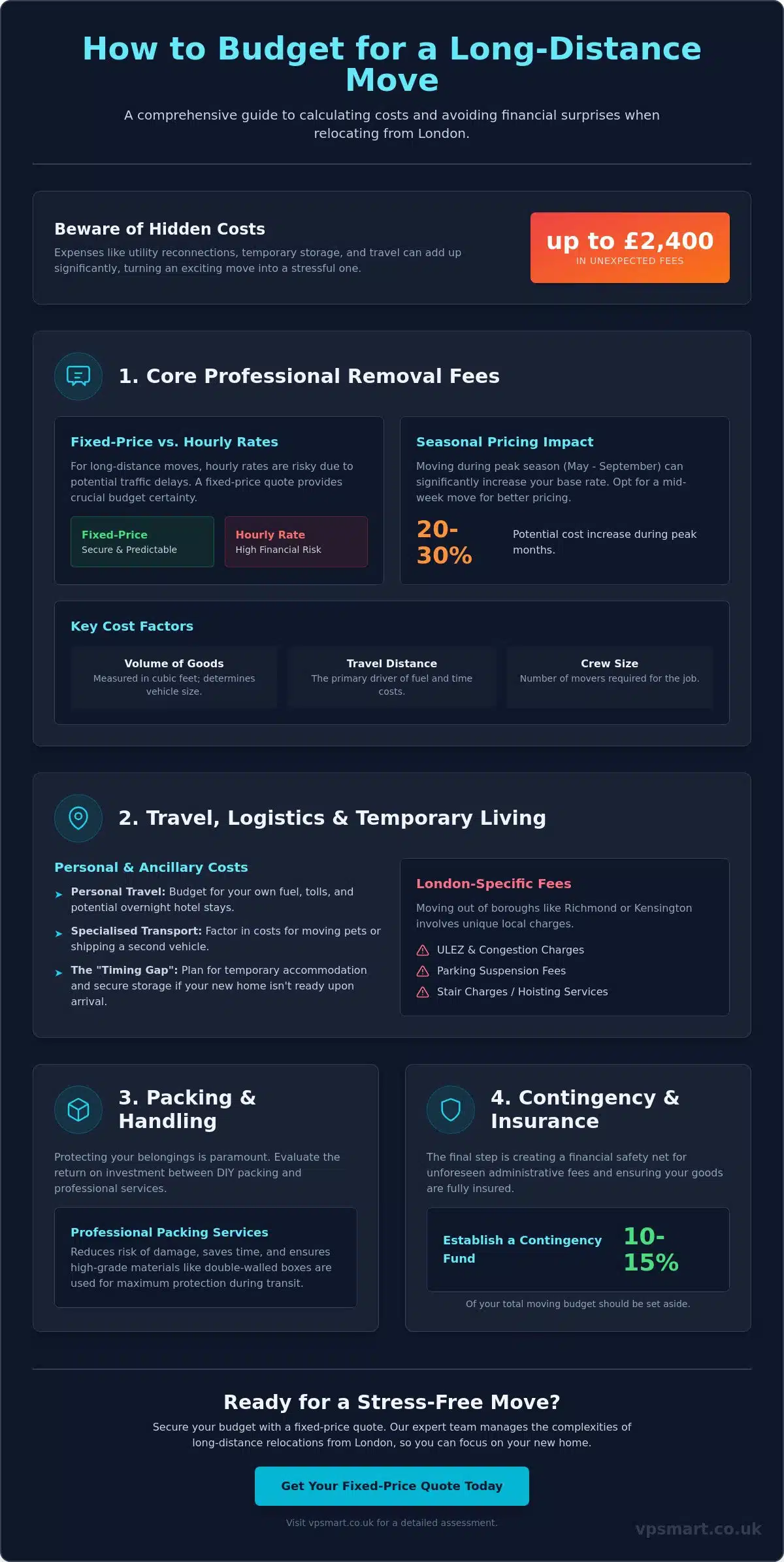
Did you know that “hidden costs” such as utility reconnections and temporary storage can add up to £2,400 to a typical family relocation? When you are planning a transition from a London borough like Richmond or Kensington to a new life further afield, these financial surprises can quickly turn excitement into anxiety.
We understand that the fear of “cowboy” movers adding surcharges on moving day is a significant concern for any modern homeowner. You want complete oversight of your finances and a clear understanding of why a fixed-price quote offers more security than an uncertain hourly rate during a cross-country journey.
This guide will teach you exactly how to budget for a long distance move by providing a comprehensive framework for calculating removal fees, travel expenses, and professional surcharges. We will walk you through a detailed checklist of every possible expense, ensuring you have the certainty needed for a stress-free transition to your new home.
Key Takeaways
- Learn how to budget for a long distance move by prioritising a detailed inventory list to secure a fixed-price quote and avoid unexpected surcharges.
- Account for the “timing gap” between London and your new destination by budgeting for travel expenses and secure storage if your move-in date doesn’t align with your departure.
- Evaluate the return on investment for professional packing services to reduce the risk of DIY damage and ensure your belongings are protected during transit.
- Establish a 10-15% contingency fund to handle administrative fees and ensure you have comprehensive insurance coverage for complete oversight of your relocation.
Calculating the Core Professional Removal Fees
The foundation of any successful relocation is understanding the technical variables that drive your primary quote. When moving from a London borough like Kingston or Richmond to a distant city, three primary metrics dictate the cost: the total volume of your belongings, the distance travelled, and the size of the crew required to manage the logistics safely. These professional moving cost factors are the baseline for your financial planning.
Understanding how to budget for a long distance move also requires an awareness of timing. Moving during peak seasons, typically between May and September, can increase base rates by 20% to 30%. Opting for a mid-week slot, such as a Tuesday or Wednesday, often allows for more competitive pricing and greater flexibility with your chosen team.
This timing is especially critical for those moving to university hubs, where securing high-quality student accommodation Lancaster early can save both time and money during the busy autumn intake.
Fixed-Price vs. Hourly Rates for Long Distance
While hourly rates might seem appealing for a quick transition across West London, they introduce significant financial risk for long-distance hauls. Unforeseeable delays on the M25 or M1 can cause costs to spiral without warning. A fixed-price relocation fee provides essential budget certainty by locking in a total cost before the first box is even lifted.
This approach protects you from “scope creep” and ensures that the price you agree upon after a professional site survey is the price you pay. It shifts the logistical burden onto the provider, giving you complete oversight and peace of mind during a complex transition.
Inventory Accuracy and Volume Assessment
An accurate inventory prevents mid-move price adjustments by ensuring the removal team arrives with the correct vehicle and equipment for your specific requirements.
Volume is measured in cubic feet, which directly influences the size of the vehicle and the subsequent fuel consumption. A 2-3 bedroom home typically requires a larger lorry and a more substantial fuel budget than a smaller apartment in North London. By providing a precise list of items, you empower your moving team to optimise the load, ensuring resource efficiency and a smoother journey to your new destination.
Accounting for Travel, Logistics, and Temporary Living
Planning your route involves more than just mapping a journey for a removals lorry. You must account for your own personal travel, including fuel, road tolls, and overnight stays for multi-day transitions. These common moving expenses often catch families off guard, so it’s vital to include them when learning how to budget for a long distance move.
Beyond the road, consider the logistics of your pets and secondary vehicles. Transporting a family dog or shipping a second car often requires specialised third-party services that sit outside your standard removal quote. Factoring these in early ensures your financial plan remains robust and realistic.
If you are using your own vehicle to transport fragile items or pets, specialized providers like Carcarpit offer custom-fit accessories that keep your car’s boot clean and undamaged throughout the journey.
Managing the Transition Period
What happens if your new home isn’t ready the moment you arrive? This “timing gap” requires a financial buffer for temporary accommodation, such as a hotel or short-term rental, and secure storage for your belongings. Rental fees for storage are typically calculated based on the volume of goods and the duration of the hold, so getting a clear quote early helps maintain complete oversight of your total spend.
London-Specific Logistical Fees
Moving out of London adds unique layers of complexity to your budget. You must factor in the Ultra Low Emission Zone (ULEZ) and Congestion Charges, alongside parking suspension fees in boroughs like Richmond or Kensington. These local regulations are strictly enforced and can lead to significant fines if ignored.
Many London apartments feature narrow stairwells or restricted access, which may trigger “stair charges” or necessitate specialised hoisting services to safely transport furniture through upper-floor windows. If you’re feeling overwhelmed by these moving parts, exploring professional house removals London services can help consolidate these logistical headaches into one manageable plan.
Budgeting for Packing and Specialized Handling
The integrity of your belongings during a long-haul journey depends heavily on the technical quality of your preparation. When determining how to budget for a long distance move, you must account for the physical protection of your assets. High-grade packing materials are essential; professional-grade double-walled boxes and acid-free tissue paper provide the structural oversight needed to prevent crushing during transit.
Beyond standard boxes, specialised crates for fine art or mirrors provide the necessary security for high-value items. Complex furniture disassembly and reassembly services are also vital for long-distance transitions. These tasks ensure that large wardrobes or bed frames are transported in their most stable form, reducing the risk of joint stress or structural damage over hundreds of miles of transit.
The ROI of Professional Packing
Professional packing significantly impacts the validity of your insurance coverage, as many providers won’t honour claims for breakages found in owner-packed boxes. While DIY packing might seem like a cost-saving measure, the time-cost often stretches over several weeks of domestic disruption. Investing in professional movers and packers allows you to maintain your daily routine while ensuring your household is prepared with technical precision in a fraction of the time.
High-Difficulty Item Handling
Certain possessions require more than just bubble wrap; they need specialised equipment like piano trolleys, tail-lifts, or hoists. If your inventory includes a grand or upright, you must budget for dedicated piano removals to ensure the instrument’s delicate internal mechanisms are protected from road vibration. This level of care is essential for maintaining the performance and longevity of high-value musical hardware.
Access surcharges can also apply if your property features narrow corridors or multiple flights of stairs. In London apartments, a “stair charge” is a standard consideration for properties without lift access, reflecting the increased labour and time required. To ensure every delicate item is handled with professional care, consider booking our comprehensive movers and packers for your upcoming relocation.
Finalising Your Budget with a Contingency Framework
The final stage of learning how to budget for a long distance move involves protecting your plan against the unpredictable. Professional relocation experts recommend establishing a 10-15% contingency fund specifically for “Day-of” surprises. In the UK, these often manifest as waiting time fees if there’s a delay in the key handover or administrative adjustments for last-minute route diversions on major motorways.
Your financial oversight should also extend to the property you are leaving behind. Budgeting for a professional end of tenancy cleaning is often a mandatory requirement to secure the full return of your rental deposit. For those moving further afield, choosing a partner with local heritage in London and Surrey ensures that international removals to Europe are managed with the technical precision required for complex cross-border logistics.
Insurance and Liability Coverage
It’s vital to distinguish between basic Goods in Transit insurance and comprehensive removals insurance. Standard liability usually covers your belongings up to a specific limit per item, which may not reflect their true replacement value. For complete peace of mind, comprehensive removals insurance provides “new-for-old” cover, ensuring that your domestic assets are protected against the stresses of a long-distance journey.
Before purchasing additional cover, check your existing home insurance policy. Some premium providers include relocation within their standard terms, which can provide a significant saving in your overall budget. Ensuring you have the right level of protection allows you to focus on the lived experience of your new home rather than the fear of financial loss.
The “First Week” Budget
Your financial planning shouldn’t end when the lorry is unloaded at your new destination. The first week in a new city often involves a cluster of setup fees, including utility connection charges and administrative costs for new council tax accounts. These small, functional expenses can accumulate quickly if not accounted for in your initial framework.
- Moving Day Essentials: Budget for a “moving day meal” and a substantial initial grocery shop to restock your new kitchen.
- Immediate Home Setup: Account for small hardware purchases or replacement bulbs that ensure your new environment is comfortable from the first night.
- Administrative Fees: Include costs for updating driving licences and redirecting post through the Royal Mail.
By following this structured approach to how to budget for a long distance move, you transform a complex logistical challenge into a well-managed transition. This level of oversight ensures your move is not just a change of address, but a step toward a future of effortless comfort.
Secure Your Financial Oversight and Comfort
You now possess a professional framework for managing the financial complexities of a cross-country transition. By prioritising fixed-price quotes and accounting for London-specific logistics like ULEZ charges and parking suspensions, you’ve gained complete oversight of your move. Understanding how to budget for a long distance move is the first step toward a future of effortless comfort in your new home. Don’t forget that a 10-15% contingency fund is your best defence against the unpredictable nature of relocation.
Achieving a stress-free move starts with choosing a partner who understands the technical demands of long-distance hauling. With over 10 years of London logistics experience and specialised expertise in piano removals and fine art handling, we provide the transparent, fixed-price relocation fees you need for total budget certainty. It’s time to move forward with confidence and clarity. Your new life awaits, and we are here to ensure the transition is as smooth as possible.
Request a Fixed-Price Long Distance Moving Quote
Frequently Asked Questions
How much does a long-distance move typically cost in the UK in 2026?
The cost of a long-distance move depends on the total volume of your belongings and the mileage between your London property and your new destination. While local moves often use hourly rates, long-distance transitions usually benefit from a fixed-price quote to ensure budget certainty. This approach protects you from traffic delays on major routes like the M25 or M4, providing a clear financial framework from the start.
Is it cheaper to hire a man and van or a full removal company for a long-distance move?
A man and van service can be more cost-effective for smaller apartment moves, but a full removal company provides better value for larger family homes. When you are learning how to budget for a long distance move, consider that professional teams include comprehensive insurance and specialised equipment as standard. This reduces the risk of expensive DIY breakages or the need for multiple trips, which can be costly over long distances.
What are the most common hidden costs in a long-distance moving budget?
The most frequent hidden expenses include London parking suspensions, Congestion Charges, and ULEZ fees for non-compliant vehicles. You should also account for “stair charges” in properties without lifts and potential storage fees if there is a delay in your key exchange. These small logistical details can add significant weight to your final bill if they aren’t identified during the initial site survey.
How far in advance should I book my movers to get the best price?
You should aim to book your removal service at least four to six weeks in advance to secure the most competitive rates. Moving mid-week or outside the peak summer season, which runs from May to September, can also help lower your core costs. Early booking allows for a more thorough site survey, which is essential for an accurate and transparent financial plan.
Do I need specialised insurance for a move from London to Europe?
International removals from London to Europe require comprehensive transit insurance that covers cross-border logistics and varying liability standards. Standard home insurance rarely provides sufficient protection for goods moving between different countries. A specialised policy ensures your belongings are covered for their full replacement value throughout the entire journey, including any sea or rail transit required to reach your new home.
Disclaimer
Some links in this article may be affiliate links, which means we may earn a small commission if you make a purchase through them, at no additional cost to you. We only recommend products or services we believe provide value to our readers.