
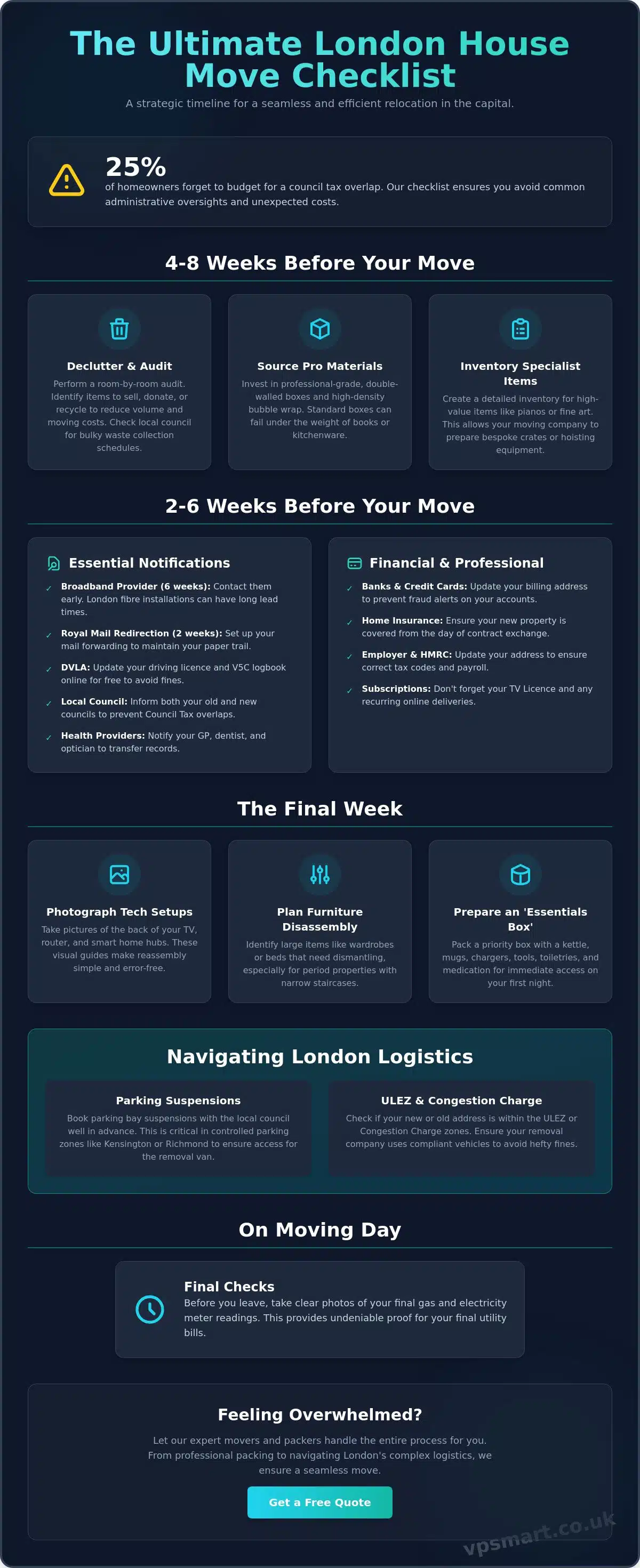
Did you know that 25% of homeowners forget to budget for council tax overlap, making it a critical item to include on any checklist for moving house? It’s a frustrating oversight that often occurs alongside the frantic search for a parking suspension in Kensington or the realisation that you haven’t updated your vehicle registration with the DVLA. We understand that the sheer volume of admin and logistics involved in a London move can feel overwhelming, especially when you’re balancing professional commitments with the physical demands of packing.
This guide provides the technical oversight and practical advice you need for a seamless transition into your new property. We’ve mapped out a precise timeline to help you manage everything from Royal Mail redirections to navigating ULEZ requirements and Congestion Charge zones with ease. By following this structured approach, you’ll maintain complete oversight of your relocation while ensuring your move into a new London home is as efficient as it is comfortable.
Key Takeaways
- Secure your administrative “paper trail” by learning exactly when and how to notify the DVLA and local councils to prevent service gaps or unexpected fines.
- Streamline your relocation with a room-by-room audit and a strategic timeline for sourcing professional-grade packing materials that protect your belongings.
- Gain complete oversight of London-specific logistics, from securing parking suspensions in boroughs like Kensington to managing ULEZ and Congestion Charge requirements.
- Use our expert checklist for moving house to execute a flawless moving day, ensuring no item is left behind and your new home setup begins with effortless comfort.
Essential Admin: Moving House Checklist of Who to Notify
Managing the process of moving involves more than just lifting boxes; it’s about maintaining your digital and legal identity. A comprehensive checklist for moving house ensures you don’t fall foul of regulatory deadlines. Start by updating your driving licence and vehicle registration (V5C) with the DVLA. It’s a free online service, but neglecting it can lead to significant fines. Similarly, notify your local council immediately. Whether you’re moving within South West London or crossing into a new borough like Kensington, updating your Council Tax records prevents billing overlaps.
Set up a Royal Mail Redirection service at least two weeks before your completion date. This preserves your “paper trail” while you settle in. Don’t forget to inform your GP, dentist, and private healthcare providers. Transferring records between surgeries can take time. Early notification ensures continuity of care for your family. This proactive approach is the foundation of a well-managed relocation.
Utilities and Digital Services
Efficiently managing your home environment depends on a seamless digital transition. Contact your broadband provider at least six weeks out. London fibre installations often involve complex street-level logistics and long lead times. On your moving morning, take clear photos of your gas and electricity meters. This technical oversight provides undeniable proof of usage for your final bill. Finally, update your TV Licence and recurring delivery subscriptions to avoid items arriving at your old doorstep.
Financial and Professional Institutions
Financial optimization requires your billing addresses to be perfectly synchronized. Notify your bank and credit card issuers to ensure fraud prevention filters aren’t triggered by a new postcode. You must also update your Home Insurance to cover your new property from the moment of contract exchange. It’s vital for your protection. Remember to inform your employer and HMRC of your new address to ensure your tax codes and payroll details remain accurate throughout your house removals in London.
Packing Strategy and Decluttering (4-8 Weeks Before)
Successful relocation begins with a rigorous room-by-room audit. By identifying items to sell, donate, or discard, you reduce the physical volume of your move and optimize your eventual quote. You can Find your local council to check for bulky waste collection schedules or recycling centres in boroughs like Richmond or Kingston. This initial decluttering phase is a vital component of any robust checklist for moving house, ensuring you only transport what truly adds value to your new lifestyle.
Once you’ve streamlined your belongings, secure professional-grade packing materials. Standard single-walled boxes often fail under the weight of books or kitchenware. Instead, utilize double-walled boxes and high-density bubble wrap to provide the structural integrity required for safe transit. For those with specialist requirements, such as piano removals or fine art handling, creating a detailed inventory ensures complete oversight and allows for the preparation of bespoke crates or hoisting equipment.
Technical Packing and Disassembly
Modern homes are filled with complex digital ecosystems. Before disconnecting your equipment, photograph the rear of your smart home hubs and entertainment systems. These visual guides make reassembly in your new property effortless and error-free. You should also identify large items that require professional furniture assembly services. Many period properties in Kensington or Chiswick feature narrow doorways and tight staircases that necessitate the careful dismantling of wardrobes and bed frames.
Finally, prepare an “Essentials Box” as a priority item on your checklist for moving house. Include a kettle, chargers, basic tools, and toiletries. Having these helpful household entities easily accessible ensures your first night is defined by comfort rather than a frantic search through sealed boxes. If you’re feeling overwhelmed by the volume of work, our professional movers and packers can manage the entire process for you.
Navigating London Logistics: Parking and Access
London logistics require a level of precision that standard guides often ignore. While you might be following official guidance on ending your tenancy, the physical reality of a narrow West London street demands early action. A vital item on your checklist for moving house is applying for parking suspensions. In boroughs like Richmond or Kensington, you typically need to submit these requests at least 10 working days in advance to secure space for the removal vehicle. This prevents expensive fines and ensures the team has a safe loading zone.
Beyond parking, you must account for the city’s environmental regulations. Verify if your route crosses into the Congestion Charge or Ultra Low Emission Zone (ULEZ) to avoid unexpected fees on moving day. Coordinate these details with your house removals London team to ensure your loading and unloading windows align with local traffic restrictions. Clear communication regarding time slots allows for a more predictable and efficient transition.
Technical oversight extends to the architecture of your new home. Measure all doorways and stairwells before moving day to identify potential bottlenecks. If a bulky sofa cannot navigate a tight Victorian stairwell, you may need to arrange a hoisting service to lift items through an upper-floor window. Identifying these needs early ensures your furniture arrives safely in its new environment. For a seamless experience, book our expert house removals in London today.
Managing Apartment and Flat Relocations
High-density living presents unique challenges for any checklist for moving house. Book the service lift with your building manager well in advance to avoid competing with other residents or deliveries. If you’re moving to a higher floor in a building without a lift, confirm whether “Stair Charges” apply to your quote. Finally, inform your neighbours of your moving date to minimize disruption on narrow residential roads and maintain a harmonious start in your new community.
Moving Day Execution and New Home Setup
On the morning of your relocation, technical precision is your greatest asset. Perform a final walkthrough of your old home, checking every loft space and fitted cupboard to ensure they’re entirely empty. It’s helpful to leave a “New Home” pack for the incoming residents. This should contain spare keys, appliance manuals, and local bin collection schedules, facilitating a smooth transition for the next family. For your own security in the new property, you might also consider London Locks – Locksmiths Keys and Fobs. to handle lock changes or provide additional security fobs. Maintaining a detailed checklist for moving house allows you to manage these final moments with confidence rather than chaos.
As the movers and packers arrive, use your pre-labelled box system to direct them efficiently to specific rooms. This ensures a logical flow and prevents a bottleneck of boxes in the hallway or entrance. Before the removal team departs, inspect large furniture items to confirm they’ve arrived in pristine condition. This immediate oversight ensures that any transit concerns are addressed while the professionals are still on-site, protecting your domestic well-being.
Settling Into Your New London Property
Domestic well-being in your new environment depends on knowing where your essential services are located. Locate the stopcock and fuse box immediately upon arrival so you can respond quickly to any technical needs. To secure your financial optimization and the return of your deposit, arrange a professional end of tenancy cleaning for your previous property. This ensures the space meets high standards for the next occupants while you focus on your new life.
Finally, verify that all keys function correctly for every external door and window. It’s a simple step that provides immediate emotional security and complete oversight of your new London home. To ensure your new residence remains in top condition, you might discover Smart Property Care Ltd for insights into property preservation and damp proofing. Once the hardware is checked and the boxes are in their correct rooms, you can begin the process of turning a new property into a comfortable, digitally integrated household.
Secure Your Seamless London Relocation
By mastering the administrative paper trail and solving complex street-level logistics, you transform a potentially stressful transition into a well-managed environment. From securing parking permits in Richmond to conducting a technical audit of your smart home setups, our checklist for moving house ensures no detail is overlooked. This structured approach provides the complete oversight necessary for a comfortable, efficient start in your new property.
Our professional team brings over 10 years of London logistics experience to every relocation, offering comprehensive insurance and transparent, fixed-price options. We specialise in the expert handling of pianos and delicate furniture, ensuring your most valued possessions are protected throughout the journey. Get a free, transparent quote for your London house move from VP Smart Removals and let us manage the technical complexities for you.
Your future of effortless comfort in a new London borough is just a few steps away. We’re here to ensure your move is as rewarding as the new lifestyle that awaits you.
Frequently Asked Questions
How far in advance should I book a removal company in London?
You should ideally book your removal company 4 to 6 weeks before your desired move date. London’s removals market is highly competitive, particularly for popular slots like Fridays or the final days of the month. Booking early gives you complete oversight of your timeline and ensures you secure a team with the specific technical expertise required for your property type.
Who is responsible for arranging parking suspensions during a move?
The homeowner or tenant is typically responsible for arranging parking suspensions with their local council. In boroughs such as Richmond or Kensington, you must apply at least 10 working days in advance to ensure the removal van has a legal space to load. While professional movers can offer guidance on local parking zones, the legal permit remains the resident’s responsibility.
What are the most common things people forget when moving house?
Homeowners frequently forget to budget for council tax overlap or update their vehicle registration with the DVLA. These oversights can lead to unexpected fines or billing errors that disrupt your financial optimization. Including these administrative tasks in your checklist for moving house ensures a smooth transition and maintains your oversight throughout the relocation process.
Do I need to notify my insurance company before I move?
Yes, you must notify your buildings insurance provider the moment you exchange contracts to ensure the new property is covered. For contents insurance, inform your provider at least 7 to 14 days before your move date. This technical step ensures your belongings are protected during transit and that your new home environment is secure from the moment you arrive.
How do I handle moving house with pets in a busy city like London?
It’s best to book your pets into a cattery or kennel or leave them with a trusted friend on moving day. London’s busy streets and the noise of a removal team can be distressing for animals. If they must stay with you, keep them in a quiet, empty room with familiar bedding until the loading process is complete to ensure their domestic well-being.
Disclaimer
Some links in this article may be affiliate links, which means we may earn a small commission if you make a purchase through them, at no additional cost to you. We only recommend products or services we believe provide value to our readers.