
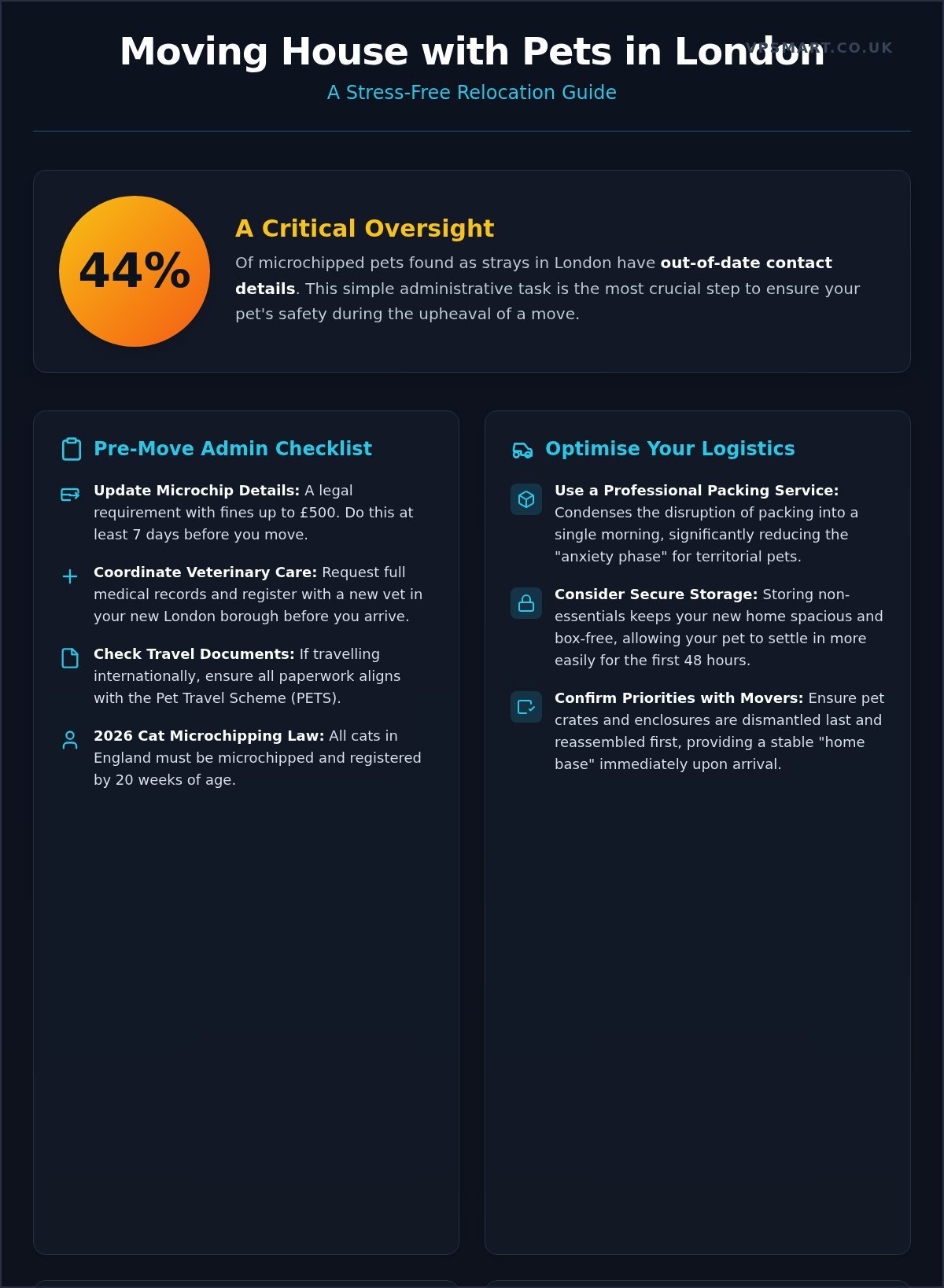
Did you know that nearly 44 percent of microchipped pets found as strays in London have out-of-date contact details? It’s a sobering statistic that highlights how easily administrative tasks can slip through the cracks during the upheaval of a relocation. We understand that moving house with pets london presents a unique set of hurdles, from navigating the new statutory rights under the Renters’ Rights Act 2025 to ensuring your dog or cat remains calm whilst the environment changes around them.
You likely feel that your pet’s well-being is just as important as the structural safety of your belongings. This expert guide provides the technical oversight and practical steps needed to ensure a stress-free transition for every member of your household. We promise to help you achieve a settled, happy pet on day one by coordinating your logistics with the same precision and care you apply to your professional life.
We will walk you through a clear timeline for legal microchip updates, explain how to utilise professional packing services to minimise domestic anxiety, and provide a checklist for settling into your new London borough with ease.
Key Takeaways
- Master the 2026 legal landscape for London pet owners, including mandatory microchip updates and your new statutory rights under the Renters’ Rights Act.
- Optimise your logistics by choosing a specialist for moving house with pets london who provides professional packing services to reduce the duration of home disruption.
- Navigate the capital’s transport network with ease by following TfL pet guidelines and avoiding busy interchanges during peak hours.
- Implement a ‘Safe Room’ strategy on moving day to ensure your pet remains secure and calm whilst the removals team handles your belongings.
- Establish domestic well-being quickly by prioritising the setup of your pet’s familiar area to create a sense of home amongst the boxes.
Pre-Move Preparation: The Pet Admin Checklist
Administrative oversight is the foundation of a successful relocation. Whilst packing boxes takes physical effort, managing your pet’s digital identity requires technical precision. When moving house with pets london, your first priority is updating the microchip registry. This small task ensures your pet is linked to your new address at least seven days before the move. Statistics from Battersea show that 44 percent of microchipped stray dogs have out-of-date details; don’t let your pet become a data error during the transition.
Updating these records is more than just a safety precaution; it’s a legal safeguard. Requesting a full copy of medical records and current prescriptions from your vet allows for a seamless handover to a new practice. If you are moving to the UK or planning future trips abroad, ensure your documentation aligns with the Pet Travel Scheme (PETS) to avoid administrative delays. Registering with a new vet in a borough like Richmond or Fulham before you arrive ensures immediate access to healthcare, which reduces the pressure on you during the first week.
The 2026 Microchipping Laws
The legal landscape for pet owners in 2026 is defined by strict accountability. It’s compulsory for all dogs to be microchipped by eight weeks of age, a regulation that has been in place since 2016. Failure to keep these details updated can result in a fine of up to £500. Moving house is the most common time for these records to lapse, which is why councils are now cross-referencing databases more frequently. By 2026, the compulsory microchipping deadline requires all cats in England to be microchipped and registered by the age of 20 weeks. This technical requirement ensures that the lived experience of your pet is protected by a robust digital record.
The Essential Pet Travel Kit
Domestic well-being depends on maintaining a sense of familiarity amongst the change. Pack a first-night bag that functions as a mobile comfort zone, containing their favourite food, bowls, and familiar-smelling bedding. Including calming aids like pheromone diffusers or vet-prescribed medication can significantly lower your pet’s cortisol levels during transit. Keep a recent physical photo of your pet and their vaccination card in your primary moving folder. This simple backup provides immediate oversight if you need to access emergency care or identify your pet in an unfamiliar London borough.
Choosing a Pet-Friendly London Removal Company
Selecting a partner for moving house with pets london requires more than just heavy lifting; it demands a strategic understanding of urban logistics. A professional house moving company in London with experience in high-density areas knows how to navigate parking suspensions and narrow stairwells with speed. This technical proficiency is vital because the faster the van is loaded, the sooner your pet can leave the transition environment. Speed isn’t just about efficiency; it’s about animal welfare.
Utilising secure storage in London provides an excellent buffer for those moving into smaller urban flats or staggered tenancies. By storing non-essential furniture, you can keep your new home box-free and spacious for your pet during the first 48 hours. Furniture disassembly is another technical specification to confirm with your team. Ensuring pet crates, cots, or enclosures are dismantled last and reassembled first provides a stable “home base” immediately upon arrival. A fixed-price quote ensures your budget remains predictable whilst you focus on your pet’s emotional needs.
The Benefits of a Professional Packing Service
Domestic disruption is often the primary trigger for pet anxiety. Professional movers and packers in London can condense a multi-day packing ordeal into a single, highly organised morning. This shorter window reduces the “anxiety phase” for territorial animals, particularly cats, who often become stressed by the sight of half-filled boxes. High-grade packing materials are also essential for specialised equipment. Using double-walled boxes and industrial-grade wrap protects glass terrariums or aquatic tanks, ensuring your pet’s habitat arrives in perfect structural condition.
Coordinating the Van and the Pet
Navigating the ‘London Factor’: Transport and Rentals
The “London Factor” introduces specific logistical variables that generic moving guides often overlook. For many residents, moving house with pets london doesn’t involve a private vehicle; it involves navigating the Transport for London (TfL) network. Pets travel free on TfL services, provided dogs are kept on a lead and smaller animals remain in secure carriers. However, technical oversight of your route is essential. Avoid high-traffic interchanges like King’s Cross or Waterloo during peak hours to protect your pet from sensory overload and physical crowding. Planning your journey for mid-morning or late evening ensures a quieter, cooler environment for your animal.
Beyond transport, the legal framework for renting in the capital has shifted significantly. As of May 2026, the Renters’ Rights Act has granted tenants a statutory right to request a pet. Landlords must respond in writing within 28 days and cannot unreasonably refuse. This regulatory change ensures that domestic well-being is no longer a luxury but a protected right for the millions of renters across the UK. Before you settle, check your new borough’s specific bylaws regarding “on-lead” zones in local parks, as these vary significantly between areas like Hackney and Wandsworth.
Pet-Friendly Living in the Capital
In highly competitive boroughs like Richmond, a “Pet CV” serves as a professional portfolio for your animal. Include training certifications, vaccination records, and references from previous landlords to establish trust. To ensure the full return of your deposit, prioritise a professional end-of-tenancy cleaning. This technical deep-clean removes allergens and traces of pet residency, satisfying the rigorous standards of London letting agents. Following expert tips for moving with your pet can help you manage these administrative layers whilst keeping your animal’s routine intact.
Urban Logistics: Parking and Access
The architectural reality of London flats often complicates the relocation of heavy pet equipment. If you are moving a large aquarium or a bespoke floor-to-ceiling scratching post, a hoisting service provides a high-tech solution for external access. This avoids the logistical bottleneck of narrow Victorian stairwells where a “Stair Charge” might otherwise apply. Securing a parking suspension through your local council is equally vital. It ensures the removals van can park directly outside your property, minimising the distance your pet needs to travel through busy London streets during the most vulnerable part of the move.
Moving Day Execution: The ‘Safe Room’ Strategy
Moving day represents the operational peak of your relocation. To ensure a calm environment whilst moving house with pets london, you must implement a ‘Safe Room’ strategy. This involves designating a specific area in your current home, ideally one that has already been cleared, where your pet can remain undisturbed by the technical noise of heavy lifting and van loading. Equipping this space with familiar bedding and fresh water allows your animal to remain in a stable state whilst the rest of the household is in flux.
Clear communication with your VP Smart Removals team is non-negotiable. Attach a large, declarative sign to the door reading ‘DO NOT ENTER – PET INSIDE’. This simple physical marker provides the crew with the necessary oversight to work efficiently whilst protecting your pet from accidental escapes. Only once the removal van is fully loaded and the environment has quietened should you move your pet to your own vehicle or a pre-booked pet taxi. This sequence ensures your pet spends the minimum amount of time in transit and avoids the peak of the domestic disruption.
Book a professional removals team for your pet-friendly move
Managing Stress During the Transition
Dogs often find the auditory environment of a move, including drills, tape dispensers, and heavy footfalls, to be sensory-overwhelming. Maintaining a regular feeding and walking schedule provides a structural anchor for their day, reinforcing a sense of normality amongst the chaos. For indoor cats, the risk of bolting through open doors is high during the loading phase. Keeping them in a secure carrier within their designated safe room prevents a domestic crisis and ensures they stay calm during the transition.
Safety Checks in the New Property
Upon arrival, your first technical task is to secure a new ‘Safe Room’ before the unloading begins. Use unwashed bedding and pheromone diffusers to establish an immediate sense of familiarity through scent. Conduct a thorough safety sweep of the premises. Inspect garden fences for gaps that might have been overlooked by previous tenants. In high-rise London apartments, checking window locks and balcony gaps is a vital safety specification. You should also scan for hidden hazards like pest control traps or the scent of previous residents’ pets, which can trigger territorial anxiety in your animal.
Settling In: The First Week in Your New London Home
The transition phase doesn’t end when the van departs; it merely shifts into a new gear. Once the removals team has safely deposited your belongings, your immediate priority is establishing a sense of domestic well-being for your animal. Unpack your pet’s primary area first, ensuring their familiar bed, bowls, and toys are in place before you tackle the kitchen or bedrooms. This creates a stable “home base” amongst the sea of cardboard. Moving house with pets london requires a controlled introduction to the new environment. Allow your pet to explore the house one room at a time to prevent sensory overload from new smells and unfamiliar layouts.
If you have moved to a new North London borough or a leafy South London neighbourhood, begin with short, frequent walks. These excursions allow your dog to map the local scents and boundaries without becoming overwhelmed by city noise. Be prepared for minor behavioural changes or “accidents” during this first week. Such lapses are a logical reaction to a major lifestyle shift and usually subside as the pet gains confidence. Patience and consistency are your most effective tools for helping them settle into their new rhythm.
Establishing a New Routine
Reliability is built on preparation. Your first technical task in the new borough should be identifying the nearest 24-hour emergency vet. Save their contact details and address in your phone immediately to ensure complete oversight of your pet’s health. Rebuilding your support network is equally vital. Locate local pet shops and grooming salons to replace the services you left behind. To accelerate your home’s organisation, utilise professional furniture assembly services. By getting your living spaces cleared and functional quickly, you reduce the visual and environmental stress that can keep a pet in a state of high alert.
Community Integration
London is a city of distinct villages, each with its own vibrant pet community. Join local pet owner Facebook groups for your specific borough to gain regional insights into the best dog-walking spots and trusted local sitters. Many London cafes and pubs are proudly pet-friendly, offering a perfect opportunity for socialisation once your animal feels secure in their new home. Taking these proactive steps ensures that your move is not just a change of address, but a successful integration into a new urban lifestyle. This visionary approach to relocation ensures your pet thrives in their new environment from the very first week.
Ready to move with your furry friends? Get a fixed-price removal quote from VP Smart Removals today.
Achieving a Seamless Transition for Your Household
Successful relocation is defined by the quality of your preparation and the technical oversight of your moving day logistics. By prioritising administrative compliance and implementing a strategic ‘Safe Room’ approach, you protect your pet’s well-being whilst navigating the complexities of the capital’s rental market. moving house with pets london doesn’t have to be an ordeal of high cortisol and domestic chaos; instead, it can be a well-managed transition that respects the needs of every family member.
Utilising expert packing services allows you to condense the disruption into a single morning, which significantly reduces the anxiety window for territorial animals. Managed storage solutions provide the necessary buffer for a staggered move, ensuring your new environment remains calm and box-free from the moment you arrive. We offer fixed-price relocation fees to give you complete budget certainty, allowing you to focus on the emotional needs of your pets rather than financial variables.
Plan your pet-friendly London move with VP Smart Removals
Your new life in London is just around the corner. With a pet-first strategy and a dependable service provider, you can look forward to a future of effortless comfort and a happy, settled pet from day one.
Frequently Asked Questions
How do I update my pet’s microchip for a London move?
You update your pet’s microchip by contacting your registered database provider, such as Petlog or Identibase, at least one week before your move. It’s a legal requirement in the UK to keep these details current. Failure to do so can result in a fine of up to £500. Keeping your digital records accurate ensures that local authorities can reunite you with your pet if they wander off in an unfamiliar London borough.
Can I take my dog on the London Underground when moving?
Yes, you can take your dog on the London Underground, buses, and Overground services free of charge. Dogs must remain on a lead at all times and are not permitted on seats. For safety reasons, you should use the stairs or a lift rather than an escalator. Planning your journey for off-peak times is a technical necessity to avoid the sensory stress of crowded interchanges like King’s Cross.
What is the best way to move a cat to a new house in London?
The best way to move a cat is to utilise a secure, well-ventilated carrier and the ‘Safe Room’ strategy. Place familiar bedding and a pheromone diffuser in the carrier to provide domestic comfort during transit. Once you arrive, keep your cat indoors for at least two to three weeks. This period allows them to establish a territorial scent before they explore the outdoor environment of their new London home.
Are there specific London councils with strict pet rules?
While the Renters’ Rights Act 2025 provides statutory protection for tenants, individual London councils enforce specific rules through Public Spaces Protection Orders (PSPOs). These orders often dictate where dogs must be kept on leads or are excluded entirely, such as in certain children’s play areas. You should check the official website of your specific borough, like Richmond or Hackney, to understand the local regulatory standards for pet owners in public spaces.
How do I find a pet-friendly removal company in London?
Finding a pet-friendly partner for moving house with pets london involves looking for companies that offer professional packing and furniture assembly. These services minimise the duration of household disruption, which is the primary trigger for animal anxiety. Seek out firms that provide fixed-price quotes to ensure budget certainty. A reliable mover will be happy to coordinate with your ‘Safe Room’ plan to ensure your pet remains undisturbed throughout the loading process.
Should I put my pet in a kennel or cattery on moving day?
Placing your pet in a kennel or cattery is often the most sensible choice if your animal is highly territorial or prone to stress. This removes them from the auditory chaos of moving day, including the noise of heavy lifting and van loading. Whilst it adds an extra logistical step, it ensures your pet remains in a professional care environment until your new home is organised and the ‘Safe Room’ is fully prepared for their arrival.
How long does it take for a dog to settle after moving house?
Most dogs take between one and three weeks to fully settle into a new environment, though this timeline varies by temperament. You can accelerate this process by maintaining a strict feeding and walking routine. Unpacking their familiar items immediately helps establish a sense of domestic well-being. If behavioural changes persist beyond the first month, consult your new local vet to ensure there are no underlying health issues triggered by the relocation stress.
What should I do if my pet goes missing during a move in London?
If your pet goes missing, you must immediately notify the local council dog warden, nearby veterinary practices, and animal shelters. Ensure your microchip database provider is aware so they can flag the pet as lost. Use local social media groups for your specific London borough to spread the word quickly. Having a recent photo and an updated microchip is your most effective technical safeguard for a successful recovery in a busy urban setting.
Disclaimer
Some links in this article may be affiliate links, which means we may earn a small commission if you make a purchase through them, at no additional cost to you. We only recommend products or services we believe provide value to our readers.