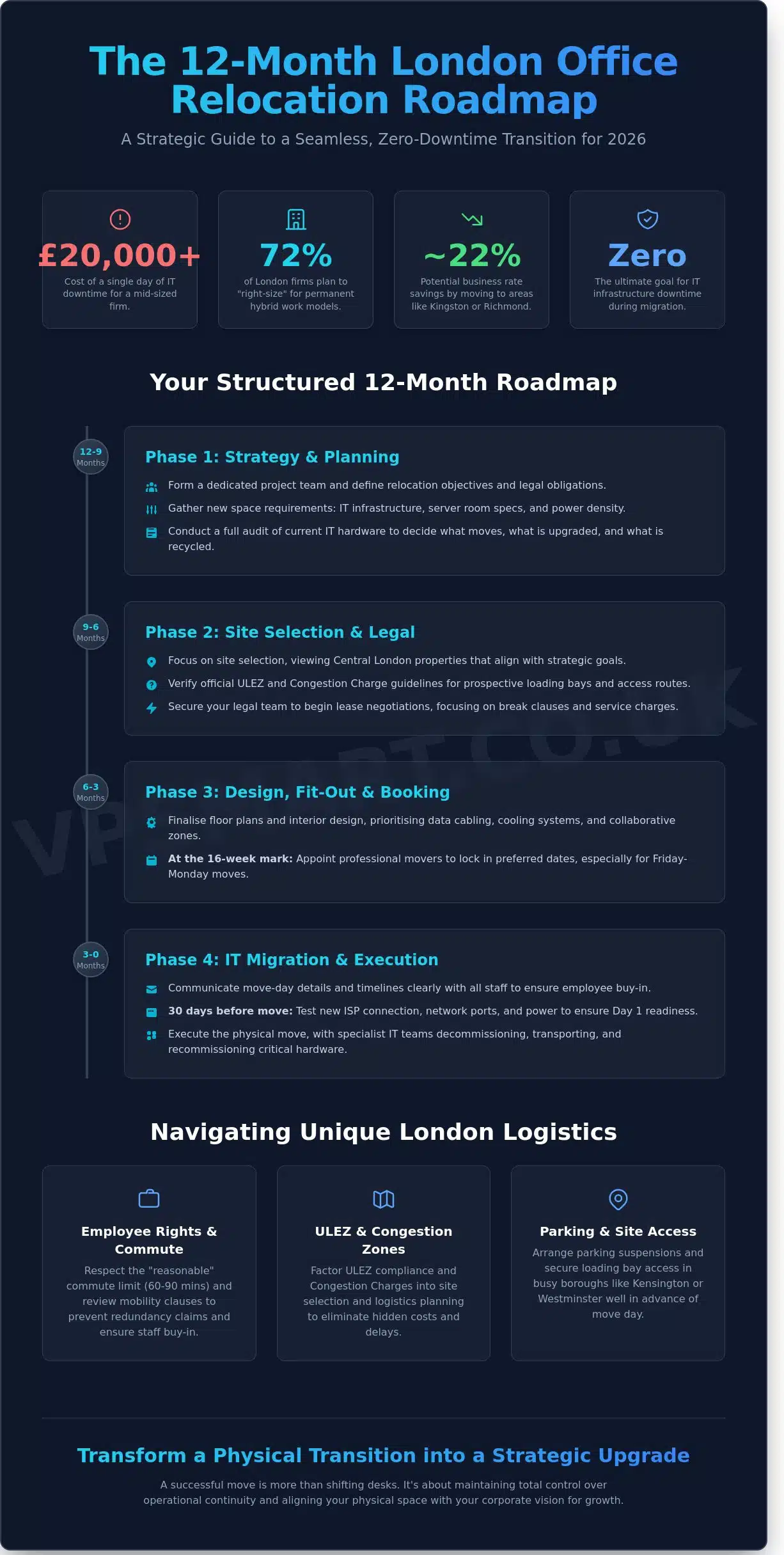
A single day of IT downtime during a London office relocation can cost a mid-sized firm upwards of £20,000 in lost productivity and missed opportunities. You’ve likely spent weeks worrying about the logistical nightmare of ULEZ charges, parking suspensions in Kensington, and the inevitable pushback from staff facing a longer commute. It is a stressful reality that many directors face when planning for 2026. We understand that moving your business is about more than just shifting desks; it’s about maintaining total control over your operational continuity.
This guide promises to help you master every stage of your transition, from navigating complex legal obligations to ensuring your high-tech infrastructure stays online throughout the move. We’ll provide a clear 12-month roadmap that eliminates hidden London costs and secures employee buy-in from day one. You’re about to discover how to transform a daunting physical transition into a seamless strategic upgrade for your entire organisation.
Key Takeaways
- Learn how to “right-size” your workspace for 2026, ensuring your London base supports hybrid work models while enhancing company culture.
- Follow a structured 12-month roadmap to master every phase of your office relocation, from initial team formation to final site selection.
- Navigate the unique logistical challenges of Central London, including ULEZ compliance and Congestion Charge management, for a delay-free move.
- Secure your business continuity with technical insights on achieving zero downtime during complex IT and infrastructure migrations.
- Discover how dedicated project management provides total control over your move, blending technical authority with practical London expertise.
Understanding Office Relocation: Strategic Goals and Legal Rights
An office relocation is far more than a simple logistical exercise of moving desks and chairs. It represents a calculated, strategic transition designed to refine company culture, slash operational overheads, or tap into the elite talent pools found in Central London. By mid-2026, data suggests that 72% of London firms plan to “right-size” their physical footprint to better accommodate permanent hybrid work models. This shift ensures that square footage isn’t wasted on empty workstations while providing high-specification collaborative zones that reflect a modern brand identity.
We view this transition as a “Smart Relocation.” This approach acts as an intelligent companion to your business evolution, much like how smart technology optimises a modern home for efficiency and comfort. When you align your physical environment with your corporate vision, you gain total control over your operational output. Gaining a deep understanding relocation services is the first step in ensuring your move supports long-term growth rather than just changing a postcode on a letterhead.
Employee Rights and the Mobility Clause
British employment law places significant weight on the mobility clause within a contract. This specific clause dictates whether you can legally require staff to move from an established site in North London to a new facility in Kensington. A request is generally deemed “reasonable” if the additional commute time doesn’t exceed 60 to 90 minutes each way. If a move significantly alters a commute or disrupts a worker’s childcare arrangements, you face genuine redundancy risks and potential constructive dismissal claims.
- Contractual Clarity: Review all contracts for specific geographic limits before announcing the move.
- Reasonable Distance: A move within Greater London is often considered reasonable, but moving from Surrey to East London may require formal consultation.
- Statutory Redundancy: If the new location isn’t a suitable alternative, employees may be entitled to redundancy pay based on their years of service.
Defining Your Relocation Objectives
Your primary driver might be achieving a prestigious West London address or accessing better digital infrastructure to support high-speed data transfers. Strategic relocation is the alignment of physical space with corporate vision. Use the move to re-energise your team culture post-2025 by creating “collision spaces” that spark innovation and spontaneous problem-solving. This isn’t just about a change of scenery; it’s about mastering your environment to drive productivity.
To ensure the move is a success, you must identify your core pillars of growth. For some, this means moving to areas like Kingston or Richmond to lower business rates by up to 22%. For others, it’s about finding a building with Lot 20 compliant heating and smart sensors to reduce carbon footprints. This level of precision ensures that your new office isn’t just a place to work, but a high-performing asset that delivers peace of mind and long-term savings.
The 12-Month Office Move Timeline: A Structured Roadmap
A successful office relocation requires a minimum lead time of 12 months to avoid operational downtime. Planning early allows you to maintain total control over every technical and logistical variable. This structured approach ensures your office relocation remains on track while protecting your high-value IT assets.
Phase 1 (Months 12-9): Your first step involves forming a dedicated project team. You’ll need to gather requirements for the new space, focusing on power density and server room specifications. Conduct a full audit of your current hardware to decide what moves and what gets recycled.
Phase 2 (Months 9-6): Shift your focus to site selection. When viewing Central London properties, check the official ULEZ guidelines to ensure your new loading bay doesn’t trigger daily charges for older service vehicles. Secure your legal team to begin lease negotiations early.
Phase 3 (Months 6-3): This is the design and fit-out stage. You should finalise floor plans that prioritise data cabling and cooling systems. At the 16-week mark, appoint your professional movers and packers to lock in your preferred dates, especially for busy Friday-to-Monday transitions.
Phase 4 (Months 3-0): The final countdown involves rigorous IT audits. Test your new ISP connection 30 days before the move. Execute the physical transition over a weekend to ensure your staff can log in on Monday morning without a hitch.
Stakeholder Engagement and Communication
Identify a “Move Champion” within your firm to lead the project. This person acts as the central point of contact between your board and the removal team. If your office has 50 or more employees, consult with unions and staff representatives early to reduce anxiety and secure buy-in.
Transparent communication prevents productivity drops. Use internal newsletters to provide monthly updates and launch a 30-day countdown on your company intranet. Providing clear instructions on how to pack personal pedestals ensures a sense of calm during the transition from Richmond to new offices in South West London.
Budgeting and Cost Control
Hidden costs can quickly erode your margins. Budget for dilapidations, which can range from £5 to £20 per square foot depending on your original lease terms. You must also account for transit insurance and service surcharges for out-of-hours work in areas like Kensington or North London.
Compare fixed-price project fees against hourly rates. Fixed fees offer more certainty for complex commercial moves involving server migrations. Always allocate a contingency fund of exactly 12.5% to cover unforeseen site issues, such as lift failures or parking permit delays. If you’re looking to streamline your costs while maintaining high standards, our expert team can help you plan a budget-friendly transition.
Navigating London Logistics: Parking, ULEZ, and Access
Moving sensitive IT infrastructure through London requires more than just a sturdy van; it demands a masterclass in urban navigation. The logistical hurdles of a office relocation vary significantly depending on your postcode. Central London moves often involve battling red routes and strict 30-minute loading windows. In contrast, South West London boroughs like Richmond or Wandsworth provide more physical space but present a labyrinth of residential parking restrictions. Our approach focuses on “Total Control,” ensuring every vehicle in the removal fleet is fully compliant with current regulations.
The Ultra Low Emission Zone (ULEZ) and the Congestion Charge are the first hurdles for any fleet. Every removal vehicle must meet Euro 6 diesel or Euro 4 petrol standards to avoid the £12.50 daily ULEZ fee. If your new premises sit within the Congestion Charge zone, you’ll face an additional £15 per vehicle per day. We manage these payments centrally to prevent administrative delays. While managing the physical move, it’s also vital to consider the legal framework. Employers should review employee rights during office relocation to ensure the transition is as smooth for the staff as it is for the hardware.
Permits and Local Authority Liaison
Securing the right to park outside your building is often the most time-consuming part of the planning phase. Most London councils, including the City of London and Westminster, require a minimum of 10 to 14 working days’ notice for parking suspensions. If you miss this window, you risk heavy fines or, worse, having the moving vehicles towed. We handle these applications on your behalf, liaising directly with local authorities to secure the necessary bays.
- Parking Suspensions: Essential for keeping the space outside your entrance clear for loading.
- Yellow Line Dispensations: Necessary when no designated parking bays are available near the building.
- Skip Permits: If your office relocation involves clearing out old hardware or furniture, a skip permit is required for any container placed on a public highway.
Specialised Handling for Complex London Sites
London’s architecture is a mix of ultra-modern glass towers and narrow, Grade II listed buildings. This diversity creates unique access challenges. Many older buildings in Kensington or the City don’t have lifts large enough for modern server racks or boardroom tables. In these scenarios, we often utilise a hoisting service to safely transport heavy items through external windows. It’s a precise operation that eliminates the risk of damage to narrow internal staircases.
You should also account for “stair charges” in your moving budget. If a building lacks a functional lift, moving heavy IT equipment up multiple flights of stairs can increase labour costs by 15% to 20%. This is why a pre-move site survey is non-negotiable. It allows us to identify these bottlenecks early and ensure the team understands the office removals London nuances specific to your site. By preparing for these “high-difficulty” access points, we transform a potentially stressful day into a seamless transition for your business.
IT Relocation and Infrastructure: Ensuring Zero Downtime
Your IT infrastructure is the digital nervous system of your business. If the servers don’t wake up on Monday morning, your entire office relocation is a failure. Technical downtime is expensive; research shows that unplanned outages cost UK firms an average of £3,600 per minute. Precision is your best friend during this transition. You aren’t just moving boxes; you’re migrating a complex ecosystem of data and connectivity.
Start with a 100% hardware audit. Document every serial number, port mapping, and peripheral device. 88% of connectivity issues after a move stem from undocumented cabling or missing components. You should adopt the “Last Out, First In” rule for your critical infrastructure. Your core switches and primary servers must stay live until the final moment at the old site. They should then be the first items commissioned at the new London centre to ensure the network is ready before staff arrive.
Coordinate with your Internet Service Provider (ISP) at least 90 days in advance. High-speed fibre installations in areas like Central London or Canary Wharf often face delays due to wayleave agreements or street works. Ensure your line is tested and live at least 72 hours before the move begins. This gives you a vital window to troubleshoot any firewall or routing issues before the physical hardware arrives.
Safe Handling of Delicate Electronics
Standard cardboard boxes don’t provide the protection needed for a £20,000 server rack. Use anti-static bubble wrap and bespoke foam-lined crates to prevent electrostatic discharge, which can silently fry sensitive components. Effective cable management is equally vital. Use colour-coded labels and digital mapping to ensure rapid reassembly at the new desks. Professional packing box delivery London services provide technical-grade materials specifically designed to shield tech assets from the vibrations of a transit van on London’s uneven roads.
The Weekend Move Strategy
The 60-hour window from Friday 6:00 PM to Monday 6:00 AM is the gold standard for a successful office relocation. This schedule provides a necessary buffer for technical troubleshooting. You should set aside “snagging” hours starting at 1:00 PM on Sunday. This is the time to test every VoIP phone, printer, and Wi-Fi access point in the building. It allows your IT team to fix minor glitches in a low-pressure environment.
Ensuring technical support is physically on-site for the 8:00 AM “Go Live” on Monday morning is a non-negotiable requirement. Even the best-planned moves can encounter “Day One” gremlins like forgotten passwords or IP conflicts. Having an expert present provides your team with peace of mind and keeps your productivity levels high from the moment the first kettle is boiled. This structured approach transforms a high-stress technical migration into a seamless transition for your workforce.
Achieve total control over your smart office setup with our expert technical relocation guidance.
Executing the Move with VP Smart Removals
Executing a successful office relocation requires more than just heavy lifting. It demands a fusion of technical precision and local intelligence. At VP Smart – Removals London, we call this “Visionary Pragmatism.” This philosophy ensures your high-value IT infrastructure is handled with the same care as a bespoke smart home installation. We bridge the gap between industrial logistics and the personal touch of a premium home service provider.
Every commercial client receives a dedicated Project Manager. This specialist acts as your single point of contact, managing the 15-point checklist required for a seamless transition. They oversee everything from cable management to the final positioning of server racks. This focused approach eliminates the communication gaps that often lead to technical delays, ensuring your team is back online within the agreed timeframe.
Our commitment to British standards, specifically BS EN 12522, provides the foundation for our service quality. We don’t believe in estimates that shift mid-move. Instead, we provide a transparent, fixed-price quoting model. You’ll receive a detailed breakdown of costs, ensuring 100% budget certainty from the start. Our post-move support is equally robust, offering expert furniture reassembly and secure storage services London firms use to manage their surplus assets during transitions.
- Fixed-Price Guarantee: No hidden fees or unexpected surcharges on moving day.
- Dedicated Oversight: One Project Manager assigned to your move from start to finish.
- Technical Expertise: Safe handling of Lot 20 compliant hardware and sensitive electronics.
- Comprehensive Support: Full reassembly of modular workstations and ergonomic seating.
Why a London Specialist Matters
Navigating the logistical labyrinth of West London and Central London requires specific expertise. We’ve managed transitions in restricted zones like Soho and the City, where narrow access and strict Red Route parking permits can stall less experienced teams. Our drivers understand the 24/7 rhythm of the capital, planning routes that avoid peak congestion to keep your move on schedule.
Our crew treats every item with surgical care. Whether it’s a concert-grade office piano or a £20,000 piece of boardroom art, we apply our “Total Control” signature to the process. This means using specialised packing materials and climate-controlled transit options for high-value assets. You’ll stay informed at every stage of the journey, giving you the peace of mind that your business equipment is in safe, professional hands.
Your Next Steps to a Stress-Free Move
The journey to a smarter workspace begins with a comprehensive site survey. One of our specialists will visit your current premises to assess access points, lift capacities, and the volume of IT hardware. This allows us to provide an accurate, no-obligation project quote tailored to your specific office relocation needs. It’s the most efficient way to ensure your move is scaled correctly from day one.
To prepare for our visit, we recommend drafting a preliminary inventory list. Identifying your most critical technical assets early helps us prioritise the order of transit, ensuring your core servers and network hubs are the first things set up in the new office. Our team is ready to transform your logistical challenges into a streamlined experience of comfort and efficiency. Transform your office move with VP Smart – Removals London today and take total control of your business transition.
Master Your 2026 London Move with Total Control
Relocating a London business in 2026 requires more than just shifting furniture. You need a structured 12-month roadmap to navigate strict ULEZ regulations and complex parking permits across the capital. Managing your IT infrastructure is equally vital to ensure your team maintains zero downtime throughout the entire transition.
Your office relocation doesn’t have to be a source of corporate anxiety. With over 10 years of London expertise, VP Smart Removals provides the technical authority needed for complex hoisting and specialised IT handling. We eliminate financial uncertainty by offering transparent, fixed-price project fees that keep your relocation budget on track from day one.
It’s time to transform your workspace into an efficient, smart environment that supports your future growth. Our team is ready to help you master every detail of your move with precision and reliability. Get a Fixed-Price Office Relocation Quote and secure a seamless transition for your business today.
Frequently Asked Questions
How much does an office relocation in London typically cost?
An office relocation for a small 10-person team in London typically costs between £1,500 and £3,000. For larger firms with 50 or more staff, budgets often range from £5,000 to £12,000 depending on the volume of IT equipment. These figures ensure you maintain total control over your overheads while benefiting from a seamless, professional transition.
How far in advance should I book an office removal company?
You should book your removal specialist at least 8 to 12 weeks before your intended move date. Central London logistics require 3 weeks of lead time just to secure necessary parking suspensions and permits from local councils. Early booking allows us to master the technical details of your site, ensuring your smart technology is handled with precision.
What is a mobility clause and how does it affect my employees during a move?
A mobility clause is a contractual term that allows an employer to change an employee’s place of work within a reasonable distance. During an office relocation, this clause usually applies to moves within a 25-mile radius of the original site. It’s a pragmatic tool that helps businesses transform their operations while maintaining British standards of employment fairness.
Can you handle IT equipment and server relocation safely?
We use anti-static crates and GPS-tracked vehicles to move sensitive servers and IT infrastructure with absolute safety. Our team understands the technical requirements of Lot 20 compliance and high-end hardware, treating your servers as intelligent companions to your business. This specialist approach provides peace of mind that your data remains secure and your systems stay online.
Do we need to pack our own office desks and files?
You don’t need to pack a single item because our team provides a comprehensive packing service for all desks, files, and hardware. We use industrial-grade materials and intuitive labelling systems to ensure every document is easily located in your new space. This allows your staff to focus on their work while we handle the heavy lifting and technical organisation.
What happens if our new office is not ready on the moving date?
We offer secure, climate-controlled storage solutions in South West London and Surrey if your new premises face a delay. Your equipment is monitored 24/7 in a protected environment until your new office is ready for a precision setup. This flexible service ensures your assets are safe and your business continuity is never compromised.
Are you insured for commercial relocations in Central London?
Our relocation services are backed by £10 million in Public Liability insurance and £50,000 in Goods in Transit coverage per vehicle. These high indemnity levels meet the strict requirements of major Central London landlords and commercial estates. It’s a mark of our UK-based expertise and our commitment to providing a dependable, low-risk service for every client.