
Most homeowners believe a layer of bubble wrap is a sufficient safety net, but without the correct structural technique, your contents insurance might be as fragile as your heirloom china. Moving house is one of life’s most significant transitions, and the anxiety of hearing a sharp “clink” from a sealed box is a stress nobody needs. You’ve spent years curating a home filled with sentimental treasures and high-value tech, so it’s only natural to feel overwhelmed by the logistics of their protection.
We understand that true peace of mind comes from complete oversight of your environment. This guide provides the technical authority you need to master how to pack fragile items for moving, ensuring your belongings arrive in pristine condition whilst keeping your insurance coverage fully intact. By adopting professional-grade standards, you can transform a chaotic packing process into a streamlined, secure operation that protects your financial and emotional investments.
We’ll walk you through the essential materials that provide genuine impact resistance, the physics of internal cushioning, and the systematic labelling methods used by expert removal teams. From delicate glassware to complex electronics, you’ll learn how to build a protective system that guarantees your most precious items are handled with the care they deserve, ensuring a smooth transition to your new home.
Key Takeaways
- Discover why double-walled corrugated boxes and anti-static materials are essential for providing the structural integrity needed to protect high-value electronics and glassware.
- Master professional techniques for how to pack fragile items for moving, including the “Burrito Method” for ceramics and creating shock-absorber bases to neutralise transit vibrations.
- Learn the critical orientation rules for delicate belongings, such as why plates must be packed on their edges rather than flat to avoid structural failure.
- Understand the “Packed by Owner” (PBO) insurance clause and how following professional standards helps ensure your contents insurance remains valid and enforceable.
- Gain insight into navigating complex London relocations, including when to deploy specialised hoisting services for pianos or glass-topped furniture.
Essential Packing Materials for Delicate Belongings
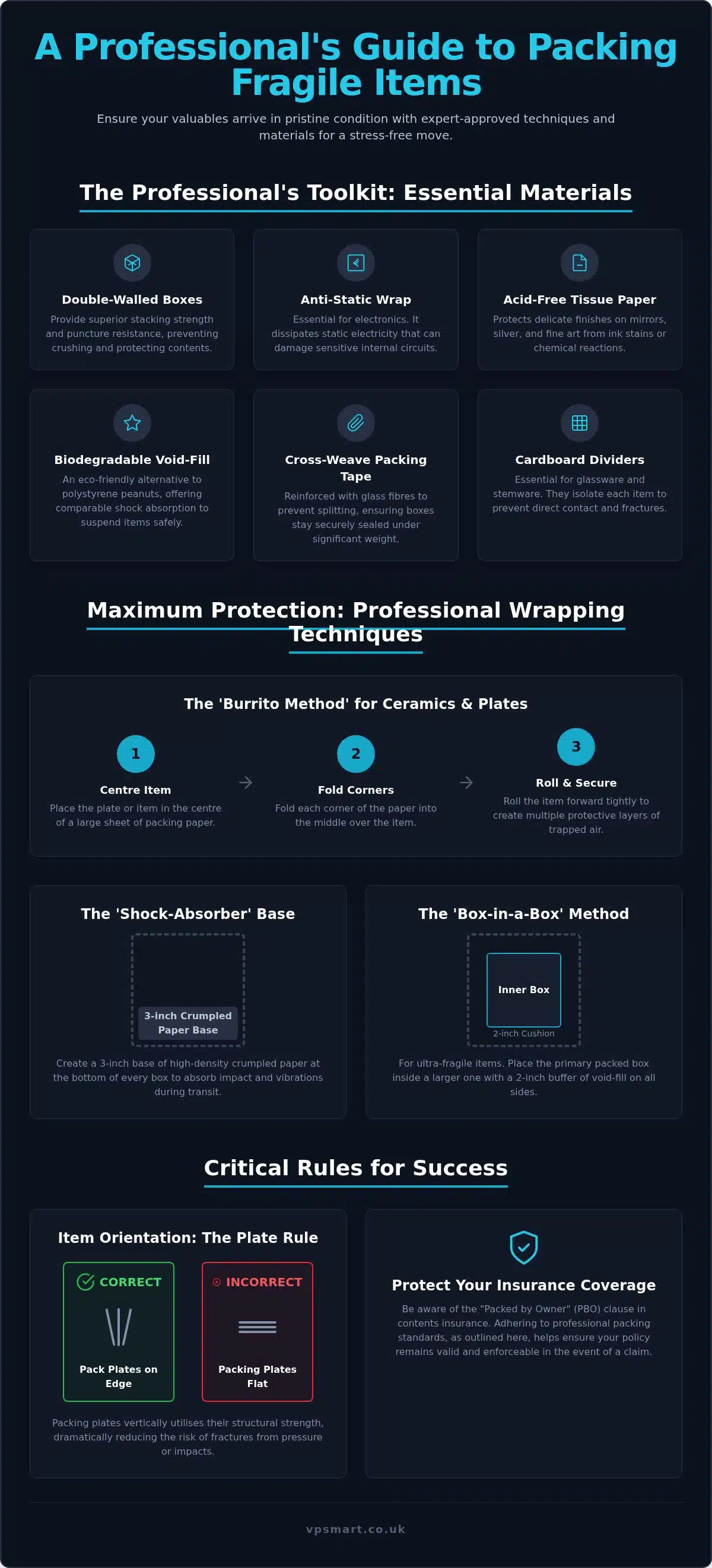
Securing your valuables starts with a professional-grade inventory. Standard cardboard often fails under the pressure of a removal van; this is why double-walled corrugated boxes are non-negotiable. These boxes feature two layers of fluting that provide superior stacking strength and puncture resistance. This technical specification ensures that the box at the bottom of a stack won’t collapse, protecting the delicate contents inside from being crushed. Understanding the technical requirements of your supplies is the foundation of learning how to pack fragile items for moving successfully.
For electronics, standard bubble wrap can generate static electricity that damages internal circuits. Use anti-static wrap instead; it’s chemically treated to dissipate charges, keeping your high-end tech safe. When handling silver or mirrors with delicate finishes, avoid standard newsprint which can leave ink stains. Acid-free tissue paper is the professional choice here, as it won’t tarnish metal or react with chemical coatings over time. These small adjustments in material choice provide a future of effortless comfort when you begin unboxing in your new home.
Traditional polystyrene packing peanuts provide excellent cushioning, but they’re often messy and environmentally taxing. Modern biodegradable void-fillers, made from starch-based materials, offer comparable shock absorption whilst dissolving easily in water. They provide the same “suspension” for your items without the ecological footprint. This logical approach to sustainability ensures your move is efficient without being wasteful.
Choosing the Right Boxes and Tape
Reliability matters in a busy city move. Don’t rely on second-hand supermarket boxes for your breakables. These are often weakened by moisture or previous use, making them prone to structural failure. Instead, invest in heavy-duty “cross-weave” packing tape. This tape contains reinforced glass fibres that prevent splitting, ensuring your boxes stay sealed even under significant weight. Remember the golden rule of sizing: use smaller boxes for heavy glass and china. Smaller volumes prevent items from shifting too much, which is a primary cause of breakage during transit.
Specialist Cushioning Supplies
Organisation is your best defence against damage. Corrugated cardboard dividers are essential for stemware, as they isolate each glass and prevent “clinking” that leads to fractures. For bespoke protection of high-value tech, foam inserts can be cut to fit, providing a snug environment that absorbs every vibration. If you’re unsure where to source these items, you can order professional packing materials for delivery directly to your door. This oversight of your packing inventory is the first step in mastering how to pack fragile items for moving like a professional.
Professional Wrapping Techniques for Maximum Protection
Physics dictates the outcome of every relocation. When you master how to pack fragile items for moving, you’re essentially managing kinetic energy. The most effective way to protect ceramics is the “Burrito Method”. Place your plate in the centre of a large sheet of acid-free paper, fold each corner into the middle, and roll the item forward. This creates multiple layers of trapped air and paper that act as a bespoke cushion, absorbing energy before it reaches the ceramic surface. Every individual piece requires its own wrapping; stacking bare plates is a recipe for hairline fractures.
Structural integrity depends on what lies beneath your belongings. Before placing a single item into a box, you must create a “shock-absorber” base. Use high-density crumpled packing paper to build a consistent 3-inch nest at the bottom of every container. This suspension system ensures that if a box is set down abruptly, the impact is dispersed through the paper rather than transferred to your glassware. For ultra-fragile goods like mirrors or fine art, we recommend the “Box-within-a-Box” technique. Pack the item securely in a primary box, then place that container inside a larger one with a two-inch buffer of void-fill on all sides. This double-layer defence is the gold standard for high-value protection.
Eliminating movement is your final objective. A perfectly packed box should pass a gentle “shake test” with zero internal rattling. If you feel any shifting, add more crumpled paper to the corners and gaps. This total oversight of the internal environment ensures that your belongings remain stationary regardless of the van’s movements. If this level of technical detail feels daunting, our professional packing services can manage the entire process for you, providing the ultimate safety net for your household treasures.
The Layering System
Efficiency in packing follows a logical hierarchy. Start with a 3-inch cushion of padding at the base to neutralise vibrations from the road. Always place the heaviest, sturdiest items at the bottom of the stack to prevent them from crushing lighter pieces below. As you build upwards, insert horizontal cardboard dividers between each layer. This creates a series of internal “shelves” that distribute weight evenly across the box’s structure rather than concentrating it on the items at the bottom.
Sealing and Labelling for Safety
A box is only as strong as its seal. Use the “H-taping” method by applying tape across the main seam and then along the side edges to create an “H” shape. This reinforces the structural corners where boxes are most likely to split. Whilst “Fragile” stickers are helpful, directional “This Way Up” arrows are more important for items like stemware or electronics. Organise your boxes by room and weight, ensuring that delicate containers are never positioned where heavy crates could be stacked on top of them during transit.
How to Pack Specific Fragile Items: From China to Electronics
Every category of fragile item requires a bespoke strategy to neutralise specific risks. When learning how to pack fragile items for moving, it’s vital to understand that plates are structurally stronger when positioned on their edges. Stacking them flat concentrates weight on the centre of the bottom plate, often leading to a catastrophic failure. By standing them vertically, you utilise the natural strength of the rim to support the load. Similarly, wine glasses are most vulnerable at the stem. You must wrap the stem first with extra padding to match the diameter of the bowl before wrapping the entire glass, creating a uniform cylinder that resists crushing forces.
For large mirrors and glass-fronted frames, apply a large “X” of masking tape across the surface. This doesn’t prevent breakage, but it does ensure that if the glass cracks, the shards remain held in place, preventing further damage to the frame or injury to the handler. If you’ve lost the original packaging for your flat-screen TV, don’t worry. Use a heavy-duty telescopic box combined with foam corner protectors to ensure the screen remains suspended and untouched by the outer cardboard wall. This technical approach ensures your lifestyle remains uninterrupted by avoidable accidents.
To ensure your digital lifestyle remains uninterrupted, if you discover that any of your mobile devices require a screen or battery fix before they are packed, you can visit iRepairMan London for specialised repair services that ensure your tech is ready for the move.
Kitchenware and Fine China
Nesting bowls is a space-efficient technique, but it only works if you place a layer of paper between every single item to prevent friction. Without this barrier, the vibration of the removal van can cause the glaze to rub away. Use cardboard sleeves for every individual glass to provide a rigid outer shell that absorbs lateral pressure. For teapots and vases, fill the hollow internal spaces with crumpled acid-free tissue. This internal support prevents the delicate handles or spouts from snapping under external pressure, maintaining the integrity of your collection.
High-Tech and IT Equipment
Modern home offices contain sensitive hardware that requires specialised oversight. Always remove cables and batteries before packing; this prevents port damage and potential chemical leaks during transit. Sensitive components like motherboards or external drives must be encased in anti-static wrap to prevent electrostatic discharge from damaging the circuitry. For those managing more complex setups, our safe office and IT relocation services provide the technical expertise needed to transport high-end equipment securely, ensuring your digital lifestyle transitions effortlessly to your new London address.
Understanding Risk: Packing Quality and Contents Insurance
Mastering how to pack fragile items for moving is a technical skill, but it’s also a vital financial safeguard. Most standard home insurance policies provide limited coverage during a relocation. You’ll often encounter the “Packed by Owner” (PBO) clause in your policy documents. This specific term means that if you pack the boxes yourself, the insurer usually won’t pay out for breakage unless there’s evidence of catastrophic vehicle damage. They assume any internal damage is the result of poor technique rather than transit conditions. This creates a significant liability gap for the modern homeowner who values their domestic well-being.
You should also distinguish between your standard policy and “Goods in Transit” insurance. Whilst your home contents cover might protect against theft, it rarely covers accidental damage whilst items are being handled between properties. Professional removals insurance is a specialised product designed for this specific transition. Without professional oversight, proving the cause of a crack in a porcelain heirloom or a shattered screen becomes nearly impossible. Ensuring your insurance remains valid is just as important as the physical wrapping itself.
The Benefits of Professional Packing for Insurance
When you hire experts, the burden of liability shifts from your shoulders to the service provider. Professional movers take on the responsibility for every item they wrap and box. This transition of risk is a key benefit of choosing a professional service, providing the reassurance that your “favourite” heirlooms are protected by more than just bubble wrap. Insurers frequently require professional packing for high-value items exceeding £1,000 to maintain the validity of a claim. This professional certification can sometimes even lead to lower premiums because the risk of a claim is statistically reduced.
Learn about our professional movers and packers
Documenting Your Belongings
Before a single sheet of paper is wrapped, you must establish a baseline. Take clear, high-resolution “before” photos of all electronics, antiques, and glassware. Write a single sentence defining the condition of high-value items, noting any existing scratches or marks before they enter a box. This documentation provides the transparency needed to resolve any potential disputes with insurers. If you decide to manage the packing yourself, keep all receipts for high-quality, double-walled boxes. Proving that you used professional-grade materials demonstrates that you took reasonable care, which is essential when learning how to pack fragile items for moving to a professional standard.
Why Professional Packing is the Smart Choice for London Moves
London’s unique architecture presents physical challenges that generic guides rarely address. Whilst you now understand the mechanics of how to pack fragile items for moving, the environment of a Victorian terrace or a modern high-rise apartment requires more than just internal cushioning. Navigating narrow, winding stairwells with oversized mirrors or delicate antiques is a high-stakes operation. Professional teams bring the technical expertise to calculate clearance margins and apply external protective layers that safeguard both your property’s walls and your belongings during the most difficult manoeuvres.
When internal access is physically impossible, a hoisting service becomes the logical solution for glass-topped tables or heavy furniture. Instead of risking a vertical carry through tight corners, specialist equipment allows for the external transit of items directly to upper-floor balconies or windows. This level of oversight ensures that even the most awkward items remain secure throughout the journey. The time-saving value is also immense; a professional team can typically organise and pack a three-bedroom house in a single day, a task that often takes homeowners weeks of stressful evenings. VP Smart Removals manages this “last mile” of fragile delivery with precision, ensuring that the final transition into your new home is as smooth as the packing phase.
Specialist Handling for Pianos and Fine Art
Relocating a piano through a London apartment block requires specific hardware, including heavy-duty trolleys and bespoke protective covers that neutralise the risk of impact. These instruments are helpful household entities that require stability; it’s not just about weight, but about protecting the delicate internal mechanisms from vibration. For sensitive antiques, we consider climate-controlled factors to prevent wood from warping or finishes from cracking during the move. Our London house removals for every borough provide the specialised care needed to manage these complex assets with technical authority.
Stress Reduction and Oversight
The most significant benefit of a managed move is the total removal of “breakage anxiety”. By shifting the mental burden to experts, you regain control over your moving experience. A professional system ensures complete oversight of your inventory from the moment an item is wrapped until it’s safely positioned in your new living room. This pragmatic approach to relocation allows you to focus on the excitement of your new home rather than the fear of loss. Mastery of how to pack fragile items for moving is a standard we uphold so you don’t have to, ensuring your belongings arrive exactly as you remember them.
Get a fixed-price quote for your move and packing service
Achieving Total Oversight of Your Relocation
Transitioning to a new property should be a milestone of excitement rather than an exercise in damage control. By mastering how to pack fragile items for moving, you shift from reactive anxiety to proactive oversight. You’ve learnt that structural integrity relies on the quality of your double-walled materials and the precision of shock-absorbing bases. These technical standards don’t just protect your belongings; they safeguard the validity of your contents insurance, ensuring your financial and emotional investments remain secure.
Whether you’re navigating the narrow stairwells of Fulham or coordinating a complex relocation in Richmond or Wandsworth, professional expertise provides the ultimate safety net. We specialise in the expert handling of pianos and delicate antiques, offering fixed-price quotes for total budget certainty. Our managed service allows you to focus on the lived experience of your new environment whilst we handle the technical logistics of your move.
Book your stress-free London move with professional packing today
Frequently Asked Questions
Is it better to use bubble wrap or packing paper for fragile items?
Use acid-free packing paper as your primary layer to prevent surface scratches and chemical reactions with glazes. Bubble wrap should be applied as a secondary outer layer for shock absorption. This combination ensures that delicate finishes remain pristine whilst the structural bubble layer neutralises external impacts. It’s a technical approach that balances surface protection with total impact resistance for your most valued possessions.
Does my home insurance cover breakages if I pack the boxes myself?
Most home insurance policies exclude damage to items packed by the owner under a “Packed by Owner” clause. Insurers typically require a professional packing certificate to validate claims for breakage during transit. Without this expert oversight, you assume the full financial risk for your belongings. Hiring specialists ensures your contents insurance remains enforceable, providing a safety net that DIY methods cannot match.
How do I pack a flat-screen TV for moving without the original box?
You can secure a flat-screen TV using a heavy-duty telescopic box specifically designed for electronics. Wrap the screen in non-abrasive foam or a soft moving blanket before sandwiching it between two rigid cardboard sheets. This creates a protective shell that prevents pressure on the delicate liquid crystal display, ensuring your high-tech entertainment system arrives ready for immediate setup in your new home.
What is the “box-within-a-box” method for packing?
This method involves placing a smaller, packed container inside a larger double-walled box with a two-inch buffer of void-fill on all sides. This creates an internal suspension system that isolates the item from external vibrations and puncture risks. It’s the most reliable technique for how to pack fragile items for moving when you’re dealing with high-value ceramics or sensitive scientific equipment.
Can I use towels and blankets instead of professional packing materials?
Whilst towels might seem like a cost-effective alternative, they lack the structural consistency of professional packing materials. Fabric compresses over time; this allows items to shift and collide inside the box during transit. Professional-grade paper and bubble wrap provide predictable, rigid support that won’t settle during the journey, maintaining the integrity of your well-managed environment and preventing avoidable damage.
How should I label boxes containing extremely fragile items?
Use clear, bold directional arrows to indicate “This Way Up” on every side of the container. Simply marking a box as “Fragile” is often insufficient for removal teams who need to know how to stack the items safely. Include the specific room and a brief description of the contents to ensure delicate boxes are prioritised and handled with the appropriate technical care throughout the move.
What items should I never pack in a removal van myself?
Avoid packing hazardous materials such as petrol, gas cylinders, and flammable paints. These items are strictly regulated and often prohibited in removal vans for safety and environmental reasons. Additionally, specialised assets like grand pianos or large-scale fine art require professional hoisting services and technical handling to prevent structural damage to both the item and your London property’s internal stairwells.
How much does a professional packing service cost in London?
Market-wide packing costs in London are influenced by the volume of your belongings and the complexity of the move. Homeowners typically find that professional packing for a standard property fits within a range that reflects the labour and high-quality materials required. Obtaining a fixed-price quote is the best way to ensure budget certainty whilst securing expert handling for your household treasures and learning how to pack fragile items for moving safely.
Disclaimer
Some links in this article may be affiliate links, which means we may earn a small commission if you make a purchase through them, at no additional cost to you. We only recommend products or services we believe provide value to our readers.