
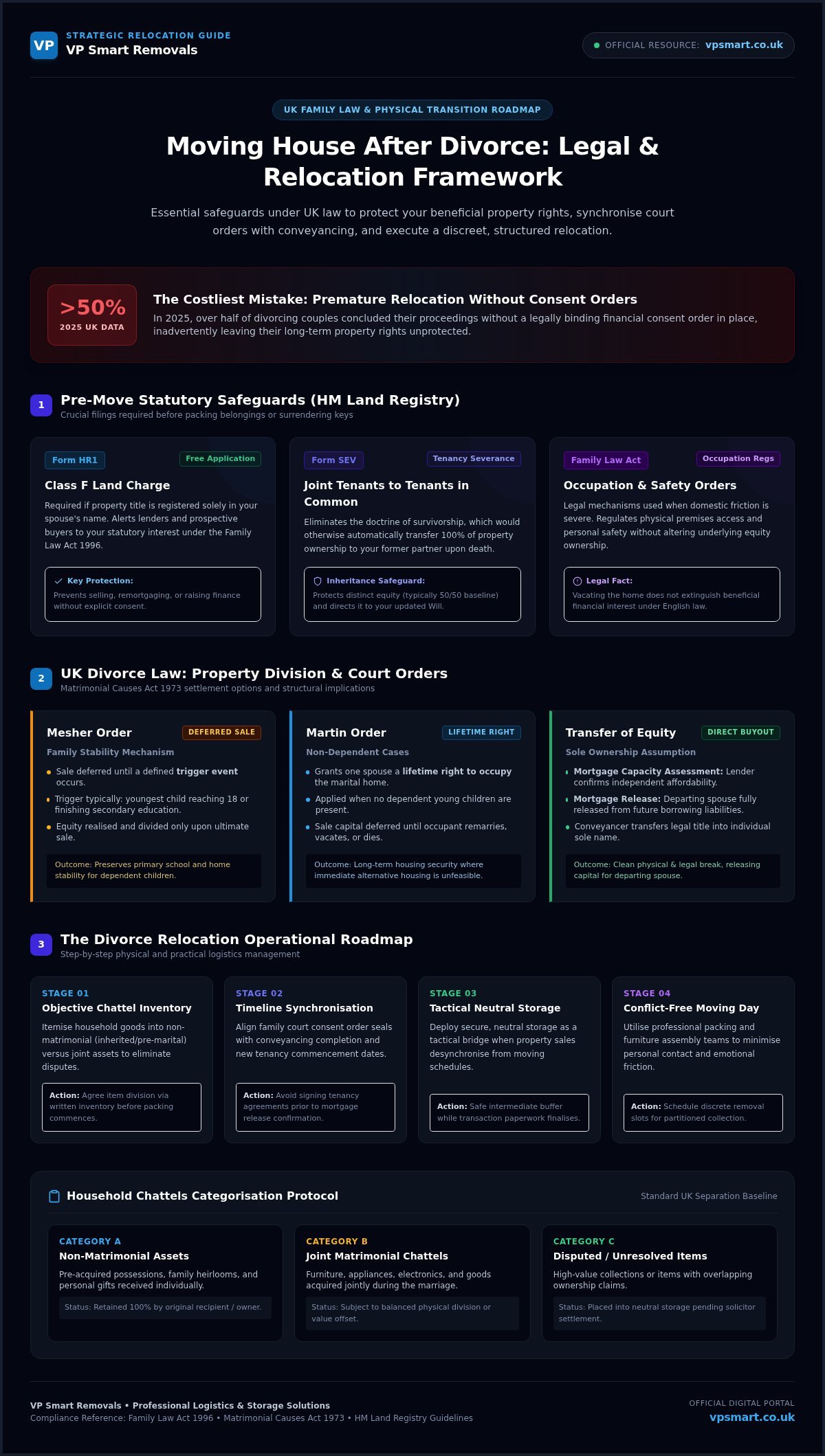
Packing your belongings and leaving the matrimonial home before securing a financial consent order is one of the costliest mistakes you can make under UK law. In 2025, over half of divorcing couples concluded their divorces without a legally binding financial order in place, inadvertently leaving their long-term property rights unprotected. Establishing complete oversight of both your legal standing and your physical transition is essential. This moving house after divorce checklist uk bridges the gap between family court timelines and the practical logistics of establishing a new home.
It is completely natural to feel exhausted by the emotional friction of dividing personal possessions whilst managing conveyancing deadlines and independent packing on your own. You shouldn’t have to carry that uncertainty without a reliable plan. This guide provides total clarity on your legal property entitlements, asset division, and moving arrangements, ensuring you protect your future with calm confidence. Below is your chronological, step-by-step roadmap covering the essential legal notices, financial safeguards, and physical moving milestones required for a smooth transition.
Key Takeaways
- Understand your statutory rights under UK law to ensure vacating the family property does not compromise your legal or beneficial financial interest.
- Follow our step-by-step moving house after divorce checklist uk to synchronise family court consent orders, conveyancing timelines, and physical removal milestones.
- Differentiate personal non-matrimonial items from joint assets using an objective inventory to eliminate conflict during household division.
- Deploy flexible, secure storage as a tactical bridge to safeguard household goods whilst financial settlements and property sales finalise.
- Minimise emotional friction on moving day by utilising professional packing and furniture assembly services to manage the transition smoothly.
Understanding Property Rights and Legal Status Before You Move
One dangerous misconception in marital breakdown is that walking out forfeits your financial stake. Under English law, vacating the family home does not extinguish your beneficial interest. Leaving prematurely without statutory safeguards can severely weaken your day-to-day negotiating position. Before packing a single box or handing over keys, establishing complete oversight of your legal occupation rights protects your long-term housing security.
Married partners have automatic “home rights” under the Family Law Act 1996, giving both individuals a legal entitlement to enter and remain in the matrimonial home regardless of whose name appears on the title deeds. Where domestic friction turns severe, you can apply for an Occupation Order to regulate who lives on the premises, or a non-molestation order to secure personal safety. Neither order alters actual ownership; they manage physical occupation whilst legal representatives negotiate the wider division of property. Consulting a qualified family solicitor before altering your living arrangements remains the foundational item on any robust moving house after divorce checklist uk.
Home Rights and the Land Registry HR1 Notice
If the title deeds are registered solely in your spouse’s name, submit Form HR1 to HM Land Registry immediately. This free application registers a Class F land charge against the property, alerting lenders and prospective buyers to your statutory interest. It prevents your former partner from selling, remortgaging, or raising finance against the property without your explicit consent, safeguarding your beneficial stake until financial proceedings formally conclude.
Severing Joint Tenancies to Protect Inheritance
Most married couples purchase property as beneficial joint tenants, meaning the legal doctrine of survivorship automatically passes the entire house to the surviving spouse if one partner dies. During divorce, this setup exposes your intended beneficiaries to significant risk. Severing the joint tenancy converts your ownership into “tenants in common”, formalising distinct individual equity shares (typically 50/50 initially).
- Submit Form SEV: Send an application to HM Land Registry alongside written notice of severance served on your spouse.
- Update your Will: Your share of the equity no longer passes automatically to your ex-partner; it transfers strictly according to your updated testamentary instructions.
- Coordinate with Conveyancers: Align these registry adjustments with your broader moving house after divorce checklist uk so that prospective home purchases or equity buyouts proceed from a clearly partitioned baseline.
Financial Orders and Property Division Options in UK Divorce Law
Ending a marriage legally does not terminate your financial obligations. Under the Matrimonial Causes Act 1973, English courts possess wide discretion to redistribute property based on fairness, housing needs, and children’s welfare. Resolving these arrangements early ensures your physical relocation rests on firm financial foundations, avoiding disruptive disputes later.
A crucial stage of any moving house after divorce checklist uk is aligning legal settlement milestones with your moving schedule. Without synchronisation, you risk signing tenancy agreements or scheduling vans before mortgage releases complete. When house sales and completion dates desynchronise, booking flexible storage services provides valuable breathing space whilst your solicitor finalises transaction paperwork.
Mesher and Martin Orders: Deferred Property Sales
Courts do not always mandate an immediate open-market sale. A Mesher order retains the family property until a specified “trigger event” occurs, such as the youngest child turning 18 or completing secondary education. In contrast, a Martin order grants one spouse a lifetime right to occupy the home without dependent children present. Both mechanisms provide domestic stability, but defer capital release until the eventual sale.
Transfer of Equity and Property Buyouts
If one party retains the matrimonial residence, an equity transfer buyout is the standard legal vehicle. Key steps include:
- Mortgage Capacity Assessment: Lenders must formally confirm that the remaining spouse can shoulder borrowing liabilities independently before approving a transfer.
- Mortgage Release Procedures: The departing spouse must obtain an official release of liability, ensuring their borrowing capacity remains unencumbered for their next property purchase.
- Tax Exemptions: Property equity transferred pursuant to a formal court order or separation agreement is normally exempt from Stamp Duty Land Tax (SDLT).
Securing a Clean Break Consent Order
A Final Order (formerly Decree Absolute) dissolves the legal marriage; it does not dismiss future financial claims. For absolute legal protection, apply to the court for a Financial Consent Order (with an agreed fee of £62). This document creates a binding “clean break”, preventing your ex-spouse from claiming against future wealth, business growth, or inherited assets. Incorporating clear clearance deadlines into this order guarantees mutual oversight regarding when personal belongings must be removed from the property, keeping your moving house after divorce checklist uk on schedule.
The Comprehensive Moving House After Divorce Checklist
Separating the physical logistics of a move from the emotional friction of relationship breakdown requires methodical discipline. Legal proceedings establish the division of assets on paper; your moving checklist translates those court rulings into practical, controlled steps. Breaking your relocation into chronological milestones protects sensitive data, prevents financial disputes, and provides your children with stable domestic routines.
Using a structured moving house after divorce checklist uk gives you complete oversight across administrative, legal, and operational tasks. The timetable below keeps your transition on track.
Six to Eight Weeks Out: Legal Filings and Administrative Setup
Early preparation centres on ring-fencing your personal information and establishing financial independence. Begin with these core priorities:
- Redirect Personal Post: Set up an independent Royal Mail Redirection service immediately so confidential legal correspondence, bank statements, and court updates go straight to a private address or secure PO Box.
- Separate Banking and Digital Profiles: Open sole bank accounts, secure individual mobile contracts, and update account recovery passwords on personal email accounts.
- Notify Statutory Bodies: Inform HMRC, child benefit offices, and your children’s schools regarding individual primary contact details and residency changes.
- Review Professional Removals: Plan your moving resources by consulting trusted house removals guidance to reserve provisional dates that align with your expected legal exchange.
Two to Four Weeks Out: Logistics and Packing Preparations
With administrative foundations secure, shift your focus to property clearance and utility transfers. These logistical steps ensure a smooth exit:
- Book Moving Support: Confirm vetted movers once completion dates become legally enforceable.
- Arrange Municipal Changes: Notify your local authority to close joint council tax liability, and apply for the statutory 25% single-occupancy discount on your prospective new home.
- Source Packing Supplies: Order dedicated, heavy-duty packing materials to protect your assigned items and prevent disputes over damaged property.
- Schedule Disconnections: Arrange broadband transfers, energy accounts, and water services well ahead of move day.
Moving Week: Final Inspections and Key Handover
The final days demand meticulous evidence gathering to prevent retrospective claims. On departure day, take clear, timestamped photographs of all utility meters (gas, electricity, and water) alongside visual records of the vacated rooms. Hand over all sets of keys strictly according to agreed solicitor instructions, marking the final physical milestone on your moving house after divorce checklist uk.
Dividing Household Chattels and Utilising Neutral Storage
Arguments over household contents often generate more acrimony than dividing liquid capital. Disputing everyday furniture through solicitors quickly burns through thousands of pounds in legal fees over depreciating items. Structuring an objective division method early is an essential milestone on your moving house after divorce checklist uk, keeping domestic transitions dignified and cost-effective.
Creating an Objective Household Chattel Inventory
English family law distinguishes between non-matrimonial property and joint assets. Items owned before the marriage, personal gifts, and direct inheritances generally remain separate property, provided they were not intermingled into joint usage. For joint chattels, compile a shared digital spreadsheet detailing descriptions, photographs, and realistic second-hand replacement values rather than original purchase costs. Allocating items based on the actual floorplans of each party’s prospective home helps resolve disputes pragmatically without court intervention.
Bridge the Relocation Gap with Secure Storage
Property completions rarely align perfectly when untangling a joint household. When sales or purchases desynchronise, flexible storage services offer vital intermediate breathing room. Placing contested or surplus goods into managed storage prevents hasty sales, accidental damage, or premature disposal. Both parties retain complete oversight through itemised storage manifests, guaranteeing transparency until financial orders are signed.
Arrange secure storage facilities for your upcoming move
Professional Packing to Minimise Conflict
Packing up a family residence alone carries immense psychological weight and easily triggers interpersonal tension. Bringing in professional movers and packers acts as an effective, neutral buffer. Trained crews pack according to agreed inventories, record item conditions before transit, and apply distinct colour-coded labels to indicate which belongings travel to which destination. This structured handling eliminates accusations of improper packing, keeping your moving house after divorce checklist uk moving forward smoothly.
Executing a Discreet, Conflict-Free Moving Day
Moving day represents the physical reality of a concluded chapter. It can also bring intense emotional vulnerability. Without intentional boundaries, loading furniture easily triggers heated arguments over old grievances. Managing move day as an operational process rather than an emotional confrontation protects your dignity and keeps the physical relocation on schedule.
Positioning a professional removals crew on-site introduces an impartial presence that naturally diffuses tension. Moving teams focus entirely on efficient loading, inventory verification, and secure transit. With experienced personnel handling the manual labour, you retain complete oversight without being drawn into exhausting personal disputes. This operational safeguard is the final practical step in completing your moving house after divorce checklist uk.
Coordinating Move-Day Timings and Attendance
Direct contact between separating partners on move day should be minimised. Establish unambiguous boundaries early by confirming written collection hours through legal representatives or mediation services. Where possible, agree that your former spouse remains away from the property during the loading window. Children and pets should spend the day with trusted family or professional carers, shielding them from domestic upheaval.
Safeguarding Sensitive Legal and Personal Documents
Never entrust private legal and financial paperwork to the main removal vehicle. Separate your essential records before loading begins and keep them in your personal transit bag:
- Court Filings and Agreements: Financial remedy orders, Form E disclosures, sealed consent documents, and solicitors’ correspondence.
- Identity and Property Titles: Passports, original birth certificates, title register copies, and vehicle logbooks.
- Digital Assets: External hard drives, laptops, and encrypted storage devices containing backups of personal records.
Settling Seamlessly into Your New Residence
Arriving at your new property marks the beginning of your domestic independence. Focus on immediate comfort rather than tackling every unboxing task at once. Assemble children’s beds first to create a secure, welcoming environment on night one. You can also review transparent rates for professional furniture assembly services, ensuring bed frames, wardrobes, and substantial tables are reconstructed correctly without added exhaustion. For comprehensive operational planning, consult our proven house removals guidance to round off your moving house after divorce checklist uk with complete confidence.
Take Confident Control of Your Next Chapter
Navigating a marital separation requires both legal vigilance and methodical practical planning. By establishing statutory property rights prior to departure, securing an enforceable clean break consent order, and following a disciplined moving house after divorce checklist uk, you protect your hard-earned financial future whilst shielding yourself from unnecessary personal conflict.
VP Smart Removals provides nationwide moving and storage logistics tailored specifically for complex life transitions. Our dedicated, neutral packing and inventory services minimise household friction, providing intermediate breathing room and dependable hands to shoulder the physical demands of relocation.
Request a discreet, professional moving quote
Stepping across the threshold of your independent home is an empowering milestone. With sound legal safeguards and reliable logistical support in place, you can turn the page with complete clarity and lasting peace of mind.
Frequently Asked Questions
Can my spouse legally stop me from moving house with our children?
Yes, your spouse can apply to the family court for a Prohibited Steps Order if your proposed relocation disrupts established schooling or co-parenting routines. Both parents with parental responsibility must consent to any significant domestic relocation. If mutual agreement cannot be reached, you must apply for a Specific Issue Order. The court evaluates your request purely based on the children’s welfare under the Children Act 1989.
Do I lose rights to the matrimonial house if I move out?
No, moving out does not surrender your legal or beneficial property rights under UK matrimonial law. Your financial stake in the property remains fully protected until a court grants an enforceable Financial Order. However, leaving prematurely can impact temporary living arrangements and daily negotiation leverage. Reviewing your rights forms a vital first step on your moving house after divorce checklist uk before surrendering house keys.
How do I divide furniture and personal belongings fairly during divorce?
Begin by cataloguing all items on an objective inventory spreadsheet, distinguishing separate non-matrimonial property from joint purchases. Value everyday furnishings at second-hand resale value rather than original purchase costs. Allocate furniture logically based on the floorplans of your respective new homes. Avoid disputing lower-value items through legal channels, as solicitor fees rapidly eclipse the actual monetary replacement value of standard household goods.
What is a Home Rights Notice and when should I register it?
A Home Rights Notice is an official Land Registry entry that protects a spouse whose name does not appear on the property deeds. You should submit Form HR1 to HM Land Registry as soon as relationship breakdown occurs. This free statutory registration alerts prospective lenders and buyers to your legal interest, preventing your spouse from selling, transferring, or remortgaging the matrimonial residence without your formal consent.
Who is responsible for paying mortgage and utility bills after one partner moves out?
Both borrowers remain jointly and individually liable to the mortgage lender for regular monthly payments, irrespective of who resides in the property. If payments stop, the bank holds both individuals accountable. For council tax and energy bills, operational liability usually transfers to the resident spouse once suppliers are notified of departure, though interim financial support agreements often address these domestic outgoings during divorce proceedings.
Can I change the locks on the family home after my ex moves out?
You cannot legally change the locks if your ex-partner is a joint property owner or holds registered Home Rights, unless you possess an Occupation Order. Taking unilateral action risks urgent court applications and financial penalties for unlawfully restricting access. If domestic safety is an issue, instruct a family solicitor to apply for an Occupation Order granting you exclusive occupation rights before altering physical entry points.
How can secure temporary storage help during a high-conflict divorce move?
Secure storage acts as a neutral tactical bridge when property sale and purchase dates desynchronise. Moving disputed or excess items into managed storage facilities prevents hasty disposals, removes friction from the family home, and ensures full transparency through itemised inventory logs. Professional removal teams can pack and transfer designated belongings directly to storage, keeping your moving house after divorce checklist uk strictly focused on practical execution.
Disclaimer
Some links in this article may be affiliate links, which means we may earn a small commission if you make a purchase through them, at no additional cost to you. We only recommend products or services we believe provide value to our readers.