
What if the most anxiety-inducing phase of your relocation, the gap between leaving your old house and entering the new one, could actually be the secret to a more organised and effortless transition? It’s a common concern amongst homeowners that utilising temporary furniture storage when moving means risking damage from damp or pests whilst doubling your logistical workload. You likely feel the weight of this pressure, fearing the complexity of opaque pricing or the physical strain of handling heavy items multiple times without a clear strategy in place.
We believe that your furniture isn’t just hardware; it’s the foundation of your domestic well-being. This complete 2026 guide provides the complete oversight you need to protect your investment and simplify your journey. You’ll discover the functional benefits of managed storage over traditional self-service options, learn how to calculate the precise space required for your household, and establish a clear plan for professional furniture protection. By the end of this article, you’ll have the technical knowledge and practical confidence to manage your relocation with total precision, ensuring your move is as refined and comfortable as the home you’re building.
Key Takeaways
- Understand the technical differences between managed warehouse facilities and self-storage to ensure your belongings receive the highest level of environmental protection.
- Learn how to properly prepare your items through thorough cleaning and strategic disassembly to prevent mould growth and maximise space efficiency.
- Discover the most effective methods for estimating volume in cubic metres to select the right capacity for temporary furniture storage when moving.
- Identify the critical security features, including intruder alarms and fire monitoring, that offer peace of mind whilst your furniture is in transition.
- Explore how professional packing and furniture assembly services provide complete oversight, turning a complex relocation into a seamless domestic upgrade.
Understanding Your Options for Temporary Furniture Storage
Temporary storage acts as a strategic buffer during the often unpredictable transition between properties. It refers to a short-term holding phase, typically lasting from a few weeks to several months, designed to keep your household inventory secure whilst your final destination is prepared. Utilising temporary furniture storage when moving provides you with the breathing room needed to manage property chains or unexpected delays without the pressure of an immediate move-in deadline.
Choosing professional facilities over domestic garages or garden sheds is a decision rooted in preservation. Whilst a shed might seem convenient, it lacks the technical oversight required to prevent environmental damage. Professional units utilise climate-controlled environments to maintain stable temperature and humidity levels. This is vital for protecting the structural integrity of solid wood furniture, which can warp in damp conditions, and fabric upholstery, which is susceptible to mould and stale odours in unventilated spaces.
Managed Storage vs. Self-Storage: Which Is Best?
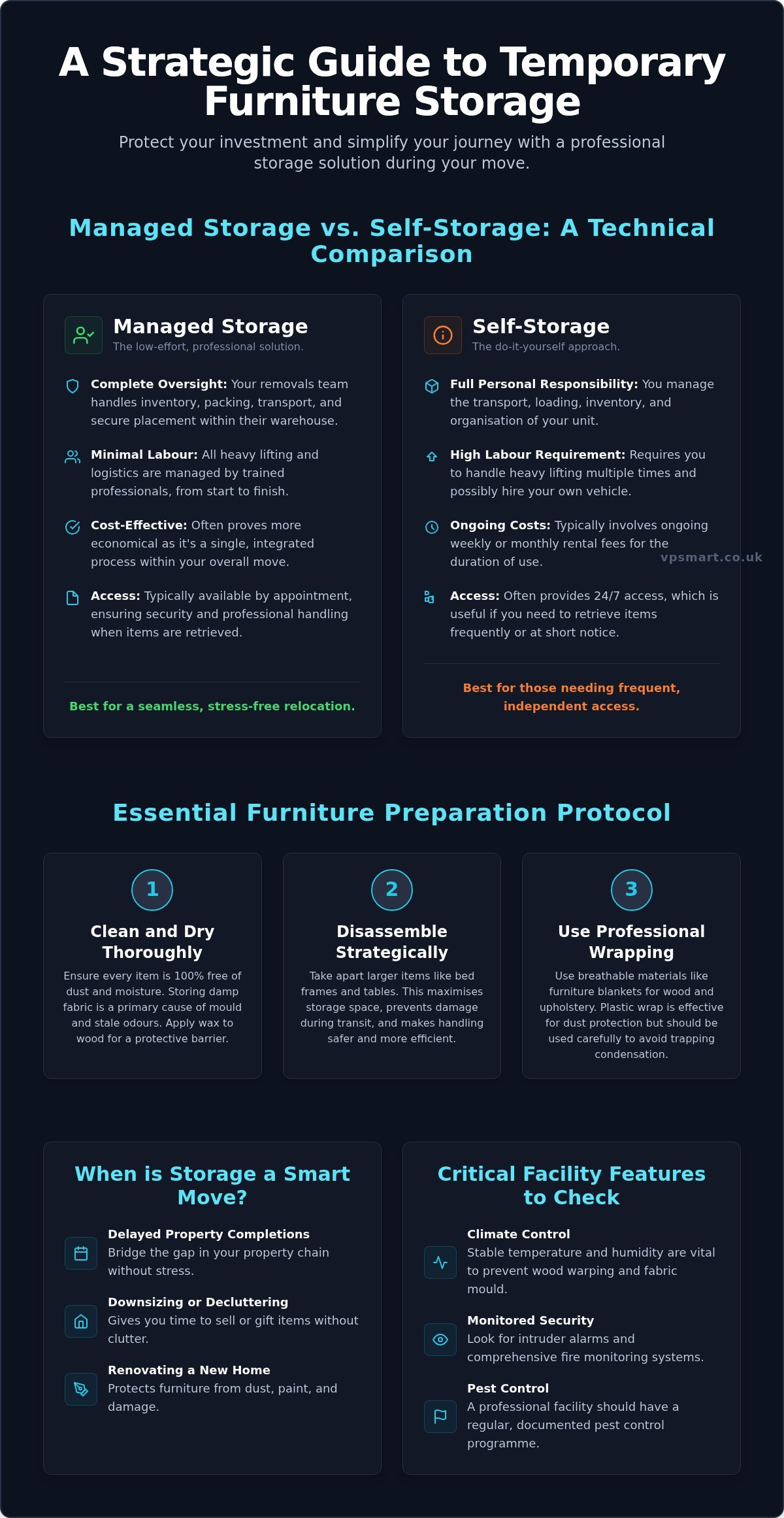
The industry generally splits into two distinct categories. To understand what self-storage is, think of it as a DIY solution where you rent a unit and manage the transport, loading, and inventory yourself. It offers 24/7 access, which is helpful if you need to retrieve items frequently. However, it places the logistical burden entirely on your shoulders, requiring you to hire vehicles and handle heavy lifting multiple times.
In contrast, storage services provided by a managed facility offer a more refined, low-effort experience. Here, your removals team handles the inventory and placement within a secure warehouse. This approach provides complete oversight of your belongings, as the same professionals who disassembled your furniture are responsible for its safe-keeping. Whilst self-storage involves ongoing weekly rental fees and multiple trips, managed storage often proves more cost-effective for those who prefer a single, professional handling process from start to finish.
Common Scenarios Requiring Short-Term Storage
Several practical situations make a storage buffer essential. Delayed property completions are a frequent driver, where a gap of a few days or weeks occurs between moving out and receiving your new keys. Downsizing also requires a temporary solution, giving you the time to sell or gift unwanted heirlooms without cluttering your new living space. Finally, many homeowners use temporary furniture storage when moving to protect their belongings whilst decorating or renovating a new property. Keeping furniture away from paint fumes and construction dust ensures your interior remains pristine until the work is finished.
How to Prepare Your Furniture for a Storage Facility
The success of temporary furniture storage when moving depends heavily on the technical rigour applied before the items ever leave your home. Proper preparation acts as a safeguard against environmental factors, ensuring that your investment remains in pristine condition. By following a structured protocol, you maintain complete oversight of your belongings and eliminate the anxiety associated with the storage phase.
Cleaning and Drying: The Essential First Step
Moisture is the primary enemy of stored goods. Before wrapping any item, you must ensure it is entirely free from dust, oils, and humidity. For wooden furniture, apply a high-quality polish or wax to create a protective barrier that prevents the wood from drying out or absorbing ambient moisture. Upholstered items, such as sofas and armchairs, require a thorough vacuuming to remove organic particles that could attract pests or encourage fungal growth.
It is vital that fabric is 100% dry before it is enclosed in any protective covering. Storing damp items in a sealed environment is a recipe for mould and persistent stale odours. Expert advice on preparing furniture for storage emphasises that even a small amount of trapped condensation can damage delicate fibres over time. Always allow professionally cleaned items at least 48 hours to air out in a well-ventilated room before they are packed for transport.
Expert Wrapping and Packing Techniques
Protection requires a strategic choice of materials. Whilst thick plastic wrap is excellent for preventing dust, it can trap moisture against wooden surfaces, leading to rot or finish damage. Instead, utilise breathable furniture covers or moving blankets that allow for air circulation. For high-impact areas, such as the corners of dining tables or the edges of wardrobes, use corrugated cardboard or bubble wrap to provide a physical buffer against accidental knocks during the transition.
Disassembly is an equally important part of the process. Large items like bed frames and wardrobes should be carefully broken down to save space and reduce the risk of structural stress on joints during handling. To ensure a stress-free reassembly, secure all screws, bolts, and small components in clearly marked, heavy-duty bags taped directly to the corresponding furniture piece. If you require technical assistance or high-grade supplies, you can order professional packing materials delivered directly to your door. This methodical approach ensures that your transition to a new home remains an experience of effortless comfort. For those who prefer a completely hands-off experience, our movers and packers can manage this entire preparation phase on your behalf, providing the ultimate level of domestic oversight.
Choosing the Right Storage Unit Size and Security
Selecting the correct environment for temporary furniture storage when moving is a critical step in maintaining complete oversight of your domestic assets. It isn’t just about finding an empty room; it’s about matching the technical specifications of a facility to the specific needs of your household items. A well-chosen unit ensures that your relocation remains a stress-free transition rather than a logistical burden. By understanding the data behind volume and security, you position yourself as the person in charge of your own environment.
Calculating Your Storage Requirements
Estimating volume requires a shift from floor space thinking to cubic capacity. For a typical 1-bedroom flat, you generally require approximately 250 to 400 cubic feet of space. A larger 3-bedroom family home often scales up to 800 or 1,200 cubic feet. To help you plan your budget effectively, you can check our storage services and pricing to see how these volumes translate into practical, cost-effective solutions.
Professional loaders prioritise stackability to maximise every inch of your unit. By utilising the vertical height of a secure container, you significantly reduce your recurring storage rental fees. This efficiency is a hallmark of managed storage, where experts organise your inventory to minimise wasted space. Unlike self-storage, where items are often left in a disorganised heap, managed placement ensures that your furniture remains stable and protected from structural stress.
Assessing Security and Environment Quality
Security must be proactive rather than reactive. When evaluating a facility, look for 24/7 CCTV, individual intruder alarms, and advanced fire monitoring systems. Managed facilities offer a superior level of protection because access is strictly controlled by the removals team. This differs from self-storage, where hundreds of different customers may have access to the corridors daily. High-level industry standards, such as those highlighted by the American Trucking Associations’ Moving & Storage Conference, emphasize that rigorous pest control protocols and climate-controlled environments are essential for preserving the lived experience of your furniture.
Finally, ensure you understand the insurance requirements for your belongings. Professional storage providers typically require comprehensive coverage for both goods in transit and items in situ. This creates a vital safety net that protects your financial interests whilst your furniture is out of your direct sight. By choosing a facility that balances high-tech security with a well-managed environment, you ensure your belongings return to you in the same condition they left.
Logistics: Moving Your Furniture into Storage Safely
The physical transition of your assets from a domestic setting into a warehouse environment is a high-stakes phase that requires technical precision. Choosing the right partner for temporary furniture storage when moving ensures that your belongings aren’t just stored, but are transitioned with complete oversight. DIY transport often introduces unnecessary risks, from structural damage caused by improper lifting to the cosmetic scuffs that occur when heavy items are moved without specialised protection.
Managing the logistics of temporary furniture storage when moving requires a deep understanding of the equipment needed to protect delicate surfaces. Professional movers mitigate these risks through a combination of high-tech hardware and refined handling protocols. Floor runners protect your carpets and hardwood from grit, whilst heavy-duty transit blankets provide a cushioned barrier for every item. One of the most significant advantages of managed storage is the “store-to-door” model. This reduces handling. Unlike self-storage, which requires multiple handling stages, a managed service often involves loading a container directly at your property. This reduces the number of times your furniture is touched, significantly lowering the probability of accidental damage.
Professional Handling and Transportation
Moving heavy or delicate items like pianos and solid oak wardrobes requires more than just muscle; it requires specialised hardware. Professional removals teams utilise hydraulic tail-lifts and non-slip ramps to transition heavy assets into the vehicle safely. Inside the van, the focus shifts to loading density and pressure management. Items are secured using tie-down points to prevent shifting during transit, ensuring that weight is distributed evenly to avoid pressure damage on delicate legs or frames. To understand how these technical standards improve your moving day, you can learn about our professional house removals and the equipment we use to safeguard your home.
Retrieving Your Belongings: The Exit Strategy
A successful storage plan always includes a clear exit strategy. In a managed warehouse environment, retrieval is a coordinated event rather than a spontaneous trip. You’ll typically need to provide a short notice period to allow the team to prepare your inventory for delivery. This structured approach allows for a seamless transition, as you can schedule the arrival of your furniture to coincide with the moment your new property is ready for occupation.
Before your items arrive, ensure the new property is prepared for furniture reassembly. Professional movers can then efficiently re-build bed frames and wardrobes in their designated rooms, restoring your domestic comfort immediately. Maintaining a detailed inventory list throughout the process ensures that every component is accounted for, providing you with the ultimate peace of mind as you settle into your new environment.
Discover our secure storage solutions
Simplifying Your Move with VP Smart Removals
Choosing a partner for temporary furniture storage when moving requires a balance between technical authority and approachable domestic warmth. We understand that your belongings are more than just inventory; they are the essential components of your home life. By providing a service that blends high-tech logistics with a dependable, human-centric approach, we ensure that your transition is characterised by effortless comfort rather than operational stress. Our managed storage solutions offer the complete oversight you need to feel confident whilst your assets are in our care.
Technical precision is at the heart of our service offering. Our specialised furniture assembly service is designed to save you significant time and physical effort, ensuring that complex wardrobes and bed frames are reconstructed with structural integrity in your new property. For those with high-value or delicate items, our expertise in piano removals provides the specialised equipment and handling protocols required to move heavy, sensitive instruments without risk. This level of oversight extends to our financial structure, where we offer transparent, recurring storage rental fees that allow for precise budget management without hidden costs.
A Tailored Approach to Your Relocation
Our personality as a visionary pragmatist ensures that every relocation is logically planned and grounded in practical household needs. We eliminate the confusion of dealing with multiple contractors by acting as your single point of contact for both removals and storage. This integrated model means the same team that packs your items is responsible for their safety in the warehouse and their eventual delivery. To see how this holistic approach improves the moving experience, read our guide to stress-free relocation.
Ready to Organise Your Storage?
Taking control of your environment starts with accurate data. We recommend scheduling a site survey, which allows us to perform a detailed inventory assessment and provide a fixed-price relocation project fee. This transparency ensures you know exactly what to expect, allowing you to focus on the excitement of your new home rather than the logistics of the move. Our team is ready to help you plan a transition that prioritises performance, visual appeal, and your domestic well-being.
Get a quote for your move and storage today
Securing Your Transition to a More Refined Home
Relocating shouldn’t be a source of domestic friction. By choosing temporary furniture storage when moving, you create a necessary buffer that preserves the integrity of your belongings whilst providing the time needed to perfect your new environment. We’ve explored how technical preparation and professional managed facilities offer far greater protection than unmonitored self-storage units. With complete oversight of the logistics chain, you can move with the confidence that your furniture remains in pristine condition throughout every phase of the journey.
Our approach ensures your domestic well-being through secure, managed warehouse facilities and professional furniture disassembly included as standard. We maintain financial transparency through a structure with no hidden surcharges, allowing you to plan your relocation with absolute precision and oversight. This visionary pragmatism ensures that your transition to your new property is as efficient and high-performing as the home you’re building. It’s about more than just moving boxes; it’s about safeguarding your lived experience.
Request a bespoke quote for removals and storage
Your journey toward a more organised and comfortable lifestyle begins with a well-managed move. We look forward to helping you create a future of effortless comfort in your new home.
Frequently Asked Questions
How much does temporary furniture storage cost per week in the UK?
Weekly rates for temporary furniture storage when moving are typically calculated based on the volume of your inventory in cubic feet. Whilst prices fluctuate across the UK depending on facility quality and regional demand, most providers offer tiered structures for standard unit sizes. It’s important to factor in additional costs such as insurance and potential collection fees if you aren’t using a managed service that bundles transport and storage into a single project fee.
Can I store my sofa and mattress in a storage unit without them getting mouldy?
Preserving upholstered items like sofas and mattresses requires strict environmental oversight. You can prevent mould by ensuring every item is professionally cleaned and 100% dry before it enters the unit. Utilising climate-controlled managed storage is the most effective way to maintain stable humidity levels. Avoid airtight plastic wrapping, which traps condensation; instead, use breathable fabric covers that allow for natural air circulation throughout the storage period.
Is my furniture insured whilst it is in a temporary storage facility?
Most professional facilities require your belongings to be insured before they accept them into storage. You should check if your existing homeowner’s policy covers off-premises belongings, as these often have a cap, typically around 10% of the total personal property limit. Alternatively, managed storage providers often facilitate comprehensive coverage specifically designed for goods in transit and storage, providing financial security against unforeseen environmental or transit-related issues.
What is the minimum duration for renting a furniture storage unit?
The minimum rental period for temporary furniture storage when moving varies between providers but generally starts at one week. For managed warehouse facilities, a one-month minimum is common to ensure the logistical process remains efficient for both parties. This flexibility allows you to use storage as a short-term buffer during property chain delays or as a longer-term solution whilst undertaking extensive home renovations or decorating projects.
Should I wrap my wooden furniture in plastic bubble wrap for storage?
You should avoid wrapping wooden furniture directly in plastic bubble wrap for long-term storage. Plastic can trap moisture against the wood’s surface, potentially leading to warping, rot, or damage to the varnish. A superior technical approach involves using professional moving blankets or breathable fabric covers. These materials protect against physical scuffs whilst allowing the wood to breathe, maintaining its structural integrity and visual appeal in a temperature-controlled environment.
How do I calculate what size storage unit I need for a 3-bedroom house?
A typical three-bedroom family home usually requires between 800 and 1,200 cubic feet of storage space. To calculate your specific requirements, you must account for large appliances, disassembled wardrobes, and boxed sundries. The most accurate method is to request a professional site survey, where an expert can assess the stackability of your furniture. This technical oversight ensures you don’t pay for unused space whilst guaranteeing all items fit securely.
Can removal companies move my furniture directly into their own storage?
Professional removal companies frequently offer an integrated service where they move your furniture directly into their own managed warehouse facilities. This model provides complete oversight of the entire logistics chain, as the same team handles the disassembly, transport, and inventory placement. It significantly reduces the risk of damage by minimising the number of times your items are handled compared to traditional self-storage methods where you manage the transport yourself.
What items are prohibited from being kept in furniture storage units?
Safety regulations strictly prohibit certain items from being kept in storage units to protect the facility and other customers’ belongings. Prohibited items include:
- Flammable liquids, gases, or combustible materials
- Perishable food items and living plants
- Hazardous chemicals or radioactive substances
- Illegal goods or unlicensed firearms
- Living creatures or biological matter
Adhering to these standards ensures a secure, pest-free environment for your domestic assets and maintains the overall safety of the warehouse facility.
Disclaimer
Some links in this article may be affiliate links, which means we may earn a small commission if you make a purchase through them, at no additional cost to you. We only recommend products or services we believe provide value to our readers.