
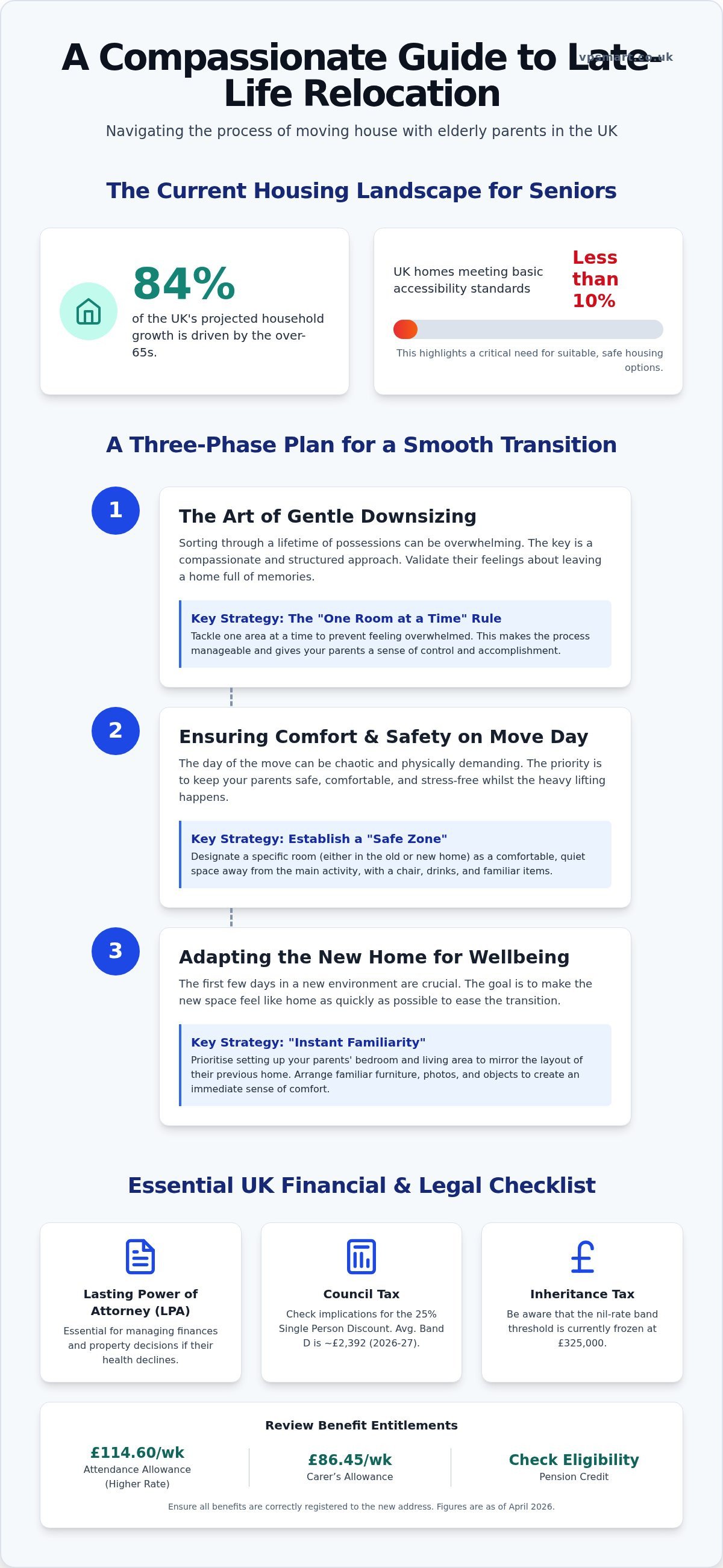
84% of the UK’s projected household growth is now driven by the over-65s, yet less than 10% of our homes meet even the most basic accessibility standards. This data highlights why moving house with elderly parents uk has become a vital yet daunting task for modern families. You’re likely facing the dual pressure of managing a lifetime of possessions whilst worrying about how the transition might impact your parents’ health and emotional well-being. It’s a significant undertaking that requires a blend of logistical precision and genuine compassion.
At VP Smart Removals, we understand these complexities and are here to help you regain oversight of this process. This guide provides a structured framework to navigate the complexities of late-life relocation, from understanding the frozen £325,000 inheritance tax thresholds to managing the physical demands of downsizing. We’ll outline how to coordinate a safe, injury-free move and share strategies to ensure the new space feels like home immediately. By the end of this article, you’ll have a clear roadmap for a transition that prioritises both financial optimisation and your family’s domestic happiness.
Key Takeaways
- Learn how to manage the emotional impact of moving by involving your parents early and using the “One Room at a Time” rule for gentle downsizing.
- Navigate the specific financial and legal requirements of moving house with elderly parents uk, including 2026 updates to Council Tax and Power of Attorney.
- Keep move day stress-free by establishing a “Safe Zone” for your parents, ensuring they remain comfortable whilst the heavy lifting happens.
- Ensure your parents feel settled quickly by using our “Instant Familiarity” strategy to recreate the comfort of their previous living space.
Navigating the Emotional Landscape of Moving Elderly Parents
Relocating is rarely just about boxes and vans; it’s a significant transition of identity. When you’re moving house with elderly parents, you’ll likely encounter the “Grief of Relocation”. This is a genuine psychological response to leaving a sanctuary filled with decades of memories. Validating these feelings is the first step toward a successful transition. Instead of dismissing their fears, acknowledge that leaving a family home can feel like losing a piece of personal history. You’re not just moving furniture; you’re helping them navigate a change in their life story.
Involving your parents early makes the move a shared project. When they feel like active participants rather than subjects of a plan, resistance often shifts into cooperation. This approach is vital for the “Sandwich Generation”, those people balancing the needs of their children and their aging parents. Managing this stress requires you to look after your own mental health whilst coordinating the complex logistics of house removals. Identifying the right time to move is equally critical. Look for concrete indicators like frequent falls, social isolation, or an inability to manage basic home maintenance. A proactive move is always safer than a reactive one triggered by a health crisis.
Communicating the Need for Change
Start conversations using “I” statements to reduce defensiveness. Instead of saying “You don’t manage these stairs well”, try “I feel worried about your safety when you use these stairs”. This shifts the focus to your concern rather than their perceived failings. Organise a family meeting to discuss options without immediate pressure. Focus on the benefits of a new environment, such as a warmer home or better proximity to local amenities, rather than the loss of the old property. This helps parents see the move as an upgrade to their lifestyle rather than a retreat from it.
Assessing Quality of Life and Safety
Evaluate the current environment for technical flaws that hinder daily life. Steep stairs, high-threshold baths, and poor lighting are significant trip hazards. Whilst many individuals value the concept of Aging in place, right-sizing involves moving to a property that is intentionally designed for your parents’ current and future needs to ensure long-term wellbeing. A well-chosen new home can actually increase independence by providing an accessible environment that requires less physical effort to manage. This transition allows them to focus on their social life and health rather than the burdens of an unsuitable building.
UK Legal and Financial Considerations for 2026
Financial oversight is crucial when moving house with elderly parents uk. With the average Band D council tax in England reaching £2,392 for the 2026-27 period, every saving counts. One common trap is the loss of the 25% Single Person Discount if a parent moves into your home or vice versa. You’ll need to calculate whether this cost is offset by shared utility bills or reduced maintenance outgoings. It’s also a vital time to review benefit eligibility. From April 2026, Attendance Allowance rates have risen to £76.70 for the lower rate and £114.60 for the higher rate. Ensuring these are correctly registered at the new address provides essential liquidity for ongoing care costs.
Benefits and Council Tax Implications
Relocation often triggers a review of Pension Credit and Carer’s Allowance, which stands at £86.45 per week as of April 2026. If you’re moving parents into a dedicated annex, check if the local authority treats it as a separate dwelling for council tax purposes. To manage the immediate costs of the transition, consult a pricing guide to build a realistic relocation budget. This oversight prevents mid-move financial surprises and allows you to focus on your parents’ wellbeing. It’s helpful to remember that whilst some benefits are portable, others require a fresh assessment based on the new local authority’s criteria.
Legal Safeguards and Power of Attorney
A Lasting Power of Attorney (LPA) for Property and Financial Affairs is an indispensable tool for this transition. It empowers you to sign contracts and manage bank transfers on your parents’ behalf if their health declines or if they find the paperwork overwhelming. Without an LPA, you might face significant delays in booking a professional moving company or finalising property sales. Be mindful of the “Deprivation of Assets” rules. If a home is sold and the proceeds are gifted to family members, local authorities may still count that capital when assessing care home funding in the future. Transparency with your solicitor is the best way to avoid these legal hurdles.
Beyond the legal paperwork, consider the practicalities of Adapting the New Home to ensure it meets safety standards immediately. If downsizing leaves you with excess furniture that holds sentimental value but won’t fit the new layout, storage services can provide a temporary solution whilst you decide which legacy items to keep. This balanced approach ensures your parents’ financial interests are protected whilst their physical environment remains secure and comfortable.
The Art of Gentle Downsizing: Sorting a Lifetime
Deciding what to keep after forty years in a family home is a profound emotional challenge. When you’re moving house with elderly parents uk, the sheer volume of “lifetime” possessions can lead to a paralysis of choice. To navigate this, we recommend the “One Room at a Time” rule. Start with low-stakes areas like the utility room or guest cupboard to build confidence. This steady progression allows your parents to maintain oversight of the process without feeling overwhelmed by the scale of the task.
Distinguish between “Legacy” and “Utility” to help parents prioritise. Legacy items are those with deep sentimental value, whilst utility items are strictly functional. If a parent struggles to part with physical documents or bulky photo albums, digital archiving provides a high-tech solution. Scanning these items preserves the memory whilst reclaiming vital floor space. Consulting Age UK’s housing advice can also help you understand which furniture pieces are truly necessary for different types of supported living or right-sized environments. This clarity ensures that every item in the new home serves a purpose or brings joy.
A Compassionate 4-Box Sorting Method
Implementing a structured sorting system creates a predictable flow for decision-making. Label four distinct areas to categorise every item in the room:
- Keep: Items that fit the new floor plan and provide essential emotional comfort.
- Gift/Donate: Treasures passed to family members now, allowing parents to see their legacy enjoyed by the next generation.
- Sell: Unneeded high-value items that can be converted into funds for the relocation.
- Storage: For “undecided” items, secure storage offers a managed environment to prevent move-day delays.
Planning the New Layout
Accurate measurement is the foundation of a successful transition. Use a detailed floor plan of the new property to determine exactly which furniture pieces will fit. Prioritise familiar items, such as a favourite armchair or bedside table, to create an instant sense of belonging and domestic well-being. This visual continuity reduces the disorientation often felt during the first few nights in a new space. Ensure a “Safe Passage” by maintaining 90cm clear walkways throughout the home to accommodate mobility aids or walking frames safely. This technical foresight ensures the new environment is ready-to-live and supports long-term independence.
Managing Move Day: Ensuring Comfort and Safety
The actual transition day represents the peak of physical and emotional exertion. When moving house with elderly parents uk, your primary objective is to maintain a sense of calm and oversight amidst the inevitable activity. Creating a “Safe Zone” is an effective tactic. Designate one quiet room in the old house where your parents can stay comfortably with their favourite chair and refreshments. This keeps them away from the chaos of moving boxes. It ensures they aren’t overwhelmed by the sight of their home being dismantled. Once the van is ready, consider whether they should travel in a private car or taxi rather than a packed family vehicle. This helps them arrive at the new property feeling refreshed rather than fatigued.
Handing over the physical labour to professional movers and packers allows you to focus entirely on your parents’ needs. This division of labour ensures that heavy lifting and logistics are managed with technical authority, whilst you provide the emotional support necessary for a smooth transition. To facilitate immediate comfort, prepare a “First Night Box” containing essential medications, a kettle, their favourite tea, and nightwear. This simple preparation ensures that the most basic domestic needs are met the moment they step through the new door, without the stress of searching through dozens of cartons.
Book professional removals for a stress-free transition
Logistical Tactics for a Calm Transition
A strategic approach to packing can significantly reduce disorientation. We recommend packing the elderly person’s bedroom last at the old property and ensuring it is the first room unpacked at the new one. This visual continuity helps them settle into a familiar environment immediately. Assigning a “Family Liaison” whose sole responsibility is to sit and converse with your parents provides a vital emotional buffer. Utilising expert packing services ensures that sentimental or delicate items are secured professionally, providing peace of mind that their most cherished possessions are in safe hands.
Health and Medication Management
Maintaining health oversight is paramount during the move. Keep at least a seven-day supply of all essential medications in a clearly marked, hand-carried bag that never leaves your side. It’s also vital to notify the GP of the move date in advance and ensure that emergency contact details are updated on all medical records. Throughout the day, monitor your parents’ hydration and stress levels closely. Plan for regular rest breaks in a quiet space. The sensory overload of a move can lead to exhaustion. By prioritising these health markers, you ensure the transition is not just efficient, but safe for everyone involved.
Settling In: Adapting the New Home for Wellbeing
The first 48 hours in a new property are critical for emotional stabilisation. This is the period when Relocation Stress Syndrome, characterised by confusion or heightened anxiety, is most likely to manifest. When moving house with elderly parents uk, we recommend the “Instant Familiarity” strategy. Replicate the living room layout from the previous home as closely as possible. Position the favourite armchair, side table, and cherished photos in the same relative locations. This visual continuity provides immediate comfort and reduces the cognitive load required to navigate a new environment, helping your parents feel settled from the moment they arrive.
Home Safety and Oversight Technology
Modern safety is a byproduct of intelligent management and technical foresight. Install motion-sensor smart lighting in hallways and bathrooms to prevent night-time falls. These helpful household entities provide automatic illumination, removing the need for parents to fumble for switches in an unfamiliar layout. Complement these digital solutions with physical adaptations like grab rails and non-slip flooring. To ensure the environment is safe immediately, prioritise professional furniture assembly. This ensures that all wardrobes and shelving units are stable whilst removing the trip hazards of half-unpacked boxes. You might also consider personal alarms or GPS trackers as part of a digitally integrated lifestyle that balances independence with complete oversight.
Building a New Social Routine
Once the physical space is secure, focus on rebuilding a sense of community. Register with a new GP practice immediately to ensure medical records are transferred and care continuity is maintained. Explore local community groups or “Silver Sunday” events to help your parents build a fresh social network. Identify a short, level route to the nearest chemist or newsagent for gentle daily walks. These small, predictable routines foster a sense of agency and belonging in the new neighbourhood. Introducing your parents to neighbours early also creates a local support network, providing an extra layer of reassurance when you aren’t physically present.
Monitor your parents’ behaviour closely during the first week for signs of withdrawal or persistent fatigue. A quiet “Housewarming Tea” with a few close family members can serve as a positive milestone, celebrating the successful transition and the start of a new chapter. By combining technical safety adaptations with a focus on social wellbeing, you create a well-managed environment where your parents can enjoy effortless comfort and long-term security.
Empowering a Seamless Family Transition
Successfully moving house with elderly parents uk relies on a precise blend of emotional validation and logistical oversight. By implementing the “One Room at a Time” downsizing rule and securing legal safeguards like a Lasting Power of Attorney, you’ve established a foundation for a safe, predictable relocation. The focus now shifts from the anxiety of the move to the comfort of a well-managed environment where your parents can thrive. Our expert packing services protect your family’s most cherished sentimental items, whilst our included furniture assembly ensures the new space is ready-to-live immediately.
Get a Fixed-Price Quote for Your Family’s Move
With reliable national UK coverage and fixed-price certainty, we’re here to alleviate the physical burden of the transition. You’ve prioritised your parents’ happiness and safety; we provide the technical authority to make that vision a reality. It’s time to look forward to a future of effortless comfort in a home designed for long-term well-being.
Frequently Asked Questions
What is Relocation Stress Syndrome in the elderly?
Relocation Stress Syndrome is a psychological or physiological disturbance that occurs when an individual moves from one environment to another. Symptoms often include anxiety, confusion, and agitation, particularly in the first 48 hours. To mitigate this, maintain consistent daily routines and involve your parents in every decision. Replicating familiar furniture layouts in the new home provides essential visual cues that reduce disorientation, helping your parents feel secure and settled in their new well-managed environment.
How do I convince my parents to downsize their home?
Convince your parents by reframing the move as “rightsizing” for a lifestyle upgrade rather than a loss of their family home. Highlight the reduction in maintenance burdens and the financial optimisation of lower utility bills. Use “I” statements to express your concern for their safety without sounding like you’re giving orders. Discussing the benefits of a digitally integrated, accessible home often shifts their perspective from a loss of independence to an increase in effortless comfort.
Should I move my parents into my home or a retirement flat?
This choice depends on the level of care required and your family’s need for privacy. Multi-generational living is the fastest-growing household type in the UK, but it requires clear boundaries and potential home adaptations. A retirement flat offers independent living with built-in accessibility and a ready-made social community. Evaluate the current property for trip hazards and isolation before deciding which option provides the best domestic well-being and long-term security for your parents’ specific needs.
How much does a professional removal service for seniors cost in the UK?
Costs vary significantly based on the volume of items and the level of service required. Factors like packing materials, furniture assembly, and specialised handling for delicate items impact the final price. For budget certainty, look for providers offering fixed-price relocation project fees rather than just hourly rates. This oversight helps manage financial anxiety, especially when coordinating complex moves that involve downsizing or secure storage for excess possessions during the transition.
Do I need to notify the DWP when my parents move house?
You must notify the Department for Work and Pensions (DWP) immediately to ensure benefit continuity and avoid payment delays. This is critical for Attendance Allowance, which rose to £76.70 per week for the lower rate in April 2026. Failing to update records can lead to overpayments that must be repaid later. You should also inform the local authority to manage Council Tax changes and any potential adjustments to Carer’s Allowance, which is currently £86.45 weekly.
Can I use my parents’ Blue Badge during the moving process?
You can only use a Blue Badge if the badge holder is travelling in the vehicle with you or is being collected or dropped off. It is a criminal offence for anyone else to use the badge, even for move-related tasks. During the transition, the badge is a helpful tool for ensuring your parents can park closer to the new entrance, reducing physical fatigue. Always ensure the badge is displayed correctly to avoid penalties and ensure complete oversight.
What are the tax implications of my parents selling their home to move in with me?
Selling a primary residence usually qualifies for Private Residence Relief, meaning no Capital Gains Tax is due. However, you must consider the “Deprivation of Assets” rules if proceeds are gifted to family. Additionally, the nil-rate band for Inheritance Tax remains frozen at £325,000 for 2026/27. Consult a solicitor to understand how moving house with elderly parents uk affects the residence nil-rate band of £175,000 when properties are passed to children or grandchildren.
How do I find a removal company that specialises in moving the elderly?
Find a specialist provider by looking for a company that offers comprehensive services like expert packing and furniture assembly. A suitable firm should demonstrate technical authority in handling delicate legacy items and provide fixed-price quotes for budget certainty. Check for national UK coverage and a history of managing sensitive domestic relocations. Choosing a visionary pragmatist in the removals industry ensures the physical move is as stress-free as the lived experience of your new home.
Disclaimer
Some links in this article may be affiliate links, which means we may earn a small commission if you make a purchase through them, at no additional cost to you. We only recommend products or services we believe provide value to our readers.