
A piano is far more than a piece of furniture; it’s a precision-engineered instrument containing thousands of delicate components that a single centimetre of careless handling can disrupt. When you’re facing the logistical puzzle of narrow Victorian hallways or steep staircases, the search for reliable piano movers london becomes about more than just physical strength. You’re looking for technical oversight that respects the instrument’s structural soul and ensures its mechanical integrity remains intact from one home to the next.
It’s natural to feel anxious about potential scratches on a high-polish finish or the subtle shifts in tuning that occur during a relocation. We understand that your piano is often both a cherished heirloom and a significant financial investment that deserves a stress-free transition. This definitive guide will show you how to achieve a damage-free move by choosing specialists who prioritise performance and safety. We’ll examine the benefits of fixed-price models, the necessity of comprehensive insurance, and the advanced handling techniques used to navigate the capital’s most challenging properties with complete oversight.
Key Takeaways
- Understand why relocating a piano is a technical engineering operation that requires managing thousands of delicate internal parts and tonnes of string tension.
- Discover how professional piano movers london utilise specialised equipment like piano shoes and heavy-duty dollies to protect your instrument’s mechanical integrity.
- Learn the importance of comprehensive insurance coverage and why standard home policies often fall short during complex instrument relocations.
- Master the essential preparation steps, including conducting a pre-move survey of narrow hallways to ensure a smooth, obstacle-free transition on moving day.
- Recognise the value of a fixed-price relocation model that eliminates financial anxiety and allows for seamless integration with wider house or office removals.
Beyond the Heavy Lift: Why Piano Removals in London Require Technical Precision
A piano is a structural paradox. It combines the immense weight of a cast-iron frame with the delicate mechanical precision of a high-end timepiece. Experienced piano movers london recognise that relocating such an instrument is a specialist logistics task rather than a standard removal job. Whilst a wardrobe is simply a hollow container, a piano is a complex machine under incredible physical stress.
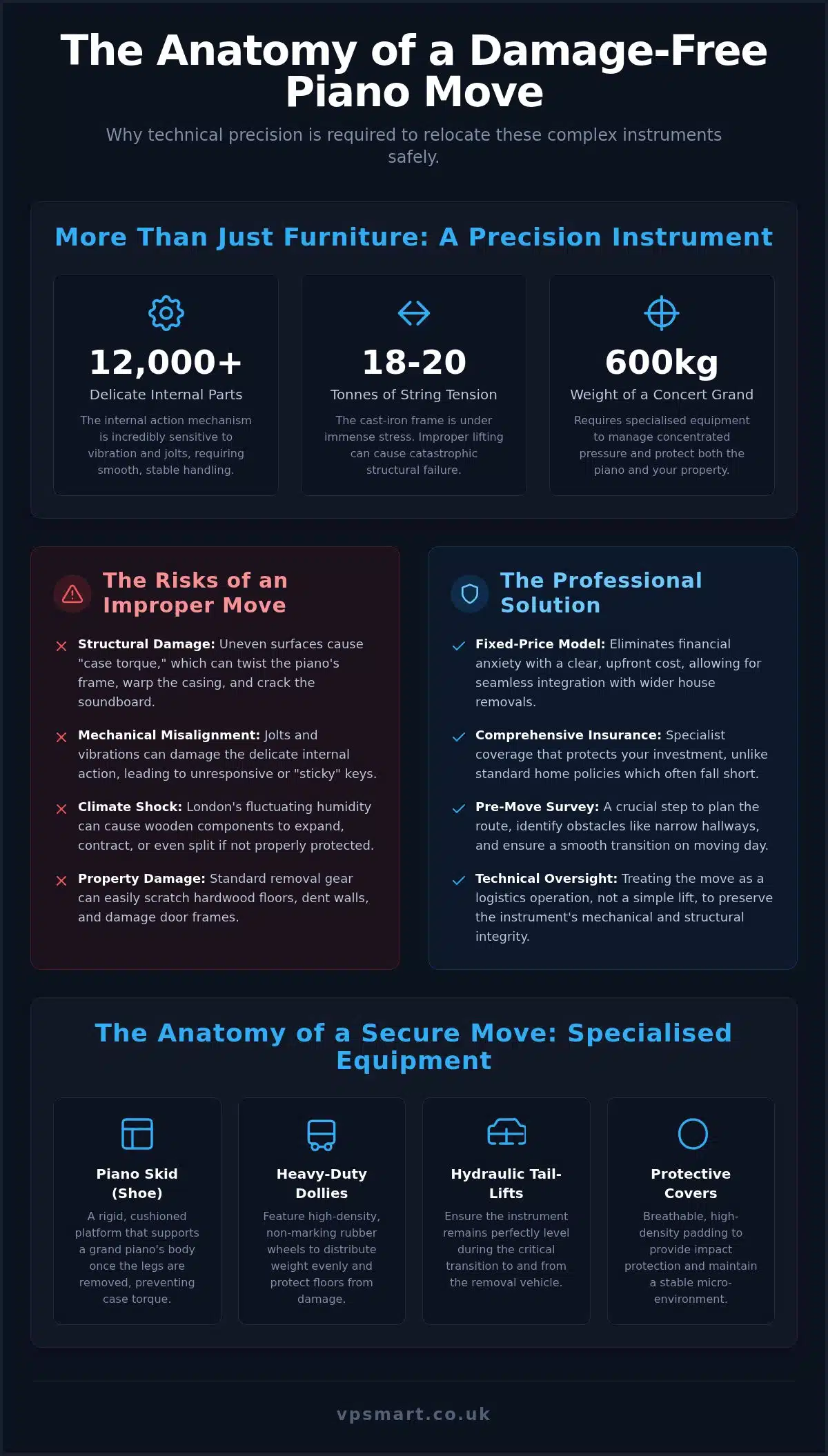
The internal iron frame supports between 18 and 20 tonnes of string tension. Any sudden impact or improper lifting technique can cause this tension to shift, potentially cracking the soundboard or warping the bridge. Understanding the anatomy of a piano is the first step in ensuring its safe transit. With over 12,000 individual parts in a standard action, the margin for error is non-existent. Technical oversight is the only way to preserve the instrument’s long-term health and musical performance.
The Mechanical Vulnerability of Grand and Upright Pianos
The internal action, including the hammers and dampers, is incredibly sensitive to vibration. When an instrument is tilted or jolted, these components can misalign, leading to “sticky” keys or a loss of tonal quality. The iron frame and soundboard require rigid, level support at every stage of the move. We pay particular attention to avoiding “case torque”. This occurs when the piano’s heavy wooden casing is twisted by uneven surfaces, such as the cracked pavements or steep thresholds common in many London properties. Without precise oversight, this torque can cause structural damage that is both invisible and permanent.
Thermoregulation and Humidity Management
London’s climate presents a unique challenge for instrument relocation. Rapid fluctuations in humidity and temperature during a move can cause the spruce soundboard to expand or contract. This movement often results in a piano going out of tune or, in extreme cases, the wood splitting. Thermoregulation in this context refers to the active management of temperature and moisture levels to maintain the physical stability of the instrument’s wooden components. To mitigate these risks, we use specialised protective covers. These are designed to be breathable whilst providing high-density impact protection. They ensure the instrument remains in a stable micro-environment from the moment it leaves your lounge until it’s safely positioned in its new home.
By treating the move as an engineering project rather than a manual labour task, we ensure your piano arrives ready to perform. Using piano movers london who understand these physical variables turns a high-risk event into a managed, stress-free transition.
The Anatomy of a Secure Move: Specialised Equipment and Protective Techniques
Specialised equipment transforms a high-risk lift into a controlled mechanical procedure. Professional piano movers london rely on an inventory of tools specifically engineered to manage the unique weight distribution of keyboard instruments. Standard removal gear simply isn’t designed for the concentrated pressure of a 250kg upright or a 600kg concert grand. Without the right hardware, you risk structural damage to both the instrument and your property.
The piano skid, often called a shoe, is the foundation of a grand piano move. It provides a rigid, cushioned platform that supports the instrument’s body once the legs and lyre are removed. This prevents case torque and protects the delicate internal soundboard from unnecessary stress. We pair this with heavy-duty, non-marking dollies. Unlike standard plastic castors, these reinforced dollies feature high-density rubber wheels that distribute the instrument’s weight. This ensures your hardwood floors or delicate tiles remain free from indentations and scratches during transit.
The transition to the removal vehicle is managed via hydraulic tail-lifts and custom-length ramps. These tools ensure the piano remains level at all times, preventing the internal action from shifting. Every component, including the lid, lyre, and pedals, is secured using non-abrasive ties and high-grade padding to eliminate any metal-on-wood friction. This level of oversight guarantees that the instrument’s aesthetic and mechanical condition is preserved throughout the journey.
Hoisting and High-Access Solutions
London’s architectural landscape frequently demands a hoisting service for upper-floor access. This involves precise engineering to remove sash windows and lift the instrument externally using heavy-duty slings. Safety remains the priority, with strict protocols in place to secure the area over public footpaths whilst the load is in transit. Our teams manage the oversight of the entire lifting process, ensuring the instrument clears the building’s facade with millimetre precision to avoid any contact with the brickwork.
Protective Packaging and Casing
Our packing services for pianos go far beyond standard household protection. We use bespoke quilted covers and ‘mummy wrapping’ techniques to shield high-polish finishes. This process involves multiple layers of non-abrasive fabric that prevents friction burns and protects against minor impacts. The keyboard receives special attention; we secure the fallboard and use felt strips to immobilise the keys. This ensures the delicate action remains static without any unnecessary downward pressure on the internal mechanisms.
Planning a complex relocation? You can request a fixed-price quote to see how our technical expertise can simplify your instrument’s journey.
Professional Movers vs. DIY: Evaluating the Risks and Long-Term Costs
The temptation to manage an instrument relocation independently is often driven by a desire for cost-efficiency. However, experienced piano movers london understand that the true cost of a DIY attempt usually emerges in the aftermath. Professional repair bills for structural damage caused by improper handling can range from £500 to over £5,000, quickly eclipsing any initial savings. Beyond the financial risk, the physical danger is significant. An upright piano typically weighs between 150kg and 250kg, whilst a concert grand can exceed 600kg. Managing these loads without specialist training often leads to personal injury or severe damage to your home’s flooring and walls.
The Risk of Structural Stress
One of the most critical risks is “pinblock” damage. The pinblock is the laminated wood block that holds the tuning pins in place under immense tension. If a piano is tilted at an incorrect angle or dropped even a few centimetres, the internal stress can cause the pinblock to crack. This makes it impossible for the instrument to hold a tune. General movers often lack the training to identify the specific centre of gravity for different models. A professional crew provides the oversight necessary to maintain the instrument’s equilibrium, protecting the delicate internal action from being jarred out of alignment.
London’s unique architecture introduces further complexity. Narrow hallways and steep staircases in period properties necessitate a “Stair Charge” for high-difficulty tasks. Specialist London removals firms include detailed access assessments in their fixed pricing to avoid the anxiety of hidden surcharges. This upfront transparency ensures you aren’t hit with unexpected costs if the crew discovers a tight corner they hadn’t planned for.
Liability and Peace of Mind
Contrast the “Man and Van” approach with a dedicated instrument relocation service. Whilst a standard van might appear cheaper, it rarely carries the specific Goods in Transit and Public Liability insurance required for high-value instruments. Most standard home insurance policies explicitly exclude owner-moved pianos or those handled by uninsured contractors. By using professional movers and packers, you receive a comprehensive condition report and a documented inventory. This oversight preserves the resale value of your instrument, proving to future buyers that it has been handled with technical precision throughout its life.
Ultimately, professional handling is an investment in the instrument’s longevity. It replaces the high-stress uncertainty of a DIY move with a predictable, managed process that respects the piano’s mechanical and financial value.
Preparing Your Instrument: A Homeowner’s Checklist for Moving Day
A successful relocation is a collaborative effort between you and your technical team. Whilst professional piano movers london handle the mechanical engineering of the lift, your oversight at home ensures the environment is primed for a seamless transition. Preparation begins with documenting the instrument’s current condition. We recommend taking high-resolution photographs of the high-polish casing from multiple angles and capturing the internal action. This creates a transparent baseline for insurance purposes and provides you with the confidence that your investment is being handled with the respect it deserves.
Measuring for Success
Precise measurements are the antidote to moving day anxiety. For upright models, measure the total height and depth; for grand pianos, you must record the length from the front of the keyboard to the furthest point of the tail. This data allows the crew to calculate corner clearance with millimetre precision. London’s Victorian and Georgian architecture often presents ‘bottlenecks’ such as narrow door frames or tight 90-degree turns. Identifying these early, along with external challenges like gravel drives or narrow garden gates, ensures the team arrives with the correct specialised dollies and ramps for your specific property layout.
On the day, clear a wide path by removing loose rugs, wall hangings, and any adjacent furniture. This allows the crew to focus entirely on the instrument’s weight distribution rather than navigating domestic obstacles. It’s also vital to follow the ‘no-tune’ rule; never tune your piano immediately before a move. The physical stress of transit and the change in environment will inevitably shift the tuning, making any pre-move adjustment a wasted expense.
Post-Move Care and Stabilisation
Once the instrument is positioned in your new home, it requires a ‘settling period’ of at least two to four weeks. During this time, the thousands of wooden components adjust to the new environment’s specific humidity and temperature levels. Ideal placement is crucial for long-term health. Position the piano away from radiators, draughty windows, and direct sunlight, as these stressors can cause the soundboard to warp or the finish to fade. Pitch stability is directly dependent on the wood’s ability to reach a state of equilibrium with the ambient moisture levels in its new surroundings.
Organise your specialised London relocation today
VP Smart Removals: Orchestrating a Seamless National Transition
VP Smart Removals operates at the intersection of technical innovation and regional reliability. We don’t view an instrument as just another item on a manifest; instead, we treat your piano as a central pillar of your home’s character. As experienced piano movers london, we’ve refined a process that balances the cold requirements of physics with the warm reality of a domestic transition. This approach ensures that whether you’re moving a studio upright or a concert grand, the experience remains stress-free and professionally managed.
Many homeowners find that an instrument move is part of a much larger life change. We specialise in integrating piano relocations into comprehensive house removals or complex office relocation projects. By consolidating these services, you gain the benefit of a single point of oversight. This streamlined coordination is particularly valuable for national moves or international transitions across Europe. We maintain the same level of technical care from the initial lift in London to the final positioning in your new destination. If your new property isn’t ready, our climate-controlled storage services provide a safe environment where your instrument can wait in perfect equilibrium.
Our Fixed-Price Commitment
Financial transparency is a core pillar of our service. We replace the anxiety of hourly rates with a fixed-price model that provides absolute budget certainty for both residential and commercial clients. This starts with a detailed site survey where we examine the technical variables of your property. This proactive assessment eliminates the hidden fees that often plague London removals. Every delicate move is assigned a dedicated project manager who provides the oversight needed to coordinate crews, specialised equipment, and timing, ensuring your instrument’s safety is never left to chance.
A Legacy of Reliability
Since our founding in 2016, we’ve grown into a trusted national mover by prioritising professional labour standards and transparent communication. We’ve built our reputation on the belief that high-tech logistics should never lose their human touch. This regional heritage serves as a trust-building benchmark for quality, differentiating our service through a commitment to domestic well-being and mechanical excellence. We invite you to experience a move where your instrument’s integrity is the primary measure of our success.
Future-Proofing Your Piano Relocation with Technical Oversight
Relocating a piano is an investment in its musical future. By prioritising technical oversight and specialised equipment for both grand and upright models, you ensure that your instrument’s mechanical integrity remains undisturbed. Choosing professional piano movers london replaces the high-risk uncertainty of a DIY attempt with the reassurance of a fully insured crew who understand the delicate physics of string tension and case torque.
We’ve explored how fixed-price certainty eliminates hidden London surcharges, allowing you to focus on the joy of your new home whilst we manage the complex logistics. With the right preparation and a respectful settling period, your piano will continue to be a cherished household entity for generations to come. Professional handling isn’t just about the heavy lift; it’s about preserving the soul of the instrument through every stage of its journey.
We look forward to helping you orchestrate a seamless transition that respects both your instrument’s value and your family’s peace of mind.
Frequently Asked Questions
How much does it cost to move a piano in London?
Moving costs are determined by the specific technical requirements of your relocation rather than a flat rate. Factors such as the type of instrument, the number of floors involved, and the distance of travel all influence the final price. We provide fixed-price quotes after a thorough site survey to ensure absolute budget certainty for our clients. This transparent approach avoids the anxiety of hourly rates or hidden surcharges often found in the industry.
Can any removal company move a piano safely?
Not all removal companies possess the specialised equipment or technical expertise required to move a piano safely. Standard furniture removal techniques are insufficient for instruments that carry tonnes of internal string tension. Professional piano movers london use dedicated tools like skids and non-marking dollies to protect the mechanical integrity of the soundboard. Without this technical oversight, you risk permanent structural damage to the iron frame and internal action.
Do I need to tune my piano after it has been moved?
You should wait at least two to four weeks before booking a tuner for your relocated piano. This settling period allows the wooden components to acclimate to the unique humidity and temperature levels of your new home. Tuning the instrument too soon is often a wasted expense, as the wood will continue to shift as it reaches equilibrium. Once the pitch has stabilised, a professional tuner can restore the instrument’s performance.
What is a stair charge and why is it applied to piano moves?
A stair charge is a specialised handling surcharge applied when an instrument must be moved via internal or external staircases. Because pianos are exceptionally heavy and have a high centre of gravity, navigating stairs requires additional crew members and specific safety equipment. This fee covers the increased technical difficulty and the extra time needed to ensure a damage-free transition. It ensures that the safety of both the instrument and the crew is prioritised.
How long does a professional piano removal take?
A standard relocation for an upright piano typically takes between two and four hours to complete. This timeframe includes the careful protective wrapping of the casing, the mechanical lift onto the vehicle, and the final positioning in your new home. Larger grand pianos or moves involving a hoisting service will naturally take longer. We provide a clear schedule during the consultation phase to ensure your day remains organised and stress-free.
Is my piano insured during the move?
Your instrument is fully protected by comprehensive Goods in Transit and Public Liability insurance throughout the moving process. Most standard home insurance policies explicitly exclude damage to pianos moved by the owner or non-specialist firms. By choosing a professional relocation service, you receive the reassurance that your financial investment is covered against unforeseen events. We provide a clear condition report before and after the move to maintain complete transparency and oversight.
Can you move a piano into a storage facility?
We offer managed storage services that are perfectly suited for the long-term or short-term holding of delicate instruments. Our facilities are designed to maintain a stable environment, protecting the wood from the rapid humidity shifts that can cause warping or tuning instability. This is an ideal solution for complex house removals where your new property might not be ready for immediate delivery. Your piano remains in a secure, climate-controlled space until you are ready.
What happens if my piano needs to be hoisted through a window?
Our specialised hoisting service provides a safe solution when narrow hallways or tight corners make internal relocation impossible. This process involves the technical removal of a window and the use of heavy-duty slings to lift the instrument externally. Our engineers manage the entire operation with millimetre precision, ensuring the piano clears the building’s facade safely. We also implement strict safety protocols to secure the public footpaths below during the lift.
Disclaimer
Some links in this article may be affiliate links, which means we may earn a small commission if you make a purchase through them, at no additional cost to you. We only recommend products or services we believe provide value to our readers.