
Packing for a house move is a technical discipline of structural integrity and risk management, not just a matter of filling cardboard boxes. Most homeowners understandably worry about fragile glassware breaking or finding unexpected costs added to their final bill for packing tape and crates. Knowing the specific questions to ask a removal company about packing ensures you maintain complete oversight of your belongings while protecting your financial interests. You deserve a transition that feels like a seamless upgrade to your lifestyle rather than a logistical burden.
We believe that a well-managed environment starts with professional transparency and technical expertise. This article promises to help you master your move with a comprehensive checklist that ensures your items are handled with precision and care. We’ll walk you through twenty essential queries covering insurance nuances, material quality, and specialised handling for delicate items like pianos. By the end of this guide, you’ll have the technical insight required to achieve a transition with zero breakages and total fixed-price certainty for your packing materials.
Key Takeaways
- Understand the technical distinctions between full, fragile-only, and owner-packed services to ensure your quote reflects the precise level of support your household requires.
- Discover why high-quality materials and specialised containers are vital for maintaining the structural integrity of your belongings during transit.
- Master the essential questions to ask a removal company about packing to bridge the liability gap and ensure your items are fully compliant with insurance standards.
- Implement a strategic labelling system that streamlines the unpacking process, allowing you to achieve a liveable home environment within hours of arrival.
- Identify the professional protocols for handling delicate items like pianos and artwork to ensure every valuable piece receives expert care.
Essential Pre-Booking Questions Regarding Packing Services
Achieving a stress-free relocation begins long before the first roll of tape is applied. It starts with technical clarity. When vetting potential partners, the specific questions to ask a removal company about packing will define whether your transition is a precision-managed project or a chaotic scramble. You are not just hiring loaders; you are engaging technicians who will be responsible for the structural safety of your most valued possessions.
Defining the Scope of Service
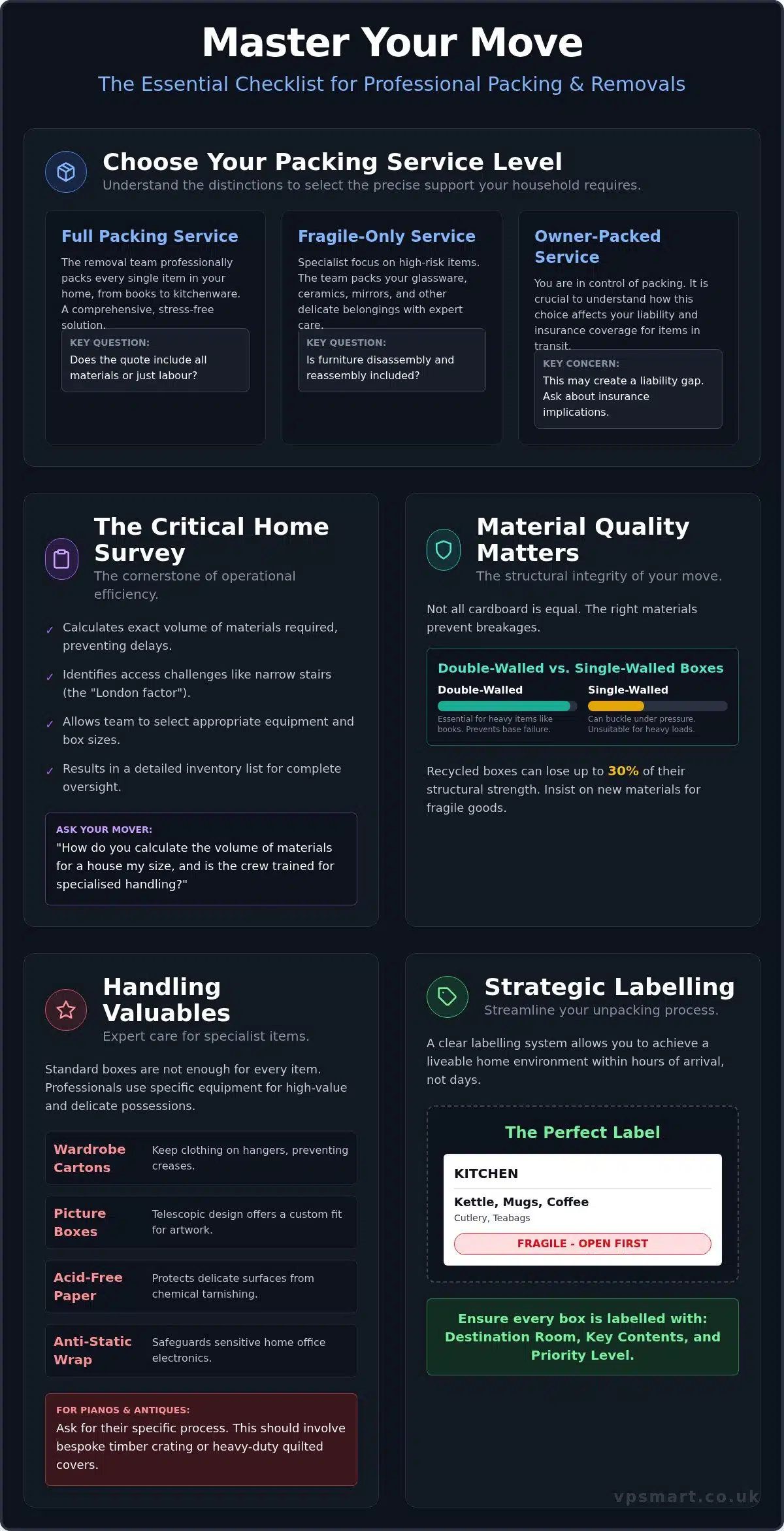
Not all packing services operate on the same logic. A “Full Packing” service involves professionals securing every item in your home, whilst “Fragile-Only” focuses exclusively on high-risk items like glassware and ceramics. If you choose “Owner-Packed”, you remain in charge of the process but must understand how this affects your liability. You should ask: “Does your quote include the cost of all materials or just the labour?” This distinction prevents budget creep. Additionally, verify if the package includes furniture disassembly and reassembly. Having the same technical team handle both the breakdown and the rebuild ensures your wardrobes and bed frames are returned to their functional state without missing components or structural damage.
The Importance of the Home Survey
A site survey is the cornerstone of operational efficiency. Whether conducted via a physical walkthrough or a detailed virtual survey, it allows the team to calculate the exact volume of materials required. For a typical three-bedroom house, estimating by “gut feeling” often leads to delays. Ask: “How do you calculate the volume of materials needed for a 3-bed house?” A professional response should involve a cubic-foot assessment or a detailed room-by-room inventory. In London, this survey is even more critical. We call it the “London factor”, identifying narrow Georgian staircases or restricted lift access early allows the crew to select smaller, more manageable boxes or specialised hoisting equipment. This foresight ensures the packing phase doesn’t stall due to architectural bottlenecks.
Finally, enquire about the specific training of the packing crew. Professional packing is a skill that involves understanding weight distribution and the structural limits of corrugated fibreboard. Ask if the team is trained in specialised handling for items like pianos or antiques; to see how these standards are applied by experts, you can learn more about Clear Lake Movers, Inc. and their approach to residential and commercial relocation. An inventory list should be a standard byproduct of this process. This list acts as your primary oversight tool, allowing you to track every carton from your old lounge to your new living room with absolute certainty.
Technical Checklist: Materials, Methods, and Specialised Items
The structural integrity of your move depends on the physical barriers between your belongings and the outside world. Professional packing is a technical discipline that prioritises the physics of weight distribution and impact resistance. When refining your list of questions to ask a removal company about packing, focus on the industrial grade of the equipment they bring to your doorstep. You deserve the certainty that your items are encased in materials designed for the rigours of transit.
Material Quality and Standards
Not all cardboard is created equal. You should ask: “Do you use double-walled corrugated boxes for heavy items?” Single-walled boxes often buckle under the pressure of books or kitchenware, potentially leading to base failures during transit. High-quality packing materials provide the necessary rigidity to stack cartons safely within the vehicle. Enquire about their policy on using new versus recycled materials for fragile goods. Whilst recycling is environmentally responsible, used boxes lose up to 30% of their structural strength. For delicate surfaces, ask if they provide acid-free tissue paper to prevent chemical tarnishing and anti-static wrap for your sensitive home office electronics.
Handling Specialised and Bulky Items
Standard boxes cannot accommodate every household entity. A professional team uses wardrobe cartons to keep your clothing on hangers, preventing creases and saving hours of ironing. For artwork, telescopic picture boxes offer a custom fit that eliminates movement. Ask: “What is your specific process for piano removals or large antiques?” These items require more than just bubble wrap; they often need bespoke timber crating or heavy-duty quilted covers. This level of technical care ensures that your most valuable assets remain protected throughout the journey.
The packing phase should also respect your property’s architecture. Ask if the team utilises floor runners and door-frame protectors. These helpful household safeguards ensure that whilst your items are being secured, your home’s interior remains pristine. If you are looking for complete oversight of your move, investing in premium packing supplies is the first step toward a damage-free transition. This methodical approach transforms a potentially chaotic day into an organised, predictable sequence of events.
The Liability Gap: Insurance Questions for Every Mover
Security is not just about the thickness of a cardboard wall; it is about the legal framework protecting your investment. One of the most critical questions to ask a removal company about packing relates to the invisible safety net of insurance. Many homeowners operate under the misconception that “Goods in Transit” cover is a universal shield. In reality, liability often hinges on who physically placed the item into the carton. Understanding these technical nuances ensures you aren’t left vulnerable if a mishap occurs during the transition.
Owner-Packed vs. Professional-Packed Liability
Most insurance providers draw a firm line at the point of origin. You should ask: “Will your insurance cover breakages inside a box I packed myself?” In many cases, the answer is no. Insurers typically exclude “internal breakage” for owner-packed cartons because they cannot verify the technical quality of the packing method. Professional packing acts as a method of risk mitigation that satisfies compliance standards. Whilst Public Liability protects your property from structural damage, Goods in Transit cover specifically addresses your belongings. However, this is often restricted to total loss or external damage if you handled the packing yourself. At VP Smart Removals, we prioritise transparent communication regarding these boundaries so you can make an informed decision about your level of oversight.
Valuation and Claims Procedures
The technical details of a policy determine your financial recovery. Ask: “What is the maximum liability per box or per item?” Standard industry terms may limit payouts to a specific amount that doesn’t reflect the true value of high-end electronics or designer furniture. You must also ask about the timeframe for reporting issues. Most professional contracts require damage reports within seven days of the move completion. Indemnity cover accounts for wear and tear by paying the current market value, whilst new-for-old cover provides the full cost of a modern replacement regardless of the item’s age. This clarity allows you to manage your environment with confidence.
Technical expertise and financial security should work in tandem to provide a dependable service. If you require absolute certainty for your upcoming move, book our professional packing services to ensure your belongings are fully protected under our comprehensive insurance framework.
Planning the Transition: Labelling, Unpacking, and Waste
The final 10% of a relocation often determines how quickly you reclaim your sense of domestic well-being. Whilst the physical transport of goods is vital, the technical organisation of those items at the destination is what transforms a house into a home. One of the most practical questions to ask a removal company about packing involves their strategy for the move-in phase. You don’t want to spend your first evening in a new property hunting through twenty identical boxes for a kettle or a phone charger. A professional approach ensures every carton is placed with precision, allowing for an effortless transition.
Systematic Labelling and Inventory
A sophisticated labelling system goes beyond writing a room name on a side panel. You should ask: “How do you colour-code or label boxes for multi-storey London homes?” In a typical townhouse, boxes should be coded by floor and specific room to ensure the crew places them correctly the first time, avoiding the need for heavy lifting later. This technical oversight is best managed through a master inventory sheet where every numbered box corresponds to a detailed list of contents. This allows you to prioritises the unpacking of essential “First Night” boxes, which should contain your immediate necessities and documents. Enquire if the team offers a full unpacking service. Having professionals handle the removal of items from cartons allows you to focus on the technical setup of your new environment, such as configuring your home network or arranging your living space.
Waste Management and Sustainability
The aftermath of a move often results in a significant volume of cardboard and paper. A visionary removal partner views sustainability as a byproduct of efficient management rather than an afterthought. Ask: “Do you collect the empty boxes and packing paper after the move?” Professional firms often provide a post-move collection service once you’ve finished unpacking, ensuring materials are recycled or reused rather than cluttering your new hallway. If your new home isn’t quite ready for every item, or if you’re transitioning between properties, consider utilising managed storage services. This provides a secure buffer that maintains your comfort without overcrowding your new living area. By choosing a company that prioritises reusable materials and responsible disposal, you align your relocation with modern environmental standards whilst ensuring your new home remains a well-managed environment from day one.
Master Your Move with Precision
You now possess the technical framework to navigate your relocation with absolute confidence. We’ve explored how high-standard materials protect your belongings, how professional packing secures your insurance liability, and how systematic labelling transforms the move-in process. By utilising these specific questions to ask a removal company about packing, you maintain complete oversight of your transition from the initial site survey to the final box being unpacked.
VP Smart Removals provides expert movers and packers across London who prioritises your comfort through transparent, fixed pricing with no hidden stair charges. We ensure your items are covered by comprehensive insurance when handled by our professional team, allowing you to focus on settling into your new environment. Our methodology is designed to alleviate anxiety and deliver a future of effortless comfort.
Get a Fixed-Price Packing and Removal Quote from VP Smart Removals
Your journey to a new home deserves a foundation of reliability and care. We’re ready to help you achieve the stress-free move you’ve been planning.
Frequently Asked Questions
Do removal companies pack everything for you?
Professional removal companies can pack every item in your home if you select a full packing service. This comprehensive option includes securing everything from delicate kitchenware and books to clothing and ornamental items. By delegating this task to technicians, you ensure that every object is encased in industrial-grade materials, providing you with complete oversight of your home’s safety while you focus on other moving logistics.
How much extra does a packing service usually cost?
The cost of a packing service is typically calculated based on the volume of your belongings and the quantity of materials required. Because every household is unique, a site survey is the most reliable way to receive a fixed-price quote that avoids unexpected charges. When considering your budget and the questions to ask a removal company about packing, remember that professional packing often reduces the risk of breakages, which can save you significant replacement costs in the long term.
Can I pack some things myself and let the movers do the rest?
You can certainly opt for a partial or “fragile-only” packing service where you handle non-breakable items like books and linens whilst the professionals secure your glassware and electronics. This hybrid approach offers a balance between personal agency and technical expertise. However, you should recall that most insurance policies only cover internal damage for cartons packed by the professional team, so it’s vital to pack your own boxes with high-quality materials.
What items will a removal company refuse to pack?
How long before the move day does the packing team arrive?
The packing team usually arrives one full day before your scheduled move to ensure the transition remains steady and logical. Separating the packing phase from the transit phase prevents a chaotic environment and allows the crew to focus entirely on the structural integrity of the cartons. For smaller properties, such as one-bedroom flats, the team might perform the packing on the morning of the move, provided the volume of items is manageable within a few hours.
Do I need to empty my chest of drawers before the movers arrive?
You should generally empty your chest of drawers to protect the furniture’s structural integrity during lifting and transit. Heavy contents can cause the frame to warp or the drawer runners to fail when the unit is tilted or carried up stairs. Removing the weight ensures the piece remains a helpful household entity in your new home. Whilst some movers allow light clothing to remain in very sturdy units, emptying them is the safest protocol for long-term furniture health.
Disclaimer
Some links in this article may be affiliate links, which means we may earn a small commission if you make a purchase through them, at no additional cost to you. We only recommend products or services we believe provide value to our readers.