
That free supermarket cardboard you’ve been collecting might actually be the most expensive mistake of your relocation. We all want to save money during a move, but watching a flimsy bottom give way while carrying a crate of glassware through a narrow Richmond hallway is a stress no one needs. It’s completely natural to feel anxious about fragile heirlooms or the sheer logistics of how many containers you’ll actually require to clear out a Surrey semi-detached.
A standard 3-bedroom house typically requires between 60 and 100 boxes depending on your lifestyle and storage habits. You’ll generally need a technical mix of 40 medium boxes for general items, 20 Large Moving Boxes for lighter bulky goods, and several speciality wardrobe boxes. This volume ensures you don’t overfill containers, which maintains structural integrity and makes the loading process more efficient for the removal crew.
Finding the best boxes for moving house is less about finding a container and more about investing in transit insurance for your life’s work. This guide will show you how to identify high-grade supplies that ensure your belongings remain secure from the first lift in Kingston to the final stack in the van. We’ll explain the technical difference between single and double-walled protection and how professional-grade materials create a more efficient, damage-free transition.
By the end of this professional guide, you’ll have complete oversight of your packing strategy and the confidence to manage a seamless move. We’ll break down the specific requirements for different room types and explain why structural integrity is the secret to a well-managed environment during transit.
Key Takeaways
- Understand the technical specifications of double-walled cardboard to ensure your fragile items survive the journey through London’s busy transport routes.
- Discover why selecting the best boxes for moving house involves matching container density to weight; this simple logic prevents injury and protects your flooring.
- Gain complete oversight of your relocation by using our room-based estimation framework to secure the correct volume of professional supplies.
- Master the “Essentials Box” strategy to maintain comfort and domestic well-being during your first 24 hours in a new Surrey property.
Understanding Box Strength: Why Double-Walled Cardboard is Non-Negotiable
The best boxes for moving house aren’t just simple containers; they’re engineered protective shells designed to withstand the pressures of transit. A professional-grade box is defined by its double-walled construction, which provides the high crush resistance needed for a successful relocation. This structural integrity comes from layers of corrugated fiberboard that act as a shock absorber for your belongings.
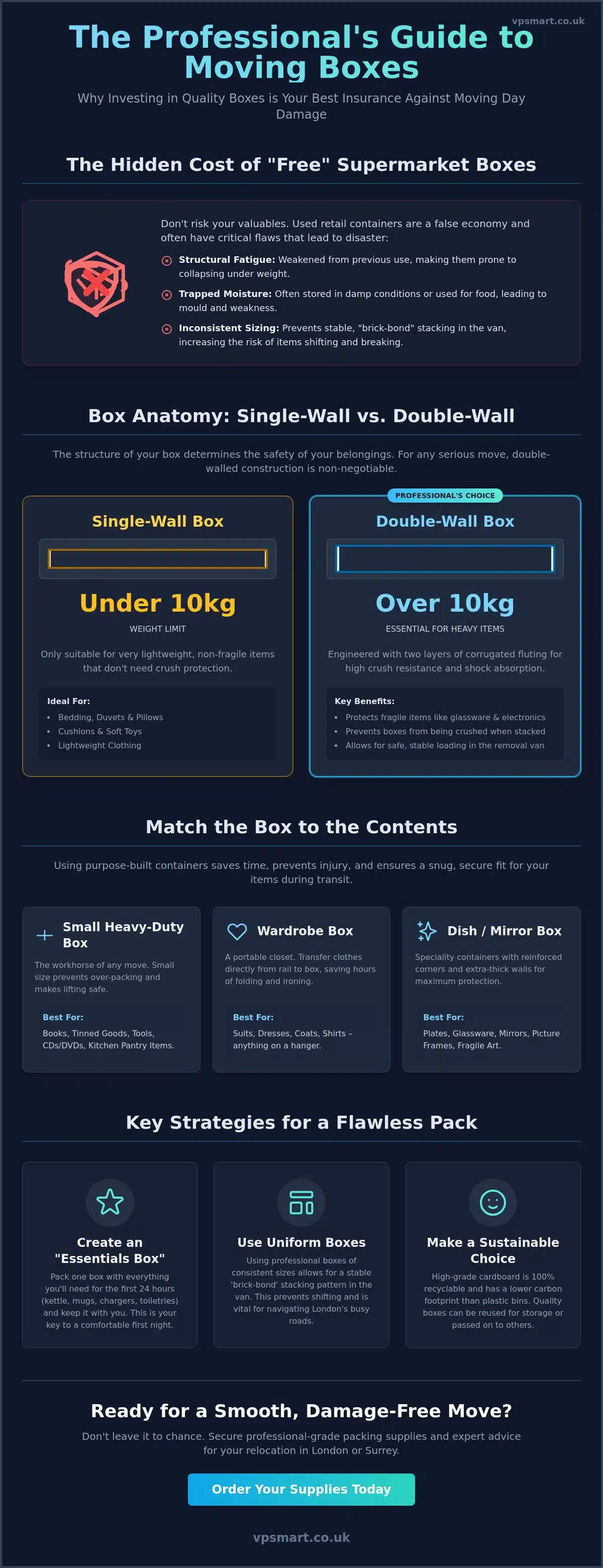
Professional boxes use a specific anatomy consisting of two outer liners and two layers of internal fluting. In the removals industry, “BC” flute is the gold standard because it combines a thick “B” flute with a thinner “C” flute. This creates a wall that resists the vertical pressure of other boxes stacked on top, ensuring your items aren’t crushed during the journey.
Selecting the best boxes for moving house means prioritising structural integrity over the false economy of “free” supermarket cardboard. Those retail containers often suffer from structural fatigue or trapped moisture from previous food storage, making them prone to collapsing. Using uniform, professional boxes allows for a stable “brick-bond” stacking pattern in the removal vehicle. This stability is vital when navigating the narrow, winding roads of Richmond or the busy transport routes through Kingston.
Single-Wall vs. Double-Wall: The Weight Limit Reality
Single-wall boxes serve a specific purpose, but they aren’t the workhorses of a move. They’re ideal for lightweight items like bedding, pillows, or cushions. However, a professional rule of thumb is that any box carrying more than 10kg must be double-walled. Over-packing large boxes with heavy items like books or tinned goods is a common mistake that risks the box bottom falling out and makes the container nearly impossible to lift safely.
The Environmental Impact of Quality Supplies
Choosing high-grade cardboard is often a more sustainable choice than purchasing plastic bins. Quality boxes are 100% recyclable and have a much lower carbon footprint during production. Because they’re durable, they can be folded flat and reused for storage services or passed on to other movers. This circular use ensures that your relocation materials don’t end up in a landfill after a single trip.
Essential Box Types: Matching the Container to the Contents
While structural integrity is paramount, selecting the best boxes for moving house also requires a strategic approach to dimensions. Using purpose-built containers significantly reduces packing time because the hardware is engineered for the specific contents. This technical precision ensures your belongings fit snugly, which is the most effective way to prevent internal movement during the journey.
Size matters when it comes to weight distribution and physical safety. Heavy items like books or kitchen pantry goods belong in small boxes. This logic protects your physical well-being by preventing back injuries and ensures each container remains manageable when navigating the narrow stairwells often found in Kensington apartments. Consistent sizing across your kit is the secret to maximising cubic capacity in the removal van. When containers fit together like a geometric puzzle, they’re less likely to shift during transit across South West London. This precision also means you’ll require fewer additional packing materials to fill empty voids.
Speciality Boxes You Didn’t Know You Needed
Wardrobe boxes are helpful household entities that act as portable cupboards. They allow you to move clothes directly from the rail, which saves hours of ironing at your new Surrey home. For those managing a home office in Richmond, archive boxes are essential. These handled containers keep documents upright and secure. For high-value items, dish barrels and mirror cartons feature reinforced corners and double-thick walls, providing a digitally integrated level of protection for your most fragile assets.
The Role of Heavy-Duty Moving Bags
Reinforced woven bags are excellent alternatives for “softs” like linens, towels, and cushions. They’re flexible and easy to squeeze into small gaps, helping you achieve complete oversight of the available van space. However, never use them for items with sharp corners or breakables. They offer zero crush protection and are unsuitable for anything that requires structural support. If you’d prefer experts to handle the selection and technical packing for you, our professional movers and packers can manage the entire transition.
Strategic Sourcing: How to Manage Your Moving Supplies
Estimating the volume of the best boxes for moving house requires a room-by-room audit rather than a simple calculation of square footage. A standard three-bedroom house in Kingston typically requires 15 to 20 medium boxes per room, in addition to speciality containers for kitchens and wardrobes. To eliminate the stress of sourcing and logistics, many homeowners choose to integrate professional movers and packers who arrive with the exact inventory required for the specific property type.
Timing is a critical component of a well-managed environment. We recommend securing your supplies at least four weeks before your move date. This allows you to pack non-essential items gradually, reducing the last-minute anxiety often associated with relocation. Don’t forget to designate an “Essentials Box.” This should be the last container sealed and the first one opened, containing kettle leads, chargers, and toiletries for your first night in the new home.
How to Assemble and Seal for Maximum Integrity
Structural failure often happens at the seams rather than the walls. The professional “H-Taping” method involves sealing the centre seam and both end edges of the box, creating a reinforced “H” shape. Never interlock the flaps without tape; this creates a physical weak point that can cause the bottom to give way under weight. Use clear labelling protocols on the side of the box, noting the destination room and “this way up” indicators to guide the removal crew through narrow Surrey hallways.
Professional Supply vs. DIY Sourcing
While “free” boxes from local shops seem cost-effective, they often carry hidden costs in the form of excessive tape usage and increased damage risks. Professional supplies offer uniform sizes that facilitate perfect stacking, ensuring your belongings aren’t subjected to shifting forces during transit. You can view our pricing for an overview of how high-quality materials represent a logical investment in the safety of your home environment.
Secure Your Move with Professional Precision
A successful relocation depends on the structural integrity of your supplies. By choosing double-walled BC-flute cardboard, you’re not just buying containers; you’re securing a future of effortless comfort in your new home. Selecting the best boxes for moving house ensures your most cherished belongings remain protected from the pressures of transit and stacking. This technical precision is what transforms a chaotic moving day into a well-managed transition.
We’ve helped thousands of UK households manage their environments with confidence for over a decade. Our professional kits provide the technical oversight you need to streamline your packing process and eliminate the anxiety of structural failure. With next-day delivery available on all essential materials, you can start your four-week preparation timeline immediately and maintain complete control over your move.
Order your professional-grade moving boxes and packing supplies today and take the first step toward a damage-free relocation. Your new life in Surrey or London deserves a transition that is as smooth and efficient as the home you’ve built. We’re here to ensure your belongings arrive safely, allowing you to focus on the excitement of your new beginning.
Frequently Asked Questions
How many boxes do I need for a 3-bedroom house move?
A standard 3-bedroom house typically requires between 60 and 100 boxes depending on your lifestyle and storage habits. You’ll generally need a technical mix of 40 medium boxes for general items, 20 large boxes for lighter bulky goods, and several speciality wardrobe boxes. This volume ensures you don’t overfill containers, which maintains structural integrity and makes the loading process more efficient for the removal crew.
Is it better to use plastic crates or cardboard boxes for moving?
Double-walled cardboard boxes are the professional standard for most relocations because they offer superior stackability and are easier to recycle. While plastic crates provide excellent moisture protection, they don’t always interlock as securely in a moving van. The best boxes for moving house are those that allow for a stable “brick-bond” stack, which maximises space and prevents shifting during transit across London’s busy roads.
Where can I get the strongest moving boxes near me?
You can source the highest-grade moving supplies directly from professional removal companies serving London and Surrey. We provide double-walled BC-flute cardboard that meets the technical requirements for heavy-duty transit. Sourcing through a local specialist in areas like Richmond or Kingston ensures you receive uniform sizes that are far stronger than the generic kits often found in high-street retail shops.
Can I reuse old boxes from online deliveries for my move?
Reusing old delivery boxes is generally discouraged because they’re typically single-walled and have already suffered structural fatigue. These containers are designed for a single journey and often lack the crush resistance needed to support the weight of other boxes stacked on top. Investing in fresh, professional-grade materials provides the technical oversight needed to prevent your belongings from being damaged by a collapsed base during the journey.
What size moving boxes are best for books and heavy items?
Small, double-walled boxes are the best choice for books, tinned goods, and other heavy household items. Using a smaller container prevents the total weight from exceeding 15-20kg, which protects both the box’s integrity and your physical safety. This size is specifically engineered to be manageable for one person to lift, which is vital when navigating the narrow stairs of a Kensington apartment or a Surrey semi-detached.
Disclaimer
Some links in this article may be affiliate links, which means we may earn a small commission if you make a purchase through them, at no additional cost to you. We only recommend products or services we believe provide value to our readers.