
Fragile packing is a matter of precision engineering, not just a domestic chore. We understand the deep anxiety that comes with taping up your most sentimental possessions, especially when navigating London’s uneven roads and tight stairwells in areas like Kensington or Richmond. It’s perfectly natural to worry about complex insurance claims or the heartbreak of finding a shattered heirloom after a long day of transit.
This guide will teach you exactly how to pack fragile items for moving using the same high-tech, three-layer shock-absorption systems employed by professional London movers. By mastering these techniques, you can protect your belongings against the latest logistics challenges, including the 2026 rise in fuel surcharges and the recent price increases for quality corrugated cardboard. You deserve a relocation that feels like a seamless transition rather than a gamble with your personal history.
We will walk you through the essential tools and structural methods needed to secure everything from fine bone china to delicate electronics. You’ll gain the confidence to manage your own environment with professional oversight, ensuring every box arrives at your new home in pristine condition.
Key Takeaways
- Upgrade from standard containers to double-walled corrugated cardboard to ensure your boxes maintain structural integrity throughout the journey.
- Master the professional “nesting” technique to learn how to pack fragile items for moving, specifically protecting plates through vertical alignment.
- Implement a cell-divider system for stemware to create individual protective zones that effectively absorb urban transit vibrations.
- Apply “soft-loading” strategies to safeguard your delicate belongings against London’s unique road challenges, including speed bumps and uneven surfaces.
- Understand the vital stacking logic that prevents fragile boxes from ever being used as a foundation for heavier items in the removal van.
The Foundation: Professional Materials for a Shockproof Move
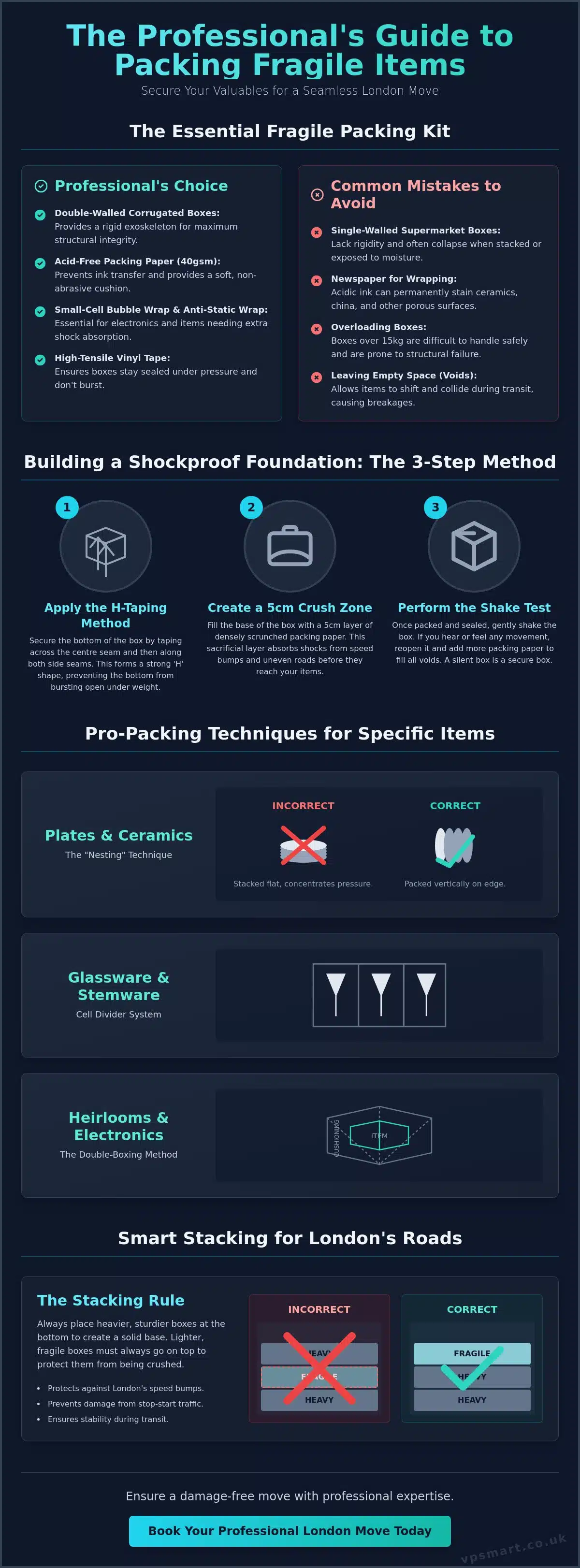
Supermarket boxes are a liability because their single-walled structure lacks the rigidity needed for urban transit. At VP Smart Removals, we employ double-walled corrugated cardboard to create a protective exoskeleton that respects the science, art, and technology of enclosing or protecting products.
When learning how to pack fragile items for moving, avoid using newspaper as the acidic ink can permanently leach into delicate ceramic glazes. Despite the 2026 price increases in corrugated materials, investing in 40gsm packing paper remains the most cost-effective way to protect your financial assets.
Specialised tools like anti-static wrap protect internal hardware, while corrugated dividers ensure glassware remains isolated from vibration. It’s these professional materials that provide the oversight necessary for a damage-free relocation. High-tensile vinyl tape completes the seal, ensuring the box doesn’t burst under pressure.
The Essential Fragile Packing Kit
Your kit must include high-tensile tape, small-cell bubble wrap, and acid-free tissue for a truly shockproof move. For a standard apartment in Kingston or Richmond, we recommend at least 20 heavy-duty boxes and two reams of packing paper. This volume accounts for the high density of delicate items often found in period London homes.
You can order these industrial-grade supplies through our Quality moving boxes London delivery service. Having the correct quantities ensures you don’t have to compromise on safety due to a lack of materials. It also helps you stay organised throughout the packing process.
Constructing the “Base Layer”
Use the H-taping method to secure the bottom of every box by taping across the centre and along both side seams. This technique provides the structural reinforcement required when you’re figuring out how to pack fragile items for moving.
Create a 5cm “crush zone” at the base by filling the bottom with densely scrunched packing paper. This sacrificial layer absorbs the vertical energy from speed bumps before it can reach your delicate items. It’s a simple engineering fix that prevents structural failure at the bottom of the stack.
The VP Smart Method: Packing by Item Category
Brittle ceramics and vibration-sensitive electronics require distinct protective protocols to ensure their safety during transit. Mastering how to pack fragile items for moving involves choosing a wrapping method tailored to each object’s specific physics. This targeted approach prevents the structural failures often seen in generic packing attempts.
Corrugated dividers act as the backbone of the American supply chain and global shipping standards. They provide the necessary rigid environment to support delicate stemware and electronics. For mirrors and fine art, we apply an “X” of low-tack tape across the glass to maintain structural tension and prevent shattering.
Kitchenware and Ceramics
Plates are strongest when standing vertically on their edges rather than stacked flat. Never stack them like pancakes, as this concentrates the entire weight on the centre of the bottom plate and causes pressure cracks. This vertical “nesting” technique is a hallmark of professional removal standards.
Use the “burrito” fold by placing a plate on packing paper, pulling the corners over the top, and rolling it forward. If you have an extensive kitchen collection, our Professional movers and packers London can execute this task with technical precision. This service allows you to focus on other aspects of your relocation while we handle the intricate wrapping.
High-Value and Sentimental Items
For heirlooms and antiques, we recommend the double-boxing technique to create a secondary shock-absorption zone. This is vital for transit through congested areas like Central London or when moving items across the Surrey border. It ensures that even if the outer box takes a hit, the internal container remains undisturbed.
The shake test is a diagnostic technique where you gently oscillate the sealed box to ensure no internal movement is felt or heard. Eliminating the “void” prevents items from colliding during the sharp turns typical of Kensington townhouses. If you hear even a slight rattle, add more scrunched paper until the box is completely silent and secure.
London Logistics: Securing Fragile Boxes for Urban Transit
London’s stop-start traffic and high-density speed bumps create unique mechanical stresses that standard motorway moving guides often ignore. Mastering how to pack fragile items for moving requires a specific strategy for the van floor, where vibrations are most intense. Clear labelling like “Top Load Only” and room destinations ensures your delicate items remain above heavier crates and are handled correctly by the crew.
We employ “soft-loading” at VP Smart Removals by placing fragile boxes on top of upholstered furniture or bedding to act as natural shock absorbers. This prevents the rigid vibration of the van from transferring directly to your glassware or ceramics. We also use recycled and reused packing materials to build sustainable buffers between tiers during the journey.
Loading the Removal Van
Stacking logic is vital for safety, especially when navigating the narrow, winding roads of Fulham or the “staircase factor” in Kensington townhouses. Fragile boxes should never form the base of a tier but should be positioned at shoulder height to avoid compression.
Our House removals London teams use furniture as a lateral buffer and secure every load with industrial webbing straps. These transit blankets and straps prevent items from shifting during the sharp turns required in tight residential parking zones.
When to Call the Professionals
Bespoke timber crates provide a rigid, non-flexing environment for items that don’t fit the standard logic of how to pack fragile items for moving. Professional packing services also provide a superior layer of liability coverage for high-value antiques and stone sculptures that require specialised handling.
Whether you’re moving between Central London apartments or relocating to a larger property in Surrey, expert handling provides complete budget certainty. You can Get a fixed-price quote for your London move to ensure your transition is managed with technical precision and care.
Securing a Damage-Free Transition to Your New Home
Success in a London relocation depends on a disciplined approach to shock absorption and structural integrity. By implementing the nesting techniques and soft-loading strategies discussed, you’ve gained the professional oversight needed to protect your household environment. Mastering how to pack fragile items for moving ensures that even the most delicate heirlooms survive the stop-start rhythm of urban traffic without a scratch.
Sometimes the complexity of a move, particularly when it involves pianos, fine art, or delicate antiques, requires a more technical solution. Our experienced London-based crew understands the specific parking and access challenges in boroughs like Richmond and Kensington, ensuring a seamless experience. We prioritize your financial optimization through transparent, fixed-price quotes, providing you with total budget certainty from the start. If you want to trade packing anxiety for effortless comfort, Book our professional packing service for a stress-free move today. You’ve done the hard work of planning; now let us ensure your belongings arrive safely to help you begin your new chapter with confidence.
Frequently Asked Questions
What is the best packing material for very fragile items?
Double-walled corrugated cardboard boxes combined with 40gsm packing paper are the best materials for protecting your most delicate belongings. These professional-grade containers provide the necessary structural integrity to resist crushing during urban transit. Using high-quality materials ensures your items are shielded from the mechanical stresses of London roads. This setup creates a rigid exoskeleton that maintains complete oversight of the internal environment, effectively preventing damage from external pressure.
How do you pack glasses for moving without breaking them?
You should use a cell-divider system within a small, sturdy box to pack glasses safely. This method provides individual protective zones for each item, which is far more effective than wrapping them alone. Start by padding the bottom of the box with scrunched paper to create a cushion. Place each glass into its own compartment after wrapping it in clean paper, ensuring there is no movement when the box is gently shaken.
Is bubble wrap or packing paper better for protecting breakables?
Packing paper is generally better for the initial protective layer because it doesn’t leave marks and allows for tighter wrapping. Bubble wrap serves as an excellent secondary layer to provide additional shock absorption against vertical jolts. When learning how to pack fragile items for moving, a strategic combination of both is ideal. Paper prevents surface scratches on ceramics, while bubble wrap handles the vibrations common when navigating London speed bumps.
How should I label boxes containing fragile items for the movers?
Label your boxes with “Fragile” and “Top Load Only” on at least two sides using a bold marker. It’s also vital to include the room destination, such as “Kitchen” or “Dining Room,” to help your house removals London crew manage the logistics efficiently. This clear communication ensures that your most delicate items are never placed at the bottom of a van tier. Proper labelling gives you complete oversight of the loading process.
Should I use original packaging for my electronics when moving?
You should use the original packaging for electronics whenever possible because the internal foam inserts are custom-moulded for that specific hardware. This original housing offers the highest level of protection against high-frequency vibrations and static discharge. If you no longer have the original boxes, choose a double-walled box and use anti-static wrap to protect the internal components. This approach is vital for how to pack fragile items for moving, especially for digital equipment.
Disclaimer
Some links in this article may be affiliate links, which means we may earn a small commission if you make a purchase through them, at no additional cost to you. We only recommend products or services we believe provide value to our readers.